Theory: Funnel Design

A funnel design is a game in which the players’ varied activities feed into a single, central resolution mechanism. Funnel designs have two distinct components: the things the players do, and the resolution mechanism that aggregates their choices to determine the impact they have on the game. That can be an extremely valuable and even necessary function, but just as a bad cooking funnel can squeeze off the ingredients needed for a recipe, a bad game design funnel can choke the fun out of a game. It’s important, therefore, to make sure that funnels in games are well-implemented, with due thought given to issues of balance and with care taken to avoid unduly limiting the design.

The odds are you’ve played a funnel design. Most wargamers will be familiar with combat resolution tables, which boil relative strengths down to dice results: at 3-1 odds a 4-6 on a single die means the defending units are eliminated, while at 2-1 odds only a 5-6 eliminates the defenders, etc. Players maneuver their units, decide which supply centers to call on for logistical support, weigh the odds of the weather improving in a few days, and make many other decisions all to get an advantage on the game’s combat resolution table. Then the table produces its result, and play continues.

If you’re not a fan of wargames, you might have played Sentinels of the Multiverse, a card-driven game about superheroes that uses funnel design. Each player stands in the shoes of a particular hero, playing a deck full of unique cards representing that hero’s powers. However, most of these cards feed into a basic mechanism in which the players inflict damage on an arch-villain by making, and then modifying, attacks. Thus, a player might play a card that causes her character to punch the villain, and then modify that attack with other cards that inspire the character to greater effort and encase the character’s fist in a ball of fire; the game’s underlying math recognizes the punch as a 3 damage attack, modified by +1 for the extra effort and +1 for the fire, for a total of 5 damage. The same math engine does the same translation into numbers for gunfire, artificially induced hailstorms, and every other form of superpowered aggression.

By way of comparison, consider a game that doesn’t use funnel design—say, the popular deck-building game Dominion. The goal in Dominion is to acquire victory cards, and one normally does that by getting treasure with which to buy them. However, treasure is not an intermediary system evaluating the players’ performance; it’s a game element that players can directly manipulate. They can buy it, find it, steal it, trade it in for better treasures, and in some cases ignore it entirely. Playing well does not directly and always mean more treasure. While treasure is important, then, players’ actions are not funneled through it while playing Dominion the way they are in the examples above.

Similarly, having a score at the end does not make a game a funnel design. It’s true that a score serves as an overall measure of player performance. However, a score does not operate on a player’s choices, mediating between the player and the game, in the way that a combat resolution table or Sentinels’ underlying math does. Scoring systems can impact the designs of their games, but they don’t pose the same issues as a funnel operating during the game. To put it another way, funnels are used while cooking, while final scoring is akin to the bowl in which the meal is served. Both are important, but they’re not the same and shouldn’t be conflated.

True funnel designs are interesting because they have two very different, yet nevertheless interrelated, parts: the players’ actions, and the funnel mechanism that interprets those actions. Often the two parts do not look, or work, anything like each other; a wargame’s tactical map-based play is replaced with die-rolling when the combat resolution table comes to the fore. Neither, however, can be understood in a vacuum. The players’ actions are all taken in light of the funnel, and the funnel is unimportant without their actions.

Having two vitally interconnected parts to a game can have substantial advantages. First, it creates what Magic: the Gathering’s developers sometimes refer to as “knobs:” values that can be changed to achieve game balance. If one of the choices available to players is too strong or too weak, the designer can either manipulate the choice directly, or alter how the funnel treats the choice. That alternative means of accessing the game’s inner workings can be very useful.

Second, a funnel can summarize very different and complex interactions, allowing a variety of pieces to interact in a consistent way. Actually simulating a battle between tanks and infantry involves measuring their very different strengths: the tanks are sturdier, but the infantry can more easily take advantage of terrain. The tanks are stable firing platforms, but the infantry might be better at getting advantageous angles. Well-designed funnels translate those disparate capabilities into a single system, making it easier for players to evaluate what’s happening and speeding resolution of dense, multifaceted situations.

These advantages do not mean, however, that funnels are invariably desirable or good. Since players must interact with them constantly, their flaws are magnified. A boring funnel can color the entire experience; an unbalanced funnel unbalances everything; an overly complex funnel slows every single turn and renders the import of player choices opaque. Errors in a funnel’s design have multiplicative effects, which makes funnels something to be implemented only when necessary and only with caution.

Moreover, even correctly designed funnels can have unintended and undesirable effects on a game’s design. Some things will be easier to fit into the funnel than others. Inevitably, this encourages the design to move in the direction of including more of what the funnel readily handles, and less of what it does not.

A quick thought experiment demonstrates the impact of a bad funnel. Suppose someone designed a wargame whose combat resolution table said, for every entry, “the defenders destroy all attacking units.” That game would be unplayable; since taking any sort of initiative would be punished by swift destruction, no one would ever want to do anything!

That is, of course, an extreme example. A subtler question might focus on the impact of the die roll that is normally involved in getting a combat resolution table’s final result. Some players strongly disfavor random elements in games, feeling that they privilege luck over skill. Others feel that they simply have “bad dice luck.” (In my experience, this is a majority of people.) Is the die roll important enough to risk losing the former group as potential customers, and to risk frustrating the latter group during play?

There is no single, constant answer to that question, which reminds us that there can be no single, constant answer to the question of whether funnel design is a good idea. It is always a balancing test, a matter of deciding whether the funnel’s advantages outweigh its dangers. Just remember that, like many tools, funnels can be harmful if employed carelessly.

Theory: Making Barriers into Benefits

When someone purchases FFG’s X-Wing, this is what comes in the box.

Image from Boardgamegeek

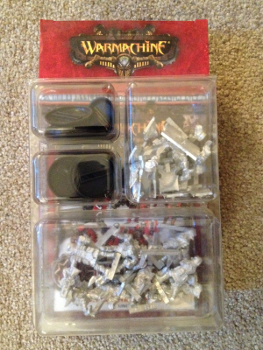
When someone purchases a box of Warmachine, he or she gets this:

12-31-14 - Warmachine BoxLooking at those pictures, one would expect Warmachine to be the province of the hardest of the hardcore, true grognards–but it is instead, as of last time I saw sales figures, the second most popular miniatures game on the market. Part of that is simply because Warmachine is a superbly designed game. Part, however, is that Warmachine turns its barrier to entry into a strength, using it to generate engagement with the game.

Every game has barriers to entry. Usually they must be purchased, sometimes at great expense. Rules must be read. The game must be set up on the table, which is easy enough in the case of something like Tsuro but which can be quite laborious in the case of wargames and RPGs.

In general, these barriers to entry are undesirable. They prevent people from buying, playing, and enjoying a game. Minimizing them is thus usually viewed as strictly beneficial. Designers try to make rules easier to learn and publishers look for simpler, less expensive components, all in the name of lowering these barriers.

X-Wing is a superb and successful example of that process in action. The minatures are ready-to-play right out of the box, fully assembled and painted to a standard much higher than most players could achieve on their own. While the game is not exactly cheap, lots of starships are available at the $10 impulse-buy price point online. FFG has done as much as possible to make getting into the game painless.

Warmachine, on the other hand, makes few concessions. Its miniatures come unpainted and in pieces. Most boxes of Warmachine minis don’t even have an instruction manual; one is expected to figure out that this piece goes here and that these arms are bent just so such as to fit those torsos. It’s not uncommon for miniatures to have flaws straight out of the box requiring non-trivial modeling skill to fix; from the beginning of the game to today, people have been fixing the “Khador gap.”

One might expect that all of this would render Warmachine the nichest of niche games. Instead, however, it’s enormously successful, begging the question of how an expensive game that requires tremendous amounts of setup could ever overcome its barriers to entry. Warmachine is a superb game, yes–but many superb games fail for lack of players willing to invest in them. That alone did not propel the game to the heights it has now achieved. How did Warmachine manage its barriers to become a key player in the miniatures space?

The answer is that Warmachine’s greatest barrier–the tabula rasa nature of its pieces–is a strength in the eyes of a substantial proportion of the player base. They become an artistic outlet; one is not just going to field pikemen, one is going to field one’s very own pikemen, with paint schemes and poses chosen in accordance with one’s taste. Many players end up involved the game just for the painting, playing only rarely as a way to show off their work.

Personalizing the miniatures in that way invites other forms of creativity, such as biographies and backstories chronicling the achievements of one’s troopers. Ultimately all of this can even feed back to the tabletop, with players devising campaigns in which rivalries between their armies are settled and new ones created. Again, these opportunities to craft something unique are the result of what would otherwise be a barrier to entry, and are an important draw for many players.

Not every game can do what Warmachine does, but it’s a possibility for more games than one might think. What if Agricola required players to build little parts of houses, instead of just using tiles? Would that lead to a greater sense of ownership over the homes, and more incentive to play? Would players be less likely to shake their heads at the depth of chess and give the game up if they painted the black squares on the board themselves?

Barriers to entry are always going to be a problem. However, it’s possible to approach them imaginatively, and ask how they can be used to encourage player investment.

Now you’ll have to excuse me–I have some pikemen to paint.

Theory: Making Losing Fun – Pinball

One way to study how to make losing fun is to look at games that can’t, techncially, be “won.” Take pinball, for example. There’s no winning a pinball table; one never beats the game. In a sense, a pinball player is always losing, trying to accomplish as much as possible before inevitable defeat. Yet, good pinball games are just as much fun as they ever were, because pinball designers have mastered the use of sub-goals to create satisfying experiences.

A reliable mechanism for making a game fun even for a player who’s losing is to provide subsidiary goals. Such goals give players who aren’t going to win–in the case of something like pinball, can never win–something to aim toward and take pride in. They beat the boss/saw the next cutscene/got the Steam achievement/etc., and that feels good.

To work, these goals need to be independent of winning, measurable, and desirable. Being unrelated to winning is central; the player isn’t winning, but we want the player to be able to achieve these goals anyway. Measurability contributes to the player’s satisfaction by enabling the player to say decisively “I did X” without the benefit of an ending cinematic. Finally, desirability prevents these goals from feeling like booby prizes.

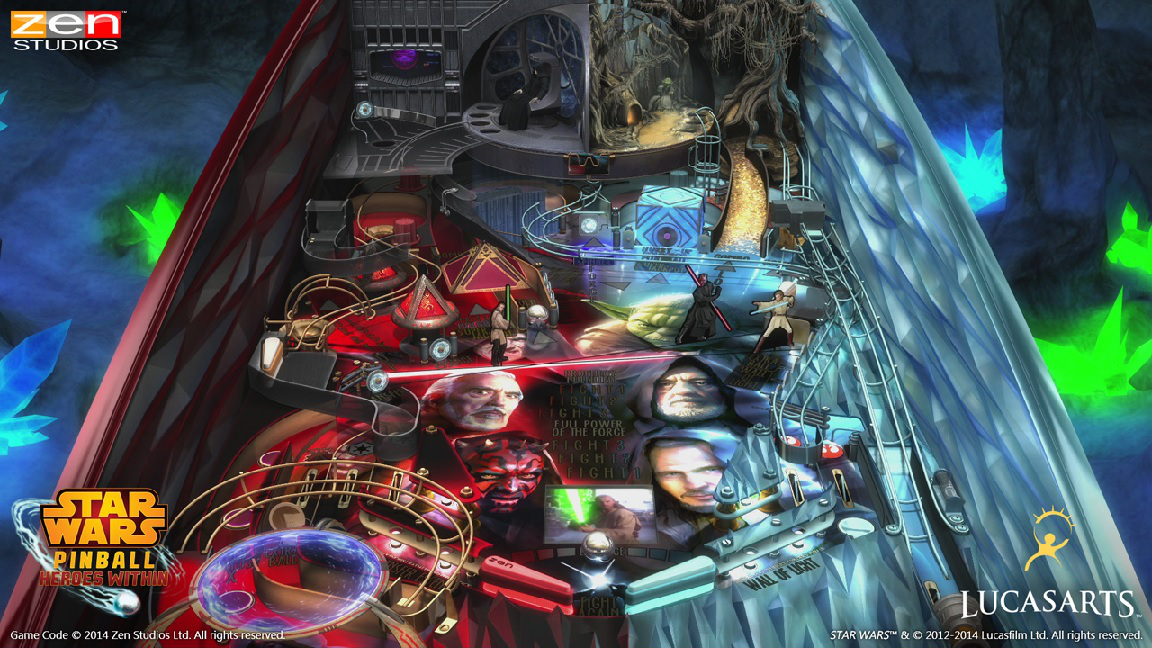
Modern pinball games have huge numbers of these goals. Consider this table, from Pinball FX2:

12-26-14 - Balance of the Force PinballIt’s hard even to know where to begin. Starting from the lower-right:

Every time the player starts the game by launching the ball down the wire ramp along the right side of the table, she can choose how hard to hurl the ball. Getting just the right amount of force causes the ball to fall onto the table at the exact end of the ramp, a “skill shot” worth lots of points. That (a) has nothing to do with winning–the ball ends up on the table either way, (b) is easily measured–the game announces skill shots prominently, and (c) is desirable, in that it improves one’s score.

See the ramp in the upper-right, that leads into a tree? Hitting that ramp several times starts a special game mode, with the opportunity to score lots of points. Hitting the ramp to start the special mode is, again, (a) independent of winning, (b) measurable, and (c) desirable for the points gained thereby.

At the center-top are Yoda’s hut and the Emperor’s throne room. They aren’t just for show. It’s possible to get the ball up there–a goal unto itself–to play a mini-game in which the player uses a smaller set of flippers to hit the ball into targets, with success being worth points. This particular table doesn’t do a perfect job of being (b) measurable here–it’s a bit difficult to tell how the mini-game’s reward works–but (a) one doesn’t have to win to get it and (c) if the player knows about the reward it’s certainly desirable.

Listing all the things to do on this table would at least triple the length of this post. See the “fights” listed in the center of the board, near the front? Each of those is an activity unto itself. The cutouts of Darth Maul, Qui-Gon Jinn, and Obi-Wan Kenobi are part of one of those fights; the goal is to hit Darth Maul with the ball while avoiding the Jedi. The pyramid to the left can be lowered to create a ramp that jumps the ball toward the upper-left platform. You get the idea.

The closest I come to being a pinball wizard is listening to The Who. However, I’ve never had an unenjoyable game of pinball. The constant flow of new sub-goals, all of them independent of winning, measurable, and desirable, keeps me engaged despite the fact that every single round of pinball ends–usually quickly, in my case–in “Game Over.”

Theory: Marvel Contest of Champions and 2D Fighting With Few Controls

I like fighting games and I like comics, so I couldn’t resist giving Marvel Contest of Champions a try. If nothing else, I wanted to know what the control scheme was like; after years of playing fighting games on an arcade joystick, my thinking on how to control a game like that had gotten stale. To my surprise, I discovered that MCoC’s tap-and-swipe system works better than it seems like it would. There’s only so many things you need to build a legitimate fighting game, and tapping and swiping enable all of them.

MCoC is a 2D fighting game. That means each player controls a martial artist, and those martial artists fight back and forth on a flat plane. In this case the martial artists are Spider-Man and Captain America instead of practitioners of karate and muay thai, but the colorful characters don’t change the underlying gameplay.

2D fighting games have two core concepts that make them work: the attack-block-throw relationship and controlling space. MCoC features both.

Fundamentals of 2D fighting games

Almost every 2D fighting game I’m familiar with–I would go so far as to say every 2D fighting game released in the last 25 years except one–has rock-paper-scissors at its core.

Blocking (rock) nullifies the damage from attacking (scissors)
Attacking (scissors) does damage to an opponent who is trying to throw (paper)
Throws (paper) inflict damage on a blocking (rock) opponent

Much of the strategy in 2D fighting games comes from manipulating opponents into making the wrong choices, so that their damage is nullified by timely blocks and they are not blocking when the time comes for one’s own attacks. That manipulation is possible because the different choices have different payoffs; knowing what the opponent wants to do makes it possible to get into his head, predict his moves, and bait out the moves you want him to make.

2D fighting games also involve a battle to control space. When Ryu throws a fireball in Street Fighter, he takes control of the lower part of the screen; since the game occurs on a flat plane, the opponent cannot advance while the fireball is approaching. Thus, Ryu’s fireball prevents the opponent from taking the offensive. By controlling space, Ryu controls the game.

Not all 2D fighting game characters have fireballs, but they all have ways to control space. The player’s goal is to use each character’s unique tools to assert control over space, take control of the game thereby, and turn that advantage into a victory.

This video, made by David Sirlin, is a great visual explanation of controlling space. Take a look; the relevant discussion begins at 0:58.

The fundamentals in Marvel Contest of Champions

Everything one would expect from a 2D fighting game exists in MCoC. The rock-paper-scissors relationship is firmly in place; MCoC uses “heavy attacks” in place of throws, but the effect–damage inflicted on a blocking opponent–is the same. So too is the struggle to control space in evidence, with Iron Man’s repulsor beams standing in for Ryu’s fireballs.

What’s striking is how few “buttons” MCoC needs to accomplish those things. Movement is thoroughly simplified; players can only shift toward and away from the opponent by swiping left or right, with no jumping, sidestepping, or other movement options. Yet, “toward” and “away” are enough to create space for oneself and reduce the opponent’s space. Hitting the opponent is also very basic–tap, swipe, or tap and hold–but that’s enough to enable attacking and throwing, which are all that’s needed.

In some respects MCoC reminds me of Divekick, the “art game” of the fighting game world. Divekick is the one modern 2D fighting game without rock-paper-scissors; it’s all about controlling space, with a total focus on jumping into the air and positioning oneself to dive down on an opponent who’s trying to do the exact same thing. Although they play very differently, both games are about stripping away the cruft that has affixed itself to the 2D fighting genre in order to explore the essentials of how such games work.

(Well, MCoC is also about incentivizing spending using a freemium model.)

I’m always fascinated by the question of the most minimal thing that would count as a game. Divekick and MCoC are interesting because they push that boundary within a specific genre: they’re both trying to find the smallest number of elements one can include in a 2D fighting game while retaining the strategy and fun. The fact that they both use minimal controls to do so is surely interesting . . . .

Prototyping Materials: Chipboard

So you’ve designed a board game. It’s working out pretty well, well enough that you want to make a nice copy–something you can show to people and have them focus on the game, rather than on managing terrible components. You need a material that’s strong enough to stand up to play, thin enough to stack and shuffle, and weighty enough to have a good feel.

You need chipboard.

Chipboard is my new favorite prototyping material. It’s heavier than cardstock or other papers, so it’s better for things like tiles that need to stay in one place during a game. I’ve also found it very sturdy; a copy of Lines of Questioning I built out of chipboard almost a month ago is almost good as new after many tens of games, with only a single tile “marked” by a damaged edge. At least one professionally-produced game in my collection has held up less well.

In addition, putting art on chipboard is trivially easy. Get the art printed on label stock, and then affix it to the chipboard before cutting. The label stock will adhere to the chipboard without any difficulty, and both stock and board can then be cut at the same time to give a tidy edge.

Perhaps most importantly, chipboard materials work well in play. 1/16″ thick chipboard is strong–it won’t bend by accident–but is still thin enough to stack without getting unwieldy. Furthermore, it feels great in the hand. One playtester specifically called out the satisfying heft of chipboard tiles as contributing to Lines of Questioning’s experience.

Unfortunately, the material isn’t entirely easy to work with. Chipboard is too strong to cut with scissors. You’ll want a rotary cutter, a steel ruler with a cork bottom to guide the cutter, and a self-healing mat to protect whatever table you’re cutting on. (All of those things are available at local craft stores.) Be certain to wear eye protection–safety glasses are about $2 at hardware stores–and kids should get help from their parents.

Still, the effort and minor up-front expenses are small prices to pay. Chipboard is inexpensive, durable, and well-suited to boards and tiles. If you’re looking for something nice to build a game out of, give it a look.

Theory: Mapped Endgames

Many games come to a point where one player is in control, and will win if she can avoid missteps. While such mapped endgames are to some extent scripted, they can still be fun. The keys are to use those last moments as a reward for previous displays of skill, and to keep them short.

“Mapped endgame” is a term that I feel captures the common situation in which a player sees what he needs to do to win, and is completely in control of whether or not he is ultimately successful. The other players cannot stop him; he will only lose if he makes a mistake that lets them back into the game. The situation is “mapped” because the player knows what course to take to reach victory.

It’s important to recognize that in a mapped endgame, the player is still making decisions and those decisions still matter. Falling dominoes are not a mapped endgame. The person setting up the dominoes has relinquished control at that point; much like the final cinematics at the end of a video game, the gameplay (to the extent that setting up dominoes is a game, a definitional issue which needn’t detain us here) is already over. Mapped endgames occur while the game is in progress, and require the player to keep things on course.

While this may smack of autopilot, mapped endgames can be interesting and even exciting. Even if one is clearly going to win a car-racing game, the rush of speed can still be thrilling. A close-fought strategy game can reach a mapped endgame yet still be tense; the player in the dominant position has to make every move precisely correctly while the opponent(s) choose positions from which they can best take advantage of the slightest weakness.

Of course, a mapped endgame done wrong is a painful grind. The winning player acts by rote while the other players suffer through irrelevant decisions. Concessions become likely as everyone starts to agree that the game is “really” over even if there’s technically more to do.

Fortunately, it’s easy to distinguish good mapped endgames from bad ones. The good ones–the ones that will be fun and interesting as players go through the final moves–follow two design rules.

1. A fun mapped endgame is a reward for skilled play. Tichu was the first game where I saw mapped endgames consistently enough to recognize them as a distinct element in a game’s design. Despite happening often, though, Tichu’s mapped endgames aren’t boring. Rather, they’re hard-earned payoffs.

For those who have never played, Tichu is a card game with some similarities to Hearts. Players go around and around the table playing higher-value cards and sets of cards, with the highest winning all the cards played. While certain cards are worth points, the big gains come from predicting at the start of the hand that one will be able to play all of one’s cards first–and then successfully doing it.

Of course, it’s not easy to make those called shots. Doing so requires a strong hand, but even more than that it demands constant attention and the ability to think several moves ahead. Making several strong plays early can leave one’s hand too weak to finish out; failing to track the cards being played can leave one uncertain about whether someone still has the ace that will beat one’s king. Going out first with other players dedicating their entire hands to preventing it is demanding to say the least.

Fortunately, the effort involved is well-rewarded. Putting the available information together to figure out what’s in the opponents’ hands, and then determining the exact right order in which to play one’s cards, creates a feeling like one has had a little taste of enlightenment. The endgame is completely mapped out, but the player drew the map herself, and every step along its indicated path is a vindication of the player’s effort.

Tichu’s mapped endgames, then, are a part of its fun. The player worked hard to reach the top of the mountain, and now gets to stand on the summit. Even if one is just going through the motions, the ease of the final moves marks out as special the difficult work that went before.

2. Mapped endgames should be brief in real-world time. Power Grid is a great game with one flaw: it can involve a mapped endgame that is completely joyless. The problem is not that the endgame is reached too early, or that it can be reached without skill. Rather, the issue is that it just plain takes forever.

In Power Grid every player controls an electric company, with the goal of having the largest network of cities. There are random elements in the game, but for the most part the results of one’s actions are completely predictable. Expanding to city A will cost $B and earn $C; expanding to X will cost $Y and make $Z.

Early on and for most of the game, there’s enough going on to make putting a fine point on those calculations largely unnecessary. Expanding to A might earn $2 more than expanding to X, but another player is heading toward X and it might be worth shutting him out. Then there’s the possibility of expanding to J, which would open the way to an area where no one else is operating. If nuclear energy becomes cost-effective all three of those might easily be within reach, and the question will be whether expanding to cities R, S, and T is worthwhile. Play keeps moving because the players are thinking about these big-picture concerns, and don’t need to spend time optimizing each move.

Unfortunately, that dynamic falls apart on the very last turn. If the last player to move is in a position to win, then that player will have no uncertainties to weigh or long-term plans to take into account. All she will have to do is find the single best move currently available.

That might sound simple, but a great many things factor into that decision: cash on hand, the number of cities one’s company can power, the state of the market, other players’ possible moves, etc. As a result, this last turn can take an enormous amount of time. I played a game of Power Grid in which the last player took half an hour for the last decisions in the last turn–and, given the number of things to consider, was justified in doing so.

Power Grid’s mapped endgame is one turn long, perhaps only one phase of one turn. It is, nevertheless, boring, because it plays out so slowly. Other players just sit and wait while the last player tries every possible combination of actions to make sure she has found the best one.

What’s worse, the time the other players are spending is just time waiting to see if they get clobbered. There’s nothing they can do to change which move is best, or to stop the last player from finding it. They just have to wait to see if she does. And wait. And wait.

It’s worth comparing Power Grid’s mapped endgames to Tichu’s. Once a player knows what to do to win the hand, the process can play out in seconds. Everyone realizes that that player is in control, makes the plays they have to make, and the hand is swiftly over. Play then resumes with a new hand that puts everyone back in the game.

I still play Power Grid, and I enjoy it every time. I’ve met people who won’t and don’t, however, and it’s often because they don’t want to sit through that last turn. Given how frequently I run into people with that viewpoint, I’ve come to feel that it’s important to avoid replicating the misstep in Power Grid’s design, and to make sure mapped endgames play out quickly.

Mapped endgames can be like Tichu’s, a fun interlude. They can also be like Power Grid’s, an unfortunate and off-putting artifact of a game’s design. To keep your game on the right side of that line, stick to the two key rules: make players earn mapped endgames, and keep them short.

Theory: Focusing on Characters’ Methods in Superhero Games

I have a full-to-bursting shelf of my favorite comic books: Superman: Peace on Earth, Christopher Priest’s run on Black Panther, some Walt Simonson Thor, several Captain America storylines. My collection of great superhero games is, to my dismay, much smaller. I try new ones out whenever I can, but few make the grade. Most miss the fundamental rule of a great superhero game: simulate, not just what the character does, but how the character does it.

Lots of games simulate what superheroes do. In fact, most of these games don’t even involve superheroes! From classic side-scrolling beat-’em-ups like Streets of Rage to the most recent Mario game, one can readily find protagonists who protect people by punching and throwing fireballs.

Hence, to make a recognizable superhero game one can’t simply focus on what comic book characters do. Instead, one has to bring out a particular character’s methods. Batman and Street Fighter’s Ryu are both martial artists, but Batman is differentiated by his detective work and his reliance on fear and surprise to overcome enemies. Captain America and Paragon Shepard from Mass Effect are both . . . well, paragons, but only Cap fights with a shield while giving inspiring speeches.

Really capturing that superhero feeling, then, requires designers to look to the methods. A Batman game that’s just walking from the left side of the screen to the right while hitting people will feel generic no matter how many references and in-jokes are packed in. By contrast, a Batman game where the player emerges from the shadows to terrify “superstitious and cowardly” villains will drip with Batman flavor.

There are a few superhero games that I feel really bring this out. First, take a look at Captain America and the Avengers, an early-’90s arcade game.

No one could deny that there’s a lot of Avengers-ness packed in there. The player controls Iron Man, who’s helped out by Wasp and Quicksilver, fighting Crossbones and the Red Skull, while the Grim Reaper (in his distinctive Marvel Comics horned helmet) jeers on a screen in the background. After defeating the Red Skull Wonderman arrives in a Quinjet to whisk the player away to safety. There are more Avengers references in less than 10 minutes of play than there are in some issues of the Avengers!

Yet, the gameplay here is completely generic. The first sequence is a classic side-scrolling shooter, with Iron Man in place of Gradius’ space ship. What follows is a beat-’em-up that owes much to classics like Double Dragon.

Compare that with Batman: Arkham Asylum. Arkham Asylum puts its players in Batman’s shoes, and asks them to use Batman’s tools. Players must sneak around gun-toting thugs to take them by surprise, lay traps, and win fistfights with perfectly-timed blocks and counters. At every step players feel like Batman–not because the character is on the screen or his name is heard, but because the player is thinking the way Batman would think and solving problems the way Batman would solve them.

I have a lot of affection for both of these games, but only one scratches the superhero itch. Arkham Asylum says “you are Batman.” It’s just about the closest one can come to being in a comic book.

With Captain America and the Avengers, on the other hand, my affection is born of nostalgia for types of gaming rarely seen since the decline in arcades in the U.S. It reminds me of playing NES games with friends. Its skin-deep superhero-ness just isn’t much of a draw; when I’m looking for a comic book experience I look elsewhere.

There are more superhero games that follow Captain America and the Avengers’ example than there are in Arkham Asylum’s mold–and many of them are a lot of fun. Only those that follow Arkham Asylum in simulating the character’s methods, though, really have a comic book feel. Designers going for that feel should keep its example in mind.

Something Completely Different: Alternate Mana in Magic

I was going to put up a discussion about how Rock Band succeeds in being fun even when the players are losing, but then I saw the #AlternateMana posts on Twitter and got inspired. Changing the way players get mana–the resource required to play cards–in Magic: the Gathering messes with the fundamental building blocks of the game. Pushing that to an extreme could end one up with a game that still has cards and mana costs and timing rules and all the other elements of Magic, but that’s nevertheless a very different experience.

How about some of these:

Mana is acquired by building a house of cards. The different colors of mana each have a different size and shape of card associated with them, which make some combinations easier and some more difficult (e.g., the red cards and the blue cards are shaped such that they’re stable when used separately, but do a poor job of reinforcing each other). Getting more mana requires building the house higher.

Mana is produced by the overall amount of Magic in the area. The more Magic is being played, the more total mana is available. Some cards’ costs can only be paid at large events; PTQs and GPs aren’t just noteworthy because of the players and the prizes, but because they’re big enough to allow Griselbrand Unleashed to hit the table.

Mana is allocated by a group, which may or may not be made up of people playing in the same game. At the start of each turn, players explain what they want to do and what they need to achieve it. The group then divides the mana up according to whose speech impressed them more. (Imagine how different Commander would be if you had to get people to give you mana by explaining why your deck’s gameplan is fun for the whole table.)

Mana comes from real-world locations. Traveling to a new place and playing Magic there permanently gives the player access to that location’s mana. Get more by further “attuning” to that location: sightsee, become proficient in the local language, etc.

Mana is captured in wargame fashion; it comes from spaces on a board, and players gain mana by taking and holding those spaces.

Mana is a flow, represented by flowing water on the table. Players gain mana by using their cards to divert the flow. (Sleeving cards suddenly becomes very important.)

Mana is acquired through a music equalizer, with sound in different ranges generating different kinds of mana. Players get the mana they need by finding (or playing?) a song that quite literally hits the right notes.

Mana is generated by emotion; to get a certain color of mana, a player must find evidence of a specific emotion in the world via news stories. To get more mana, the player needs to get better at searching up information. Bonus mana comes from finding it in other languages, from different countries, etc. The metagame is influenced, not just by the card pool, but also by the state of the real world.

Now I really want to design games that involve building houses of cards and redirecting water. If only there was a 25th hour in the day . . . .

Theory: Rules for a Toddler-Proof Game

Identifying an issue–creating a board game that works even when a toddler messes with the pieces–is just the first step. The next and more difficult phase is finding rules that will guide the work.

Since most board games don’t (and, to be fair, were never meant to) account for the possibility of a two-year-old moving things around, I haven’t come up with many helpful examples to learn from. As a result, this will be a largely theoretical exercise. I’m interested to hear your views on what I’ve come up with, what should be included here that I missed, and on games that I should be thinking about.

Without further ado:

The game must be safe: this is perhaps obvious, but obvious things can be overlooked when they’re not made an explicit part of the process. Any game that’s meant to be resilient when kids interact with it also has to be safe for the kids. “This game is proof against children–because it’s MADE OF LAVA!!!!!” is not OK.

Damage should be irrelevant to the design: very small children play rough; it’s inevitable when they’re still learning fine motor control. Any game designed with the expectation that toddlers will interact with it needs to be able to handle having its components knocked around. This might be accomplished through making the components sturdy enough not to be damaged, or it might involve designing the game to take battered components into account.

Position cannot be required to remain constant: many if not most turn-based games assume that pieces will remain in place from round to round. (How many rulebooks specifically say “don’t pick up your pieces?”) That assumption doesn’t hold when there’s a toddler present. For a game to work while within arm’s reach of a small child, it has to be able to continue after the pieces are jostled.

Every piece is optional: kids are natural collectors; toddlers will gather whatever pieces the adults are playing a board game with so that they can play, too. Since they aren’t actually playing the game (or at least, are playing a different game–“gather these interesting things”), this tends to lead to an ever-growing number of pieces being taken out of circulation. Our hypothetical game therefore can’t rely on its components being available. The rules have to allow the players to keep going with an unpredictable set of the game’s pieces missing.

These rules present some really fascinating challenges. What kind of board game doesn’t need its components? What should the pieces be made of? I won’t be stopping development of Over the Next Dune or Lines of Questioning to work on this, but I’ll be coming back to it from time to time. Problems this interesting shouldn’t be left by the wayside!

Theory: Games for Parents . . . and Their Toddler

I’m accustomed to thinking about game design projects in terms of goals I set for myself: I want to make a game that’s about this, or works like that. As an attorney, though, my “projects”–cases–were driven by the client’s needs rather than what I was interested in. This past weekend I was reminded that that’s a valid approach to game design as well, and I saw some clients that I really want to help out. I want to build a game that works for people with toddlers.

Here are the facts of the case. I visited some friends of many years. They’re board gamers–the engineer and one of the law students from this story, as it happens. In addition, they have a two-year-old.

(Parents who are reading this already see the problem.)

It turns out that playing board games while taking care of a toddler is a challenge. Now, their child is very well-behaved. Two-year-olds, though, can’t resist colorful game pieces–and my friends’ daughter is no exception. They tend to pile up around her as she collects people’s cards and meeples.

This is just about the cutest thing in the world, but it makes playing Galaxy Trucker, or even a party game like Apples to Apples, tricky. Secret information gets revealed and pieces get moved when a toddler is around. The game state is constantly subject to change.

Watching my friends balance letting their child participate against keeping the game going made me realize how badly we need board games that work with new parents rather than against them. The vast majority of board games only function if small children are kept at a distance. That’s fine so far as it goes, but it means that most games can’t reach the table when there’s a toddler in the house. It would be great if we could design more board games that are suitable for play in the presence of small children; games that are interesting for the adults at the table, but that are resilient and can handle the child taking an interest in them.

My first thought, inspired by the cheerful destruction at the table, was a game about cleaning up after a natural disaster, with the child taking the role of the disaster. One of my friends suggested a game centered around a mobile that the child could spin and play with. I still like both of those ideas, but I feel like there’s so much more that could be done here. Kids don’t just whack game pieces; they move them, gather them, and even walk away from the table to play games of their own devising with them. It would be amazing if a game could take advantage of that creativity.

I haven’t had the chance to think too much about this over the week to date, but I think it’s a fascinating topic and I aim to explore it further. You have, as part of your game, a completely unpredictable player who is not subject to any rules. How does that game work?