Theory: Kigo and Hidden Rules

This past weekend I had the opportunity to play Jamey Stevenson’s fascinating Kigo. It’s fun, and also an interesting look into the things one can do with digital implementations of board games. Features that are difficult or impossible to incorporate into a board game, like hidden game rules that can only be discovered through play, are completely doable when an analog experience goes digital.

If you follow the link above, you can play Kigo in your browser. There’s a thorough tutorial explaining the game, but basically the goal is to build a tree according to rules inspired by haiku. Getting the tree higher means more points, but also more risk; each turn is timed, and the taller the tree the faster time runs out.

With just the basic mechanisms of play Kigo is essentially a board game, one that could be played with physical pieces and a sand timer. (In fact, I think it would be a lot of fun that way!) However, Kigo’s tutorial includes this fascinating line:

“Rumor has it you can earn even more points through something called a ‘resonance bonus.’ What could that mean?”

That struck me when I first went through the tutorial, and it’s stayed with me since. Board games often have hidden information, but rarely is a whole aspect of the rules locked away to be found through exploration. After all, how would the player know when she had discovered it? In analog gaming players have to be let in on the secret, if only enough to recognize the trigger for the big reveal.

By contrast, in a digital game the computer knows the secret—and how to find it. As a result, the designer can make finding the secret much more satisfying, providing the player with clues without having to give things away at the outset.

Keeping secrets in a digital game is, of course, a problem all its own. Still, I feel that there’s a lot of untapped potential here. I think of digital implementations of board games as providing two things: rules enforcement and easy access to opponents. Kigo suggests one way they can do much more.

Theory: Game Design and Parking Lots

(Apologies for the weird re-dating of this post. I wanted to add a tag, and either WordPress got confused when I tried to edit a post from some time ago or I pushed the wrong button.)

Game design isn’t just about building better games. It can also be used to think about topics ranging from political strategy to education. During the holidays, we also find out that it can apply to parking lot design.

A mall near my home, like many newer shopping centers, has angled parking. For those who have never seen it, angled parking squeezes the spaces together so that there’s only a single one-way lane between them. The idea is that having the spaces close together is fine, because people don’t need to turn as sharply to get into and out of the spaces. Parking in a normal space involves turning the car roughly perpendicular to traffic, which takes up a lot of room; getting into or out of an angled space never involves being turned more than about 45 degrees, there’s adequate room even with the tighter lane.

Or at least, that’s the theory. In reality angled parking is not always so efficient. People go down the lanes the wrong way, leading to traffic jams. Those accustomed to pulling through discover that when they do so in angled spaces, they either have to go against traffic when they pull out or make a 135-degree turn in a lane not at all intended to accommodate such a maneuver.

Game design can help one see issues like this coming. Designers know that when people are presented with a system, they will often use it incorrectly–not because they are “bad” or inattentive or foolish, but because the system is different from what they’re used to and requires mastery they have not yet attained. Furthermore, designers know that people often misuse systems in predictable ways, trying to do things that worked in the past–e.g., pulling through–even if those strategies are not well-suited to the project at hand.

Game design can also help one build systems that work with their users’ requirements rather than against them. It’s interesting to think about the ideal parking lot, one that has the benefits of angled parking but is proof against the errors people make while using it. Clearer messaging, to encourage people to go down the lanes in the correct directions? Barriers to prevent pulling through? Or something even more imaginative–spaces arranged so that pulling through is actually intended?

Part of the fun of game design is its incredible breadth; there are so many design problems out there to be considered. Mall parking lots are a reminder that many of them don’t look like games at first glance.

Until those problems are solved, be careful while shopping during in late December. 😉

Theory: Early D&D as an Indie RPG

Dungeons and Dragons’ older editions are often treated as progenitors of a genre, historically important but missing key gameplay innovations. Yet, when looked at with fresh eyes the classic versions of D&D reveal themselves to have mechanical and thematic unity, a trait associated with recent trends in role-playing game design. These old games thus have more in common with today’s indie RPGs than one might think.

Over about the last 15 years, a substantial proportion of role-playing games have sought to use their mechanics to reinforce the game’s intended theme. Indeed, this has become an important part of an indie movement in RPGs.* Dogs in the Vineyard, for example, uses poker-style raises to help players think about how far their characters are willing to go to win a conflict. In Polaris, a game about the last defenders of a dying civilization, gaining experience also means being one step closer to succumbing to exhaustion. These games, and others like them, are about something—and their rules meant to drive the point home.

I don’t intend to take up the question of whether aligning theme and rules in role-playing games is a good or a bad approach. That debate has been played out countless times in countless fora. For our purposes here it suffices to say that having mechanics that support a theme is one hallmark—not necessarily the only one or the best one, but a hallmark—of current role-playing game design.

Older editions of Dungeons and Dragons are sometimes criticized as lacking this sort of link between mechanics and theme. These versions of D&D take their cues, it is argued, from The Lord of the Rings; one can play as a ranger like Aragorn, or as a hobbit, or even as a Gandalf-esque wizard, and do the things those characters did. However, the rules are generally focused on combat, with relatively little support for other elements of the LotR story: singing traveling songs, negotiating with the spirits of dead warriors, fighting against the corrupting influence of an evil artifact. The game’s purpose and its rules misalign.

Or so the argument goes. It is fair to say that the early versions of Dungeons and Dragons were combat-focused. Extending that to criticize the games as incoherent, however, is going too far. The early editions of D&D were very good at doing the thing they were specifically designed to do: be games about going into dungeons and fighting dragons.

Paging through the Advanced Dungeons & Dragons 2nd Edition Player’s Handbook, one sees this purpose very clearly. Over and over, the rules point toward a game-wide goal of supporting players who want to delve underground seeking treasure. The section on the unique traits of humans, elves, and dwarves specifically notes which species can see in the dark. Gnomes get a call-out for their ability to determine whether a tunnel is soundly constructed or in danger of collapsing. Magic spells for creating light feature in the wizard’s bag of tricks. It’s sometimes said today that when a player puts something on an RPG character sheet, she is signaling that she would like that thing to be relevant in-game; it would be difficult to create an AD&D character whose sheet does not somehow indicate an interest in dungeoneering.

That early Dungeons and Dragons was essentially intended to be about underground fantasy combat, with rules directly supporting that activity, is reinforced by the game’s history. Gary Gygax and Dave Arneson, the creators of D&D, were wargamers. The very first iterations on what would ultimately become Dungeons and Dragons were essentially squad-based fantasy wargames. D&D grew beyond that, but the early versions of the game reflect a wargaming background and the expectation that combat would be a central aspect of play.

The fact that one could do other things than fight in D&D, even from its earliest days, does not in any respect undermine this argument. Every tabletop role-playing game offers players a wealth of possible options limited only by their imaginations. Being able to do something outside the norm does not make a game incoherent or indicate a divide between rules and purpose. It merely demonstrates that role-playing games, more so than most games, are toolsets that can be put to unexpected uses. Polaris can be approached as an Arthurian romance, and Dogs in the Vineyard could be played as a comedy of manners, but that does not mean either one is somehow broken.

The early editions of Dungeons and Dragons told players what their archetypal activity was, starting with the title, and then presented rules focused on doing that. In many respects those games were old-fashioned or used mechanisms common at the time but largely dispensed with today. With regard to unifying mechanics and theme, however, they tapped into a line of RPG design thinking that would become prominent decades later. They had more indie in them than they, or we, often realize.

* “Indie” is, admittedly, a term whose meaning has been much debated; which games are indie games, and whether there is one indie movement or several, can be hard to say. With that in mind, I think everything that needs to be true for the purposes of this post is uncontroversial: that there is at least one group of people who design RPGs and who want to have mechanics and theme work together.

Theory: Achievements As Communication Between Designer and Player

I’m a fan of achievements in games. That’s not because of the collection aspect; I’ve never been a completist. Rather, it’s because achievements are a powerful way for the designer to reveal things about the game to players. Done well, achievements help players find fun in the game that they might have missed out on, and thereby get lots of value out of their investment.

We should start by defining exactly what I mean by “achievements.” An achievement is a marker that the player did something noteworthy in the game. The archetypal achievement is publicly available for others to see and does not have in-game effects, but neither of those is a hard and fast rule. The discussion here applies equally to Playstation trophies that can be compared over the Playstation Network but don’t grant any rewards beyond pride, and to Final Fantasy X’s hidden Aeons which will probably only be seen by the person earning them and which confer substantial power.

Knowing what achievements are allows us to consider what they do. Think about them from the player’s perspective. What messages does the player get when she sees an achievement listed?

  1. I can do this.
  2. I will be rewarded for doing it, so I should do this.

Achievements, then, aren’t just a bookkeeping solution for keeping track of how far a player has gotten. They’re also a means of communication, an opportunity for the designer to get outside the strictures of the game to make suggestions about how to play.

Being able to talk to players in that way is very powerful. Normally designers don’t come in the box, and can’t tell people how to get maximum enjoyment out of a game. We have to rely on clues, signals, and the occasional rule to get players on the path toward the best experiences. Achievements are much more direct: they enable designers to say directly “I know where the fun is in this game, and if you do XYZ you’ll find it, too.”

Like all great power, though, there must come with achievements great responsibility. If they can point players toward the fun, achievements can also lead them in unproductive directions. How, then, can we create achievements that work for players?

Achievements Done Right

  1. Incentivize playing the game in an unusual way.

Games are often more open than they appear. Designers and playtesters might find oddball strategies that work, or there might be ways to play that don’t have much to do with the stated goals but are nevertheless interesting. Providing achievements for pursuing these against-the-grain approaches shows players the full range of the game’s options.

Perhaps my favorite examples of this are the speedrun achievements in the last-gen Prince of Persia. (Do we have a name for the PS3/360/Wii generation of games?) Prince of Persia is well-suited to speedrunning, but since the game relies more on careful observation than speed it’s not intuitive to play that way. Having achievements encouraging players to try it thus introduces them to the possibility, and perhaps even to the idea of speedrunning more generally. That’s not bad for a few badges.

  1. Reward exploring the game world.

Many games are big, much bigger than a player who just pushes from start to finish will realize. Achievements for exploring encourage players to seek out all that additional content they might otherwise miss, and to find all the fun that’s waiting for them.

Burnout Paradise is my go-to example for this sort of achievement. Normally Burnout Paradise calls on its players to race through city streets, but the game has lots of out-of-the-way areas players can explore for a change of pace: a dirt track suited to rally racing, a construction yard allowing for some truly death-defying stunts, seaside boardwalks with nice views. I can say from personal experience that finding each of those areas and seeing what they had to offer was a lot of fun, and I’m sure I would have missed some without achievements hinting that they were out there.

  1. Encourage players to achieve mastery.

Achievements can drive players to push the bounds of what’s possible and to strive for new heights of skill. Does the player know how to do a combo? Does the player know how to do a 100-hit combo? Creating an achievement for the latter pushes players to learn about the combo system and experiment with new ideas, and ultimately to experience the joy of attaining mastery.

Of course, there’s no reason why only fighting games can have these skill-driven achievements. Burnout Paradise has an achievement for getting a huge stunt multiplier by chaining many more stunts together than is necessary to win any given event. That achievement kept me wrapped up in Burnout Paradise for a very long time, and the sense of satisfaction when I finally got it is one of the highlights of my gaming life.

Achievements that take away from the fun

It’s worth noting that each category of good achievements has its dark side. Prince of Persia’s speedrunning achievements work because that game has precise controls and well-done movement; by contrast, an achievement for doing something possible-but-frustrating would be problematic at best. Similarly, achievements based on exploring will be irksome without something worth doing or seeing when the players get there.

Fortunately, both of those are rare. Much more common, in my experience, is the achievement that purports to reward mastery but actually encourages boring, repetitive play. If getting X headshots is a demonstration of skill worthy of an achievement, a further achievement for 5X headshots is probably just keeping the player from trying something new and exciting. Calibrate achievements to the point of mastery, and then stop providing them for that particular skill so that the player is incentivized to explore a different part of the game.

Achievements as a marketing tool

I’m not a marketing expert, but I think it stands to reason that players who have a lot of fun with a game, and find the game to be a good value, are likely to buy further products from the same creator(s). Good achievements are helpful in both of those areas. Players who have spent lots of time getting each and every one of many well-designed achievements, enjoying everything the game has to offer along the way, probably feel like they received good value from their gaming purchase. Hence, they’re apt to look at future works from the same person/studio/company/etc. more favorably.

It’s impossible for me to talk about this without going back to Burnout Paradise. (Yes, I like Burnout Paradise a lot.) Completing all of its in-game achievements took years; I played many other games along the way, but always came back to Paradise City to make a little more progress—and every time I did I had fun, because Burnout Paradise is a great game and its achievements do an excellent job of pointing out neat things to try. I now pay attention when Criterion releases a new racing game, because they’ve proven capable of creating something remarkable.

Achieving good achievements

Designers can use achievements as more than just a way to mark progress through a game. They are a valuable means of signaling to players what they should be doing, activities that might be fun to try, places they should take the time to visit, and areas where there’s room to explore the game’s systems and improve their skill. In doing those things achievements can help ensure that players enjoy the game and get as much value as possible out of it, which will encourage them to look for future games from the same designer. Achievements are thus an important tool, one that should be used thoughtfully.

Also, everyone should play Burnout Paradise.
Theory: Twixt and the Power of Paring Down

I was regrettably unable, this past weekend, to attend a favorite board gaming get-together. However, I still had the chance to play the classic Twixt. In addition to being just plain fun, Twixt is a great example of how minimal, focused rules can expand an interesting dynamic into a compelling game.

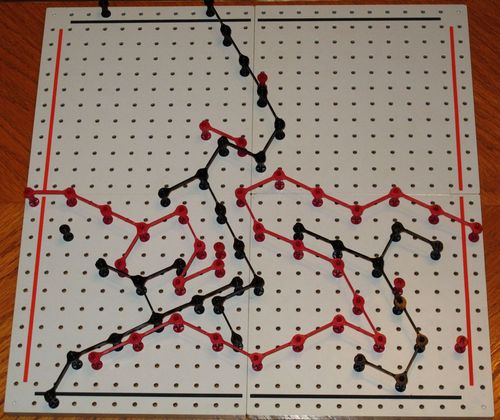
Twixt is an abstract in which two players draw lines across a square board, trying to get from one side to the opposite. Of course, each player’s line tends to block the other’s, and so the players have to jockey for position and set themselves up to extend their lines in multiple directions. The game ends up feeling very much like chess, with players thinking several moves ahead and trying to threaten many lines of advance.

Image from Boardgamegeek
Black and red blocking each other in a game of Twixt. Image from Boardgamegeek.

One of the central problems a Twixt player has to solve is that, because both players extend their lines at the same rate, it’s impossible to cut off an opponent whose line is in the lead. Chasing therefore doesn’t work; one must instead find a new spot to play in, in front of the opponent’s line, and build a fresh defensive position.

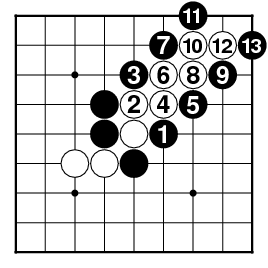
Fans of abstracts might recognize that situation from another game:

Image from GoGameGuru.
A ladder in Go. So long as Black keeps playing in the prescribed order, White cannot get out. Image from GoGameGuru.

A fundamental part of Go strategy is the “ladder.” The player climbing the ladder (White, in the image above) can never escape by continuing; the other player will counter-move until the ladder reaches the edge of the board and all the pieces in the ladder are captured. Instead, the player in the ladder has to play somewhere else, creating a new threat that might eventually make it possible to free the endangered pieces.

Go enjoys enormous depth, and the ladder is only a basic element of its strategy. Yet, Twixt takes the problem of the ladder and turns it into an entire game in its own right. There is no taking of the opponent’s pieces in Twixt, and unlike chess none of the pieces move in a special fashion. There is only the futility of the chase, of climbing the ladder once behind, and the complex decisions about how to jump forward one has to make as a result.

The primacy of getting out of chases by finding new positions in Twixt strategy is emphasized by how few rules there are. Add one peg to the board each turn; connect the new peg to any other pegs the connecting pieces included with the game can reach. Most questions about whether a move is legal can be answered without resort to the rulebook, since the connecting pieces physically prevent illegal links. The entire ruleset, complete with four-player variant, strategy advice, and a brief sample game, fits on a cardboard sleeve about the size of an A4 sheet of paper. Learning the game takes less than a minute, and from that point on there’s nothing to distract from recognizing that chasing won’t work and thinking about how to respond to that problem.

One might think that that would not be enough–but it is. Twixt is not a trivial game. Blocking an opponent who has gained the lead is difficult. Fooling an opponent with a blocking position into blocking incorrectly so that a line can continue is even more difficult. It has given rise to its own version of chess problems, and is played in tournaments.

Twixt, then, is an object lesson in the power of finding something interesting in a design and then turning the entire game toward that element. In the vast context of Go laddering is a relatively minor player; when put on the stage alone, however, it proves able to carry a show by itself. The result of focusing an entire design on the laddering dynamic is an elegant and fascinating game, one very much in the moments-to-learn-lifetime-to-master category. As someone who hopes to add his own work to the pantheon of easy-to-learn-lifetime-to-master games that Twixt has reached, I won’t forget its example.

Semi-Coops and the Maharajadhiraja

I love semi-cooperative games, where the players have to work together but there will ultimately only be one winner. They have a natural narrative to them: an Act I in which players are careful to demonstrate their goodwill even as one or two antagonists start to emerge, an Act II that sees the players’ interests diverge and cooperation become more difficult, and then finally an Act III where the players make their final bids for power. Every play of a semi-cooperative game has the potential to become a great story.

Recently I’ve been thinking a lot about this sort of game, thanks to John Keay’s excellent India: A History.

Image from Amazon
Image from Amazon

In his book Keay talks about the concept of the maharajadhiraja, the “raja of rajas of rajas.” To acquire this title one had to do more than merely conquer territory. In fact, taking and holding ground wasn’t necessarily even desirable; the maharajadhiraja might exert personal control over only a relatively small area. Rather, to be the raja of rajas of rajas one had to command the loyalty of other rulers. Far from annihilating competing kings, one left them in place to acknowledge one’s superiority.

Although the idea of the maharajadhiraja was never intended to serve a game design purpose, I can’t help but feel that it points toward an interesting approach to a semi-coop. The leader seeks, not to eliminate other players from the game, but to keep them involved and even powerful, so that their might will make the leader’s supremacy all the more impressive. Of course, those other players are candidates to be leader as well, and must weigh their odds of successfully claiming the title for themselves against the benefits of peace and prosperity under the current order.

Such a design would also raise fascinating questions about the nature of winning. Is it necessary to end the game as the maharajadhiraja in order to win? What if a player succeeds in maintaining a safe, happy kingdom as a subordinate ruler—is that a victory? Should it be? What message does either choice send?

I’m currently spending some time on Over the Next Dune, and in fact hope to have everything in place to jumpstart its playtesting very soon. However, I’d love to pursue this idea further, both as a design and as a source of theoretical questions. Is anybody on the whole 25th-hour-in-the-day issue?

Theory: Provide Guidance during Organic Tutorials

As a game designer—and an avid game player as well—I love what I call “organic tutorials:” games that allow players to learn how to play by exploring in a safe space. However, I’ve found that the appeal of this sort of tutorial is not universal; some players find them confusing and frustrating. It’s important, therefore, to inject enough guidance into the organic mold to bring those players up to speed.

Many games use organic tutorials, but the first example I ran into—and, I feel, still one of the best examples period—is the first level of Flower. In Flower the player controls a gust of wind. The goal is to use the wind to collect flower petals. Collecting certain petals makes things happen—say, a wind turbine starts turning. Eventually the player achieves all the goals and moves on to the next level.

The trick is that the game doesn’t explicitly state that the player should collect petals, or that certain petals are special, or that finding all the special flowers causes the player to progress. Players figure those things out through observation and experiment. Even learning to move is a process of exploration: the game gives only brief and fragmentary guidance as to how the controls work.

I played Flower’s first level, which is effectively an extended organic tutorial, and was astonished. No, more than that: I was moved. It was such a pure, marvelous experience. I couldn’t wait to share it with others.

So, I handed the controller to a scientist. This is someone with experience programming supercomputers. Technology is a part of this person’s day-to-day life and work.

The scientist found Flower completely mystifying.

I’ve had that experience several times since, with Flower and with other games that use organic tutorials. The problem in every case is that while the technology is fine—the person is always conversant with the keyboard or controller—the approach an organic tutorial requires is completely alien. Most people have always learned games by getting step-by-step instructions, from a manual or another player or the game itself, before they begin. Dropped into a game without those instructions, their instinct is not to explore. It is to wait.

On reflection, that’s a completely predictable response. I approached Flower with the idea that I was going to see what the game was about. That’s a very game designer way to think about what was happening. People who engage with games in a different way will expect to know what the goals are and what tools are at hand to achieve them before they begin. By not providing those tools, organic tutorials send the signal that it is not yet time to start playing!

To be clear, players who don’t respond positively to organic tutorials are not bad at games. We’ve known for years that different classroom students learn best in different ways. None of those ways are necessarily better, and in the same way no approach to learning games is better. The question is, acknowledging that some players will learn effectively from an organic tutorial and others won’t, how does one get the immersive experience of an organic tutorial without leaving lots of players in the cold?

The key is to give just enough information to put players on the intended course. Even brief, minimal instructions are enough to signal that the player should start doing things. Once the player is over that initial hurdle, learning-through-exploration can kick in.

An excellent recent example can be found in Elegy for a Dead World. Elegy begins with the player floating in space. There’s a star field in the background, but otherwise there’s no clear statement as to what the player should be doing.

If the player likes organic tutorials, he or she might start pushing the arrow keys. Doing that will move the player around, and eventually one of the game’s “portals”—windows to the dead worlds in question—will come into view. Hitting the enter key (a natural enough way to try to interact) will bring up a menu of story options, and off the player goes.

If the player is uncertain how to proceed and waits for a few seconds, a message appears at the bottom of the screen indicating that the arrows or WASD keys can be used to move. Once the player reaches a portal, waiting will generate a prompt that the enter key will open the portal.

That’s all Elegy does, but it’s enough. Players who like exploring can do so without nudges that they might resent. Players who hold off until the instructions have been read will get enough information to proceed. Everyone ends up playing the game.

Good organic tutorials are interesting, get players involved right away, introduce concepts in a measured fashion, and allow players to learn at their own pace. However, they’re not for everyone any more than just studying from a textbook or just doing hands-on projects is best for every student. Teachers know that mixing approaches helps students learn; mixing some instruction into an organic tutorial will have the same effect for players.

Recent Innovative Board Games?

Elegy for a Dead World is a fascinating game, one that mixes creative writing with some fundamentals of CRPG play. It’s challenging, not in the game sense of “it’s hard to get to the ending” but in the artistic sense of making one think. By doing something completely different from what most video games do it engaged a part of my brain that I don’t expect video games to interact with.

It also made me reflect on how long it’s been since I played a board game with that kind of power. Over the past year or so I’ve played many excellent board games, but none since Concept have pushed the boundaries of my thinking about how board games work and what they can do.

Are these games out there, and I’ve just missed them? If you have suggestions leave them in the comments, or drop me a line at @lawofgamedesign. The weirder the better!

Theory: Advice for Writing Rules

One of the best ways to find and resolve weaknesses in a design is to write the rules early–but what should those rules actually look like? Ryan Macklin’s recent post answers that question brilliantly. It inspired me to go back through Lines of Questioning’s rulebook, making sure I used the second person and the active voice.

If you haven’t read it previously, I also recommend Jay Treat’s post on making good rules. It is perhaps more about overall game design than the specific topic of how the sentences in the rulebook should read, but as the comments point out, those two issues overlap a great deal.

For my own part, I would just add that it’s critically important to explain how the game starts. Experienced boardgamers know to begin playing by starting the turn sequence; that’s not necessarily intuitive for those new to the field.

Theory: Drawbacks of Rotating Metagames

A rotating metagame—the situation where every pre-game choice a player might make can be countered by another pre-game choice, so that none of the choices become dominant—is a commonly-cited tool for balancing games with lots of moving parts. However, it is not a panacea. Implementing a rotating metagame creates some new problems, and puts certain pressures on the game’s overall design.

“Rotating metagame” is a term of art, and like all terms of art it might sound opaque. However, it’s simple enough in practice. Think of Magic: the Gathering, with its many cards and decks. Each card has a counter, something that destroys it or negates its effectiveness, and through these individual counters whole decks can be countered. If one card or deck starts to become prominent in the competitive scene, people will play the relevant counters and that card or deck will be taken down a few notches. Then as the counter becomes strong people will start to counter it, and so on and so forth. Through this process tournament play begins to look like a wheel: cards and decks move to the top and then get pushed to the bottom, at which point their counters lose popularity and they start to rise again. Hence, the strategic situation rotates.

A rotating metagame creates game balance in the sense that there is no dominant, unbeatable strategy. However, it is not necessarily desirable for every game, or even for many games. The technique has serious limitations.

First, a rotating metagame offers a good environment, not good individual games. In a rotating metagame one accepts that blowouts can occur when someone is caught on the wrong side of the rotation. When viewed as a whole and over time the tournament scene will look healthy, but the zoomed-in experience of the individual player might be very poor.

This problem is exacerbated by the fact that bad games will be concentrated among new and casual players. Players with little experience or who are less informed about the game are the most likely to be rolled over by rotation’s wheel, because they often will not realize that they need to learn about the current state of the metagame. Deeply committed competitive players, by contrast, will know exactly what they should be playing.

Unfortunately, this distribution puts unfun games in exactly the wrong place. Casual players might quit after an unfun game or two, and new players are especially likely to pass on a game after a single bad experience. These are the groups who should be getting protection from blowouts, but a rotating metagame instead makes them grist for the mill.

A further challenge for rotating metagames is that everything hinges on the ability to rotate. Rotating metagames work when they are in a state of dynamic imbalance; something is always on top, but that something changes frequently. If the changes stop, all that’s left is a game with a dominant strategy.

Ensuring that the wheel of the metagame keeps rotating, then, becomes extremely important—and that imposes several design requirements. First, the resources for rotation must always be available. No strategy can be without its counter, and those counters must appear in a reasonable percentage of players’ toolboxes so that they can do their work.

An interesting example of what happens when this isn’t the case can be found in the NBA. Without getting into the minutiae of basketball’s rules for defensive play, it used to be the case that defenders had to set themselves up against specific offensive players and follow them around the court, rather than staying in “zones” and defending against anyone who came near. As a result, the game began to trend toward a dominant offensive strategy of passing the ball to a single unstoppable player—the gigantic Shaquille O’Neal, the too-quick Allen Iverson, or someone else with an enormous physical advantage—and then having all the other offensive players just get out of the way. Defenders were required to follow the irrelevant players to irrelevant places, and then the hard-to-stop player would beat the lone defender permitted to be anywhere near him and score. Since the resources required to stop the unstoppable player weren’t available—there just aren’t many people Shaquille O’Neal’s size—the game could not rotate away from this lone wolf approach, and basketball strategy began to stagnate. Ultimately the league had to change the rules to allow zone defenses in order to break the deadlock.

Additionally, rotating metagames only work when the barriers to change are relatively low. Shifts in Magic’s metagame are painless because those who are keeping up with tournament play probably have all the cards they need for the change and emotional investment in any given deck is relatively low. By contrast, a game where changing strategies means a massive new investment (e.g., miniatures games where starting a new army involves a great deal of money and time spent at the modeling table) can’t rely on players keeping up with a changing strategic environment. Similarly, games where players have reasons to stick a single deck/army/team through thick and thin will find that the metagame doesn’t rotate. Fans of the Philadelphia Eagles who want to see the Dallas Cowboys defeated can’t transfer their loyalty to another team with a better chance of taking the Cowboys down.

Thus, implementing a rotating metagame means designing and marketing in ways that keep those barriers low. Important counter-cards can’t be at too high a rarity in Magic, even if limited play would benefit thereby, because they have to be broadly available. Team loyalty can’t be too big a part of how the game is sold, lest it stop players from shifting gears when they necessary. Every aspect of the game has to be looked at with an eye toward, not just how it impacts strategy, but whether it could have an ossifying effect on players looking to change strategies.

Finally, rotating metagames are a major design challenge. It isn’t easy to maintain a web of counters and counters-to-counters, all good enough to dethrone a dominant strategy but not so good as to make the countered strategy unplayable. Fine judgment about how strong each strategy is going to be and how effective to make the related counters is vital. Attaining that judgment requires enormous amounts of quality playtest data, which is not always easy to come by.

Given all of these weaknesses, when is a rotating metagame appropriate? The short answer is “when there are too many things happening to balance all of them at once.” Magic has a functionally infinite number of possible decks giving rise to a tremendous wealth of strategies; it’s impossible to arrange for each to have an even game against all of the others, so the rotating metagame serves as a safety valve that gives as many of them as possible a chance to shine. The many benefits Magic gains from its diversity of options outweigh the drawbacks of the rotating metagame they necessitate.

In the end, a rotating metagame is a tool. Like all tools, it places certain demands on its user and can be harmful if employed thoughtlessly or in the wrong situation. Don’t just assume that it’s right for other games because it’s been used successfully in the past; instead, think critically about what it will accomplish, what it will cost, and whether the former is worth the latter.