Theory: What to Do If Your Game’s Not Random

Riffing on the idea that the promise of a rare lucky moment is attractive, I thought it might be interesting to look at the fate of VS System–a game where people didn’t get those lucky moments. I should say up front that I only have this story second-hand, but even if it’s wrong it’s still interesting as a thought experiment. It’s a cautionary tale about a game that ended up being unfriendly to new players, and a chance to learn lessons about what to do if your game doesn’t randomly offer new players help.

VS System was a superhero card game. If you wanted to play something Magic-ish, but instead of knights fighting dragons you wanted Captain America fighting Doctor Doom, this was your game. Its crowning achievement may have been its substantial tournament popularity; lots of people got very good at VS System, played it very seriously, and won quite a bit of money in the process.

Part of what made VS System so popular among tournament players was that, even though it was a card game, luck actually had very little to do with the outcome. Better players almost always beat worse players. For heavily-invested players who had spent a lot of time practicing, that was a valuable feature. Their hard work was consistently rewarded.

New players, however, found VS System quite frustrating. Since everyone was better than them, they lost almost every time. They couldn’t hope for a rare lucky moment; no such moment was coming.

Losing is, of course, part of getting better. I have vivid memories of going to the local arcade in Japan once a week and getting trounced for a full year before I managed to win. However, at that point in my life I was dedicated to improving at fighting games. It’s not unreasonable for people to try a game that they’re only casually interested in, get clobbered, and decide that this particular mountain isn’t one they’re interested in climbing.

That was the decision people often made about VS System. Although a dedicated group of old-timers kept the game going, fewer and fewer new players appeared to reinforce their ranks. Tournament players who moved on were not replaced, and ultimately the game folded for lack of sales.

Compare VS System’s experience to Magic: the Gathering. In Magic, the better player wins . . . most of the time. The fall of the cards can give the worse player a chance, creating the openings they need to win. When it happens it makes the better player crazy–but even Mark Rosewater believes the game is better because those moments can happen, and the sales data support him. Magic lets new players get the lucky moment they need once every so often, and as a result it can appeal to a much larger player base.

So, judicious use of randomness can help new players win, and in the process can contribute to keeping a game popular. What if a game has no randomness? Chess has no dice, no cards, nothing that’s outside the players’ control (and I depart from Mr. Rosewater’s view that opening moves are random; a decision made with incomplete information is not random, it is simply risky). Yet, Chess has lasted for a very long time. Diplomacy has a less impressive pedigree, but it’s also a popular game of long standing with no random elements. How do they keep going?

I think there are two key things that non-random games can do to avoid frustrating new players:

Ranked play: Chess’ ELO system helps players find others at the same skill level. Weaker players can avoid being clobbered by playing people at the same ELO–or can opt into a challenge by finding someone at a higher level. Players control how much frustration they experience.

Make it hard to lose quickly: Even an extremely bad Diplomacy player can’t be eliminated in the first few turns. (The writing, admittedly, might be on the wall by then.) Furthermore, the early turns are often when most of the wheeling and dealing at the heart of Diplomacy occurs, so even the newest player gets to experience what the game has to offer and feel like he or she got to participate meaningfully.

I’m sure there are more approaches to this problem, but I feel that these are particularly effective. If your game doesn’t enjoy the luxury of offering rare lucky moments to give new players hope, doing one or both of these will help ensure that they still have a positive experience. That, in turn, will contribute greatly to the long-term health of your game.
Theory: Story Time

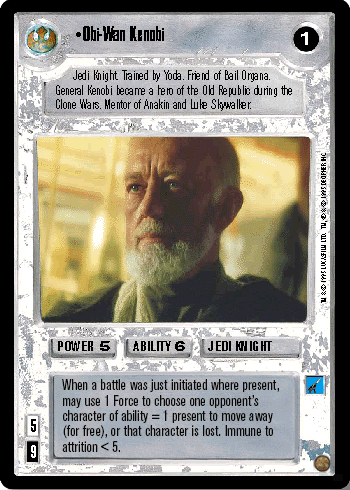
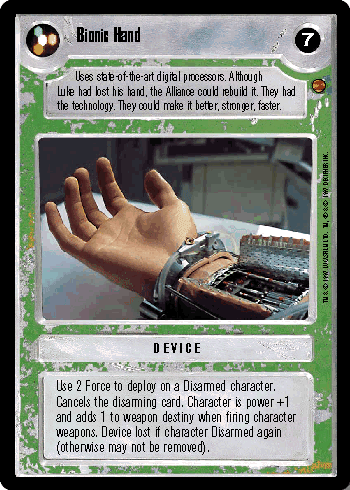
When I was a kid, I saw these two Star Wars cards:

8-13-14 - Obi-Wan Kenobi8-13-14 - Bionic HandTake a look at the numbers in the upper-right corners. They’re used to generate random numbers in-game. Higher is usually better. Mostly they scale from 1-6.

Now, Bionic Hand is pretty useless. IF your opponent is playing the Disarmed card, and IF the situation came up in which that card can be played, and IF your opponent had the card in hand and played it, THEN you can play your Bionic Hand.

But it’s tempting to put it in your deck anyway, because Bionic Hand is a 7.

Obi-Wan Kenobi, on the other hand (no pun intended), is pretty great. Explaining all the ways that he’s great requires some knowledge of the game’s mechanics, so suffice it to say that he’s as awesome as it seems like Obi-Wan Kenobi should be. Obi-Wan is so great that it’s tempting to play multiple copies of him.

But he’s a 1.

These two cards taught me the first game design lesson I ever learned: very powerful things should have some drawback associated with them. Obi-Wan is great once he’s on the table, but he’s terrible if you flip him while generating a random number. Having that weakness prevents Obi-Wan from completely overshadowing cards like Bionic Hand.

Yet, there are more lessons to be found here. Weak things can be interesting if they’re narrowly powerful. Random values can be generated in many ways. The promise of a rare lucky moment is attractive.

I know I’ve been talking about the Star Wars CCG a lot recently. Part of that is because it’s fun to walk down memory lane, but part of it is because the game did a lot right. When looked at critically, it has a lot to teach.

Theory: What Can Game Designers Consider?

I’m on a bit of a Star Wars CCG kick right now, owing to the recent reset of the game. Not only is that stripping away a lot of accumulated cruft (thereby making the game a great deal more accessible), it’s also presenting an interesting design question: what are valid considerations for a game designer?

To see the problem, put yourself in the shoes of one of the people guiding SWCCG’s reset. Your job is to go through hundreds, perhaps even thousands of cards, and choose no more than 150 that will continue to see regular play. How do you do it?

Some approaches are intuitively obvious. You could look at each individual card, and ask “is this card good for the game, in light of the lessons learned since it was originally designed?” The message boards have many discussions in that vein. Alternatively you could take a broader view, asking “are the strategies that this card enables fun and interesting?” Players called for one card to be included in the new base set expressly because it was the centerpiece of deck that was both fun and fun to play against.

The issue gets tricky, though, when one considers factors outside the game proper. One member of the “reset strike force” argued against including cards that helped a deck which is expensive to build. He felt that the reset would fail to attract new players if they found out that the strongest tournament deck cost hundreds of dollars to piece together on the secondary market. The deck, and the cards that went into it, were essentially sacrificed to marketing considerations. Is that valid from a design perspective?

Similarly, there was a Dark Side deck that everyone agreed was fun, balanced, and generally good for the game. However, it was based on a card of an unusual type–an “Objective”–and none of the Light Side Objectives were going to make the cut. The Dark Side Objective was therefore left out, and its associated deck with it, on the thinking that the perceived unfairness of the DS getting something the LS wasn’t would bother players. Mark Rosewater would agree that people would dislike the incomplete pair, but the problem is external to the play of any specific match. Should a game designer care?

Underlying these issues is the general question of how we should define a game designer’s ambit. If a good designer cares about the game in play, and only that, then marketing-driven decisions are at best right for the wrong reasons and at worst actually harmful to the game. On the other hand, if the designer is crafting something larger–an overall experience that includes both play and the activities surrounding play–then it’s appropriate to think about how players will feel when they see an unbalanced card list.

In practice game designers clearly care about the experience. Most games are intended for a broad audience, after all, and the overall experience is part of how one attracts players. Nevertheless, I think it’s interesting to puzzle over the question in the abstract. Are game designers inherently marketers, or is that just a function pushed upon them? Is the marketing part of the game, or ultimately external to it? How far afield do we want game designers to go?

Theory: When Card Advantage Wasn’t

Years ago the second-place collectible card game was Decipher’s Star Wars game. When Decipher lost the Star Wars license an arrangement was put into place allowing players to carry on making cards, which is fascinating from a legal perspective–I’d give a great deal to have been a fly on the wall during those negotiations. However, the game remains interesting from a design standpoint as well. It turns the conventional wisdom regarding card games on its head, and in the process demonstrates that even fundamental ideas about a type of game can be subverted successfully.

In 99% of card-based games, having more cards in hand is almost strictly better than having fewer. Cards give one options in the game, so more cards in hand means more options. Moreover, additional cards ultimately lead not just to more choices, but to better ones; a player with few cards has to improvise with what he or she has, while a player with many cards can select the perfect tool for the job.

The idea that more cards in hand is better is so thoroughly ingrained that Magic: the Gathering players developed a name for it: “card advantage.” Magic players routinely talk about getting card advantage, or ways to achieve card advantage. Card advantage is so commonly discussed that it was featured in a new-player series on the official Magic website. Whole theories of Magic exist to explain why decks that don’t achieve card advantage can possibly win. Even cards that don’t actually add to a player’s hand are understood in terms of the “virtual” card advantage they provide.

Getting more cards is so important in card games that Magic designers built a card that forces a player to voluntarily take on extreme card disadvantage as a wacky puzzle. They created One with Nothing–a card which forces a player to discard his or her own hand–just to intrigue those players who feel that “no card is too bad to find a use for.”

Star Wars turned all of this on its head. Drawing cards in Star Wars is easy, and there’s no maximum hand size. You can draw cards almost to your heart’s content. There’s just one problem: if you draw lots of cards, you’ll lose.

The designers who worked on Star Wars–I regret that I don’t know who they were–achieved this very elegantly. The cards in one’s deck are one’s “life bar;” when they run out, the game is over. Drawing cards, of course, reduces the number of cards in the deck. Hence, drawing cards is powerful, but also dangerous.

(Magic has somewhat the same setup, in that running one’s deck out puts one in danger of losing. However, because it’s unusual for the opponent to be able to attack one’s deck directly it’s much easier to manage one’s card drawing against the size of the deck. Furthermore, most decks don’t have anything like the card-drawing power of a Star Wars deck. Magic therefore lacks this tension in all but very unusual situations.)

Star Wars’ designers took this tension one step further. At the start of each turn, player takes a set number of cards from the top of his or her deck to form a separate pool. Costs of playing cards are paid from that pool. However, one can only draw cards from that pool. Players therefore have to weigh not only how much card drawing is safe, but also how far they can afford to go before they’re limiting what their plays for the turn too severely.

The result of all this is a number of interesting decisions. Is it better to play Darth Vader and lose out on drawing cards for the turn, or to rely on a lowly stormtrooper and refill one’s hand? When one is losing and needs to find a specific card to turn things around, is it better to draw lots of cards–and thereby lower one’s “life bar” a great deal–or to gamble by taking just a few? How does the opponent’s strategy influence that choice?

I imagine that most of the Star Wars CCG’s fans played because of the theme–I know that’s why I did, many years ago. However, under the theme (and the extreme complexity of the rules) there was a very strong design concept. If you get a chance, give the game a try. It’s a much different experience from other card games, and well worth your time.

The Case Study: Player Powers, Take Two

Cooperative games often give each player a unique power: Pandemic makes one player a scientist and another a medic, while Forbidden Desert has one player be good at carrying water while another can dig quickly. Yet, it isn’t necessary for a co-op to do so; Space Alert is a great game, and all of its players are on equal footing. I’ve been interested in bringing unique player abilities into Over the Next Dune, and have even put forward some untested ideas, but before sinking a lot of time into it I want to figure out with confidence whether OtND is in the category of games that benefit from such abilities or the category that doesn’t.

When would one want to add unique player powers to a game? I’ve come up with a couple of possibilities:

1. The game benefits from a certain amount of something, but no more. Pandemic would be easy if everybody had the medic’s ability to cure lots of people in a turn. However, letting one person do that is just enough to keep the players above water when the cards flip the wrong way and disease suddenly spreads all over. A single medic serves as a safety valve without making the game trivial.

2. The unique abilities provide very different game experiences. Playing a Dwarf Trollslayer in Warhammer Quest has little in common with playing a Grey Wizard. Providing such distinctive experiences adds a lot of replayability, since getting tired of one of them doesn’t mean you’re tired of the game as a whole.

3. The unique abilities create new, interesting decisions. Playing the water carrier in Forbidden Desert is neat because in addition to the game’s usual decisions you have to decide how important it is to stay close to oases. Figuring out when it’s safe to go help the team and when you should to stay behind collecting water is tricky. The unique power is valuable in part because it brings that interesting decision to the table.

Looking at that list, I’m struck by the fact that it’s mostly about the powers rather than the game. Do the abilities provide different experiences? Do they create new decisions? It depends on what the abilities are!

We could come at the problem from the other direction. When would one not want unique player powers in a game?

1. Giving players unique capabilities would undermine the game’s mechanics. Diplomacy is a classic game of cooperation (and competition). It’s a wargame where the players’ strengths start out relatively even, so to make progress you have to cut deals. If the players had special abilities they could rely on it might make negotiation less important–and the negotiation is the reason to play.

2. The game is at a complexity limit. Space Alert is played in real-time on a 10-minute clock. Players make mistakes and overlook things, even without having to track the effects of special powers. If people were also trying to manage unique abilities the game could tip from “hilarious barely-controlled chaos” into “impossible and frustrating.”

Over the Next Dune certainly isn’t so complicated that it can’t bear the weight of unique abilities. I’m less certain whether player powers would undermine the game’s central challenge of tricking the searchers. On the one hand, the more tools the players have the less likely they are to take the risk of getting close to searchers to pull them around. On the other hand, it seems like abilities could be created that would increase rather than detract from engagement with the searcher-tricking mechanic.

The best way to resolve that uncertainty is with some testing. How about this as a starting point:

Pop a Tire: If this player token is adjacent to one or more searchers at the start of the Sneak Phase, that searcher is affected by terrain during the next Search Phase. (Any time during the next Search Phase that searcher’s movement would cause it to enter one or more squares with terrain in them, the searcher must expend two squares of movement instead of one. If it does not have enough movement remaining to expend two squares of movement, it stops moving.)

My thought is that this creates a new decision (whether and when to slow down a searcher) and a potentially different game experience (seeking out searchers instead of avoiding them), without adding complexity (players will already know the terrain rules) or undermining the central mechanic (since it increases rather than decreases the mechanic’s use during the game). I also like that, as noted in the first iteration of this ability, it doesn’t empower one player; rather, it helps a player assist the others.

That’s one power, but there can be five players in a game of Over the Next Dune. I’ll be back with more on Monday.

Theory & The Case Study: Gates in Over the Next Dune

I’ve been considering whether to try out gated player abilities in Over the Next Dune. Gating player capabilities would be a substantial change, and unusual for a cooperative game. On the other hand, gates are a commonly-used, proven mechanic. It’s not a trivial decision.

Let’s start at (what I think is) the beginning. Why would one ever use a gate, instead of just letting players deploy their capabilities whenever they want? I can see two reasons:

1. The gate leads to interesting decisions. Mark Rosewater likes to say that “restrictions breed creativity.” Limiting the player’s access to a capability forces the player to think about when to use it, and to find alternative solutions when the capability isn’t available or shouldn’t be employed.

As a quick example, think about Barrier in League of Legends: a protective shield that isn’t available for a few minutes after being used. Since access to the Barrier is limited, players have to make tough decisions about precisely when it will do the most good. They also have to find ways to conserve the Barrier for those key moments, and to protect themselves when the Barrier is “on cooldown.” If players could just throw up the Barrier all the time, those decisions would be lost–and no other decisions would appear to replace them.

2. The gate prevents an ability from dominating gameplay. In some ways this is the inverse of the previous rule: the gate is in place because unlimited use of a player ability makes the game less interesting. RPGs often use gates in this way; powerful abilities would make the early game trivial, so players can’t access them until later.

(There’s also a third reason–to help monetize the game. However, that opens up a can of worms that I’m not looking to address right now.)

Those both seem like good reasons to include gates. Yet, they aren’t universal in cooperative games. Pandemic‘s Scientist doesn’t need to do anything to be able to cure a disease with four cards instead of five; that ability is always “on.” Shadows Over Camelot‘s Sir Bedivere can trade cards in for new ones without earning the privilege. Clearly, gates aren’t for every power or every game.

What considerations, then, militate against gating player powers? Ironically, I find it much easier to think of why a designer would want to limit powers than why the designer wouldn’t. Perhaps that says something about me. 🙂 Here’s what I’ve come up with:

1. The game is unplayable when the ability is not available. Most RPGs don’t limit your capacity to walk around. In fact, I’m not aware of any at all that do. That’s not surprising, because if the player can’t move around the world in an RPG the player can’t do anything at all. Limiting walking would tend to destroy people’s ability to play the game.

2. The game needs something, and the ability provides it best when it is constantly available. League of Legends needs a way to ensure that games move toward their conclusions. A big part of ending a game of League is damage output; players and teams need damage to destroy the opposing team’s defenses and ultimately the enemy base. Thus, the game needs to ensure that teams have reliable access to damage output. If no team can damage objectives, the game cannot progress (setting aside really grindy strategies like letting minions do all the pushing–let’s not go down this road).

League’s need for guaranteed damage is met by “auto-attacks.” Every character can punch, swing a sword, fire arrows, or has some other freely available mechanism for inflicting damage. Since they’re costless, auto-attacks guarantee that the game cannot stall completely. Regardless of the team composition or overall situation, both teams have the theoretical ability to bring down objectives and end the game.

3. You want to encourage a behavior. If players should be doing something in a game, designers can incentivize it by letting players do it no strings attached. Ikaruga, for example, is a “bullet hell” game in which the player(s) can switch colors to absorb enemy fire. The color-switching mechanic made the game an instant classic. Having no limits on switching colors was a good design move, because it encouraged players to try the mechanic out early (desirable because color-switching was the game’s innovative feature) and to do it often thereafter (important because it helped players progress and kept them hooked).

So, two reasons to use gates and three not to. What do they mean for OtND?

To date players have three capabilities in the game: moving, tricking searchers, and rescuing other players. Moving should not be gated. The game is unplayable if players can’t get around the board.

Tricking searchers also should not be gated. It is, at least arguably, the most interesting aspect of the game. Keeping it freely available encourages players to interact with this important mechanic.

Rescuing is already gated by the need for several players to work together. That proved necessary to stop rescuing from dominating gameplay. However, the current limitations appear sufficient; I don’t think more are needed.

What about additional player abilities, then? Things like Pandemic’s Scientist and Shadows’ Sir Bedivere, that are outside the core rules of the game? Do they need to be gated? Should they exist in OtND at all? Let’s take that up next time.

The Case Study & Theory: Gates

Thinking about how to add on to Over the Next Dune raises the question of whether and how to gate player powers. Of course, that begs the question of what a “gate” is. 😉 To avoid definitional confusion, let’s hammer that out.

A gate is something that controls a player’s access to in-game capabilities. The classic example is mana, as seen in League of Legends or the Final Fantasy games. A player uses up mana each time he or she employs a special ability, and when the mana is gone the player cannot use special abilities until it recharges. Ammunition is also a gate; it limits how much the player can use a certain weapon before having to switch or seek out more ammo.

Gates do not have to be numbers. Many role-playing games, for example, control players’ power via progress through the storyline. As the player explores new areas, meets new people, and learns new things, the player gets new capabilities.

Gates can go one way or bi-directional. One-way gates result in permanent changes. For example, in Burnout Paradise access to new cars is generally gated by completing races. Once you complete the race associated with a car, you have access to that car forever. Mana and ammunition are usually bi-directional gates; you can run out and lose access to a power, but replenishing the resource takes you back through the gate and enables you to use it again.

I believe that that’s a reasonably complete discussion of what gates are. They also have some properties that aren’t definitional but that I feel are worth putting forward:

Gates can be thought of in either direction. This is kind of a weird one, and it’s usually not relevant, but it can be useful. All gates can be described as having something or not having the opposite. For example, in Battletech firing weapons builds up heat. You can think of heat as the gate (too much is bad) or coolness as the gate (not enough is bad). It doesn’t matter, from a theoretical perspective, which approach you take.

Admittedly, this can get kind of silly. You could say that “lack of mana” is the gate, and that a player can use a certain ability because his or her lack of mana has been kept below a certain threshold. It’s a lot easier, though, to say that the player has enough mana.

Basically, this is like flipping an equation to put the variable you’re solving for on the left. It doesn’t really change anything, but if you’re accustomed to a certain presentation it might help you understand what’s going on.

Out-of-game gates are ineffective. Experience has shown that players cannot be limited by resources outside the rules of the game. Money and physical difficulty are two examples of out-of-game gates which have been proven not to work.

Money. If your game is popular, you will have a subset of players who will spend whatever they need to to get a competitive advantage. Magic: the Gathering was originally designed to use card rarity as a gate, on the thinking that players would be limited by their collections. Over time it became clear that tournament players assembled complete collections regardless of the cost. Magic still uses rarity for various design purposes, but not to balance constructed-deck tournament play.

Physical difficulty. It does not matter how difficult a physical task is; if it will help players win, some of them will put in the necessary time to be able to do it reliably. Fighting games often use precise timing as a gate, demanding that players time their moves to 1/60th of a second in order to get the longest combos and the most damage. Many, many players have practiced enough to hit those 1/60th of a second windows routinely.

From here we need to think about whether OtND should use gates at all. I’ll get into that next time.

Theory: PSA for New Warmachine and Hordes Players

So you’ve decided to try Warmachine or Hordes. Great! They’re excellent games. And you’ve looked through some of the books and you’ve decided to try a Cygnar gunline. All ranged attacks, all the time. You’ll annihilate them before they even get close! Right!?

Wrong. This is completely wrong. The gunline will not work–and there are solid game design reasons why.

Imagine a universe where a gunline can realistically plan to wipe the opponent’s army from the board before it can get into close combat. In that universe, a close combat-focused army (like, say, many of the steampunk and fantasy armies in WarmaHordes) is unusable. You’re playing Rock, and they’ve got a lot of Scissors. They lose every time–and that kind of lopsided game is boring.

What’s more, if gunlines are successful scenario-based play is pretty much out the window. Experience has demonstrated that all-ranged armies do not move forward. After all, moving forward makes them more vulnerable to being engaged in close combat! Hence, all-ranged armies tend not to push into scenario zones, or capture flags, or otherwise take advantage of all the board’s real estate. They are resistant to incentives to maneuver, and in the process an important part of the game is lost.

Privateer Press knows that Warmachine and Hordes will suffer if gunlines work. As a result, the games are balanced so that they won’t. You must have a close combat aspect to your army, because if the opponent wants to, he or she will be able to get to you.

Isn’t it a cost to have gunlines be weak in this way? Why should all-ranged armies suffer so that close combat can function? It’s because gunlines shut out so many other options and considerations. Scenario-win armies don’t work because the gunline just eradicates them. Close combat units are irrelevant because they get swept off the board without doing anything. Even setting up the board gets reduced to “where are the clear fields of fire.” Unworkable gunlines are the price we pay to keep Warmachine and Hordes interesting.

The gunline doesn’t work. It has never worked. There is no reason to think it will ever work. Please, please, don’t spend your money on one. Spend it on Warmachine and Hordes, they’re great games! But buy a unit of Sword Knights or a Centurion to go along with your Gun Mages.

Theory: *Stand-In* and Puzzle Pure Co-Ops

I wasn’t really satisfied with the terminology I used to discuss the types of pure co-ops in the previous post. “Simulation” sounded like it related to the theme of the game. Using that word was going to lead to definitional confusion; it needed to be changed.

I’ve revised the post to use “stand-in” instead of “simulation.” The new term should be clearer that the distinction is between co-ops whose AI imitates a human player and those whose AI does not.

In addition, I’ve added some more examples and cleaned up some wording. It’s an all-around better post now.

If you checked it out before, please take another look and let me know what you think of the changes. If you haven’t yet, try it on for size.

Theory: Simulation and Puzzle Pure Co-Ops

It’s an article of faith that a great opponent makes a game more fun. A good pure co-op game, then, needs a good AI foe to challenge the players. Designing that opponent requires, first and foremost, deciding what kind of co-op you’re creating: a stand-in or a puzzle. Mashing elements from both types together leads to trouble.

A stand-in challenges the players by imitating a living opponent. It tries to do what a human would do in a given situation. In essence, it simulates the experience of having a human sitting across the table (or on the other side of the internet connection) playing against you.

A puzzle challenges the players by presenting a problem for them to solve. It is not concerned with doing as a real person would do; its only goal is to provide an interesting dilemma, and it acts in whatever way the designer thinks will best achieve that. Puzzles may (should?) have a theme, and they may be good simulations of that theme, but they aren’t trying to simulate an opposing player.

Which category a game falls into has a huge impact on what kind of AI is appropriate. Stand-in AIs need capacities that puzzle AIs don’t. A human will respond to his or her opponent’s actions; to feel “real,” the stand-in needs to be able to do the same. It has to be able to find out what the players are doing, determine what an appropriate response might be, and implement that response.

Puzzles, by contrast, don’t have to care what the players are doing. In fact, they don’t have to do any specific thing so long as they’re interesting. The central question is what the game needs, not how a person would behave, and the AI needs only those capabilities relevant to the game’s particular answer.

Either choice can lead to a great game. Pandemic and Forbidden Desert, for example, are both great puzzles. The diseases to cure in Pandemic and the sandstorm to dig through in Forbidden Desert don’t act like human opponents–but why would they? Diseases and sandstorms aren’t sapient, and it would be weird if they could respond to the players’ actions. Instead they operate in ways that are both thematic for the natural forces they represent and interesting in play. For puzzles, that’s the gold standard.

As an example of a great stand-in I always go back to the Reaper Bot and Zeus Bot for the original Quake. (Wow. I’ve been playing FPS games for a long time.) At a time when a lot of people were on dial-up and internet play with other humans was a lag-filled affair, the Reaper and Zeus Bots were striking for their ability to navigate without bumping into walls, good aim, and consistent connection. Many real players, fighting against 300-500ms pings, couldn’t offer those things. The bots out-humaned the humans!

Designers run into trouble, however, when they mix the two categories. One sees this a lot with “cheating” computer game AIs (which are usually intended for solo play rather than co-op, but the issues involved are comparable). They look like stand-ins but are actually puzzles, and as a result they often end up being unsatisfactory.

For example, players often express frustration with the AI in the Civilization series of games. Civ’s AI promises stand-ins; the player controls one civilization and the others are guided by an AI that has each civilization pursue its own ends–just like they would if humans were guiding them. The goal is to beat the other civilizations, eliminating or outscoring each as though they were separately controlled by human players. The AI-driven civilizations sometimes cooperate and sometimes attack each other, imitating what humans do. It looks like a stand-in, it quacks like a stand-in . . .

. . . but it’s not a stand-in, and at least anecdotally it ends up irking many players as a result. Civ’s AI doesn’t get much smarter as the difficulty level goes up; it just gets more and more resources, far outstripping what the human player receives. Those resources enable the AI to challenge a skilled player, but they undermine the simulation; no human can do the things a high-difficulty AI can do. Ultimately the game becomes a puzzle in which the player must find optimal moves that will allow him or her to keep up with the AIs’ lead in technology and production. Players choose a higher difficulty level looking for a simulation testing their diplomatic ability and battlefield tactics, instead find an optimization problem testing their command of the math behind the game, and walk away aggravated.

(To be fair, some players greatly enjoy the higher difficulty levels. However, they’re usually knowledgeable about the game, know they’re in for an optimization problem, and are specifically seeking that experience.)

Civilization demonstrates–-has in fact been demonstrating for years–-that a really tasty apple is not a substitute for an orange. When designing a pure co-op, follow in the mold of Pandemic, Forbidden Island, and Quake’s excellent bots by figuring out whether you need a puzzle or a stand-in and then delivering fully on that experience. Slipping elements of one into the other is apt to confuse the game’s message and frustrate players.