Theory: Twixt and the Power of Paring Down

I was regrettably unable, this past weekend, to attend a favorite board gaming get-together. However, I still had the chance to play the classic Twixt. In addition to being just plain fun, Twixt is a great example of how minimal, focused rules can expand an interesting dynamic into a compelling game.

Twixt is an abstract in which two players draw lines across a square board, trying to get from one side to the opposite. Of course, each player’s line tends to block the other’s, and so the players have to jockey for position and set themselves up to extend their lines in multiple directions. The game ends up feeling very much like chess, with players thinking several moves ahead and trying to threaten many lines of advance.
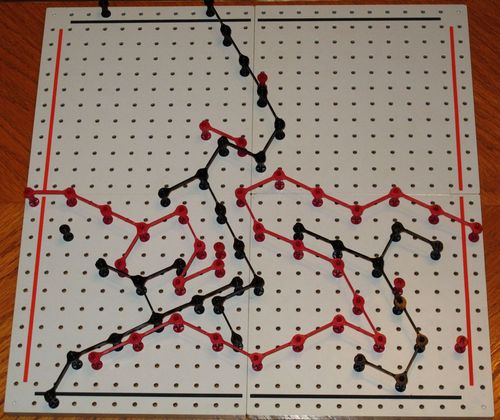
Image from Boardgamegeek
Black and red blocking each other in a game of Twixt. Image from Boardgamegeek.

One of the central problems a Twixt player has to solve is that, because both players extend their lines at the same rate, it’s impossible to cut off an opponent whose line is in the lead. Chasing therefore doesn’t work; one must instead find a new spot to play in, in front of the opponent’s line, and build a fresh defensive position.

Fans of abstracts might recognize that situation from another game:
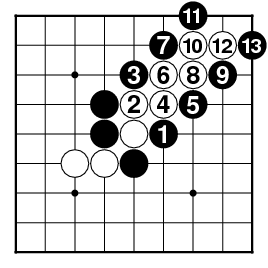
Image from GoGameGuru.
A ladder in Go. So long as Black keeps playing in the prescribed order, White cannot get out. Image from GoGameGuru.

A fundamental part of Go strategy is the “ladder.” The player climbing the ladder (White, in the image above) can never escape by continuing; the other player will counter-move until the ladder reaches the edge of the board and all the pieces in the ladder are captured. Instead, the player in the ladder has to play somewhere else, creating a new threat that might eventually make it possible to free the endangered pieces.

Go enjoys enormous depth, and the ladder is only a basic element of its strategy. Yet, Twixt takes the problem of the ladder and turns it into an entire game in its own right. There is no taking of the opponent’s pieces in Twixt, and unlike chess none of the pieces move in a special fashion. There is only the futility of the chase, of climbing the ladder once behind, and the complex decisions about how to jump forward one has to make as a result.

The primacy of getting out of chases by finding new positions in Twixt strategy is emphasized by how few rules there are. Add one peg to the board each turn; connect the new peg to any other pegs the connecting pieces included with the game can reach. Most questions about whether a move is legal can be answered without resort to the rulebook, since the connecting pieces physically prevent illegal links. The entire ruleset, complete with four-player variant, strategy advice, and a brief sample game, fits on a cardboard sleeve about the size of an A4 sheet of paper. Learning the game takes less than a minute, and from that point on there’s nothing to distract from recognizing that chasing won’t work and thinking about how to respond to that problem.

One might think that that would not be enough–but it is. Twixt is not a trivial game. Blocking an opponent who has gained the lead is difficult. Fooling an opponent with a blocking position into blocking incorrectly so that a line can continue is even more difficult. It has given rise to its own version of chess problems, and is played in tournaments.

Twixt, then, is an object lesson in the power of finding something interesting in a design and then turning the entire game toward that element. In the vast context of Go laddering is a relatively minor player; when put on the stage alone, however, it proves able to carry a show by itself. The result of focusing an entire design on the laddering dynamic is an elegant and fascinating game, one very much in the moments-to-learn-lifetime-to-master category. As someone who hopes to add his own work to the pantheon of easy-to-learn-lifetime-to-master games that Twixt has reached, I won’t forget its example.
Maharajadhiraja: Further Thinking

I couldn’t resist spending some time working further on a game based around the concept of the maharajadhiraja, the ruler who doesn’t want to destroy other rulers but rather to preserve them so that they can acknowledge his or her greatness. The more I think about the idea, the more it seems like it leads in neat directions.

First, I still like what it does with player elimination. Everyone wants to secure their own power, but the leader has to stop short of fully removing rivals from the game. Complete safety is thus unachievable, which helps keep the game interesting as it goes along.

Second, I’ve started to be very interested in how the design might naturally control snowballing—the situation where players get more powerful as they advance toward victory, so that they enter a positive feedback loop where winning gives them power and the power causes them to win even faster. (The name comes from a snowball rolling downhill, picking up snow so that it speeds up and picks up even more snow.) Most games with the potential for snowballing rely on mechanical barriers that limit how much power the players can acquire at different points in the game. By contrast, this game could have players limiting their own snowballing, stopping their feedback loops in order to keep their opponents in the game. That’s unusual, and I feel that it would be fascinating in play.

My ideas so far have been minimalist, with some dice for each player as the only components. The intent was that simple mechanics would put focus on the key dynamic of getting some—but not too much—power at the opponents’ expense. Unfortunately, nothing’s worked yet; having few mechanics means there aren’t many levers to pull when something doesn’t play out as intended.

So, an interesting idea, but one that’s not quite there yet. I’ll have some free time this weekend to plug away at it a little more.

Semi-Coops and the Maharajadhiraja

I love semi-cooperative games, where the players have to work together but there will ultimately only be one winner. They have a natural narrative to them: an Act I in which players are careful to demonstrate their goodwill even as one or two antagonists start to emerge, an Act II that sees the players’ interests diverge and cooperation become more difficult, and then finally an Act III where the players make their final bids for power. Every play of a semi-cooperative game has the potential to become a great story.

Recently I’ve been thinking a lot about this sort of game, thanks to John Keay’s excellent India: A History.

Image from Amazon
Image from Amazon

In his book Keay talks about the concept of the maharajadhiraja, the “raja of rajas of rajas.” To acquire this title one had to do more than merely conquer territory. In fact, taking and holding ground wasn’t necessarily even desirable; the maharajadhiraja might exert personal control over only a relatively small area. Rather, to be the raja of rajas of rajas one had to command the loyalty of other rulers. Far from annihilating competing kings, one left them in place to acknowledge one’s superiority.

Although the idea of the maharajadhiraja was never intended to serve a game design purpose, I can’t help but feel that it points toward an interesting approach to a semi-coop. The leader seeks, not to eliminate other players from the game, but to keep them involved and even powerful, so that their might will make the leader’s supremacy all the more impressive. Of course, those other players are candidates to be leader as well, and must weigh their odds of successfully claiming the title for themselves against the benefits of peace and prosperity under the current order.

Such a design would also raise fascinating questions about the nature of winning. Is it necessary to end the game as the maharajadhiraja in order to win? What if a player succeeds in maintaining a safe, happy kingdom as a subordinate ruler—is that a victory? Should it be? What message does either choice send?

I’m currently spending some time on Over the Next Dune, and in fact hope to have everything in place to jumpstart its playtesting very soon. However, I’d love to pursue this idea further, both as a design and as a source of theoretical questions. Is anybody on the whole 25th-hour-in-the-day issue?

Inquiring Minds Want to Know

One of the things I keep in mind as I write posts is what’s been useful to readers in the past. Macro-perspective theory posts, for example, tend to generate a fair amount of interest, so I try to make them a regular feature on the site.

It struck me that while taking note of trends is valuable, it would also be perfectly good to just ask what people want to see. 😉 So: is there a topic you’d like to discuss? A conversation you’d like to have, or a form of media you’d like me to produce? Maybe a game idea to riff off of? The one request I’d make is that we avoid reviews; there are lots of high-quality sources for those already.

Let me know in the comments, on Twitter, or by email–and don’t feel like you can’t get in touch past a certain deadline. I’m always open to suggestions!