Kickstarter is, I think, much on the minds of game designers these days–both as an opportunity and as a source of potential pitfalls. That being the case, I found this article very interesting. While it’s not directly related to games, it certainly points out issues that designers might encounter, and provides warnings that we can sensibly heed.
Slack
We’re using Slack intensively this semester, and while keeping teams up-to-date and communicating is always good, I have to admit that I’m not yet clear on why it’s become so popular. I’m hoping that experienced Slack users can set me straight: what are some valuable features I should be aware of? What is Slack good at that other forms of online communication aren’t? The value of intra-team communication is undeniable, but thus far Slack doesn’t feel like it’s enormously better than other solutions.
Theory: Procedurality Runs Amok
It turns out that it’s not too hard to procedurally generate stuff. However, it’s quite difficult to procedurally generate a reasonable amount of stuff. 😉
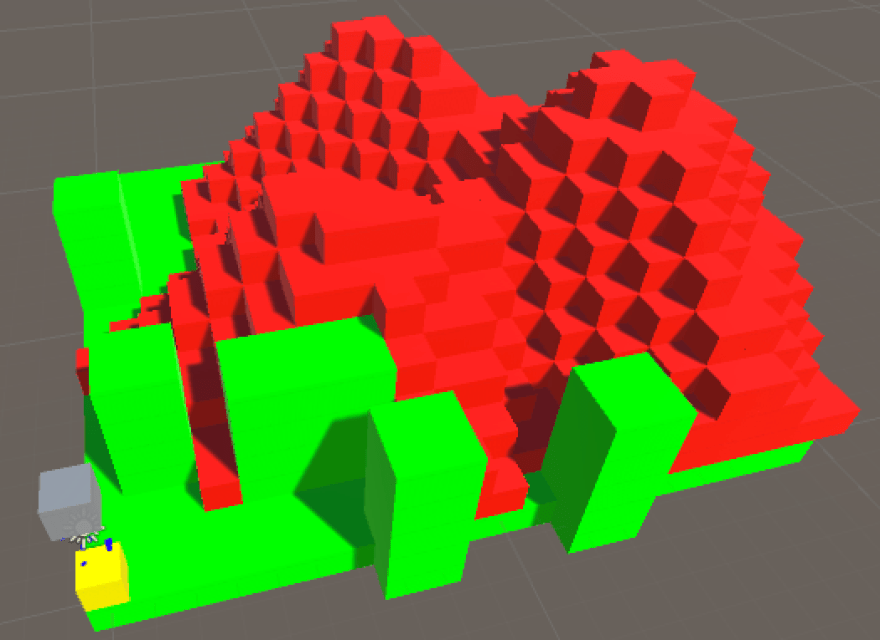
The fire (in red) probably should not be higher than the mountains in green. 😉
Global Game Jam 2016: Gift Swap
I was fortunate enough to get to work with several great designers at last weekend’s Global Game Jam, including Eric of the Push Your Luck Podcast (which everyone should listen to!). We developed Gift Swap, a semi-cooperative game that combines a tricky logic puzzle with easy-to-learn gameplay. Gift Swap was ultimately nominated for Best Tabletop Game at the NYU Game Center jam site, and we’re all the prouder of that because our site was tied for best-attended in North America!
The rules and cards are available above. Let me know what you think, and share your games as well!
Theory: Many Small Meetings
I am not certain how to categorize this bit of knowledge. Organizational theory, perhaps, or behavioral theory, or something else. Regardless, it has proven relevant to and valuable in my design work, so I thought I would pass it along: frequent short meetings can be more effective than a few long ones.
While I don’t know if the literature supports that conclusion, it stands to reason that three one-hour meetings in a week can be more useful than a single three-hour meeting. The single meeting is a major disruption to a workday, and tests the participants’ ability to focus. In addition, having only a single check-in time during the week encourages those involved to prioritize other tasks. A series of brief meetings are easier to fit into a day, encourage all involved to keep current on the project, and everyone is likely to be attentive and involved for the entire meeting.
Not being a behavioral scientist, I cannot offer a proper scientific justification for the idea that having a number of shorter meetings is better. It has been so in my experience, however. Give the approach a try; I suspect you’ll find it beneficial.
25th Hour Projects: The Dead Man’s Hand
No one likes a cheat. That’s good; you don’t want them to like you.
It would be easy enough to win this game. An ace in the hand, an ace in the river, and an ace up your sleeve pretty much guarantee that you can take the pot. With four raises behind you and more ahead, it would be quite a haul.
The money, though, isn’t what you’re looking for. No, you need to show them that you can fool them. That you have been fooling them, all along. You need to win and win, so that they know you must be cheating, and then you need to let them see how, so that they see without a shadow of a doubt that you did cheat them, and that they couldn’t catch you until you let them.
Of course, that final reveal has to be perfect in every respect. It must reveal the trick while also proving that you’re in total control of the situation. That they’re only realizing what happened because you wanted them to.
They won’t be happy. It’ll still be worth it.
Theory: Notes on Controllers
Just a few interesting notes about controllers from recent playtesting:
- People will continue to attempt to use the first controller that works with your game, even if it is no longer functioning. It is very important, therefore, not to switch from the keyboard to a mouse, or from a mouse to a console controller, etc. Keep the player using one controller from start to finish.
- Players don’t necessarily explore to find out whether there are controls available beyond those they are aware of. They might push all the buttons on a controller, but that’s about it–and if a button doesn’t have a function at that moment, they probably won’t come back to it later. Don’t assume that the player will learn all of a game’s controls without instruction/tutorials/etc.
- Players will do things as fast as they can, not as fast as they need to. If you want players to do things slowly–e.g., in a rhythm game–you need to incentivize the pace you’re looking for, or find some other way (for example, visual and sound design) to lull them into a more restful pace.
Link: PRACTICE 2015 Videos
I’m a bit behind on this one, but the talks from PRACTICE 2015 are now online. There’s a lot of amazing stuff there, including Brian Moriarty’s incredible history of interactive fiction, Ben Ruiz’s masterclass on attack animations, and Jeff Mishtawy on balancing Nascar races. Meg Jayanth’s keynote was also remarkable; I was particularly struck by her discussion of how players feel themselves in control even of entirely out-of-control situations.
Check the videos out when you get the chance; they’re fascinating, and well worth your time.
Age of Sigmar: New-ish Rules for a More Narrative Focus?
Let’s start from the assumption that Games Workshop’s Age of Sigmar is all about telling good stories. Let’s further assume that it’s best when a game’s rules directly support what it’s about. Given those two assumptions, these rules are noteworthy; they feel like an effort to push the game in the direction of having exciting things worthy of having stories told about them happen on the table.
In sum, the rules linked cap the number of models each player can have, but not how good those models are. Players with significantly worse models are the “underdog,” and have access to a bunch of ways of getting victory points that the player with the advantage does not. These special means of scoring are aimed toward things a weaker army might be able to accomplish: don’t get wiped out, focus fire on one single model until it’s destroyed, etc.
“Don’t get wiped out” and “focus fire” might not sound like great stories, but think about how they might work out in play. A small force organizes itself into a spearhead to reach the enemy general; beleaguered defenders fall back step-by-step, trying to hold on. This is the stuff of cinema, and the rules are encouraging it to happen.
I haven’t gotten to try these rules myself, but I very much like the direction they suggest for the game. Age of Sigmar seems to be positioning itself as being for those who aren’t engaged with tournaments and instead want a more narratively-driven experience. Rules that give every casual game the potential to turn into an exciting scenario are a great way to provide that, and are something really different and interesting in minis gaming.
PSA: Warmachine Errata
Privateer Press released a new set of errata for Warmachine and Hordes today. The changes include substantial alterations to a number of theme forces, but I think what’s perhaps most interesting is the way PP handles errata in general. The influence of tournament data is clear, but there are also tweaks that seem to be aimed toward the “feel” of traditionally disfavored models. Nothing that’s likely to shake up the metagame, but little improvements to help those who enjoy the pieces feel justified in playing them.
Maintaining a current errata document is a kindness to players, and putting thought not just into rules issues but also into maintaining balance is especially welcome. That goes double when some of the errata are bringing balance, not just to tournament play, but also to the fun-factor of centerpiece models like (in this case) heavy cavalry and people wearing steam-powered armor. Kudos to Privateer Press.
 The Law of Game Design