Looking for Recommendations re: New Laptop

I’m in the market for a new laptop; my current one has served admirably for five years, but its hardware is starting to tip over from “probably going to fail before too long” to “actively failing right now.” As a result, I’m looking for recommendations. My goal is to find one that has:

1. Portability–I’ll be traveling a fair amount with it, and so it needs to be convenient to walk around with/take on the train/set up in shared workspaces/etc. Battery life, weight, and size are relevant considerations.

2. Performance–Doing more Unity work is making me very aware of the limitations of my current system. Integrated graphics cards just won’t cut it; I need something faster. Plus, I’m a little tired of getting 20fps even on older games.

3. Reliability–There’s no tool more useless than a broken one.

Cost is certainly a factor, but I’m willing to grit my teeth for a laptop that meets my needs. Thoughts?

The Case Study: See for Yourself

Following up on the last post, today League of Gamemakers posted an excellent comparison of dice and cards as design tools. I was particularly struck with the idea of drafting dice, which I didn’t think of when writing Monday’s post but which is a great way to manage randomness. Be sure to give Mr. Caputo’s article a look.

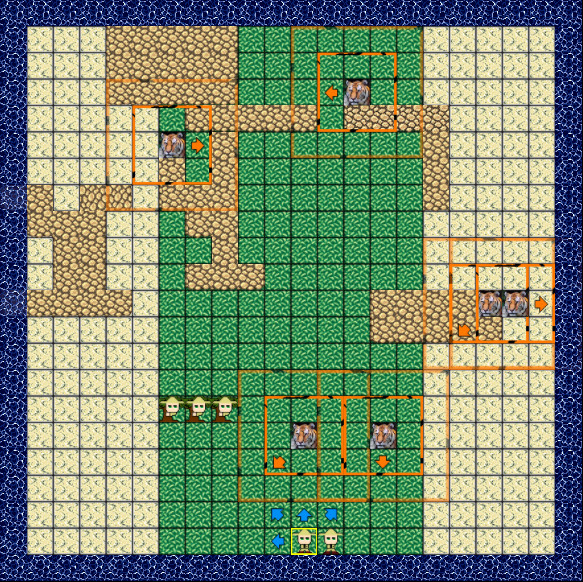
I also wanted to follow up on this post regarding the status of Over the Next Dune. A picture is worth a thousand words, so:

4-8-15 - OtND AlphaThe rules enforcement is almost complete; all that’s left is players leaving paths in the sand. While the art is simple, it beats the strictly-abstract print-and-play by a country mile. Every day sees a few more bugs squashed. I was hoping to have the alpha version available by the end of the week; that might not be feasible, but we’re definitely getting there.

Theory: Mitigating Randomness

So you’ve decided to use dice, or some other randomizer, to help shape your game experience. You’ve thought carefully about what the odds of success for different actions should be, and have calibrated the randomizer accordingly. However, you’re finding the results unsatisfactory; perhaps the occasional bad roll is too devastating, or players are getting into unwinnable positions early through unlucky dice rather than bad play. Below are some tools you can use to mitigate the effects of randomness, keeping the excitement of an unpredictable outcome without the risk that dice will dominate the game.

Change the odds for key rolls

If something is critically important—because it’s the culminating move in a strategy, for example, or because it’s necessary for the game to progress—shift the odds so that that specific roll is more likely to succeed. Players naturally get frustrated when a game’s randomizer undoes their hard work at the final moment, or even worse when it stymies the game completely (the “I need to make this Investigation roll to find the clue, but I keep failing” problem). Twisting the odds toward the players at key junctures retains the tension inherent in the possibility of failure, but makes it unlikely that an actual failure (or worse, repeated actual failure) will inhibit their fun.

Broadly speaking, there are three ways to push the odds in the players’ favor:

  1. Roll more dice

As you roll more dice there are more opportunities to outweigh bad results. The average result when rolling two dice is 7, but if one of those dice comes up as a 1 the total result is probably going to be low. By contrast, rolling three dice means that even if one of them lands on 1 the other two will probably still get the total to or above 7. Rolling more dice while looking for the same end result thus leaves open the possibility of failure, but makes it less likely.

Warmachine implements this concept to great effect. It allows players to expend a resource to roll more dice when trying to hit a target, without changing the math that determines the total the player needs. This allows players to improve their chances on vital rolls, reducing the risk that a single unlikely fall of the dice will decide the game while promoting simplicity by keeping the math consistent.

Adding dice to control randomness works even in systems that don’t rely on totals. For example, role-playing games sometimes count the number of dice that meet or exceed a certain threshold value—say, one might roll ten six-sided dice and count all the dice that came up with a 4 or better. Even though there’s no totaling of values here, rolling more dice still helps, since one has more opportunities to get those 4+s.

  1. Roll the dice more times

One’s odds of succeeding on a roll go up substantially if one is allowed to roll the dice again, especially on “easy” rolls. Allowing the players to roll a second (or third, or fourth . . . ) time can thereby act as a safety valve against unexpected and/or undesirable results.

Heroclix uses this approach. The results of an attack in Heroclix are based on a single roll. Each roll can lead to a hit, or a miss, or an unusually damaging hit, or a miss so severe that it reflects damage back on the attacker! As one can imagine, the outlier results can be devastating, especially “critical misses;” wasting a turn setting up an attack that instead results in damage to one’s own piece is often a game-ending setback.

To limit how often those crushing failures occur, Heroclix is liberal about allowing players to re-roll their dice. There are many ways to get the ability to do so, or to get access to a limited variant (e.g., the ability to re-roll a die that lands on 1). Critical misses therefore end up being very rare. Furthermore, when they do happen they are usually the result of a strategic decision to forego re-rolling in order to get some other advantage, so they feel like a justified outcome rather than being struck down by random chance.

  1. Change the goal

Perhaps the most obvious means of shifting the odds in the players’ favor, this may also be the most dangerous. It’s easy enough: if the players normally need to roll a 7, make it so that they need to roll a 6 or a 5.

Unfortunately, this seemingly simple approach can be complicated in play. First, it can introduce memory issues when the change is not directly followed by the roll. This issue comes up in many miniatures games: piece A can increase the defense of one of its friends, B or C. By the time it comes to the opponent’s turn it’s not always easy to remember whether A made B harder to hit, or C, or neither of them. By contrast, picking up an extra die or re-rolling a bad result both happen at the moment of roll, and so memory issues generally are not present.

Second, changing the goal can significantly add to the game’s mental overhead. It’s much easier to look at a lousy roll and decide to re-roll it than it is to do math. Adding a step to calculating the goal—or even worse, making the players calculate the goal when normally they wouldn’t have to at all—can be trying.

Changing the goal, then, is a technique to use with caution. Forego it if the game already involves significant calculations, or if the game otherwise involves no calculations. Outside of those circumstances, think about whether another solution would provide the same in-game benefits.

Remove the worst results

If a certain possibility is going to be bad for the game, consider removing it entirely. There’s no need to be content with “this unfortunate thing won’t happen often;” as the designer, you can make it happen never.

The example of this that sticks out in my mind is the Combat Resolution Table in Avalon Hill’s classic wargames. CRTs generally looked something like this:

Roll 1-1 2-1 3-1
1 A eliminated A eliminated Exchange
2 A eliminated A back 2 Exchange
3 A back 2 Exchange D back 2
4 Exchange Exchange D back 2
5 D back 2 D back 2 D eliminated
6 D eliminated D eliminated D eliminated

The CRT’s X-axis is the odds in the battle, while the Y-axis is the attacker’s roll. Thus, if the attacker and defender are of equal strength (1-1), then a roll of 1 means the attacker’s entire force is eliminated while a roll of 6 eliminates all defending units. If the attacker has double the defender’s strength (2-1), the table changes so that there are more of the results favorable to the attacker, and so on.

CRTs could be a bit unwieldy; they changed the goal in a calculation-heavy context, with all the mental load that implies. One had to total up the attacker’s strength, then the defender’s, divide the former by the latter, and then check the table to find out how high one actually needed to roll to win the battle. Playing games with a CRT could involve a lot of basic arithmetic (which, in retrospect, may in part be why my father suggested them when I was little).

The trouble was worthwhile, however, because CRTs allowed the designers at Avalon Hill to encourage good play by removing the worst results. Attacking at even odds is easy, but the CRT allows an even-odds attacker to be eliminated wholesale. 3-1 attacks, by contrast, are rather trickier to set up, so players who manage it are rewarded by having the possibility of total defeat taken off the table.

Avalon Hill’s wargames were games of maneuver, and it would have been a problem if players had maneuvered skillfully and then been crushed regardless. They might have been confused as to what was expected, or even concluded that sound tactics were not to be used. By using CRTs that protected players from bad results after they managed their troops well, Avalon Hill’s designers made sure that the game was consistent in encouraging strong play.

Put outlier results behind multiple rolls

Sometimes a game would benefit from an outcome being rare—rarer than one can achieve through a single roll. In that case, it can be useful to require multiple rolls to get that result. With each successive roll that needs to succeed (or fail), the odds that a player will get through all the rolls diminish.

Warhammer 40,000 uses this technique to give battlefield primacy to important models like unique characters and giant futuristic battle-robots. It needs to be possible to take these centerpiece models off the table, but 40K’s designers have concluded that to emphasize their power and importance it should be quite difficult. As a result, damaging such models involves many rolls in sequence: one to hit, then a roll to see if they were hit hard enough to do damage, then a further roll to see if their armor saves them, and then a final roll for an “invulnerable save” to see if a force field or their own doggedness keeps them going. It’s very difficult for an attacker to get all of those rolls to work out as he or she needs—a friend of mine once had a character survive multiple turns of an opponent rolling hundreds of dice against him—and so these centerpiece models are subject to some risk while generally being very safe even when they lead from the front.

Choose from a pre-set list of results

It’s possible to manage, not just how likely a result is, but how often it can occur overall. For example, a game can produce random results by having players draw from a deck of cards rather than rolling dice. By adding and subtracting cards from the deck, the designer can control not just the odds of getting a 7 or an 11, but how many 11s it’s possible to have during a game.

Forbidden Desert uses this strategy. During the game a sandstorm swirls around the players; it gets worse over time, and will eventually bury them. If the storm rose too quickly it would be patently impossible to win—and not much fun. It’s easy to imagine that happening if, for example, the storm got worse on every roll of 6 on a die; inevitably someone will have the unlucky game where they roll a bunch of 6s in a row, and will walk away irritated.

The game avoids that problem by using a deck with a limited number of “Storm Picks Up” cards. Since the players will go through the deck multiple times during the game, and the storm can’t get too strong on any one trip through it, there is no danger that the storm-rises result will occur too often.

Choose from one of several lists of results

An outgrowth of the previous technique, here the game has different pre-set lists of results for different events/points in the game/etc. Players get a random result from a list appropriate to the situation.

Many games do this, but I think an especially strong example is Through the Ages. Through the Ages is a civilization-building game in which players buy cards representing noteworthy elements of their civilizations—inventions, an important person, etc. Each card is available in limited quantities, controlling how often it appears in the game.

Even that level of control, however, is insufficient for Through the Ages’ purposes; it would be frustrating if the random draw of cards gave a player whose civilization is in the 1900s options like basic agriculture and bronze weapons. As a result, the cards are subdivided into three decks, each appropriate to an historical era. This still provides a random draw, but the draw is guaranteed to generate options that at least have the potential to be impactful given the stage of the game.

Allow some tasks to be accomplished without randomness

If accomplishing something is absolutely vital to the game, should it be rolled for at all? It may be better simply to assume success and reserve uncertainty for matters where failure doesn’t bring the game to a screeching halt.

The GUMSHOE role-playing system follows this line of thinking to make sure that games simulating an investigation work. Essentially, GUMSHOE provides that player-detectives can never miss vital clues entirely; if something they need to know is present they will always find it, no rolling required. This ensures that, like a good mystery novel, the players get to the end with the all the pieces of the puzzle. Also like a good mystery novel, the challenge is in recognizing them for what they are, and putting them together correctly!

The problem of must-succeed situations can also be resolved in other ways; for example, players might be asked to roll just to see how well they succeed (the worst result of failure having been removed). However, assuming success and moving on will always have the benefits of simplicity for players and predictability for the designer. Neither of those should be undervalued.

Make failure as interesting and fun as success

The brass ring of randomness mitigation, here there’s no frustration because all possibilities are awesome. Randomness is still present, but there’s no need to go out of the way to control its effects; the effects are positive for the game as a whole no matter how the dice turn up.

Very few games even try to follow this road, but when it works the results are impressive. For example, the (sadly) short-lived Marvel Heroic Roleplaying used a system in which high rolls were more likely to result in success, but rolls of 1 could be a source of “Plot Points” which give the players extra capabilities. As a result, even bad rolls were good—just on a different axis.

Don’t leave fun to random chance

Adding an element of chance can do a lot for a game—but it can take over the game if incautiously implemented. The techniques above can help take control of randomness, mitigating its potential downsides. Give them a try when your game needs the Goldilocks amount of uncertainty–not too little, not too much, just right.
Inquiring Minds Want to Know

Art is a major bottleneck for me. Game concepts, playtesting . . . all of that I can handle. When it comes time to make an attractive prototype, however, things grind to a halt. Nice artwork is beyond my skills.

I’m sure others have run into this issue, so I thought I’d ask: when you need art for a prototype, where do you go?

Theory: Theme As a Mechanism for Discouraging Optimization

It’s generally understood that tournament players of card games will gravitate toward optimal decks and strategies. However, last year a fascinating situation arose in which the players of Legend of the Five Rings (“L5R”) chose not to optimize, and ultimately forced designers to alter the game around that preference. In the process L5R demonstrated that it’s possible to get players not to play the best cards and decks, if a powerful theme creates an adequate incentive to do otherwise.

By way of background, L5R is a card game which goes to great efforts to simulate life in a world inspired by mythic Japan and dynastic China. Battlefields are replete with samurai, while in palaces courtiers jockey for influence. The victory conditions are meant to capture a range of ways in which one might attain respect and power in such a setting: conquering opponents’ lands is one option, but players can also achieve dominance in court or become a religious leader. Players are encouraged to be loyal to one particular “clan,” following it like one might follow a sports team, and to represent it in tournaments. Everything about the game is designed to create a “you are there” feeling, immersing the player in the game world.

In last year’s tournament season one clan was extremely strong, putting up more than its share of victories. That led to a great deal of discussion about where the clan’s strength came from. Some argued that the clan’s cards were too good–a design flaw in the game. Others suggested that the problem lay with the players, who neglected cards that would rein that clan in.

Ultimately the game’s designers gave both sides some credit as they announced errata meant to level the playing field. They conceded that the powerful clan “ha[d] come out of the gates far too strong.” However, they also noted that players were not doing everything they could to maximize their chances of defeating the front-runner. “[P]eople are generally not preparing their decks for fighting [the powerful clan],” they said, citing cards that “are fantastic . . . yet are seeing very little play.”

It’s unusual, in my experience, for game designers to have the problem that tournament players aren’t well prepared. In the age of information, it’s usually the other way around: good strategies propagate quickly, are studied intensively, and counter-strategies then appear promptly. (Alternatively, sometimes it’s determined that no possible counter-strategies exist, and that errata are needed–but the problem in that case still is not insufficient preparation.) How is it that L5R’s tournament players bucked the trend, and were so unready that the designers had to take action?

Certainly, one contributing factor is that relatively less data comes out of L5R tournaments than those of other games. However, players who wanted to know could easily find examples of the strong clan’s best decks. While not the wealth of information that comes out of, for example, Magic: the Gathering events, the data available was enough to point out the utility of the “fantastic” cards that players didn’t use.

Some have also argued that the “fantastic” cards actually weren’t all that good, or that it was too onerous to use them, or at least that it was too onerous to use them in the numbers necessary to hold back the strong clan. L5R’s design team, however, is generally drawn from those skilled at the game. Indeed, its lead designer was once its winningest tournament player. Under those circumstances I’m inclined to hew to their opinion on how good cards are, and how realistic it is to include them in one’s deck.

If the issue wasn’t that players couldn’t find answers for the strong clan, and wasn’t that the answers didn’t exist, what was it? The answer, I think, lies in L5R’s intense focus on theme. Its players are encouraged to choose a clan that appeals to them, to pursue a victory condition that they like, and even to use or not use particular cards as a means of personalizing their experience. Thus, there are devoted players of the Scorpion Clan, players who always try to win by enlightenment and eschew military victories, and players who won’t use cards that are associated with the “Shadowlands” because those cards represent evil forces in the game’s setting. Mark Rosewater would say that it’s a very “Johnny” game. Telling these players that they have to build their deck a certain way in order to compete is often going to be futile. Players who have been hooked by the promise of immersion and even self-expression will not want to break their suspension of disbelief to do something as “game-y” as running athematic meta cards.

To be clear, I’m not criticizing those players. I’ve played L5R on and off for about two decades because I enjoy the personalized experience too. I don’t love using athematic cards in my decks any more than anyone else. My goal here is to understand why people don’t play them, not to rake anyone over the coals for passing them up.

Nor is it my intent to criticize L5R’s designers. It was completely rational to expect that tournament players would optimize in the pursuit of victory. Their decision not to was unpredictable to say the least.

Unpredictable, but interesting. Players’ refusal to change their decks to react to the tournament environment was a problem for L5R, but a superb lesson for game design generally. Even in a tournament setting, L5R showed us, it is possible to get players to forego advantages and play sub-optimal strategies. The competing incentives provided by theme can outweigh the desire to win.

Theory: Kigo and Hidden Rules

This past weekend I had the opportunity to play Jamey Stevenson’s fascinating Kigo. It’s fun, and also an interesting look into the things one can do with digital implementations of board games. Features that are difficult or impossible to incorporate into a board game, like hidden game rules that can only be discovered through play, are completely doable when an analog experience goes digital.

If you follow the link above, you can play Kigo in your browser. There’s a thorough tutorial explaining the game, but basically the goal is to build a tree according to rules inspired by haiku. Getting the tree higher means more points, but also more risk; each turn is timed, and the taller the tree the faster time runs out.

With just the basic mechanisms of play Kigo is essentially a board game, one that could be played with physical pieces and a sand timer. (In fact, I think it would be a lot of fun that way!) However, Kigo’s tutorial includes this fascinating line:

“Rumor has it you can earn even more points through something called a ‘resonance bonus.’ What could that mean?”

That struck me when I first went through the tutorial, and it’s stayed with me since. Board games often have hidden information, but rarely is a whole aspect of the rules locked away to be found through exploration. After all, how would the player know when she had discovered it? In analog gaming players have to be let in on the secret, if only enough to recognize the trigger for the big reveal.

By contrast, in a digital game the computer knows the secret—and how to find it. As a result, the designer can make finding the secret much more satisfying, providing the player with clues without having to give things away at the outset.

Keeping secrets in a digital game is, of course, a problem all its own. Still, I feel that there’s a lot of untapped potential here. I think of digital implementations of board games as providing two things: rules enforcement and easy access to opponents. Kigo suggests one way they can do much more.

Theory: Game Design and Parking Lots

(Apologies for the weird re-dating of this post. I wanted to add a tag, and either WordPress got confused when I tried to edit a post from some time ago or I pushed the wrong button.)

Game design isn’t just about building better games. It can also be used to think about topics ranging from political strategy to education. During the holidays, we also find out that it can apply to parking lot design.

A mall near my home, like many newer shopping centers, has angled parking. For those who have never seen it, angled parking squeezes the spaces together so that there’s only a single one-way lane between them. The idea is that having the spaces close together is fine, because people don’t need to turn as sharply to get into and out of the spaces. Parking in a normal space involves turning the car roughly perpendicular to traffic, which takes up a lot of room; getting into or out of an angled space never involves being turned more than about 45 degrees, there’s adequate room even with the tighter lane.

Or at least, that’s the theory. In reality angled parking is not always so efficient. People go down the lanes the wrong way, leading to traffic jams. Those accustomed to pulling through discover that when they do so in angled spaces, they either have to go against traffic when they pull out or make a 135-degree turn in a lane not at all intended to accommodate such a maneuver.

Game design can help one see issues like this coming. Designers know that when people are presented with a system, they will often use it incorrectly–not because they are “bad” or inattentive or foolish, but because the system is different from what they’re used to and requires mastery they have not yet attained. Furthermore, designers know that people often misuse systems in predictable ways, trying to do things that worked in the past–e.g., pulling through–even if those strategies are not well-suited to the project at hand.

Game design can also help one build systems that work with their users’ requirements rather than against them. It’s interesting to think about the ideal parking lot, one that has the benefits of angled parking but is proof against the errors people make while using it. Clearer messaging, to encourage people to go down the lanes in the correct directions? Barriers to prevent pulling through? Or something even more imaginative–spaces arranged so that pulling through is actually intended?

Part of the fun of game design is its incredible breadth; there are so many design problems out there to be considered. Mall parking lots are a reminder that many of them don’t look like games at first glance.

Until those problems are solved, be careful while shopping during in late December. 😉

Game Design in the Real World: Prosecutorial Incentives

I wanted to draw attention to this story in the ABA Journal, in which a former prosecutor explains his missteps in a case that saw an innocent man sentenced to death. Reflecting on his actions and taking responsibility, especially in such a public way, was an act of great courage.

I also think it’s worth noting the comments to that article, several of which talk about the incentives confronting prosecutors. The American Bar Association’s ethics rules for prosecutors include a note that “[a] prosecutor has the responsibility of a minister of justice and not simply that of an advocate,” but the article’s comments describe a variety of factors that might encourage prosecutors to feel that they will be rewarded more for winning than for achieving fairness in a broad sense. We as a society need to make sure that we evaluate prosecutors on their contributions to justice rather than solely on the number of their victories, so that they are supported when they seek good outcomes that don’t involve a jury verdict in their favor.

Hmm. We’re looking for a nuanced scoring system that weighs a number of inputs, most of which have no number or other measurable quantity inherently associated with them, some of them entirely intangible.

Sounds like a job for a game designer, doesn’t it?

Theory: Early D&D as an Indie RPG

Dungeons and Dragons’ older editions are often treated as progenitors of a genre, historically important but missing key gameplay innovations. Yet, when looked at with fresh eyes the classic versions of D&D reveal themselves to have mechanical and thematic unity, a trait associated with recent trends in role-playing game design. These old games thus have more in common with today’s indie RPGs than one might think.

Over about the last 15 years, a substantial proportion of role-playing games have sought to use their mechanics to reinforce the game’s intended theme. Indeed, this has become an important part of an indie movement in RPGs.* Dogs in the Vineyard, for example, uses poker-style raises to help players think about how far their characters are willing to go to win a conflict. In Polaris, a game about the last defenders of a dying civilization, gaining experience also means being one step closer to succumbing to exhaustion. These games, and others like them, are about something—and their rules meant to drive the point home.

I don’t intend to take up the question of whether aligning theme and rules in role-playing games is a good or a bad approach. That debate has been played out countless times in countless fora. For our purposes here it suffices to say that having mechanics that support a theme is one hallmark—not necessarily the only one or the best one, but a hallmark—of current role-playing game design.

Older editions of Dungeons and Dragons are sometimes criticized as lacking this sort of link between mechanics and theme. These versions of D&D take their cues, it is argued, from The Lord of the Rings; one can play as a ranger like Aragorn, or as a hobbit, or even as a Gandalf-esque wizard, and do the things those characters did. However, the rules are generally focused on combat, with relatively little support for other elements of the LotR story: singing traveling songs, negotiating with the spirits of dead warriors, fighting against the corrupting influence of an evil artifact. The game’s purpose and its rules misalign.

Or so the argument goes. It is fair to say that the early versions of Dungeons and Dragons were combat-focused. Extending that to criticize the games as incoherent, however, is going too far. The early editions of D&D were very good at doing the thing they were specifically designed to do: be games about going into dungeons and fighting dragons.

Paging through the Advanced Dungeons & Dragons 2nd Edition Player’s Handbook, one sees this purpose very clearly. Over and over, the rules point toward a game-wide goal of supporting players who want to delve underground seeking treasure. The section on the unique traits of humans, elves, and dwarves specifically notes which species can see in the dark. Gnomes get a call-out for their ability to determine whether a tunnel is soundly constructed or in danger of collapsing. Magic spells for creating light feature in the wizard’s bag of tricks. It’s sometimes said today that when a player puts something on an RPG character sheet, she is signaling that she would like that thing to be relevant in-game; it would be difficult to create an AD&D character whose sheet does not somehow indicate an interest in dungeoneering.

That early Dungeons and Dragons was essentially intended to be about underground fantasy combat, with rules directly supporting that activity, is reinforced by the game’s history. Gary Gygax and Dave Arneson, the creators of D&D, were wargamers. The very first iterations on what would ultimately become Dungeons and Dragons were essentially squad-based fantasy wargames. D&D grew beyond that, but the early versions of the game reflect a wargaming background and the expectation that combat would be a central aspect of play.

The fact that one could do other things than fight in D&D, even from its earliest days, does not in any respect undermine this argument. Every tabletop role-playing game offers players a wealth of possible options limited only by their imaginations. Being able to do something outside the norm does not make a game incoherent or indicate a divide between rules and purpose. It merely demonstrates that role-playing games, more so than most games, are toolsets that can be put to unexpected uses. Polaris can be approached as an Arthurian romance, and Dogs in the Vineyard could be played as a comedy of manners, but that does not mean either one is somehow broken.

The early editions of Dungeons and Dragons told players what their archetypal activity was, starting with the title, and then presented rules focused on doing that. In many respects those games were old-fashioned or used mechanisms common at the time but largely dispensed with today. With regard to unifying mechanics and theme, however, they tapped into a line of RPG design thinking that would become prominent decades later. They had more indie in them than they, or we, often realize.

* “Indie” is, admittedly, a term whose meaning has been much debated; which games are indie games, and whether there is one indie movement or several, can be hard to say. With that in mind, I think everything that needs to be true for the purposes of this post is uncontroversial: that there is at least one group of people who design RPGs and who want to have mechanics and theme work together.

The Case Study: Sooooo Close Now

While working on the PC version of Lines of Questioning, I realized that I had incidentally learned how to do everything that had previously prevented me from doing a PC implementation of Over the Next Dune. Since one of my current goals is to get OtND in front of more playtesters, and being able to put a ready-to-play version of the game up for download would certainly help with that, I decided to give it a try.

Currently sitting on my hard drive is a version of the game that works. It’s rules-enforced, although a few rules aren’t implemented yet. It has art–not anything that would win awards, but at least something that demonstrates a theme.

Unfortunately, as of last week the game had two bugs. Absolutely game-breaking, comical bugs. One allowed the enemy to Time Walk the players; the other caused everything to screech to a halt and the game to enter an unrecoverable state.

Today I squashed one of them.

One more bug and the game will be playable, albeit in a cheerfully feature-incomplete alpha state. A few additions past that, and some polish, will have the game ready for speedy distribution to playtesters. At that point we’ll have both a PC version of the game and freely and broadly distributable playtest copies, all in one go. Not bad . . . .