Theory: How to Make Losing Fun–Give the Player Something Fun to Do

For many games the fun is in the winning, and so when a player is losing the designer needs to take special steps to prevent the entire experience from falling apart. However, there’s a whole other category of games, ones where the entertainment is found primarily in the doing. Those games point toward a different, and very powerful, way to help a losing player have fun: make the core game experience inherently enjoyable.

Rock Band is a game about singing, pretending to be a guitar shredder, and banging on drums. Although it’s very challenging, Rock Band is a great time even when the player is not doing well. Part of that is because the game has easily measurable goals short of winning: to get a little further in the current song before the crowd boos the player off the stage, to survive the crowd’s ire to the end of the song, to master the song and keep the crowd cheering all the way to the end.

Much of the reason Rock Band works, however, is because the activities it asks the player to do are fun completely independent of the rewards on offer. People just plain like singing! The crowd’s cheering, the score at the end—those are nice, but they hardly matter. Players would sing without the prospect of any reward (and in fact they do, all the time—how many people sing along with the car radio, or in the shower?). Rock Band is fun, not just because it has finely-tuned goals short of winning, but because it’s an excuse to do something that’s fun without any incentives at all.

The same goes for playing guitar (I played in college, and I assure you, no rewards were in the offing) and drums. Drumming is literally a socially acceptable way to hit things with sticks. That’s something people want to do so badly that they do it even when they’ll be punished for it, as countless broken windows resulting from baseball games played too close to the house will attest. Certainly part of the fun of drumming in Rock Band is achieving the goals the game sets out, but those goals don’t have to carry too much of the weight. The player will have fun even if she never reaches them, because drumming in Rock Band means getting to hit things! With sticks!

Jenga, a modern classic among dexterity games, provides another example of this dynamic at work. For those who have never played, the only game pieces in Jenga are blocks, which start the game on top of each other to form a tower. Players take turns removing blocks, trying not to knock over the tower as they do so. Whoever topples the tower loses.

There is only one sub-goal in Jenga, which is to get through the turn without knocking over the tower. One might reasonably wonder whether that would be sufficient to keep players who don’t see themselves winning entertained.

Yet when one plays the game one discovers that the relative paucity of intermediate goals doesn’t matter, because the things the players do are so much fun. Jenga is very tactile, involves lots of dexterity, and frequently has players laughing as they try to catch a tower that’s swaying perilously. Even the moment when a player loses can be entertaining, as it involves a great crash of blocks (loud, but not so loud as to frighten children) and stuff flying everywhere.

Compare Rock Band and Jenga to the average CRPG with a menu-based combat system and conversation trees. A CRPG like that has to do an enormous amount of work to be fun, providing many different goals short of winning, because the fundamental activity the player is engaged in is moving an arrow up and down followed by pressing a button. With winning far in the distance and an unenthralling basic mechanism, the average CRPG relies heavily on carefully placed sub-goals to keep the player engaged.

Of course, many CRPGs—yes, even menu-driven CRPGs—are great fun, just as entertaining as are Rock Band and Jenga. The key is in how these games provide their fun. We are accustomed to the sort of sub-goals that we see in CRPGs: story progression, gaining experience levels, collecting items. Rock Band and Jenga point to another way to amuse players who will not win, at least not for a long time: give them something inherently fun to do.
Something Completely Different: Ideas for Games Involving Drones?

When I run into a roadblock while coding Lines of Questioning, I sometimes mess around with other tools and ideas as a way to clear my mind. Recently that’s meant experimenting with the Flying Drone Toolkit. (Full disclosure: I know the Toolkit’s creator.) It’s basically a pre-programmed setup for implementing VTOL drones in 3D games.

To date I’ve just been poking around and learning about the Toolkit’s features. That’s fine so far as it goes, but there’s a natural temptation during that sort of exploration to focus on what the Toolkit does easily rather than on what it can do with some effort. I need a project to really test its–and my–boundaries.

In searching for ideas I’ve tried to draw inspiration from the way the drones fly. They don’t act like jet planes; rather, they move like helicopters. What else flies that way, and what interesting things to they do?

– A news helicopter that has to fly around getting good footage.

– A guardian angel that has to protect someone without being seen doing it.

– Superman, being Superman.

– Vehicles moving in zero gravity, that have to pick out precise orbits or land on broken extraterrestrial terrain.

– Vehicles that move like they were in zero gravity–martian landers, repulsorlift speeders in Star Wars, the U.S.S. Voyager when it lands–carrying people to and from adventures, often through hostile terrain.

I like some of these ideas (let’s be honest, I basically like any idea involving Superman), but I feel like I’ve only scratched the surface. If you could make any game involving something that flies like a VTOL drone, what would you do?

Theory: There’s No Such Thing As “Accidental Cheating”

The number-one most reliable way to start a fight around the gaming table is to call someone a cheater. It’s the nuclear option, the thrown gauntlet that says I don’t want to play anymore, I want to talk about how terrible you are instead. As a result, it’s important only to use “cheat,” “cheater,” and “cheating” when you really mean it—when you want to start that adversarial confrontation. Using those words to discuss innocent play errors, as with “unintentional cheating” and the like, only serves to make fixing problems impossible.

All unfair advantages in games are bad, but not all of them are moral issues. Just like there’s a difference between accidentally knocking into someone and intentionally shoving them, there’s a difference between breaking the rules through error or ignorance and intentionally violating the rules to get a leg up on an opponent. The former situation in each case is unfortunate, but only the latter involves an ethical failure.

We make this distinction between the innocent and the unethical, in life and in the law, because it matters. If John accidentally knocks Fred down, we want John to help Fred pick up his things. If John shoves Fred to the floor, we want John to back off. We also want the endgame for John to be different: accident-John probably doesn’t need to go to jail, but shove-John might deserve it.

Unfortunately, over the past year or so I’ve seen people crossing the streams with terms like “accidental cheating” or “unintentional cheating.” Introducing the language of cheating into situations of accident makes it difficult to sustain the vital distinction between the two ideas, and to get the results we want out of each situation.

First, calling accidents—even serious, game-deciding accidents—cheating gives rise to the wrong final result. It puts accident-John in jail. What should have been cause for an apology and perhaps an effort at setting things right becomes a source of shame and even punishment.

Second, the word “cheating” makes people defensive and discourages them from taking remedial steps. If I say to someone “I think you made a rules mistake,” they’re likely to listen to what I’m saying and to fix any problems that have resulted. If I say “I think you cheated,” they’ll try to defend what they did or just walk away from the table. They’re not going to be in a receptive frame of mind.

What’s worse, the first problem feeds into the second. Since there’s a penalty to being a cheater, the incentive to resist an accusation of cheating-via-mistake is very strong. It becomes difficult to say “yep, looks like I messed up, let’s figure out what to do” when that might be admitting guilt.

The ironic—and regrettable—result is that the idea of “unintentional cheating,” meant to promote clean play and better games, ends up making things worse. Rather than encouraging players to play correctly, it demands that they play defensively. As soon as a rules issue comes up the collaborative effort to play a great game devolves into a joyless multi-tiered conflict, the fight on the board and the fight between the players, with the goal of maintaining a healthy game state lost.

I think those using terms like accidental cheating intend to take the sting–and the conflict it produces–out by specifying that the cheating was unintentional. It’s a good-hearted effort, but as a practical matter “accidental cheating” is always going to sound like (accidental) CHEATING. “Cheat” is too loaded a word to be managed so precisely.

None of this is to say that we should never say anyone is cheating. Rather, my point is that we should call a spade a spade. If someone is intentionally breaking the rules, say that they’re cheating. If someone is making an innocent mistake, don’t use terms that imply something else.

The law also cares a great deal about using the correct word. Some of that is motivated by a desire to be technically correct. Much, however, arises from the fact that different things need to be treated differently. “Unintentional cheating” and “accidental cheating” are phrases that use the wrong words, and in the process they get undesired results. They should be abandoned in favor of older, less exciting, but ultimately more precise terms: “mistake,” “error,” and similar words that make it easy for everyone involved to admit their missteps and rectify problems.

Lines of Questioning: Further Updates

I banged up my hands and wrists over the weekend (winter sports are lots of fun, but it turns out they hurt quite a bit during the learning process), so I have to keep this update brief–too much typing starts to hurt. 😉

Recent work has been devoted to finding the best way to handle rules enforcement in Lines of Questioning. This has involved writing a lot of pseudocode in search of an approach to checking for legal tile placement that is both (a) correct within the rules of the game and (b) proof against errors resulting from how the rules are programmed–e.g., race conditions where two tile exits are both trying to update the list of valid exits, and the result depends on which of these hypothetically simultaneous activities actually begins and ends first. I haven’t found a completely satisfactory answer yet, but some avenues have been promising; it’s only a matter of time.

My wrists are starting to complain again, so it’s time to sign off. Back Wednesday!

Lines of Questioning: PC Version Update

I’ve been hammering away at implementing rules enforcement in Lines of Questioning’s PC version. The process generally goes like this:

1. Figure out how to do something.

2. Code.

3. Debug.

4. Realize that it would have been better to do it entirely differently in the first place.

Occasionally there’s also a further step:

5. Determine that some seemingly separate aspect of the game is causing a problem, and that needs to work completely differently as well.

Today was a step 5 day; fixing bugs in the system that registers whether a new tile correctly links to the existing line required thoroughgoing changes to how the player puts tiles on the board. None of that is a bad thing–the changes are for the better–but it does mean the day’s progress has to be measured in absolute terms, not relative to where we were yesterday.

I’m pleased with how the project is going so far, and looking forward to getting it into your hands. Stay tuned!

Lines of Questioning: “Standard” Variant

Following up on the last post: below is a revised rulebook for Lines of Questioning, offering a basic version focused on the core concept. It’s called “standard” because that sounds a lot better than “basic.” 😉 In my defense, this variant earns the upgraded name; the rules are simple, but the difficulty is sufficient to challenge players for a long time.

Let me know what you think!

Lines of Questioning 1-21-15

Lines of Questioning & Theory: Test the Boring Option

Sometimes you need to test the simple thing that will probably work, even though no one will be impressed that you thought of it. As a designer I always feel good when I come up with a unique solution to a problem. Recent playtests of Lines of Questioning have reminded me, however, that basic fixes are considered basic for a reason: they consistently do the job. Flashy solutions that bring excitement to the table are much more likely to come apart under the pressure of play. It’s therefore wiser to check the simple possibilities first, deploying unique and tricky mechanics only when their necessity outweighs the risks involved.

Last time we talked about Lines of Questioning I was looking forward to testing a new player power.

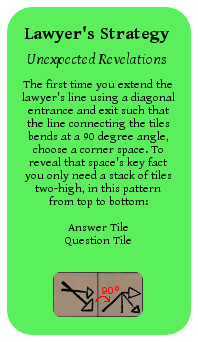
Lawyer - Unexpected Revelations One of my expectations for this power was that it would make the game substantially easier. Lines of Questioning was fun, but incredibly difficult. Providing an easier victory condition in return for engaging with a lesson seemed like a reasonable fix.

To my surprise, however, this power fell flat on its face. One of the things I track in playtests is how close a losing player came to winning. Based on that data, I estimated that the power would turn approximately 20% of near-losses into victories. In practice it had virtually no effect on the win rate.

Even now I’m not sure why the power didn’t work. Variance is a possibility, either in the pre-power data (lucky players got close to victory more often than the game’s difficulty made sustainable) or in the power testing (unlucky players had tougher games than normal, canceling out the effect of the power). Whatever the cause, the result was clear: for all its theoretical advantages the power wasn’t working.

That left me with only one idea for how to handle the excessive difficulty issue. It wasn’t neat. It wasn’t interesting. It did, however, have the merit of being simple.

Facts:  Testing has demonstrated that some tiles are better than others. In particular, tiles with multiple entrances and exits are very strong. Such tiles offer the player lots of options, can be used in unusual ways to get out of trouble, and enable efficient movement around the board.

90-degree turn tiles, on the other hand, are quite weak. This is both because of their limited usefulness and because there are a lot of them. Hands entirely made up of 90-degree turns are common, and are quite challenging to play through successfully.

There is almost no situation where this hand is good.

For that and other reasons, Lines of Questioning is very difficult. While opinions may differ on how challenging a solo game should be, a win rate near 0% is clearly unacceptable by any standard.

Issue: How should Lines of Questioning be made easier?

Rules:

1. Try the simple thing that will probably work.

2. Having more of the stronger tiles, and fewer of the weaker tiles, makes the game easier.

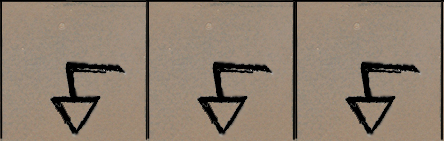
Holding: Replace these lawyer tiles:

1-19-15 - Replaced TilesWith these tiles:

1-19-15 - ReplacementsDo the same for the witness tiles as well.

Thinking it through: I’ve been trying to do all sorts of complicated things to make Lines of Questioning easier—but what about the simple solution? If 90 degree turn tiles are bad, especially when there’s a lot of them, why not have fewer of them and more of the good ones?

As it’s turning out, this change works like a charm. The win rate is substantially higher, and frustrating all-90 degree-turn hands are rare. Having more diagonal entrances and exits also allows for some interesting strategic maneuvering, like doubling the lines back on themselves.

In fact, this is going so well that it’s providing a great foundation for the “basic” variant I’ve been wanting to lock in. Up to this point I’ve been looking at new rules to make the basic game easier, which of course runs contrary to the goal of a simple, quick-to-learn version. Lowering the difficulty without needing more rules makes that variant realistic.

Sometimes a game needs an additional, complex rule. Sometimes, though, what it needs is a willingness to try the obvious solution to a problem. Exchanging bad tiles for good ones isn’t a remarkable design achievement, but if it makes Lines of Questioning better, then so be it. I’ll trust the extra impressiveness from the game being good to take up the slack.

Prototypes: 3D Games Are Fun Before They’re Done (and Board Games Aren’t)

File this one under unintended effects of one’s choice of prototyping material: I’ve noticed a big difference in the experience of coding board games and 3D games. Putting a 3D game together in Unity is fun, even when the game is in its very earliest stages; there’s a player to control, things bounce off of each other, etc. Board games, by contrast, don’t do very much until they’re substantially complete. As a result I find myself drawn to work on 3D games.

Even in game design, it seems, moral hazards are everywhere!

Theory: The Power of a Fun Tutorial (R.I.P. John Hill)

Earlier this week John Hill, designer of the classic Avalon Hill wargame Squad Leader, passed away. Squad Leader should be of interest to every game designer, because it includes what might be the single greatest learn-to-play scenario ever devised: The Guards Counterattack. The Guards Counterattack did not stop at teaching the rules; it was a fascinating exercise that advertised the depth of its game and the fun to come.

Squad Leader is certainly a game that needs a tutorial scenario. Like many wargames of its day, Squad Leader’s rules were so numerous and complex that only someone with a photographic memory could master them just by reading. “Programmed instruction”–the then-current term for “peppering the rules with scenarios that reinforced what the player just read”–was vital.

Most of us hear about programmed instruction, think of video game tutorial levels, and sigh. Do this, then do this, then do this. Instructive, but joyless. The incentive to play the game is the promise of fun to be had after completing the tutorial’s lessons.

The Guards Counterattack turned all of that on its head by being a learn-to-play scenario that’s also a challenging tactical puzzle. The Guards in question are Russian infantry trying to retake buildings from the Germans during World War II. Each side has an advantage over the other: the Russians enjoy the weight of numbers, but the Germans begin with strong defensive positions. Leveraging those numbers and finding ways to hold back the tide are still compelling problems almost 40 years after Squad Leader was first published.

Simply by being fun (though, to be fair, it cannot have been simple to achieve such fine balance), The Guards Counterattack completely changed the role of the tutorial. It became an advertisement: if the game is this awesome with only the most fundamental rules, imagine what’s in store in the pages to come! Rather than being daunting, the many pages of reading to follow suddenly began to look full of promise.

I’ve spent a great deal of time over the past weeks working on a basic version of Lines of Questioning, one without special rules for off-topic witness answers and the like. That’s because I’ve never forgotten playing The Guards Counterattack, and how motivated I was to work through Squad Leader’s rulebook afterward. A great tutorial scenario, one that goes beyond teaching the rules to showcase the game’s depth and fun, is an irreplaceable source of player engagement.

Here’s to John Hill, and to his contributions to wargaming and to game design as a whole.

Lines of Questioning: Implementing Player Powers

Part of elegant game design is killing as many birds as one can with as few stones as possible. To that end, I’d like some of the player powers in Lines of Questioning to serve both as a way to make the game easier and as a kind of “tutorial mode” for new players. Let’s hammer out how that might be accomplished.

Facts: Bending the line where tiles connect is a powerful strategy in Lines of Questioning, and is important to success. It’s also fun; bending the line in this way opens up many new possibilities, and players consistently enjoy using the technique to get to unexpected places. Put simply, it feels smart!

However, new players often take several games to realize that the line can bend in that way. As a result, during those first few games they routinely miss possible moves. This is a problem for two reasons.

First, it makes the game less interesting. New players who don’t see the moves bending the line allows think the game has fewer options than it does. They also miss some mandatory moves that they would need to weigh and either play into or around.

Second, missing a line-bending move sometimes leads new players to think a line cannot continue when in fact it can. These errors have an unpredictable effect on the game’s difficulty, depending on whether the line that’s incorrectly ended is a useful one or one the new player wants to get out of. Unintended variations in difficulty are a likely source of unsatisfying experiences, so these errors aren’t just bad in some abstract sense; they can do real damage.

Separate and apart from those considerations, Lines of Question’s “basic variant” is extremely difficult. The player badly needs a power boost.

Issue: What player power would simultaneously give the player substantially more power while also helping new players master bending the line at sharp angles?

Rules:

From the last post:

1. Use a weighted power when (a) the power should help players, especially new players, decide how to approach the game; and/or (b) the power is meant to add satisfaction to the game experience.

2. Use a unique power when (a) the goal is to create a new set of decisions; and (b) the power will not frustrate players by being difficult to use correctly.

Holding: Try this power: Lawyer - Unexpected RevelationsReasoning: Since an important goal of this power is to teach new players about the game’s strategy, a weighted power is more appropriate than a unique one. Weighted powers encourage players to do something, and we want this power to encourage players to try out crazy bends in the line.


A weighted power “make[s] the player better at a game action everyone can take. The player might pay a lower cost for the action, or get a bigger payoff, or be able to take it when other players cannot.” Lines of Questioning is a relatively simple game, so there isn’t as much design space for weighted powers as there might otherwise be. For example, there are no costs to playing tiles other than the opportunity cost of choosing this one over that one, and that cost isn’t amenable to being lowered.


There is, however, room to improve the payoff when a player bends the line at a connection point. Giving an additional payoff is also a very direct way of giving a power boost, so this seems like a valid avenue to explore.


Lots of new payoffs are conceivable, but this power is specifically aimed toward new players. That means the payoff should (a) be obviously impactful, as new players might not appreciate subtle game effects, and (b) not be difficult to use.


My feeling is that the reward here achieves those things. It’s a blatant, desirable payoff that’s virtually impossible to use incorrectly. Although it needs more testing, I also think it’s appropriately strong, a sufficient power boost to make the game winnable without being so much as to make the game easy.


In fairness, this does edge into the realm of unique powers. However, my first impression is that it will comply with the rule that unique powers not be frustrating. The only wrong way for a new player to use this power would be to pick a space that already has a winning stack in it. Any other choice is at least fine, and might be great. Since bad choices will be both hard to find and clear when they exist, they shouldn’t be made very often.

We are somewhat violating the rule that unique powers should be used only when the goal is to create a new decision; that wasn’t one of the objectives here. Unfortunately, the limited design space for weighted powers makes it difficult to give a reward without doing something new. I feel that the benefits probably outweigh this downside.


Last but not least: one of the rules for Lines of Questioning, instituted back when it wasn’t even called Lines of Questioning, is that the gameplay needs to be thematic. Casting the player power as a strategy pursued in the courtroom makes the power less of an artificial construct, keeping the theme of the game intact.


Testing will likely reveal that this power needs to be tweaked, or perhaps even changed wholesale. As an early attempt, however, I’m happy with it. On Wednesday I’ll let you know how it’s shaking out in play.