I’ve been playtesting “the wall” in Over the Next Dune. Since I haven’t finished all of the games I don’t want to report data just yet, but thus far the wall has sometimes put up great results, sometimes been iffy, and on one occasion imploded hilariously. I’m hoping to have the testing done by the end of this week or the beginning of next, and will let you know the results.
Concept, the Concept behind it, and the Concept of Game Design
Over the weekend I had the opportunity to try Concept. I’ll be frank: it didn’t grab me at first. However, as time has gone on I’ve started to appreciate it more and more. It’s really forced me to think in detail about the boundaries of what counts as a game.
Concept is a lot different from most other games; it’s sort of like Pictionary with pre-set images. There is a board with pictures, and on your turn you mark various pictures to try to get the other players to guess a word or phrase from a card. For example, at one point a teammate and I had “Mount Rushmore;” we marked a picture with a rock, a picture with an arrow that we hoped would denote “tall,” and put four markers next to a picture of people in historical garb. (We also put down lots of other markers, which proved to be incredibly confusing to the group and generally a bad idea. 😉 ) Those who had played before felt that the scoring system in the game didn’t add much to the experience, so we played without keeping track of who was winning; the only goal was to communicate as effectively as possible.
Immediately after playing I found the game was interesting, but kind of odd. Another player commented that it was more of an activity than a game, and I felt like that was about right. There was a task, and when you completed it you moved on. A fascinating exercise–expressing “heritage” with pictures was not easy–but not a game.
Yet, when I compare Concept to the rules for what-is-a-game, I find it meets all of them. Played for fun? Check. Rules? Nothing complicated, but they’re there. We played without scoring, but measuring victory isn’t a requirement for a game; think about SimCity, or some variations of Minecraft, or 99% of all role-playing games.
Moreover, of all the games I played over the weekend Concept is the one I keep thinking about. It was undeniably interesting, with tough decisions and a lot of thought involved. (Oh man, “heritage.” Don’t get me started.) Concept was also by far the newest experience. One of my tests for “should I buy this game” is “do I already own something that provides similar gameplay;” I don’t have anything on my shelf that’s like Concept.
So why was I cold on it at first? I think it was because I went in expecting . . . well, something that felt like other games. What I got was a really offbeat experience. It wasn’t until I had time to sit and think about Concept that I realized that (a) there’s a game there and (b) for all that it threw me off-balance, I greatly enjoyed it.
At this point, I think the best word for Concept is “refreshing.” Being so different from other games while still being a game and pushing the emotional and intellectual buttons games do is an accomplishment. It renews my faith in game design as a field; it doesn’t have to narrow down to a few valid designs, but can instead open up to many different experiences that all work.
When I taught school, seeing really great teachers made me want to teach like them. As an attorney, watching great lawyers work inspires me to litigate the way they do. In game design, Concept makes me want to try to build something that extends the boundaries of games the way it does. If you’re interested in the field, I would urge you to check it out; I think you’ll find it as interesting as I do.
Something Completely Different: Throwing Dice at Dad’s Plastic Army Men
Not every game needs to be complicated. I recently saw a discussion of simple, off-the-cuff rules for miniatures, and it reminded me of a game I used to play with my father. Here’s how it worked:
1. Grab some plastic army men. Players should probably have the same number–about eight is good.
2. Go outside. Both players can build a little fortress out of whatever stuff is around, or one player can build a fortress and the other player can be the attacker (in which case the attacker gets to make some shallow ditches to serve as trenches, set up low walls, and otherwise prepare the terrain).
3. Put your army men in sensible places, pretty close to each other–there shouldn’t be more than a couple yards of “no man’s land” between the players’ armies. Feel free to have your army men take cover in your fortress or in the terrain, but you’re not allowed to completely hide army men from your opponent and you’re not allowed to wedge your army men in or otherwise make it unnaturally hard for them to fall over.
4. Take turns throwing a die–just a regular six-sided die from a board game–at the opponent’s army men. You have to throw from close to one of your soldiers, so positioning matters. If you knock down or flip over an opponent’s army man, that guy is out. If you just jostle an army man but it stays upright, the army man can keep fighting.
5. Players have to move way out of the way during the opponent’s turn, so that no one gets hit by the die. This is a very safe game so long as everyone is reasonable about it; be reasonable by moving aside so that the die can’t hit you if it bounces (or if the opponent just misses).
6. During your turn you can move one of your army men the length of a short stick–maybe six inches. You can use a stick from outside, or if you cut the army men off sprues you can use a sprue. It doesn’t matter so long as both players have the same length stick. (Be careful with the sticks, of course.)
That was it. In fact, that’s enormously more rules than my father and I actually had; we just kind of figured things out as we went. It seemed logical that army men should be able to move, so we grabbed some plastic sprues from the army man set and used them to measure how far they could go. The game wasn’t fun when army men were braced and impossible to knock down, so we said that that wasn’t legal. We never wrote the rules of this game down; the listing above is the first time they’ve been recorded in any kind of formal way (at least by me–I’m sure other people have played similar games).
And you know what else? That game was super fun! It was very thematic (which wasn’t the word I used when I was eleven, but you get the idea). Good tactics were important, but there were also elements of physical skill and luck that allowed for comebacks after a tactical mistake. (Plus, throwing things has an entertainment value all its own.) Building the fortresses was great; we played on a rocky beach that had lots of building materials.
I’d like to say I have a big point about game design to make with this post. Maybe there is something here about how understanding game design in a rule-driven way doesn’t have to lead to ossification of the art, or how the fun of building something in the context of a game can extend to building the game itself. If I’m being honest, though, my real motivation was to say this:
Play outside with your kids. They’ll treasure those memories. I know I do.
The Case Study: A New Dominant Strategy?
If it’s not one thing, it’s another. 😉
Adding rescues to Over the Next Dune also added sacrifice plays to the game’s strategic repertoire. One simply protects a group of player tokens by putting one of them in front of a searcher. The searcher catches that player and stops, leaving the rest of the group unscathed. Everyone else then makes the rescue next turn.
None of that is especially objectionable, though it is “gamey.” So long as it’s better to avoid being caught entirely, it’s OK to include letting someone get caught as an emergency backup plan. Prior to adding tracking to OtND, I felt that that condition was met; once every so often the sacrifice play was useful, but in general it was better not to get caught.
The tracking mechanic may have changed the power balance between those two strategies. It enables one player to use his or her track to create a “wall” that protects the other players. Searchers encountering the wall will chase after its maker, never going after the other players. As a result, those players are free to make low-risk rescues. If this approach works to its best effect, it would allow a single player token to serve as the sacrifice over and over again. That would make things pretty boring; one player’s job would be limited to moving forward while getting captured, and the other four would be in no significant danger of ever being caught.
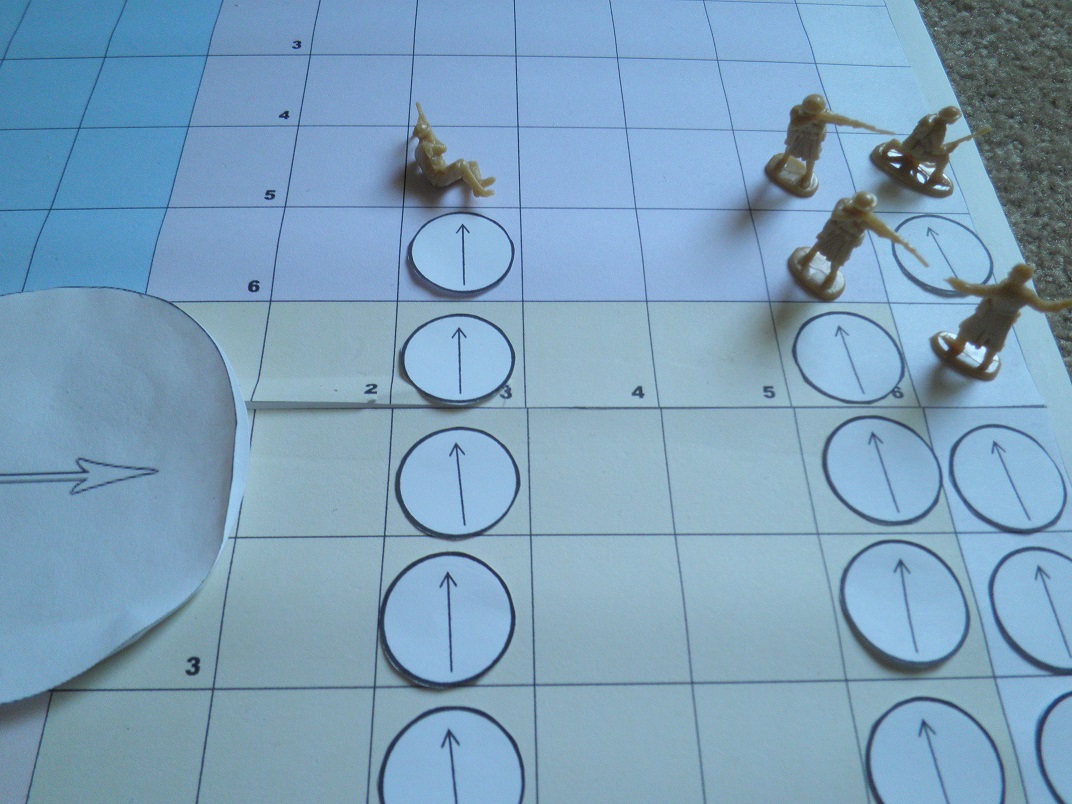
I haven’t yet determined whether this strategy is too good. Eliminating direction markers as searchers move over them will help by disassembling the wall; the next searcher to come along won’t be fooled. However, it might be that the wall provides enough safety to keep the end run going strong. I’m testing it, and will report back with the results.
The Case Study: Bugfixes for the End Run Solution
I’ve been testing having players leave tracks as a solution for the dominance of the end run. So far it’s working well. The end run seems to be quite a bit more difficult, and the consequences of the tracks are impossible to ignore.
As is always the way in testing, I’ve found some circumstances where the rules as written lead to weird outcomes. Two minor revisions fix the problems; I’ve bolded them below.
Whenever a player token leaves any space in columns 1-5 or 16-20, the player must place a direction marker in the space from which the token departed, facing the direction in which the token went. Whenever a searcher covers one or more spaces which are marked in this way, it immediately turns to face the direction marked. (If the searcher has more than one direction to choose from, it chooses the direction in the space closest to the “top” of the board. If multiple spaces with a direction marked in them are equally close to the “top” of the board, the searcher chooses the direction in the space closest to the center of the board among those options.) If the searcher has not yet finished moving, it continues moving in the new direction. Whenever a searcher covers one or more direction markers, it removes those markers after making any necessary change in facing.
(This solves a problem whereby searchers could get stuck at the edge of the board; they would try to move away, encounter a direction marker pointing back toward the edge, turn around to face the edge again, and just bounce back and forth. Oops!)
If a player leaves a space which already has a direction marker, remove the old marker and replace it with a new one showing the direction in which the player’s token left the space.
A searcher with a captured player token ignores direction markers.
(Once a player is captured, the rest of the team is supposed to be on a clock. If the searcher with the captured player goes off to try to make more captures, it could remove the intended time pressure.)
The Case Study: More Testing
It’s not enough to theorize that a fix will work; one has to experiment to find out. I’m running that experiment now; another ten games with the now-familiar setups, seeing if allowing the searchers to track the players resolves the end run. I’ll report the results soon.
The Case Study: Revised Print & Play and Example
Following up on the idea of tracking the players’ movement, I’ve added a page to the print-and-play file with markers for the trail. There are a lot of markers there, probably more than are needed. Don’t feel obliged to cut them all out!
I also thought the tracking rules might be hard to understand just from the text. Thus, I took some photos of how they’re meant to play out in practice.


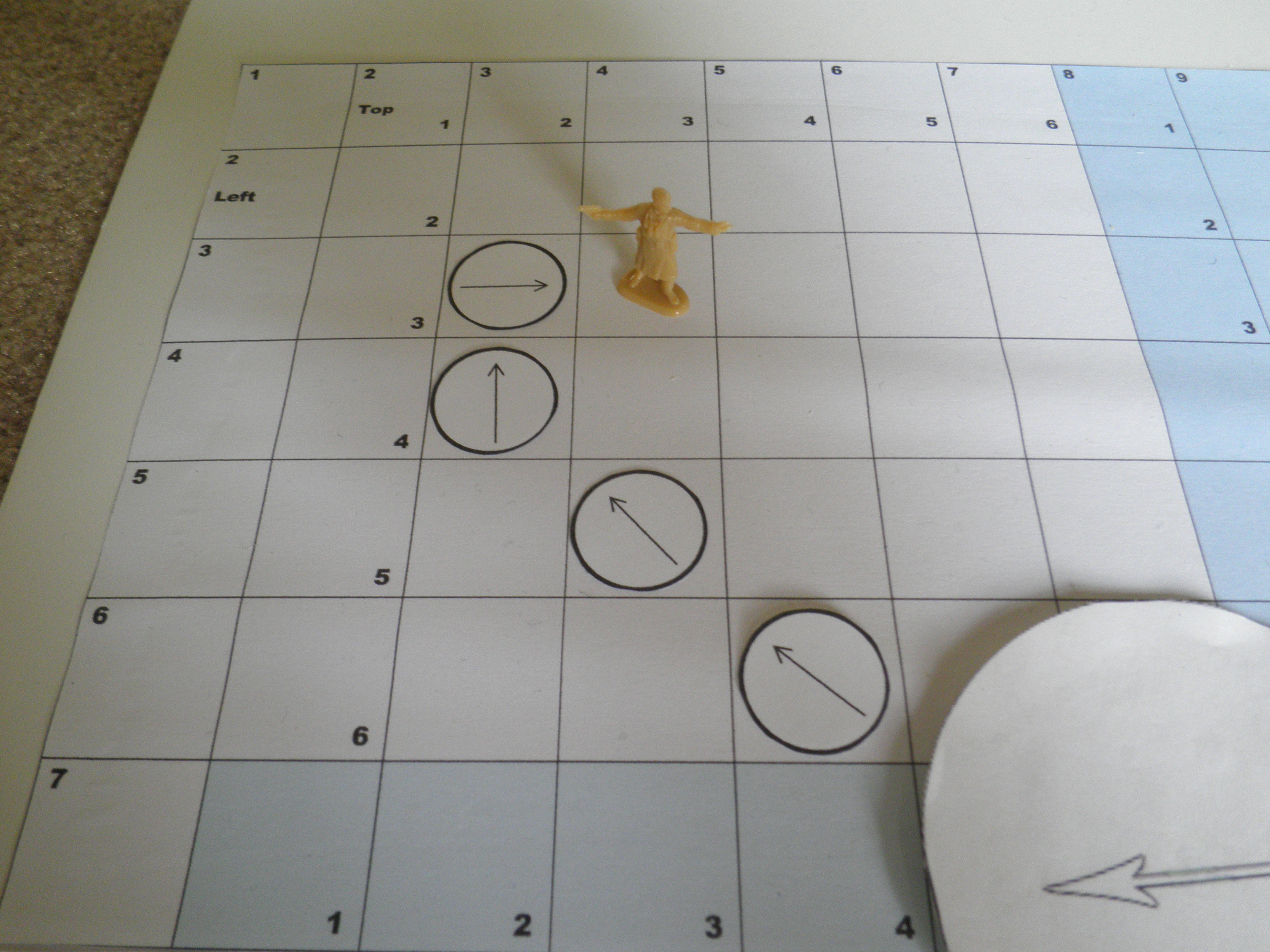


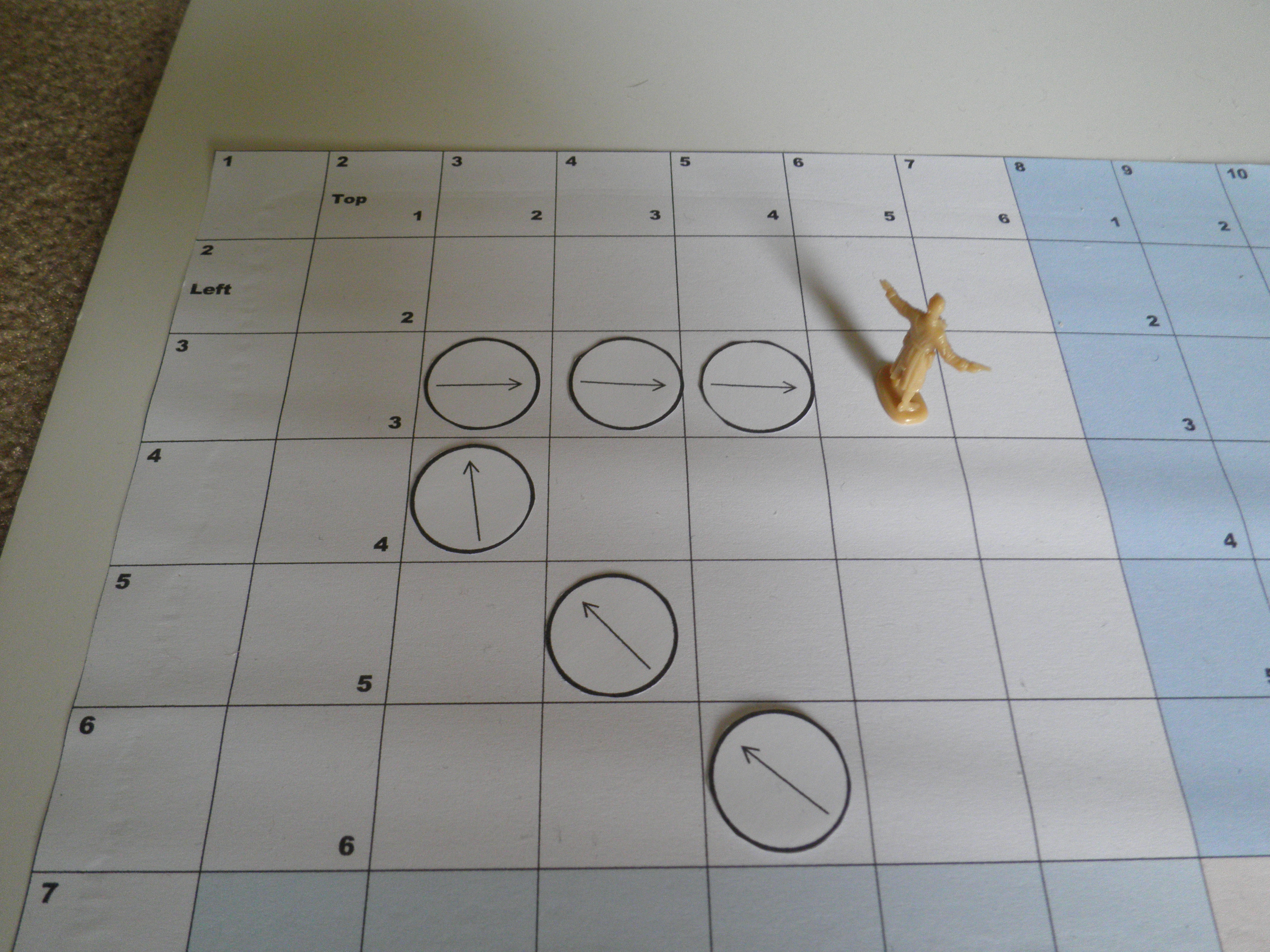

Sorry about the iffy pictures, but I hope they’re helpful!
The Case Study: A New Solution to the End Run
(Sorry about the late-in-the-day update; my day job has been very busy.)
Last time I went through the results of the latest playtesting project, which showed (at least preliminarily) that the end-run strategy in Over the Next Dune is still both too strong and not very much fun to play. Although that’s regrettable, it’s not really surprising–the end run has been powerful and boring throughout the game’s history to date. Time to have another go at fixing it once and for all.
Facts: As discussed in this post.
Issue: How can the end run be made both less effective and more interesting, without increasing the power of strategies that involve moving up the middle of the board?
I’m pretty sure that this is a complete statement of the issue. Playtesting has revealed that going up the middle of the board is a strong approach that wins most of the time. If that strategy gets easier the game could become trivial. Whatever is done to fix the end run, it cannot have that sort of collateral damage.
As regards the end run itself, there are really two things that need doing. It has to be made weaker as a way to win the game, and it has to be made more engaging. Right now the game is in the deeply regrettable position of having a dominant strategy which is boring to play. Fixing just the strategy’s dominance still leaves it boring, an ineffective and joyless trap for those who haven’t tried it before. Addressing the boring-ness without reducing the strategy’s power makes a game that’s fun but lacks replay value, worth playing only for so long as it takes to master the best approach. Both problems have to be dealt with.
Rules: The rules for OtND’s design; the most important of them for this purpose is that the decisions players make must be interesting.
Thinking it through: Over time I’ve found that the fundamental challenge the end run poses is that it exposes a weakness of dividing the board into a grid. The grid allows players using the end run to move just as quickly as players going up the middle. This diagram shows what I mean (warning: terrible art ahead):
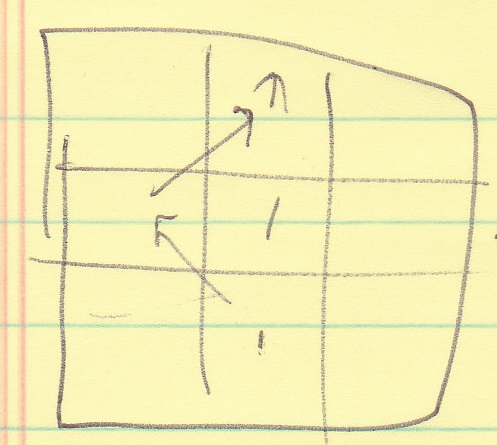
Since the board is a grid, and diagonal movement has the same “cost” as orthogonal movement, players can shift to the side without losing forward progress. As searchers tend to be found more often in the center of the board than at its edges, going sideways makes players safer. Thus, it’s natural to go sideways: in terms of winning and losing, it’s all upside. Players who move to the sides get safety and lose nothing.
One possible solution would be to divide the board differently. Using hexagons rather than blocks, for example, would make sideways movement slower:
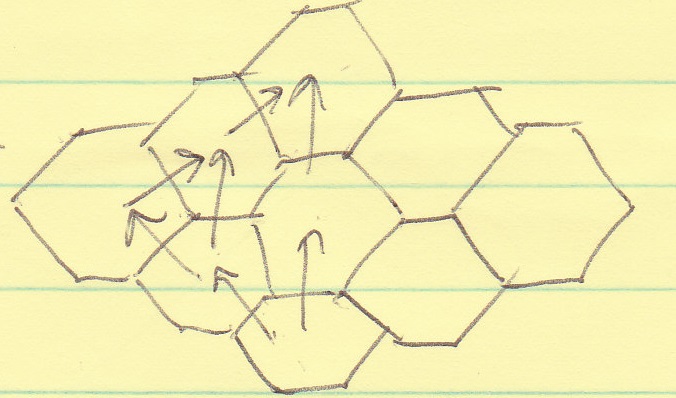
Changing the board to make the end run take a much longer amount of time could end its dominance as a strategy. Searchers will not trouble the player often, but even minor disruptions could cost the player too much time. It would become a risky play.
I fiddled with that solution for a little while, but ultimately discarded it. Part of the trouble was that it made the rules for searcher “bouncing” a lot less intuitive. Right now just about everyone is comfortable with how searchers move once they see it in action; having lots of right angles makes it easy. Hexagons, by contrast, turned out to need weird rules right from the get-go just to stop the searchers from continuously moving back and forth.
The bigger issue, however, was that changing the length of the board edges did nothing to make the end run more interesting. Players at the edge would still rarely have to deal with a searcher; indeed, they would probably have to do so even less often than before! It would just take longer to do something boring, which might be fair but surely isn’t fun.
Given that the problem seemed to be with the shape of the board, I considered trying to attack the problem from another angle: instead of increasing the length of the edges, reduce the length if one moves through the middle. The idea was to combine some of the middle spaces into “giant” spaces. If this worked, it would indirectly make the edges longer:

Unfortunately, this concept also didn’t get off the ground. It threatened to strengthen moving up the middle, which is good enough (and possibly far too good) as-is. Furthermore, it didn’t make the edges that much more interesting. If the searchers also treat the giant spaces as a single space (which had its own rules strangeness) they’ll get to the edges a bit more often. That doesn’t add much. To get them to the edges frequently the giant spaces will have to appear in several places and/or be very large, which would make balancing the middle strategy a nightmare. Quite possibly, it would prove impossible to make both the end run and going up the middle interesting strategies.
At this point I knew I didn’t want to mess with the board. It was hard, and it broke things. 😉 However, figuring out those possibilities brought home the centrality of the searchers to me. The searchers are the challenge in the game; they’re why players have to make difficult decisions; they are, in a very real sense, what makes the whole exercise count as a game. To make the end run harder, I needed to make it harder for players at the edges to deal with searchers. To make it more interesting, I needed to up the ante on those confrontations.
My first thought was just to have lots more searchers. That would make it more likely that players at the edges would confront multiple searchers, a situation in which end-runners often fare poorly. However, it would also increase the game’s “overhead” dramatically, slowing play. Adding time between interesting decisions is regrettable at best.
Another possibility was to have searchers appear on the sides of the board–to make the edge not really the edge, with a conceptual space beyond it from which searchers might appear. However, that basically amounted to “if you are at the edges you may randomly get caught.” That’s not interesting; it’s just unpredictable punishment. There’s no counterplay.
The idea of more realistic searchers, though, put me on to something that I really liked. What if the searchers could follow the players’ trail when they’re at the edges?
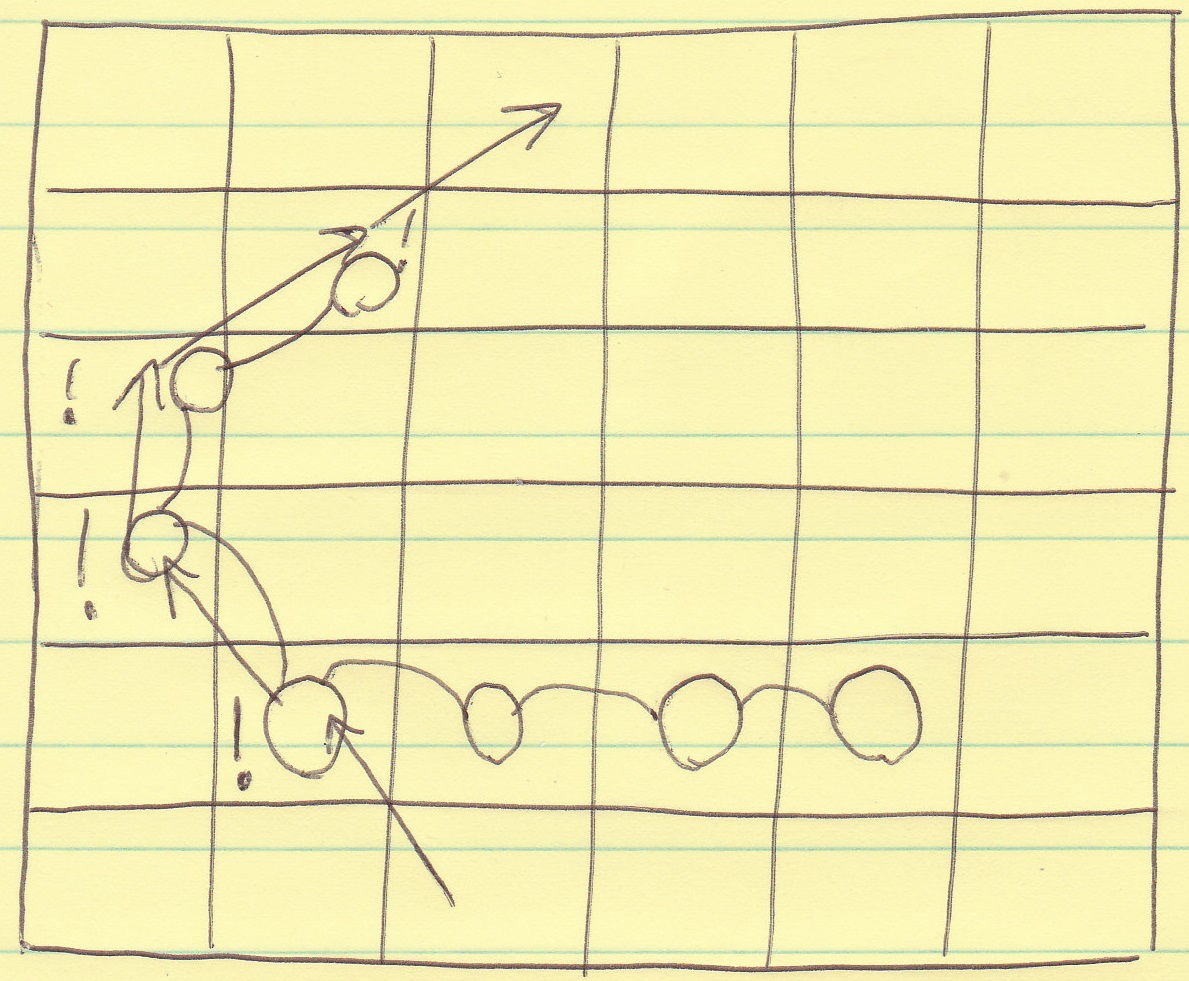
It would work like this: when the players move to the sides of the board, they enter special terrain in which they have to mark their paths. Searchers follow those paths, chasing after the players. (Conceptually, perhaps the edges have wet sand that retains tracks, or something else the searchers can use to follow the players’ movements.) They continue to follow until the players move out to a “trackless” space in the center of the board, at which point they resume moving normally.
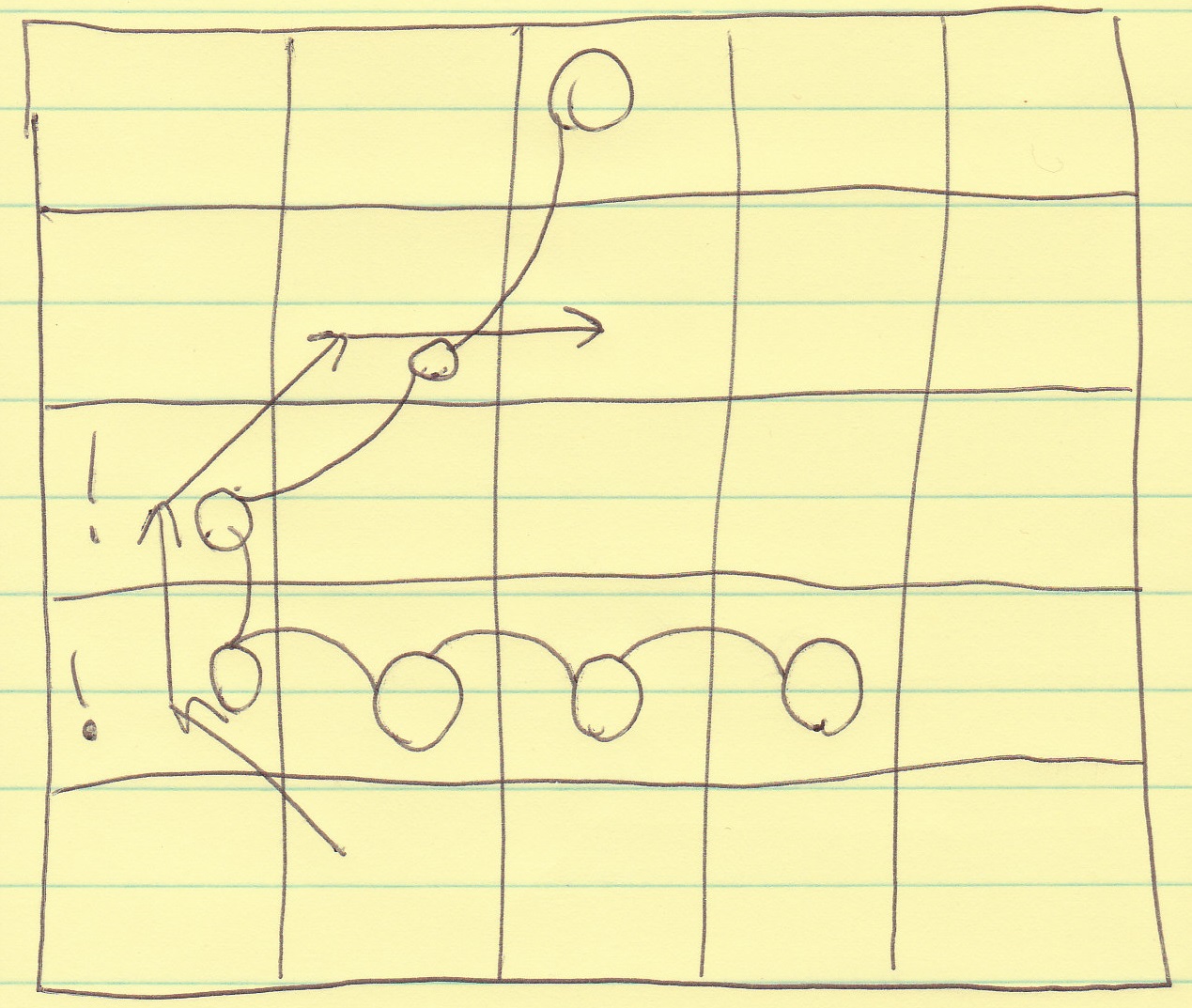
I’m pretty sure that this solves both problems. It makes the end run weaker, because players who just go up the side of the board can now find themselves in a race with searchers who move faster than they do. It makes the end run more interesting, because players have to choose their paths carefully, knowing that they’re leaving trails that can be used against them later. Finally, it doesn’t make the up-the-middle strategy better.
As a first draft of the rules:
Whenever a player token leaves any space in columns 1-5 or 16-20, the player must mark the direction in which the token goes. Whenever a searcher covers one or more spaces which are marked in this way, it immediately turns to face the direction marked. (If the searcher has more than one direction to choose from, it chooses the direction in the space closest to the “top” of the board. If multiple spaces with a direction marked in them are equally close to the “top” of the board, the searcher chooses the direction in the space closest to the center of the board among those options.) If the searcher has not yet finished moving, it continues moving in the new direction.
If a player leaves a space which already has a direction marker, remove the old marker and replace it with a new one showing the direction in which the player’s token left the space.
If you get a chance to try this out, let me know–I’m very interested to hear about how it works out for you.
The Case Study: Playtesting Results
A while ago I set out to test whether end-runs in Over the Next Dune are better than just running up the middle. It proved necessary to be more specific about my definitions and to make sure I was testing both strategies in the same environments. Having done that and played the games, here are the results:
Game Middle End-Run
1 W/8/1 W/7/0
2 W/7/2 W/7/0
3 L/3/2 L/5/5 On replay, middle strategy: L/6/6
4 W/8/3 L/3/2 On replay, end-run: W/6/0
5 L/6/3 W/7/0
6 W/6/1 L/7/3 (But winnable for the end-run with different play?)
7 W/6/0 W/5/0
8 W/9/3 W/9/0
9 W/9/4 W/5/0
10 W/8/3 L/4/1
You can find my original notes here: OtND Mar.-Apr. 2014 Playtesting Project.
Before getting into the nitty-gritty, I think it’s worth being frank about the weaknesses of this experiment. The sample size is not large. Dave Sirlin makes a compelling case, however, for the argument that a relatively small number of plays can be sufficient for testing purposes if the players involved know what they’re doing. I believe that I have as much experience with Over the Next Dune as anyone does, so I’m going to conclude that the sample size is enough to be useful.
In addition, this wasn’t a proper double-blind experiment. I had at least some knowledge of how the searchers would move going into the end-run games, since I was setting up the searcher movement decks. While I tried not to take advantage of that information, I’m sure I was subconsciously influenced at times. There’s no easy way to sort out when that was, so it may just be that this problem has to be accepted.
Keeping those weaknesses in mind–and proceeding from the assumption that they don’t completely undermine the results–what does the data say?
1. The end-run was often better. In six of the ten games, the end-run strategy won faster, with fewer players captured, or both. That number goes up to seven if one adds game four, where I played the end-run poorly the first time out (and knew it). There were only two games where the end-run lost and the middle strategy won. Furthermore, the end-run won game five handily after the middle strategy lost.
2. The middle strategy is workable. Although it had to work harder, the middle strategy won 80% of its games. (Whether that’s too high is a separate question, albeit one that does need to be addressed.) The challenge being presented is not that going up the middle is doomed and terrible; it’s that players can pretty consistently get a better result by shifting sideways.
3. The end-run still isn’t as interesting. Admittedly, this is a more subjective conclusion. However, I feel that it’s an accurate one. I had hoped that starting the players in the center of the board would add a lot of decision-making to the end run. It did add some, but in practice it’s not as much as I would’ve liked. Going up the middle is hard and involves a lot of tricking searchers; the end run is mostly just not standing in the wrong place.
4. The end-run doesn’t like confronting multiple searchers. I noticed this one in the games the end-run strategy lost. Put simply, players at the edge of the board have little space to work with. When several searchers close in at once, it’s hard for them to trick those searchers into safe positions. By contrast, players in the middle of the board can often find a way to stay alive, even if it means putting a player in harm’s way to buy time for the group.
5. The end-run doesn’t like splitting up. This is intuitively obvious, but it’s good to have test results for confirmation. When the players split up to use both edges of the board they’re much more vulnerable. Rescues become difficult or even impossible to arrange.
The end-run has been too strong for a while. On Monday I’ll walk through a full analysis of the next attempt at a fix. Of course, that means I have to figure out what the next attempt will be–but every attorney knows that filing deadlines are great motivators. 😉
Something Completely Different: Making Competing Players Powerful – Rules
There aren’t a lot of competitive games that are designed so that all of the players feel good at the same time. Usually it’s exactly the opposite: at any given moment someone is losing, knows it, and feels lousy. Miniatures games are no exception; since everything is (usually) right there on the table, it’s easy to see when you have taken greater losses than your opponent or are further away from an objective.
Since minis games weren’t helping me find rules germane to the issue, I ranged around a bit. Here’s what I came up with:
1. Players should “fail forward.”
This one comes from role-playing games. In essence, it says that failure should not mean that the player’s turn just ends in defeat. Instead, something interesting should happen.
Knowing a little role-playing game history might help clarify how this rule works in practice. (It’s also interesting in its own right.) Dungeons & Dragons, arguably the first major role-playing game as we’ve come to think of the term, was designed by wargamers. Those designers modeled D&D’s combat on the wargames they were familiar with: dice were used to model the uncertainties of combat, with a good result meaning you succeeded in hitting the target and a poor result meaning failure. This system is used even by game designers with military experience, so I assume that it’s at least a reasonable way to model people fighting.
Over time, however, problems revealed themselves. When playing a wargame, one normally controls many pieces. A single piece’s bad roll is just one part of a larger turn, so even when the dice go against you it’s still possible to have a satisfying turn overall. By contrast, in role-playing games the player usually controls a single character who makes a single roll in a turn. If that roll comes up snake eyes, that’s it–the turn ends on a down note.
Failing forward is one solution to that issue. (It also relates to other role-playing game design issues, to say nothing of the term’s use in self-help books and other arenas; I’m focusing on this particular application of the idea.) In essence, it says that failure should make things more interesting instead of just being a stopping point. The player doesn’t get what he or she wanted, but does get something else: plot advancement.
So, for example, in D&D (or at least, some versions of D&D) a player might try to swing a sword at a monster in order to slay it. If the player fails to slay the monster, that’s it; the player’s turn is over. By contrast, in a fail-forward model the player might fail to slay the monster–and be carried back to the monster’s lair. That means a whole new set of opportunities and options: maybe the player will have another go at fighting the monster, or sneak away, or find out that the monster’s lair is full of the monster’s artwork and the monster is actually a sentient being. Instead of the player’s turn just crashing to a halt with failure, the player is left with new possibilities to consider while waiting for his or her next chance to act.
Failing forward doesn’t mean failure is impossible or that players are choosing between a menu of good options. It just takes some of the sting out. The player missed the mark this time, but something interesting still happened and so the player can focus on that instead of stewing over the failure.
2. The game should involve building something the player can take pride in.
Agricola is a controversial game, which is surprising for a farming simulation with tried-and-true mechanics. A lot of people find the theme dull, or don’t like the “Euro” design sensibility wherein much of the game boils down to constructing an economic engine. I can’t say those criticisms are unfair–I’m not, I have to admit, all that interested in agriculture myself–but Agricola is nevertheless one of my favorite games. That’s for one simple reason: each and every time I play, I get a sense of accomplishment from building my little farm even if I lose.
I see the same dynamic play out in the Civilization series of video games, Minecraft, even building toys like lego. It’s fun to make something. Creating is enjoyable even if you lose, or even if the game is such that winning and losing aren’t meaningful concepts. Seeing something neat that’s new in the world, and being able to say “I did that,” is for many people compelling regardless of the context in which it occurs.
Building doesn’t have to be linear or unopposed; Civilization, Minecraft, and many other games involve building in an environment of challenge with the possibility of setbacks. Overcoming those obstacles can be another part of the fun, and can even give character to one’s result. The key is the sense of accomplishment; players need to be able to take pride in the results of their efforts, even if those efforts don’t result in winning.
That last sentence deserves a little more emphasis. It’s critical that the players end up with something they can take pride in. Agricola’s building is fun because your farm is a nice, productive spot even if it doesn’t earn the most points. Games where the building is just another way to keep score–where one can end the game with a useless half-constructed building, or a spaceship that could never fly–don’t provide this kind of satisfaction.
So what does all this mean?
I’ll be honest: I’m not quite sure yet how rules from role-playing games and a farming simulation apply to a miniatures wargame. However, I feel like these rules are already pushing in interesting directions. This game is supposed to play out a story, and failing forward involves plot advancement; doesn’t that suggest a very different kind of minis game? One where success is measured, not in the number of opposing units destroyed, but in telling a story? Where does that story come from? How does the building factor in? What are the players building? A thing? Character competence? The story themselves? How is the building handled so that players can enjoy the result even when they lose?
At the risk of being unfair, I’m going to leave those questions hanging for a little while: on Friday I’ll have the results for the latest round of Over the Next Dune’s playtesting.
 The Law of Game Design