Theory: Knowing Who’s Best Isn’t as Important as Fun

It’s interesting to read about how sports were officiated years ago, and to compare that with how the same sports handle rules enforcement today. Over time there has been a strong drift toward trying to make sure every call is perfect, and to remove any possible asterisk from the final results. While that’s a worthwhile goal, I think it’s ultimately unrealistic, and pursuing it too far can lead to an inferior experience for players and fans. Better instead to accept that games will always be a slightly imperfect measurement of the players’ abilities, and to emphasize making each game fun rather than trying to turn it into an ideal measuring device for skill.

Historically, umpires, referees, and other people responsible for enforcing a sport’s rules were treated as a part of the game. It was understood that they would be wrong some percentage of the time, and that mistaken calls could affect the outcome just like an unexpected gust of wind or a player getting hurt. To paraphrase Justice Jackson, they were not final because they were right, they were right because they were final. If they made some errors in the course of being “right” with scare quotes, and final without them, well, mere mortals were the only ones available to run our games.

Technology has in many respects freed us from the tyranny of human fallibility in refereeing. We can view plays from different angles, slow them down, and revisit them many times over if necessary. Close calls can now be decided through multiple people’s painstaking examination rather than by a single, rushed observer. Opportunities for mistakes are fewer, and we can say with much more confidence that the players, rather than the rules-enforcers, drove the result of the game.

Yet, this accuracy has come at a cost. Games are slower, sometimes substantially so. As a result, watching professional sports has become, at least for me, a real test of patience; whenever the game starts to develop some momentum the refs head for the replay booth and the thrill is lost. Nor do I think I’m alone in feeling that way; I don’t know how often I’ve heard people bemoan things like TV timeouts, and instant replay has made games longer still.

Although I’ve never spoken to professional sports players about it, I have to think they can grow similarly frustrated as they are dragged out of the moment to wait for a review. Getting into the right mindset is critical in sports. That must be difficult when one is idly knocking about the field, waiting for the game to resume.

Doubtless some games have been won by the more deserving team because of technologically-assisted refereeing. However, I can’t help but feel that in trying to make sure that sports are more accurate, we’ve made them less fun. It’s not fun to wait for the umpires to get the results on a replay. (Whereas by contrast, it can be fun to grouse about blown calls. It’s a grand tradition!) Winning is fun, but winning on a technicality “after further review” when the other team is already dancing isn’t the same. Making sure that the record books are correct is causing us to sacrifice some of the experience on the ground.

In the end, we should accept that sometimes there will be judgment calls that might be made incorrectly. Eliminating those situations has a cost, and–in my view–it is a cost major league sports should not be paying. We watch and attend games for the fun, not for technical precision; let the mistakes be, as they long were, just part of the experience.

Theory: Baroque Game Design

The Babylon 5 CCG was a game about everything.

It’s hard even to begin to explain what players could do in the B5CCG. Each player took the role of an ambassador on a space station, with the goal of accumulating political influence. They could do that through diplomacy, or by intriguing against other players, or via missions of conquest, or with mind-readers who stole valuable secrets, or by generating unrest in opposing factions. Players lent their strength to a budding galactic government, or voluntarily became client-states of ancient powers in return for a portion of their might.

Some strategies revolved around following a single character through his or her story arc–or changing that arc, turning terrible villains into destined heroes or vice-versa. Other strategies were all about building up groups. I mean that literally; there was a card type called “Group,” which gives a sense of just how much was going on in this game.

Votes of the players were common, on every topic from who should gain influence to whether someone should be allowed to play a card from outside the game. Occasionally these votes were rigged through in-game effects. Usually getting a vote passed relied on table-talk.

Games were long, and could be very long. Part of that was just because there was a lot to do; a four-player game might well have five “conflicts” to participate in during a turn, along with playing cards and drawing and otherwise doing card game-y things. Some of the length resulted from the fact that real-life diplomacy wasn’t just encouraged, it was vital. Occasionally a game grew long because of mechanical factors: woe betide anyone who has somewhere else to be if the Shadow War between the ancient powers starts.

In some respects the Babylon 5 CCG is an example of a previous era in game design, when the baroque was more appreciated than the elegant and more detail was considered almost strictly better. This extends from the top-level things one does–even a two-player game involves tracking the influence of five different groups, and basically requires a playmat–to individual cards, a few of which have so much text that they’re difficult even to parse. I still remember a discussion around the table of exactly what “Triple-Cross” did.

Yet, the B5CCG’s intricacies gave it what I can only describe as a rich texture. It felt more like a simulator than like a game, and at its best it was deeply immersive. One plotted and schemed and made deals and broke them, masterminding a rise to power worthy of the television series the game was based on. The mechanics could fall away and be replaced by something more akin to an RPG experience.

One doesn’t really see games like the Babylon 5 CCG anymore. Perhaps that’s for the best; there’s no denying that it was a little frustrating not knowing whether one was sitting down to an hour-and-a-half game or a four-hour one. Still, I sometimes miss that feeling of playing a card game and an RPG at the same time, watching the player to my left manipulate the media while the player to my right tries to keep a fractious alliance of minor worlds together. There’s a lot to be said for simplicity and focus in design. However, the B5CCG taught me that it’s OK to be in the mood sometimes for the ornate.

Theory: Achievements As Communication Between Designer and Player

I’m a fan of achievements in games. That’s not because of the collection aspect; I’ve never been a completist. Rather, it’s because achievements are a powerful way for the designer to reveal things about the game to players. Done well, achievements help players find fun in the game that they might have missed out on, and thereby get lots of value out of their investment.

We should start by defining exactly what I mean by “achievements.” An achievement is a marker that the player did something noteworthy in the game. The archetypal achievement is publicly available for others to see and does not have in-game effects, but neither of those is a hard and fast rule. The discussion here applies equally to Playstation trophies that can be compared over the Playstation Network but don’t grant any rewards beyond pride, and to Final Fantasy X’s hidden Aeons which will probably only be seen by the person earning them and which confer substantial power.

Knowing what achievements are allows us to consider what they do. Think about them from the player’s perspective. What messages does the player get when she sees an achievement listed?

  1. I can do this.
  2. I will be rewarded for doing it, so I should do this.

Achievements, then, aren’t just a bookkeeping solution for keeping track of how far a player has gotten. They’re also a means of communication, an opportunity for the designer to get outside the strictures of the game to make suggestions about how to play.

Being able to talk to players in that way is very powerful. Normally designers don’t come in the box, and can’t tell people how to get maximum enjoyment out of a game. We have to rely on clues, signals, and the occasional rule to get players on the path toward the best experiences. Achievements are much more direct: they enable designers to say directly “I know where the fun is in this game, and if you do XYZ you’ll find it, too.”

Like all great power, though, there must come with achievements great responsibility. If they can point players toward the fun, achievements can also lead them in unproductive directions. How, then, can we create achievements that work for players?

Achievements Done Right

  1. Incentivize playing the game in an unusual way.

Games are often more open than they appear. Designers and playtesters might find oddball strategies that work, or there might be ways to play that don’t have much to do with the stated goals but are nevertheless interesting. Providing achievements for pursuing these against-the-grain approaches shows players the full range of the game’s options.

Perhaps my favorite examples of this are the speedrun achievements in the last-gen Prince of Persia. (Do we have a name for the PS3/360/Wii generation of games?) Prince of Persia is well-suited to speedrunning, but since the game relies more on careful observation than speed it’s not intuitive to play that way. Having achievements encouraging players to try it thus introduces them to the possibility, and perhaps even to the idea of speedrunning more generally. That’s not bad for a few badges.

  1. Reward exploring the game world.

Many games are big, much bigger than a player who just pushes from start to finish will realize. Achievements for exploring encourage players to seek out all that additional content they might otherwise miss, and to find all the fun that’s waiting for them.

Burnout Paradise is my go-to example for this sort of achievement. Normally Burnout Paradise calls on its players to race through city streets, but the game has lots of out-of-the-way areas players can explore for a change of pace: a dirt track suited to rally racing, a construction yard allowing for some truly death-defying stunts, seaside boardwalks with nice views. I can say from personal experience that finding each of those areas and seeing what they had to offer was a lot of fun, and I’m sure I would have missed some without achievements hinting that they were out there.

  1. Encourage players to achieve mastery.

Achievements can drive players to push the bounds of what’s possible and to strive for new heights of skill. Does the player know how to do a combo? Does the player know how to do a 100-hit combo? Creating an achievement for the latter pushes players to learn about the combo system and experiment with new ideas, and ultimately to experience the joy of attaining mastery.

Of course, there’s no reason why only fighting games can have these skill-driven achievements. Burnout Paradise has an achievement for getting a huge stunt multiplier by chaining many more stunts together than is necessary to win any given event. That achievement kept me wrapped up in Burnout Paradise for a very long time, and the sense of satisfaction when I finally got it is one of the highlights of my gaming life.

Achievements that take away from the fun

It’s worth noting that each category of good achievements has its dark side. Prince of Persia’s speedrunning achievements work because that game has precise controls and well-done movement; by contrast, an achievement for doing something possible-but-frustrating would be problematic at best. Similarly, achievements based on exploring will be irksome without something worth doing or seeing when the players get there.

Fortunately, both of those are rare. Much more common, in my experience, is the achievement that purports to reward mastery but actually encourages boring, repetitive play. If getting X headshots is a demonstration of skill worthy of an achievement, a further achievement for 5X headshots is probably just keeping the player from trying something new and exciting. Calibrate achievements to the point of mastery, and then stop providing them for that particular skill so that the player is incentivized to explore a different part of the game.

Achievements as a marketing tool

I’m not a marketing expert, but I think it stands to reason that players who have a lot of fun with a game, and find the game to be a good value, are likely to buy further products from the same creator(s). Good achievements are helpful in both of those areas. Players who have spent lots of time getting each and every one of many well-designed achievements, enjoying everything the game has to offer along the way, probably feel like they received good value from their gaming purchase. Hence, they’re apt to look at future works from the same person/studio/company/etc. more favorably.

It’s impossible for me to talk about this without going back to Burnout Paradise. (Yes, I like Burnout Paradise a lot.) Completing all of its in-game achievements took years; I played many other games along the way, but always came back to Paradise City to make a little more progress—and every time I did I had fun, because Burnout Paradise is a great game and its achievements do an excellent job of pointing out neat things to try. I now pay attention when Criterion releases a new racing game, because they’ve proven capable of creating something remarkable.

Achieving good achievements

Designers can use achievements as more than just a way to mark progress through a game. They are a valuable means of signaling to players what they should be doing, activities that might be fun to try, places they should take the time to visit, and areas where there’s room to explore the game’s systems and improve their skill. In doing those things achievements can help ensure that players enjoy the game and get as much value as possible out of it, which will encourage them to look for future games from the same designer. Achievements are thus an important tool, one that should be used thoughtfully.

Also, everyone should play Burnout Paradise.
Theory: Twixt and the Power of Paring Down

I was regrettably unable, this past weekend, to attend a favorite board gaming get-together. However, I still had the chance to play the classic Twixt. In addition to being just plain fun, Twixt is a great example of how minimal, focused rules can expand an interesting dynamic into a compelling game.

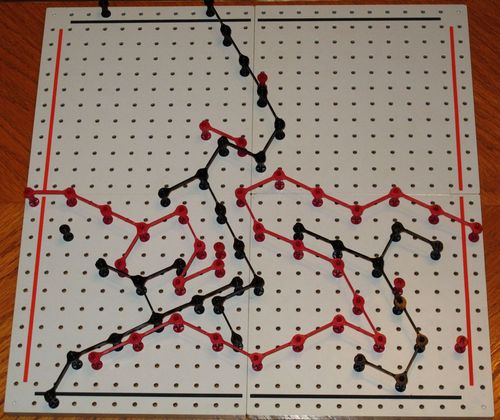
Twixt is an abstract in which two players draw lines across a square board, trying to get from one side to the opposite. Of course, each player’s line tends to block the other’s, and so the players have to jockey for position and set themselves up to extend their lines in multiple directions. The game ends up feeling very much like chess, with players thinking several moves ahead and trying to threaten many lines of advance.

Image from Boardgamegeek
Black and red blocking each other in a game of Twixt. Image from Boardgamegeek.

One of the central problems a Twixt player has to solve is that, because both players extend their lines at the same rate, it’s impossible to cut off an opponent whose line is in the lead. Chasing therefore doesn’t work; one must instead find a new spot to play in, in front of the opponent’s line, and build a fresh defensive position.

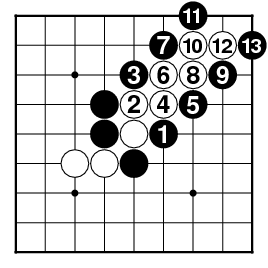
Fans of abstracts might recognize that situation from another game:

Image from GoGameGuru.
A ladder in Go. So long as Black keeps playing in the prescribed order, White cannot get out. Image from GoGameGuru.

A fundamental part of Go strategy is the “ladder.” The player climbing the ladder (White, in the image above) can never escape by continuing; the other player will counter-move until the ladder reaches the edge of the board and all the pieces in the ladder are captured. Instead, the player in the ladder has to play somewhere else, creating a new threat that might eventually make it possible to free the endangered pieces.

Go enjoys enormous depth, and the ladder is only a basic element of its strategy. Yet, Twixt takes the problem of the ladder and turns it into an entire game in its own right. There is no taking of the opponent’s pieces in Twixt, and unlike chess none of the pieces move in a special fashion. There is only the futility of the chase, of climbing the ladder once behind, and the complex decisions about how to jump forward one has to make as a result.

The primacy of getting out of chases by finding new positions in Twixt strategy is emphasized by how few rules there are. Add one peg to the board each turn; connect the new peg to any other pegs the connecting pieces included with the game can reach. Most questions about whether a move is legal can be answered without resort to the rulebook, since the connecting pieces physically prevent illegal links. The entire ruleset, complete with four-player variant, strategy advice, and a brief sample game, fits on a cardboard sleeve about the size of an A4 sheet of paper. Learning the game takes less than a minute, and from that point on there’s nothing to distract from recognizing that chasing won’t work and thinking about how to respond to that problem.

One might think that that would not be enough–but it is. Twixt is not a trivial game. Blocking an opponent who has gained the lead is difficult. Fooling an opponent with a blocking position into blocking incorrectly so that a line can continue is even more difficult. It has given rise to its own version of chess problems, and is played in tournaments.

Twixt, then, is an object lesson in the power of finding something interesting in a design and then turning the entire game toward that element. In the vast context of Go laddering is a relatively minor player; when put on the stage alone, however, it proves able to carry a show by itself. The result of focusing an entire design on the laddering dynamic is an elegant and fascinating game, one very much in the moments-to-learn-lifetime-to-master category. As someone who hopes to add his own work to the pantheon of easy-to-learn-lifetime-to-master games that Twixt has reached, I won’t forget its example.

Maharajadhiraja: Further Thinking

I couldn’t resist spending some time working further on a game based around the concept of the maharajadhiraja, the ruler who doesn’t want to destroy other rulers but rather to preserve them so that they can acknowledge his or her greatness. The more I think about the idea, the more it seems like it leads in neat directions.

First, I still like what it does with player elimination. Everyone wants to secure their own power, but the leader has to stop short of fully removing rivals from the game. Complete safety is thus unachievable, which helps keep the game interesting as it goes along.

Second, I’ve started to be very interested in how the design might naturally control snowballing—the situation where players get more powerful as they advance toward victory, so that they enter a positive feedback loop where winning gives them power and the power causes them to win even faster. (The name comes from a snowball rolling downhill, picking up snow so that it speeds up and picks up even more snow.) Most games with the potential for snowballing rely on mechanical barriers that limit how much power the players can acquire at different points in the game. By contrast, this game could have players limiting their own snowballing, stopping their feedback loops in order to keep their opponents in the game. That’s unusual, and I feel that it would be fascinating in play.

My ideas so far have been minimalist, with some dice for each player as the only components. The intent was that simple mechanics would put focus on the key dynamic of getting some—but not too much—power at the opponents’ expense. Unfortunately, nothing’s worked yet; having few mechanics means there aren’t many levers to pull when something doesn’t play out as intended.

So, an interesting idea, but one that’s not quite there yet. I’ll have some free time this weekend to plug away at it a little more.

Semi-Coops and the Maharajadhiraja

I love semi-cooperative games, where the players have to work together but there will ultimately only be one winner. They have a natural narrative to them: an Act I in which players are careful to demonstrate their goodwill even as one or two antagonists start to emerge, an Act II that sees the players’ interests diverge and cooperation become more difficult, and then finally an Act III where the players make their final bids for power. Every play of a semi-cooperative game has the potential to become a great story.

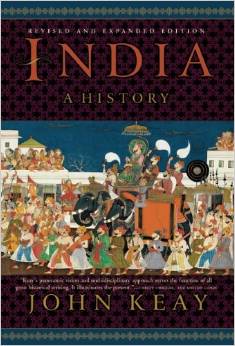
Recently I’ve been thinking a lot about this sort of game, thanks to John Keay’s excellent India: A History.

Image from Amazon
Image from Amazon

In his book Keay talks about the concept of the maharajadhiraja, the “raja of rajas of rajas.” To acquire this title one had to do more than merely conquer territory. In fact, taking and holding ground wasn’t necessarily even desirable; the maharajadhiraja might exert personal control over only a relatively small area. Rather, to be the raja of rajas of rajas one had to command the loyalty of other rulers. Far from annihilating competing kings, one left them in place to acknowledge one’s superiority.

Although the idea of the maharajadhiraja was never intended to serve a game design purpose, I can’t help but feel that it points toward an interesting approach to a semi-coop. The leader seeks, not to eliminate other players from the game, but to keep them involved and even powerful, so that their might will make the leader’s supremacy all the more impressive. Of course, those other players are candidates to be leader as well, and must weigh their odds of successfully claiming the title for themselves against the benefits of peace and prosperity under the current order.

Such a design would also raise fascinating questions about the nature of winning. Is it necessary to end the game as the maharajadhiraja in order to win? What if a player succeeds in maintaining a safe, happy kingdom as a subordinate ruler—is that a victory? Should it be? What message does either choice send?

I’m currently spending some time on Over the Next Dune, and in fact hope to have everything in place to jumpstart its playtesting very soon. However, I’d love to pursue this idea further, both as a design and as a source of theoretical questions. Is anybody on the whole 25th-hour-in-the-day issue?

Why Play 3D Chess? (In Memory of Leonard Nimoy)

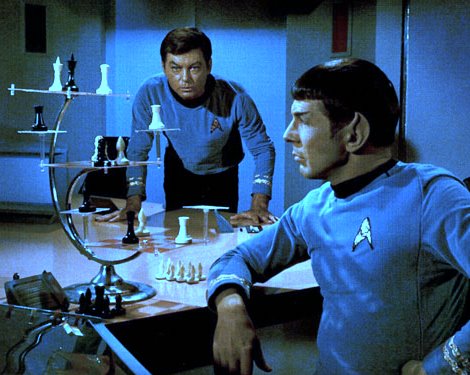
I’ve long been fascinated by Star Trek’s 3D chess.

Image from Wikipedia

3D chess puzzled me, not in its technical implementation—people can and have created rules for the game—but because I wasn’t sure why one would want it. Chess is a tremendously challenging game; there are hundreds of billions of possible positions after just a few moves, and even top-flight computers (to say nothing of top-flight players!) haven’t solved it. Making the game even more complex, opening it up to even more possible game states, seemed likely to make it totally unmanageable.

Leonard Nimoy passed away today. That got me thinking about Spock, and about 3D chess. What’s the draw for Spock and his comrades, all of whom play this beast of a game?

Here’s my theory: 3D chess is incredibly complicated. It’s so complicated, possessed of so many moves and counter-moves and openings and midgames and endgames and tactical tricks and schools of thought, that one never fully explores it. The fun comes not just from competing with the person across from you, but also from the game’s endless strategic vistas, the beautiful intricacies that appear as one plays and that, upon examination, promise still more amazing things to be found beyond them.

In other words, it’s a game about exploring, not physical worlds, but strategic ones. That sounds like something Spock would play to me.

RIP Leonard Nimoy, 1931-2015. LLAP.

Theory: Provide Guidance during Organic Tutorials

As a game designer—and an avid game player as well—I love what I call “organic tutorials:” games that allow players to learn how to play by exploring in a safe space. However, I’ve found that the appeal of this sort of tutorial is not universal; some players find them confusing and frustrating. It’s important, therefore, to inject enough guidance into the organic mold to bring those players up to speed.

Many games use organic tutorials, but the first example I ran into—and, I feel, still one of the best examples period—is the first level of Flower. In Flower the player controls a gust of wind. The goal is to use the wind to collect flower petals. Collecting certain petals makes things happen—say, a wind turbine starts turning. Eventually the player achieves all the goals and moves on to the next level.

The trick is that the game doesn’t explicitly state that the player should collect petals, or that certain petals are special, or that finding all the special flowers causes the player to progress. Players figure those things out through observation and experiment. Even learning to move is a process of exploration: the game gives only brief and fragmentary guidance as to how the controls work.

I played Flower’s first level, which is effectively an extended organic tutorial, and was astonished. No, more than that: I was moved. It was such a pure, marvelous experience. I couldn’t wait to share it with others.

So, I handed the controller to a scientist. This is someone with experience programming supercomputers. Technology is a part of this person’s day-to-day life and work.

The scientist found Flower completely mystifying.

I’ve had that experience several times since, with Flower and with other games that use organic tutorials. The problem in every case is that while the technology is fine—the person is always conversant with the keyboard or controller—the approach an organic tutorial requires is completely alien. Most people have always learned games by getting step-by-step instructions, from a manual or another player or the game itself, before they begin. Dropped into a game without those instructions, their instinct is not to explore. It is to wait.

On reflection, that’s a completely predictable response. I approached Flower with the idea that I was going to see what the game was about. That’s a very game designer way to think about what was happening. People who engage with games in a different way will expect to know what the goals are and what tools are at hand to achieve them before they begin. By not providing those tools, organic tutorials send the signal that it is not yet time to start playing!

To be clear, players who don’t respond positively to organic tutorials are not bad at games. We’ve known for years that different classroom students learn best in different ways. None of those ways are necessarily better, and in the same way no approach to learning games is better. The question is, acknowledging that some players will learn effectively from an organic tutorial and others won’t, how does one get the immersive experience of an organic tutorial without leaving lots of players in the cold?

The key is to give just enough information to put players on the intended course. Even brief, minimal instructions are enough to signal that the player should start doing things. Once the player is over that initial hurdle, learning-through-exploration can kick in.

An excellent recent example can be found in Elegy for a Dead World. Elegy begins with the player floating in space. There’s a star field in the background, but otherwise there’s no clear statement as to what the player should be doing.

If the player likes organic tutorials, he or she might start pushing the arrow keys. Doing that will move the player around, and eventually one of the game’s “portals”—windows to the dead worlds in question—will come into view. Hitting the enter key (a natural enough way to try to interact) will bring up a menu of story options, and off the player goes.

If the player is uncertain how to proceed and waits for a few seconds, a message appears at the bottom of the screen indicating that the arrows or WASD keys can be used to move. Once the player reaches a portal, waiting will generate a prompt that the enter key will open the portal.

That’s all Elegy does, but it’s enough. Players who like exploring can do so without nudges that they might resent. Players who hold off until the instructions have been read will get enough information to proceed. Everyone ends up playing the game.

Good organic tutorials are interesting, get players involved right away, introduce concepts in a measured fashion, and allow players to learn at their own pace. However, they’re not for everyone any more than just studying from a textbook or just doing hands-on projects is best for every student. Teachers know that mixing approaches helps students learn; mixing some instruction into an organic tutorial will have the same effect for players.

Thief in the Night: Annotated Edition

I feel badly for the little decisions in game design, the ones that edge a game from OK to good, or from good to great. Usually they don’t warrant a blog post or designer diary entry in and of themselves, but they have a significant impact on the final product. There needs to be a format where we can bring these small-but-important design choices to light.

Below is my attempt at creating that format: an annotated version of Thief in the Night’s rules. It includes some behind-the-scenes discussion of how the game came to be and thoughts on why specific rules are the way they are. Here’s hoping you find it enjoyable and informative.

Thief in the Night – 2-20-15 (Annotated)

Recent Innovative Board Games?

Elegy for a Dead World is a fascinating game, one that mixes creative writing with some fundamentals of CRPG play. It’s challenging, not in the game sense of “it’s hard to get to the ending” but in the artistic sense of making one think. By doing something completely different from what most video games do it engaged a part of my brain that I don’t expect video games to interact with.

It also made me reflect on how long it’s been since I played a board game with that kind of power. Over the past year or so I’ve played many excellent board games, but none since Concept have pushed the boundaries of my thinking about how board games work and what they can do.

Are these games out there, and I’ve just missed them? If you have suggestions leave them in the comments, or drop me a line at @lawofgamedesign. The weirder the better!