Theory: Advice for Writing Rules

One of the best ways to find and resolve weaknesses in a design is to write the rules early–but what should those rules actually look like? Ryan Macklin’s recent post answers that question brilliantly. It inspired me to go back through Lines of Questioning’s rulebook, making sure I used the second person and the active voice.

If you haven’t read it previously, I also recommend Jay Treat’s post on making good rules. It is perhaps more about overall game design than the specific topic of how the sentences in the rulebook should read, but as the comments point out, those two issues overlap a great deal.

For my own part, I would just add that it’s critically important to explain how the game starts. Experienced boardgamers know to begin playing by starting the turn sequence; that’s not necessarily intuitive for those new to the field.

Theory: Drawbacks of Rotating Metagames

A rotating metagame—the situation where every pre-game choice a player might make can be countered by another pre-game choice, so that none of the choices become dominant—is a commonly-cited tool for balancing games with lots of moving parts. However, it is not a panacea. Implementing a rotating metagame creates some new problems, and puts certain pressures on the game’s overall design.

“Rotating metagame” is a term of art, and like all terms of art it might sound opaque. However, it’s simple enough in practice. Think of Magic: the Gathering, with its many cards and decks. Each card has a counter, something that destroys it or negates its effectiveness, and through these individual counters whole decks can be countered. If one card or deck starts to become prominent in the competitive scene, people will play the relevant counters and that card or deck will be taken down a few notches. Then as the counter becomes strong people will start to counter it, and so on and so forth. Through this process tournament play begins to look like a wheel: cards and decks move to the top and then get pushed to the bottom, at which point their counters lose popularity and they start to rise again. Hence, the strategic situation rotates.

A rotating metagame creates game balance in the sense that there is no dominant, unbeatable strategy. However, it is not necessarily desirable for every game, or even for many games. The technique has serious limitations.

First, a rotating metagame offers a good environment, not good individual games. In a rotating metagame one accepts that blowouts can occur when someone is caught on the wrong side of the rotation. When viewed as a whole and over time the tournament scene will look healthy, but the zoomed-in experience of the individual player might be very poor.

This problem is exacerbated by the fact that bad games will be concentrated among new and casual players. Players with little experience or who are less informed about the game are the most likely to be rolled over by rotation’s wheel, because they often will not realize that they need to learn about the current state of the metagame. Deeply committed competitive players, by contrast, will know exactly what they should be playing.

Unfortunately, this distribution puts unfun games in exactly the wrong place. Casual players might quit after an unfun game or two, and new players are especially likely to pass on a game after a single bad experience. These are the groups who should be getting protection from blowouts, but a rotating metagame instead makes them grist for the mill.

A further challenge for rotating metagames is that everything hinges on the ability to rotate. Rotating metagames work when they are in a state of dynamic imbalance; something is always on top, but that something changes frequently. If the changes stop, all that’s left is a game with a dominant strategy.

Ensuring that the wheel of the metagame keeps rotating, then, becomes extremely important—and that imposes several design requirements. First, the resources for rotation must always be available. No strategy can be without its counter, and those counters must appear in a reasonable percentage of players’ toolboxes so that they can do their work.

An interesting example of what happens when this isn’t the case can be found in the NBA. Without getting into the minutiae of basketball’s rules for defensive play, it used to be the case that defenders had to set themselves up against specific offensive players and follow them around the court, rather than staying in “zones” and defending against anyone who came near. As a result, the game began to trend toward a dominant offensive strategy of passing the ball to a single unstoppable player—the gigantic Shaquille O’Neal, the too-quick Allen Iverson, or someone else with an enormous physical advantage—and then having all the other offensive players just get out of the way. Defenders were required to follow the irrelevant players to irrelevant places, and then the hard-to-stop player would beat the lone defender permitted to be anywhere near him and score. Since the resources required to stop the unstoppable player weren’t available—there just aren’t many people Shaquille O’Neal’s size—the game could not rotate away from this lone wolf approach, and basketball strategy began to stagnate. Ultimately the league had to change the rules to allow zone defenses in order to break the deadlock.

Additionally, rotating metagames only work when the barriers to change are relatively low. Shifts in Magic’s metagame are painless because those who are keeping up with tournament play probably have all the cards they need for the change and emotional investment in any given deck is relatively low. By contrast, a game where changing strategies means a massive new investment (e.g., miniatures games where starting a new army involves a great deal of money and time spent at the modeling table) can’t rely on players keeping up with a changing strategic environment. Similarly, games where players have reasons to stick a single deck/army/team through thick and thin will find that the metagame doesn’t rotate. Fans of the Philadelphia Eagles who want to see the Dallas Cowboys defeated can’t transfer their loyalty to another team with a better chance of taking the Cowboys down.

Thus, implementing a rotating metagame means designing and marketing in ways that keep those barriers low. Important counter-cards can’t be at too high a rarity in Magic, even if limited play would benefit thereby, because they have to be broadly available. Team loyalty can’t be too big a part of how the game is sold, lest it stop players from shifting gears when they necessary. Every aspect of the game has to be looked at with an eye toward, not just how it impacts strategy, but whether it could have an ossifying effect on players looking to change strategies.

Finally, rotating metagames are a major design challenge. It isn’t easy to maintain a web of counters and counters-to-counters, all good enough to dethrone a dominant strategy but not so good as to make the countered strategy unplayable. Fine judgment about how strong each strategy is going to be and how effective to make the related counters is vital. Attaining that judgment requires enormous amounts of quality playtest data, which is not always easy to come by.

Given all of these weaknesses, when is a rotating metagame appropriate? The short answer is “when there are too many things happening to balance all of them at once.” Magic has a functionally infinite number of possible decks giving rise to a tremendous wealth of strategies; it’s impossible to arrange for each to have an even game against all of the others, so the rotating metagame serves as a safety valve that gives as many of them as possible a chance to shine. The many benefits Magic gains from its diversity of options outweigh the drawbacks of the rotating metagame they necessitate.

In the end, a rotating metagame is a tool. Like all tools, it places certain demands on its user and can be harmful if employed thoughtlessly or in the wrong situation. Don’t just assume that it’s right for other games because it’s been used successfully in the past; instead, think critically about what it will accomplish, what it will cost, and whether the former is worth the latter.

Theory: Theme By Doing

One of the most thematic games I’ve ever played is also one of the simplest. Utopia Engine is a print-and-play game that uses a greyscale map, a pencil, and some dice to simulate an artificer trying to rebuild an ancient machine. The game accomplishes that by transmitting, not the mental experience of building a singular work of mechanical brilliance, but the physical experience of fiddling with knobs trying to get the darn thing to work. In doing so it reminds me that a game’s theme can be implemented, not just at an intellectual level, but also through the actions players physically take during the game.

When we think about a game’s thematic power we usually take a bird’s-eye perspective. Is the artwork compelling? Do the mechanics produce the same incentives that a similarly-situated person in the real world would encounter? Are the rules of the real world enforced in a sensible way?

By contrast, we rarely worry about the more grounded issue of what the players are physically doing. If a board game about World War II aerial dogfighting has realistic art for the planes, mechanics that encourage players to use strategies real pilots used, and limits on maneuverability appropriate to the era, it’s a thematic game. We forgive the abstraction wherein players fly by moving pieces on a map rather than using a joystick and throttle.

We shouldn’t assume, however, that the players’ physical actions must necessarily be abstract. To the contrary, getting players to do something that feels like the activity being simulated can be very powerful. It’s like food that both tastes good and smells good; just the former is great, but having both is amazing.

That’s where Utopia Engine comes in.

Utopia Engine is about putting together a half-understood device using scavenged parts and incomplete blueprints. It could have simulated the painstaking work of getting old and weathered pieces of a machine to work, and work together, in many ways: completing sets of cards, perhaps, or drawing specific chips from a cup.

Instead, the game has players roll dice and choose boxes in which to put the results, trying to set up arithmetic equations that produce desired answers. It feels exacting, unpredictable, and even math-y. It feels, in other words, just like we imagine the work of a semi-mystical artificer trying to rebuild an ancient and complex artifact would feel!

Utopia Engine has nice art and sensible mechanics, but it’s the feel that really brings the theme home. Playing the game by taking notes and doing math—the very sorts of things an artificer might do at the workbench—puts the player in the game in a very immediate way. By asking the player to do thematic things, Utopia Engine creates an unusually compelling experience.

Other games have also taken this approach to good effect. In Thebes, a game about excavating archaeological sites, players “dig” by reaching into a bag full of cardboard chits–some representing treasure, others with simple dirt–and pulling one out. Thebes’ designers could have achieved the same technical result by having players draw cards from a deck, but actually digging for the valuable pieces adds immeasurably to the atmosphere.

Board games are not the only type of game that can deploy this approach. Flight simulators, car racing games, and rhythm games all have spawned whole cottage industries devoted to providing specialized controllers that closely mirror real-world equipment. Those controllers are not necessary for good play; one could very well succeed at Rock Band or Guitar Hero using a QWERTY keyboard. Rather, they are popular because flying a video game plane using a joystick, or driving a video game car with a wheel, makes the experience more convincing and real. The special controllers allow the theme to extend beyond the TV screen and into the player’s hands.

There’s nothing wrong a game whose theme works on an entirely intellectual level. My own Lines of Questioning is exactly that sort of game, one where the theme is in the thinking and player’s actions have no real-world parallels. (“Your Honor, I move to . . . play this tile!”) However, it’s worth remembering that theme can also be expressed through what the player does to interact with the game—and that bringing a game’s theme out in that way can be exceptionally powerful. Keep an eye out for opportunities, like Utopia Engine’s die-rolling-as-machine-maintenance and Thebes’ bags of dirt and treasure, to take advantage of that possibility.

Theory: How to Make Losing Fun–Give the Player Something Fun to Do

For many games the fun is in the winning, and so when a player is losing the designer needs to take special steps to prevent the entire experience from falling apart. However, there’s a whole other category of games, ones where the entertainment is found primarily in the doing. Those games point toward a different, and very powerful, way to help a losing player have fun: make the core game experience inherently enjoyable.

Rock Band is a game about singing, pretending to be a guitar shredder, and banging on drums. Although it’s very challenging, Rock Band is a great time even when the player is not doing well. Part of that is because the game has easily measurable goals short of winning: to get a little further in the current song before the crowd boos the player off the stage, to survive the crowd’s ire to the end of the song, to master the song and keep the crowd cheering all the way to the end.

Much of the reason Rock Band works, however, is because the activities it asks the player to do are fun completely independent of the rewards on offer. People just plain like singing! The crowd’s cheering, the score at the end—those are nice, but they hardly matter. Players would sing without the prospect of any reward (and in fact they do, all the time—how many people sing along with the car radio, or in the shower?). Rock Band is fun, not just because it has finely-tuned goals short of winning, but because it’s an excuse to do something that’s fun without any incentives at all.

The same goes for playing guitar (I played in college, and I assure you, no rewards were in the offing) and drums. Drumming is literally a socially acceptable way to hit things with sticks. That’s something people want to do so badly that they do it even when they’ll be punished for it, as countless broken windows resulting from baseball games played too close to the house will attest. Certainly part of the fun of drumming in Rock Band is achieving the goals the game sets out, but those goals don’t have to carry too much of the weight. The player will have fun even if she never reaches them, because drumming in Rock Band means getting to hit things! With sticks!

Jenga, a modern classic among dexterity games, provides another example of this dynamic at work. For those who have never played, the only game pieces in Jenga are blocks, which start the game on top of each other to form a tower. Players take turns removing blocks, trying not to knock over the tower as they do so. Whoever topples the tower loses.

There is only one sub-goal in Jenga, which is to get through the turn without knocking over the tower. One might reasonably wonder whether that would be sufficient to keep players who don’t see themselves winning entertained.

Yet when one plays the game one discovers that the relative paucity of intermediate goals doesn’t matter, because the things the players do are so much fun. Jenga is very tactile, involves lots of dexterity, and frequently has players laughing as they try to catch a tower that’s swaying perilously. Even the moment when a player loses can be entertaining, as it involves a great crash of blocks (loud, but not so loud as to frighten children) and stuff flying everywhere.

Compare Rock Band and Jenga to the average CRPG with a menu-based combat system and conversation trees. A CRPG like that has to do an enormous amount of work to be fun, providing many different goals short of winning, because the fundamental activity the player is engaged in is moving an arrow up and down followed by pressing a button. With winning far in the distance and an unenthralling basic mechanism, the average CRPG relies heavily on carefully placed sub-goals to keep the player engaged.

Of course, many CRPGs—yes, even menu-driven CRPGs—are great fun, just as entertaining as are Rock Band and Jenga. The key is in how these games provide their fun. We are accustomed to the sort of sub-goals that we see in CRPGs: story progression, gaining experience levels, collecting items. Rock Band and Jenga point to another way to amuse players who will not win, at least not for a long time: give them something inherently fun to do.

Theory: There’s No Such Thing As “Accidental Cheating”

The number-one most reliable way to start a fight around the gaming table is to call someone a cheater. It’s the nuclear option, the thrown gauntlet that says I don’t want to play anymore, I want to talk about how terrible you are instead. As a result, it’s important only to use “cheat,” “cheater,” and “cheating” when you really mean it—when you want to start that adversarial confrontation. Using those words to discuss innocent play errors, as with “unintentional cheating” and the like, only serves to make fixing problems impossible.

All unfair advantages in games are bad, but not all of them are moral issues. Just like there’s a difference between accidentally knocking into someone and intentionally shoving them, there’s a difference between breaking the rules through error or ignorance and intentionally violating the rules to get a leg up on an opponent. The former situation in each case is unfortunate, but only the latter involves an ethical failure.

We make this distinction between the innocent and the unethical, in life and in the law, because it matters. If John accidentally knocks Fred down, we want John to help Fred pick up his things. If John shoves Fred to the floor, we want John to back off. We also want the endgame for John to be different: accident-John probably doesn’t need to go to jail, but shove-John might deserve it.

Unfortunately, over the past year or so I’ve seen people crossing the streams with terms like “accidental cheating” or “unintentional cheating.” Introducing the language of cheating into situations of accident makes it difficult to sustain the vital distinction between the two ideas, and to get the results we want out of each situation.

First, calling accidents—even serious, game-deciding accidents—cheating gives rise to the wrong final result. It puts accident-John in jail. What should have been cause for an apology and perhaps an effort at setting things right becomes a source of shame and even punishment.

Second, the word “cheating” makes people defensive and discourages them from taking remedial steps. If I say to someone “I think you made a rules mistake,” they’re likely to listen to what I’m saying and to fix any problems that have resulted. If I say “I think you cheated,” they’ll try to defend what they did or just walk away from the table. They’re not going to be in a receptive frame of mind.

What’s worse, the first problem feeds into the second. Since there’s a penalty to being a cheater, the incentive to resist an accusation of cheating-via-mistake is very strong. It becomes difficult to say “yep, looks like I messed up, let’s figure out what to do” when that might be admitting guilt.

The ironic—and regrettable—result is that the idea of “unintentional cheating,” meant to promote clean play and better games, ends up making things worse. Rather than encouraging players to play correctly, it demands that they play defensively. As soon as a rules issue comes up the collaborative effort to play a great game devolves into a joyless multi-tiered conflict, the fight on the board and the fight between the players, with the goal of maintaining a healthy game state lost.

I think those using terms like accidental cheating intend to take the sting–and the conflict it produces–out by specifying that the cheating was unintentional. It’s a good-hearted effort, but as a practical matter “accidental cheating” is always going to sound like (accidental) CHEATING. “Cheat” is too loaded a word to be managed so precisely.

None of this is to say that we should never say anyone is cheating. Rather, my point is that we should call a spade a spade. If someone is intentionally breaking the rules, say that they’re cheating. If someone is making an innocent mistake, don’t use terms that imply something else.

The law also cares a great deal about using the correct word. Some of that is motivated by a desire to be technically correct. Much, however, arises from the fact that different things need to be treated differently. “Unintentional cheating” and “accidental cheating” are phrases that use the wrong words, and in the process they get undesired results. They should be abandoned in favor of older, less exciting, but ultimately more precise terms: “mistake,” “error,” and similar words that make it easy for everyone involved to admit their missteps and rectify problems.

Lines of Questioning & Theory: Test the Boring Option

Sometimes you need to test the simple thing that will probably work, even though no one will be impressed that you thought of it. As a designer I always feel good when I come up with a unique solution to a problem. Recent playtests of Lines of Questioning have reminded me, however, that basic fixes are considered basic for a reason: they consistently do the job. Flashy solutions that bring excitement to the table are much more likely to come apart under the pressure of play. It’s therefore wiser to check the simple possibilities first, deploying unique and tricky mechanics only when their necessity outweighs the risks involved.

Last time we talked about Lines of Questioning I was looking forward to testing a new player power.

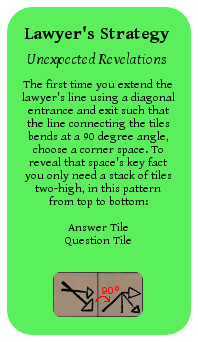
Lawyer - Unexpected Revelations One of my expectations for this power was that it would make the game substantially easier. Lines of Questioning was fun, but incredibly difficult. Providing an easier victory condition in return for engaging with a lesson seemed like a reasonable fix.

To my surprise, however, this power fell flat on its face. One of the things I track in playtests is how close a losing player came to winning. Based on that data, I estimated that the power would turn approximately 20% of near-losses into victories. In practice it had virtually no effect on the win rate.

Even now I’m not sure why the power didn’t work. Variance is a possibility, either in the pre-power data (lucky players got close to victory more often than the game’s difficulty made sustainable) or in the power testing (unlucky players had tougher games than normal, canceling out the effect of the power). Whatever the cause, the result was clear: for all its theoretical advantages the power wasn’t working.

That left me with only one idea for how to handle the excessive difficulty issue. It wasn’t neat. It wasn’t interesting. It did, however, have the merit of being simple.

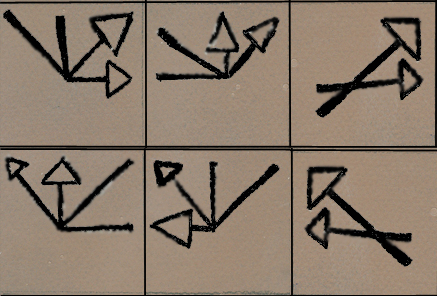
Facts:  Testing has demonstrated that some tiles are better than others. In particular, tiles with multiple entrances and exits are very strong. Such tiles offer the player lots of options, can be used in unusual ways to get out of trouble, and enable efficient movement around the board.

90-degree turn tiles, on the other hand, are quite weak. This is both because of their limited usefulness and because there are a lot of them. Hands entirely made up of 90-degree turns are common, and are quite challenging to play through successfully.

There is almost no situation where this hand is good.

For that and other reasons, Lines of Questioning is very difficult. While opinions may differ on how challenging a solo game should be, a win rate near 0% is clearly unacceptable by any standard.

Issue: How should Lines of Questioning be made easier?

Rules:

1. Try the simple thing that will probably work.

2. Having more of the stronger tiles, and fewer of the weaker tiles, makes the game easier.

Holding: Replace these lawyer tiles:

1-19-15 - Replaced TilesWith these tiles:

1-19-15 - ReplacementsDo the same for the witness tiles as well.

Thinking it through: I’ve been trying to do all sorts of complicated things to make Lines of Questioning easier—but what about the simple solution? If 90 degree turn tiles are bad, especially when there’s a lot of them, why not have fewer of them and more of the good ones?

As it’s turning out, this change works like a charm. The win rate is substantially higher, and frustrating all-90 degree-turn hands are rare. Having more diagonal entrances and exits also allows for some interesting strategic maneuvering, like doubling the lines back on themselves.

In fact, this is going so well that it’s providing a great foundation for the “basic” variant I’ve been wanting to lock in. Up to this point I’ve been looking at new rules to make the basic game easier, which of course runs contrary to the goal of a simple, quick-to-learn version. Lowering the difficulty without needing more rules makes that variant realistic.

Sometimes a game needs an additional, complex rule. Sometimes, though, what it needs is a willingness to try the obvious solution to a problem. Exchanging bad tiles for good ones isn’t a remarkable design achievement, but if it makes Lines of Questioning better, then so be it. I’ll trust the extra impressiveness from the game being good to take up the slack.

Prototypes: 3D Games Are Fun Before They’re Done (and Board Games Aren’t)

File this one under unintended effects of one’s choice of prototyping material: I’ve noticed a big difference in the experience of coding board games and 3D games. Putting a 3D game together in Unity is fun, even when the game is in its very earliest stages; there’s a player to control, things bounce off of each other, etc. Board games, by contrast, don’t do very much until they’re substantially complete. As a result I find myself drawn to work on 3D games.

Even in game design, it seems, moral hazards are everywhere!

Theory: The Power of a Fun Tutorial (R.I.P. John Hill)

Earlier this week John Hill, designer of the classic Avalon Hill wargame Squad Leader, passed away. Squad Leader should be of interest to every game designer, because it includes what might be the single greatest learn-to-play scenario ever devised: The Guards Counterattack. The Guards Counterattack did not stop at teaching the rules; it was a fascinating exercise that advertised the depth of its game and the fun to come.

Squad Leader is certainly a game that needs a tutorial scenario. Like many wargames of its day, Squad Leader’s rules were so numerous and complex that only someone with a photographic memory could master them just by reading. “Programmed instruction”–the then-current term for “peppering the rules with scenarios that reinforced what the player just read”–was vital.

Most of us hear about programmed instruction, think of video game tutorial levels, and sigh. Do this, then do this, then do this. Instructive, but joyless. The incentive to play the game is the promise of fun to be had after completing the tutorial’s lessons.

The Guards Counterattack turned all of that on its head by being a learn-to-play scenario that’s also a challenging tactical puzzle. The Guards in question are Russian infantry trying to retake buildings from the Germans during World War II. Each side has an advantage over the other: the Russians enjoy the weight of numbers, but the Germans begin with strong defensive positions. Leveraging those numbers and finding ways to hold back the tide are still compelling problems almost 40 years after Squad Leader was first published.

Simply by being fun (though, to be fair, it cannot have been simple to achieve such fine balance), The Guards Counterattack completely changed the role of the tutorial. It became an advertisement: if the game is this awesome with only the most fundamental rules, imagine what’s in store in the pages to come! Rather than being daunting, the many pages of reading to follow suddenly began to look full of promise.

I’ve spent a great deal of time over the past weeks working on a basic version of Lines of Questioning, one without special rules for off-topic witness answers and the like. That’s because I’ve never forgotten playing The Guards Counterattack, and how motivated I was to work through Squad Leader’s rulebook afterward. A great tutorial scenario, one that goes beyond teaching the rules to showcase the game’s depth and fun, is an irreplaceable source of player engagement.

Here’s to John Hill, and to his contributions to wargaming and to game design as a whole.

Theory: Rules for Player Powers

After hammering away at Lines of Questioning for a while, I feel that the latest variant is a great foundation for a “basic game.” However, it’s also incredibly difficult; saying that playtest victories have been elusive is somewhat like saying that one doesn’t often see a unicorn.

My thinking at the moment is that the core gameplay mechanics are solid, and that the difficulty issue can be addressed with role or power cards that give the player a little boost. Legal analysis teaches that a free-ranging quest for good ideas is less effective than following reliable guidelines, so I thought that as a first step I should try to create those guidelines. Here’s what I’ve come up with.

Player powers in cooperative games (which can include solo games for our purposes here) come in two types: weighting and unique. Both serve to make the game easier, and hopefully more fun as well. However, they accomplish these goals in very different ways.

Weighting powers make the player better at a game action everyone can take. The player might pay a lower cost for the action, or get a bigger payoff, or be able to take it when other players cannot. However it happens, the power weights the player’s choice; it puts something heavy on one side of the scale that balances the options.

Perhaps the quintessential weighting power is the Medic role in Pandemic. The Medic can do all the things the other players can do, but is the best in the game at treating sick people. Since treating sick people is absolutely necessary to win, and the Medic does it better than everyone else, the Medic player’s evaluation of how he should spend his turn is always going to be tilted in that direction.

Unique powers, by contrast, enable the player to do something outside the normal game rules. Instead of making a choice more appealing, as in the case of a weighting power, it adds a whole new option. Players without the power cannot replicate it, even inefficiently. Recent implementations of the idea include Forbidden Desert’s Climber, who cannot be buried under the game’s shifting sands, and Space Hulk: Death Angel’s squad-specific action cards.

Admittedly, the distinction between these categories is not always a bright line. Having a unique power does tend to weight one’s choices; the Climber can move to the same squares as every other Forbidden Desert character, but her additional safety can have a substantial effect on the choice of destination. Similarly, weighting powers can be considered “unique” insofar as they enable players to break the game’s normal rules.

I nevertheless feel that it’s useful to think in terms of powers as coming in two flavors, because they work out somewhat differently in play. Weighting and unique powers produce different behaviors in players and can be used for different purposes.

Weighting powers have subtle, but important, impacts. First, they provide guidance to the player. By making one choice more appealing, weighting powers signal to the player that that is a good choice and he should go in that direction as often as possible.

Think back to Pandemic. If you take a group of people who have never played the game and give them each a role, the players will naturally gravitate toward whatever their roles tell them they’re good at. The Medic will start treating the sick; the Researcher will try to get cards to the Scientist; the Operations Expert will build research stations. All of those are useful contributions, and so that inexperienced group will make progress in the game.

Compare that to what would happen if Pandemic had no role cards. Should everyone treat the sick? Maybe the best strategy is for everyone to build research stations all at once, and completely ignore the cards? Who knows! New players would be completely at sea, and might suffer through many frustrating games while they figured out a reasonable distribution of labor.

That thought experiment points toward another benefit of weighting powers: they are an easy source of player satisfaction. It feels good to treat sick people as a Medic, because each treatment is a little chance to be top dog. No one else can treat people like the Medic can.

As the game goes on those opportunities can even build into something especially satisfying, a reputation for competence and accomplishment. When the table comes to rely on the Medic, trusting him to keep them in the game while everyone else does their behind-the-scenes work, it gives a taste of what it’s like to achieve a position of responsibility in the real world.

By contrast, unique powers offer neither of those things. They do not generally help players decide what to do; if anything, they make in-game decisions more complex. In Space Hulk: Death Angel the purple squad has the ability to move the evil aliens around. It’s difficult to say whether and when that’s better than just attacking them; the choice is highly context-driven, and nothing about the ability itself signals which way the player should go.

Nor are unique powers always going to be wells of player satisfaction. Frequently they just create agita as players struggle to decide whether they should use a power now, or save it for later, or use the power in a different way. We have all seen people frustrated at the end of a game because they were so afraid of wasting their Cool Thing that they never actually did it.

Unique powers are nevertheless still valuable despite those weaknesses because they are an effective route to new decisions and different play experiences. As an example, take another look at Forbidden Desert. Most of Forbidden Desert’s players operate in an environment characterized by water scarcity. The Water Carrier, on the other hand, can have as much as she pleases if she’s willing to spend the time to dig a well; for her the game is all about opportunity costs. Having a unique power fundamentally changes the experience for that one player, which helps keep the game fresh and interesting.

These, then, are the rules I’ll be using as I design player powers for Lines of Questioning:

First, follow the rules here for when player powers are useful, and in what amounts.

Use a weighted power when (a) the power should help players, especially new players, decide how to approach the game; and/or (b) the power is meant to add satisfaction to the game experience.

Use a unique power when (a) the goal is to create a new set of decisions; and (b) the power will not frustrate players by being difficult to use correctly.

On Monday I’ll be back with first-draft ideas.
Theory: Decisions in Physical Games

Miniature golf is fun, even though there’s only ever one right move: to hit the ball in a way that results in a hole-in-one. The same is true of tennis (players should hit unreturnable serves that land perfectly in the corners), baseball (it’s always best to swing the bat along an arc that will produce a home run), and many other games that turn primarily on physical accomplishments rather than strategic calculations. All of these games work, despite their tactical simplicity, because they still have compelling decisions; they simply fold those decisions into the physical performance involved.

Let’s look at one of the first games many people play: catch. The only “move” in catch is to throw the ball back and forth, with the goal of making a good throw directly to the other player. There are no decisions to make, no opposing players to outwit or special moves that score more points. Catch has absolutely no strategic depth.

Yet, people of all ages play catch. It could be that they do it out of obligation, as practice for other games, or as something to occupy their hands while they discuss other things. I’m sure that in some cases one of those is exactly what’s happening. However, given the number of games of catch I see played between people who aren’t members of competitive sports teams and who seem focused on what they’re doing, I think there’s a better explanation: catch, despite being strategically simple, involves a lot of interesting decisions.

Consider what goes into that “good throw.” The amount of force on the ball must be correctly judged; too little and the ball doesn’t get to the other player, too much and she has to go chase after it (or, perhaps, the thrower has to chase after it!). One must tune one’s arm motion to produce that amount of force in the correct direction. Last but not least, one has to find just the right point at which to release the ball—too early or too late will spoil all the other work.

Each of those decisions involves selecting, without complete information, the best option from many alternatives. They are interrelated and must be made in a time-pressured environment. A variety of factors play into them, and one must weigh those factors appropriately. Those decisions are, in other words, interesting, for the very same reasons that decisions in board games are interesting.

Another example of interesting physical decisions comes out of first-person action video games. David Sirlin once described the primary skill in these games as “aiming:” moving one’s mouse, joystick, or directional pad so that the targeting reticule is over the enemy. That doesn’t sound all that enthralling, but millions of people play these games every day. Why?

Part of the answer, no doubt, is AAA graphics and sound. Part, though, is the simple fact that aiming is hard. Like making a good throw in catch, it’s a physical act with many decisions bundled up in it. How exactly should the mouse move, given that the player is also running diagonally forward and jumping and the opponent looks like he’s going to rocket-jump but hasn’t done it yet? It’s not trivial to work that out in less than a second while everything is in motion!

I get the same feeling of satisfaction from a really good throw in catch as I do from a really good move in a board game. That’s not surprising, because in both cases I’ve made a series of tricky decisions correctly. In the end, physical games are games, and they draw their fun from the same well of interesting decisions as their more sedate counterparts do.