I’ve built an initial version of the follow-up to Trust Me.
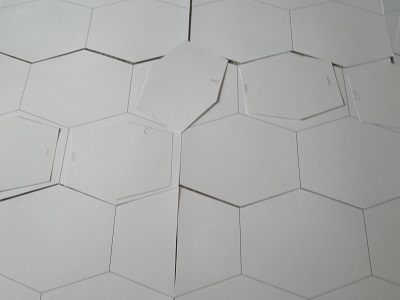 It turns out that hexagons are not easy to fabricate . . . .
Tom used to be a lawyer. Now he's a game designer. The two have more in common than you think.
I’ve built an initial version of the follow-up to Trust Me.
It turns out that hexagons are not easy to fabricate . . . .
Part of the reason why we have so many sayings to the effect that “winning isn’t everything” is that winning is closely tied to having fun. Yet, it’s possible to make a game fun for players who are currently losing–even for those who have no hope of victory. Providing measurable goals losing players can meet separate and apart from overall victory enables them to walk away from the game with a sense of satisfaction.
The recent poster child for game design that’s fun even when the player is failing is Dark Souls. For those who haven’t played it, Dark Souls is an action game. A very, very hard action game. “Prepare to Die,” its ad copy declares, and die the player will. Many times.
Yet, Dark Souls can be a very satisfying experience even as it clobbers its player. Progress in Dark Souls is easy to measure; monsters are always waiting in the same places, and so one can always tell when one has gotten a little further. Last time the ghoul waiting in the hallway beat me; this time I beat it. Those tiny but clear bits of advancement let players put the controller down with a sense of accomplishment, even if the end of the game is still very far and many deaths away.
Dark Souls’ puzzle-like form–enemies are always in the same place, paths always lead in the same directions–allows for concrete sub-goals. However, there are other ways to introduce objectives that are satisfying even though they are short of winning. Role-playing games, for example, use story for this purpose. Winning might be tens or even hundreds of hours away, but the next chunk of plot and character development is much closer. If the player is enjoying the game and its story, reaching that intermediate point is a powerful incentive and satisfying when it happens.
Games that call heavily on player skill also have this dynamic going for them, although they approach it from a different perspective: they encourage the player to create her own goals. Fighting games, for example, involve a tremendous number of skills. Being good at fighting games is incredibly difficult, so much so that most players will never achieve it (myself included; I top out at a journeyman level). In other words, the vast majority of fighting game players will never “win.”
Fighting games are, nevertheless, deeply compelling, because even if a player will never reach the highest plateau she is constantly achieving things. The first time a player successfully does the forward-down-down + forward motion for a dragon punch feels great. Being able to do it consistently is even better. Comboing into the dragon punch from a standing close hard punch is better still. Pulling off Evil Ryu’s one-frame link to wipe out half of the opponent’s health in a single flurry of attacks is amazing! There’s a never-ending series of little goals fighting-game players can set for themselves, and they maintain players’ interest in climbing the next rung of the ladder even if the player knows its top will always be beyond reach.
These examples offer three different mechanisms by which players can have satisfying, engaging goals short of winning: a puzzle structure that allows one to see progress in concrete terms, a story that is doled out in limited amounts to leave the player wanting more, and a skill-driven model in which players take pride in each small accomplishment. What overall lessons can we derive from the examples?
First, a good sub-goal for keeping losing players engaged is measurable. The player can tell when she has met it. Achieving something isn’t as much fun when the result is in doubt, so there’s no uncertainty about the accomplishment.
Second, these goals are independent of winning. They may involve actions which are conducive to overall victory–hitting a combo contributes to winning a fighting game, and getting part of an RPG’s story is a step toward the game’s conclusion–but they don’t rely on reaching that lofty plateau, or even being ahead at any particular time. It’s possible to get the satisfaction of these achievements even if the game has turned severely against the player.
Third and finally, they’re desirable. None of these are mocking “most improved” awards. They allow one to progress along an interesting axis, even if it’s not the most competitive one.
It’s easy to make winning feel good. Getting losing to feel good is harder–but not impossible. The key is to provide measurable, desirable goals that can be achieved independent of beating the opponent.
Last time we said that Trust Me has two issues: Player 1’s game needs to be more interesting without being more challenging, and Player 2 needs more satisfying gameplay without making it easier to win. The solution, I think, lies in going all the way back to the beginning of the design. Decoupling Player 2’s activity from Player 1’s opposition makes it possible to fix both problems.
Player 1 currently can’t be challenged because Player 2 is providing the challenge, and for thematic reasons it needs to be difficult for Player 2 to win. If Player 2 isn’t the opposition, however–if that role is filled by a hypothetical Player 3, or by the game itself–then Player 1 can be confronted with as many difficulties as necessary to make her game interesting. This is fighting the hypothetical, in some measure; we’re not finding ways to increase interest without increasing challenge, we’re just making it possible to increase challenge. Still, I think it’s a good solution.
With Player 2’s experience no longer directly opposed to Player 1, it becomes easier to measure Player 2’s progress on axes other than “how is Player 1 doing.” It will be easier to give Player 2 sub-goals that can provide satisfaction even if Player 2 isn’t winning.
I’m on my way out the door for a trip as I type this, so I can’t go into as much detail as I would like. On Monday I’ll talk about Player 2’s sub-goals: how they work and why they’re important.
There’s a classic legal ethics problem that goes something like this: the client is accused of a crime. He has an alibi, but he doesn’t want you to use it because it’s embarrassing. Should you override the client’s wishes in order to win, or does the client have the right to tank his own case?
Academics aren’t the only ones who care about the answer to that question. Disputes over control can poison the attorney-client relationship, especially when they’re mismanaged. I envisioned Trust Me as a simulation of these issues, an abstract demonstration of how divisions arise in the partnership and why they can be difficult to address. The challenge of the design now is to make Trust Me into a game that captures the unequal and potentially conflict-ridden nature of the situation, yet is still a game people would want to play.
“Unequal” may seem like a strange goal for a game, but inequalities are a fact of attorney-client interaction. Lawyers have specialized knowledge that their clients lack. They are familiar with the legal environment and its processes, while the client likely finds them strange and even intimidating. Lawyers are repeat players, while the client is probably being opposed–and judged–by strangers. Ethics rules give the lawyer final say over many decisions, including some that the client may care very much about. The lawyer is even on familiar ground, in an office or a courthouse the lawyer has practiced in before, while the client feels like he or she is an outsider. Any game about attorney-client interaction needs to recognize and represent that inequality.
(As a side note: I am not saying that these inequalities are necessarily good or desirable. Scholars have struggled for years to find ways to reduce the paternalism involved in lawyer-client interaction without losing the value of the lawyer’s expertise. The topic remains one of hot debate, with arguments for many different solutions. Some have even argued in favor of the inequality. I have my own views on this subject, but Trust Me is not about whether or how the playing field between attorneys and clients should be leveled. It is evoking the inequalities that have existed in the past and that are still present today.)
In real life the issue of attorney-client inequality stirs up a pot already set to boiling by the fact that lawyers and their clients don’t always want the same things. Traditionally litigators have focused on winning the case. Clients usually want to win too, but they can have additional goals separate and apart from overall victory. They might want to punish someone who has harmed them, and hope the lawyer will really put the screws to that person on the witness stand. They may want answers to burning questions, and feel that the only way they’re going to get them is if the person who knows the truth is under oath. They may simply want to have as little to do with the situation as possible, and favor solutions that keep them far from the courthouse and the opposing party–even if that means a less-desirable outcome. A client may simply want to feel like he or she still has control over an important situation in his or her own life, and want something minor just for the satisfaction of influencing the case. The attorney-client relationship can become a tug-of-war, the attorney pulling toward a winning verdict while the client tries to move the attorney toward other objectives.
Trust Me succeeds, I think, in demonstrating the challenges of a building a constructive relationship despite these two problems. The players are unequally situated: Player 1 has more influence than Player 2, and is more likely to win. Each has different goals–Player 1 to reach the opposite side of the board, Player 2 to have markers collected–that sometimes align but often conflict. It’s possible to work together, but it’s also possible for only one person to get what he or she wants, or for the relationship to break down entirely. (I equate Player 2 boxing Player 1 in out of spite with a client firing his or her attorney.) As an art installation that exists to make a point, Trust Me works.
It falls down, however, when evaluated as a game. Player 2’s lack of control is thematically appropriate but frustrating. Having Player 2 manipulate the barriers captures abstractly the client’s efforts to get an attorney to take certain approaches, but interacting directly with Player 1 would feel more accurate. The game is too easy for Player 1, but in the current design the difficulty can’t be increased without giving Player 2 an unthematic amount of power.
At this point Trust Me is achieving its thematic ends, but no one would want to play it more than once. Turning it into a better game–and, perhaps, a more effective art piece–requires solving some design problems. How can Player 1’s experience be made more compelling, when it probably can’t be made significantly more difficult? How can Player 2 be given interesting decisions and opportunities for satisfying gameplay without making it easier to win? I have some preliminary ideas about the answers, and will get into them next time.
One nice thing about two-player games is that they’re a lot easier to playtest than five-player co-ops. I’ve been able to get Trust Me to the table, and have made some changes:
1. Player 1 now moves one barrier and then moves the mini one space. This allows more time for players 1 and 2 to signal whether they’re looking to cooperate or to compete. It also gives Player 1 more interaction with the barriers, which is the meat of the game.
2. Since Player 1 moves more slowly, the game is only played to the end of area 2. The print-and-play file has been updated to have the goal line in the correct place. This change also eliminates the need for area 3’s barriers, and they have been removed as well. Trust Me is now really, really quick to assemble. 🙂
3. As matters stand, it’s possible to rough out the optimal path for a Player 2 victory at the start of the game. That can lead to frustrating gameplay, either because it’s lengthy (in which case Player 2 is apt to feel like he or she can’t win no matter what), or because a player does something that appears sub-optimal (which can lead to confusing signals and ultimately post-game recriminations). There are two changes in the rules that are intended to make “solving” the board before turn one impossible:
– The game-end condition has changed: now, at the start of the 16th turn and every turn thereafter, the players roll a four-sided die. If the die comes up as a 1, the game ends.
– Most markers in area 2 are distributed during play, much like the barriers.
4. The number of markers has been changed to four in area 1 and five in area 2, with six markers needed for Player 2 to win. Having a greater percentage of markers in area 2 helps avoid situations in which Player 2 is “out” relatively early in the game.
I’m experimenting with a fifth change, in which barriers are distributed using smaller dice that place them in the middle of their areas. This avoids useless barriers that are way off to the sides, but having different numbers for distributing markers and barriers makes the board visually busy. A computerized version of this game would make setup a lot faster . . . .
We’re just past the summer, and that means we’re out of tournament season and into arguing-about-tournament-judging season. As an attorney I feel that I have some insight into one of those debates: the question of active vs. passive judging. Passive judging is often derided as an abdication of responsibility, but as with so many things we wish people wouldn’t do, it always happens for a reason. We need to understand why one might choose to employ passive judging before we can evaluate whether it was sensible in any given case to have done so.
Everyone is familiar with “active” judging; it’s what we see in professional sports. The judge (in the form of the referee) watches the game, and when someone breaks the rules he or she takes action. The players are beholden to the judge/referee’s decision as to when he or she will get involved.
“Passive” judging reverses the flow of the interaction. The players decide when to involve the judge, and judges will not take action unless and until a player asks them to. Even if a judge sees a flagrant rules violation, in passive judging scenarios he or she will do nothing absent a player’s request to step in.
Games that employ passive judging take a lot of flak, and it’s not hard to understand why. Tournaments are intended to establish who’s the best at [game], not [variant of the game where the players don’t always follow the rules]. It seems to undermine the meaning of the competition.
Furthermore, passive judging can look odd. A player does something wrong . . . and the person empowered to correct the problem does nothing. It feels as though the judge is at least implicitly condoning the behavior.
Yet, for all its faults, passive judging has one key advantage that a lawyer is well-positioned to recognize: it puts the onus to maintain the integrity of the game on the players, instead of on the judge. That hand-off has a number of benefits.
First, the company or event can use officials who might not be up to the task of active judging, but who can answer specific questions. Smaller outfits that cannot afford a thoroughgoing training program and have to rely on the volunteers they can get might consider this very important.
Second, the judges’ reduced participation means they have a less obvious impact on games and their outcomes. The spectator experience is much improved thereby; everybody hates it when a referee’s call rather than a player’s play is clearly the deciding factor in a game.
Third, the company or event and its judge program gain some insulation from bad decisions. It might seem odd to say that the oft-criticized passive judging can help protect a company’s reputation, but that’s exactly what it does. In an active judging situation, judges–and, by extension, the organization that selected them–bear some responsibility for mistakes and malfeasance. The judges, after all, were supposed to be aggressive about maintaining a proper game state. When something goes wrong during active judging, it means the judge made a mistake, and perhaps the organization did as well when it chose that person to be a judge in the first place.
By contrast, passive judging puts the weight of incorrect play on the players. Now the players are the ones who erred in not catching a problem. Whether the responsibility for monitoring the game was rightly or wrongly assigned to them, they had it, and they failed to carry it out.
It may well be that even when those advantages are placed on the scale, the benefits of active judging still outweigh them. My goal here, however, is not to say that passive judging is superior to active judging. Rather, it is simply to point out that there are reasons other than sheer laziness for implementing a passive judging system. Before criticizing a company or event for using passive judging, we have to think about why it does so, and evaluate the success or failure of the system with that in mind.
Trust Me’s initial setup poses some challenges. On the one hand, randomness in the setup improves replayability. On the other hand, even when relatively few rerolls are needed it takes over five minutes. Furthermore, the setups that result can be uninteresting. It’s easy for barriers to get stuck between the edge of the board and a marker, such that they can’t move until Player 1 has passed them by and they’re irrelevant. I’ve also had barriers tuck themselves into corners or along the edges, where they’ll never affect the game.
In an effort to speed things up, and to ensure that there are enough barriers in relevant positions, I’m experimenting with starting some of the markers and barriers on the map. There’s no need to reprint the board if you have already; the changes are easily made with a pencil.
There are also two technical changes: the setup rules now prevent markers or barriers from starting the game in the “Start” space . . . and the “Start” space is now marked on the board. Oops!
Although I don’t play role-playing games often, I like to think about them. They’re interesting both from a definitional perspective (is Dungeons & Dragons a “game” if there’s no winner?) and as a source of technical problems to solve. One of those technical problems came up recently online: how to motivate players in a freeform, “sandbox” game. I find that issue particularly fascinating because at its root are definitions–the competing natures of the “sandbox” and the “railroad”–and solving it requires one to break down some of the barriers between them, mixing the two styles of play.
“Sandbox” role-playing games are familiar to video gamers who enjoy the Elder Scrolls series or Minecraft. These games allow players to participate in storylines, or not, as they choose, and provide alternative activities for those who want to explore the game world on their own terms. Star Wars Galaxies, the now-defunct MMO, was a classic example: players could save the galaxy . . . or set themselves up as a shopkeeper . . . or attend in-game dance parties.
“Railroad” role-playing games, by contrast, have a fixed plot that the players are required to follow. They can make tactical decisions about how to negotiate with a queen or defeat a dragon, but the plot only proceeds when the queen gives the players a quest or the dragon is slain. Deposing the queen, allying with the monster, or otherwise deviating from the pre-determined story is not an option.
In recent years, “railroad” has often been treated as synonymous with “bad.” If someone wants to run a railroad game, it’s said, he or she should instead write a book and spare players the experience of going through the characters’ motions. Sandboxes, where the players can do anything they choose, are argued to be a more interesting mode of play for all involved.
The trouble is that setting up the sandbox doesn’t always lead to a great game. People often go to great effort to construct a wonderful, vibrant, fascinating world–and then find that their players don’t interact with it. Rather, the players wait for someone to give them direction, as though they can’t do without the hated rails.
Frustrated world-creators sometimes frame this problem in terms of preferences: they like the sandbox while their players prefer the railroad. However, there’s another way of approaching the issue that makes it far more manageable. The problem, one could say, is that the players are behaving rationally in an unknown environment.
Consider what a sandbox looks like from a player’s perspective. The player is confronted with a very complex system (good sandboxes, after all, have a lot going on). It’s hard to predict the consequences of actions, but given the elaborate weave of the setting there are apt to be unforeseen and even negative ones. How should the player respond?
A player might, completely logically, answer “do nothing.” Since any action could end up badly, and there’s no way to predict which courses will be fruitful and which will get the players in over their heads, it’s sensible for them to wait and see. Rather than empowering the players, the sandbox encourages them to give in to paralysis.
Getting the players moving again is not a matter of changing their gaming preferences, nor is it a matter of locking them into a railroad. Instead, the sandbox needs to change so that players are incentivized to act. The railroad isn’t needed, but the rails are, because they tell players what they’ll be rewarded for doing.
Think about, for example, Red Faction: Guerilla. RF:G tasks players with replaying the American Revolution, with Martian colonists standing in for the Americans and Earth as the exploitative, mercantilist power. Think that building up support among the colonists is most important? Prefer instead to steal industrial equipment? Feel that it’s time to take the fight to the Earth forces? Want to just plain drive fast in low gravity? Players can do any or all of those, and more besides. RF:G is a great sandbox experience, with lots of things for players to do or ignore as they choose.
Yet, although RF:G has freedom, it also has guidance. Players are introduced to the rebellion-against-Earth plotline early, and it’s made clear that in the game world participating in the rebellion will be viewed as a morally good act. They’re also rewarded for participating in the first few missions with new equipment. At that point the player is cut loose to do as he or she will, but missions on behalf of the rebellion are clearly marked on the player’s map, available whenever the player is interested.
By putting players in a sandbox but giving them some initial goals, RF:G avoids the problem of the cautious player. I’ve never heard of anyone who responded to RF:G’s sandbox by doing nothing. Players are incentivized to act by the plot, and have enough information to feel comfortable taking advantage of the additional opportunities available.
Other successful sandbox games follow this freedom-with-guidance model. The Elder Scrolls IV: Oblivion has a plotline about stopping cultists from summoning monsters that incidentally helps players become acclimated to the game world; players can stop the cultists or not, but they at least know what kinds of things are available to do. Infamous puts the player in the shoes of a superhero, and lets him or her know the game world’s citizens will be grateful if he or she saves the city before opening the game up. Even Lego sets come with instructions. Incentives to do something are provided along with the option to do otherwise, and thus the player is given both freedom and some forward momentum.
Making a good sandbox, then, doesn’t involve completely dismantling the railroad. It instead requires designers to provide both open-ended choices and some direction to encourage players to engage with them. Run some rails through the sandbox, even though the players will be permitted to leave them. If they do nothing else, those rails will help players understand what they can do. The fun of the game will take it from there.
Trust Me is a game about working together with someone when the two of you don’t have much in common. It’s quick to learn and easy to play. At this point it’s also largely untested; I’m still at the stage where I’m trying to figure out if these mechanics are worth pursuing. If you get a chance to give the game a try, I’d be glad to hear your thoughts.
Assembly for this game is a lot quicker than it is for Over the Next Dune. I printed everything, cut it out, and was ready to go inside of an hour. OtND has, admittedly, a lot of prep; Trust Me is on the other side of the spectrum.
There are a few things I’m particularly interested in feedback on:
1. Is the game easier for one player than for the other?
2. How long did it take you to set the game up–not the printing and cutting, but putting the pieces on the board?
3. How long did the game last overall?
4. How many times did you play? Are you interested in playing again?
Let me know what you think!
It’s important to wary of the impact choice of prototyping material can have on game design. Having a familiar method for building prototypes can channel one’s thinking, limiting the design options available.
Lots of people build games in Game Maker. It’s a powerful tool that allows one to create computer games without needing a thorough background in programming. Any computer-literate person can use Game Maker to construct a prototype.
Or at least, certain kinds of prototypes. Game Maker is built on the assumption that you want to create the kinds of games commonly seen on computers–platformers and shooters, for example. Its easy, drag-and-drop options have those games in mind.
By contrast, it’s quite difficult to use Game Maker to prototype, say, a classic hexgrid wargame. None of Game Maker’s built-in menu functions apply intuitively to creating such a grid or to moving units around it. Game Maker has a “gravity” button, but it doesn’t have a “divide up the playing area into equal spaces” button.
Experienced users can, of course, use Game Maker to produce hexgrid games. I suspect, however, that those who think in Game Maker terms will naturally gravitate toward prototypes–and, ultimately, finished products–that Game Maker readily supports. It’s easy to build action games with Game Maker, and hard to build turn-based strategy. That feedback will tend to shape the mechanics one uses, and ultimately the games one creates.
One can set aside Game Maker for tried-and-true paper, but that has its own problems. Tracking multiple objects through three-dimensional space is relatively easy for a computer, but is a lot of work when done by hand. Games with many modifiers affecting a single random decision benefit from a computer to do the math. The decision to prototype a game with foamboard and 3″ x 5″ cards is also an implicit decision to accept limitations on mathematical and physical complexity that computers can brush right past.
There’s no prototyping tool that doesn’t impose some kind of restriction. Java programmers and C++ programmers may have different opinions about whether it’s realistic to design a game that must run at a consistent 60 frames per second. Someone who builds prototypes out of wood is apt to make a very different game about constructing a house than someone who exclusively uses paper. No matter what one chooses to prototype with, that choice will impose demands on the later design.
Yet, the limitations of one’s prototyping tools need not extend to one’s design thinking. The key is not to let the tail wag the dog. Allowing the game’s needs drive how the prototype is made ensures that the prototype is making the game better, rather than turning the game into an excuse for the prototype.
I’ve been thinking about this because of a new game I’ve been working on recently, something with a more “arty” bent than Over the Next Dune. The game calls for player 2 to have an effect on player 1’s movement. At the start of the process I briefly considered using a simple physics model, with player 2 as a sort of deity who could manipulate gravity in real time. However, that seemed like it would be most obviously suited to a PC or tablet game–and since I have only a very modest background in programming, I wasn’t prepared to go down that road. I started looking for designs that could be mocked up with paper instead.
Although I’m pleased with where the game has gone since, it was, in retrospect, an error to abandon that early concept just because it would have been difficult to prototype. The preconception that “I don’t do prototypes on computer” caused me to shy away from an interesting idea without giving serious consideration to whether I could make it work in a board game format. I limited my own options without finding out whether that limit was really necessary.
They say that when you have a hammer, everything looks like a nail. In the same way, preconceived notions about how to build prototypes can limit one’s design creativity. Focus first on the design, and then find a way to prototype it when the time comes.
 The Law of Game Design