Theory: Defining Games in Light of the Simplest One

What’s the most minimal game you can build?

It doesn’t have to be a good game. It doesn’t need to stand up to many plays, staying interesting over time. It just needs to count as a game, with as few lines of rules as possible.

I raise the question because I think it’s an interesting way to get at the issue of what “games” are. Consciously trying to make a game as simple as possible forces one to decide what has to be included–and what can go.

My first thought was Sirlin’s rock-paper-scissors with unequal payoffs: play RPS normally, but rock is worth 10 points. The first person to 10 points wins. (Sirlin made it even more complicated, but let’s skip ahead to this simplified revision.)

So, how many rules?

1. Both players make a sign simultaneously.
2. The three signs are rock, paper, and scissors.
3. The sign for rock is a fist.
4. The sign for paper is a flat hand with fingers together.
5. The sign for scissors is the index and middle fingers extended.
6. Determine the winner as follows:
a. Rock beats scissors.
b. Scissors beats paper.
c. Paper beats rock.
d. If both players made the same sign, no one wins. Return to step 1.
7. Players score as follows:
a. If a player won with scissors or paper, he or she gets one point.
b. If a player won with rock, he or she gets 10 points.
8. If a player has 10 or more points, he or she wins.
9. If no player has 10 or more points, play again, adding the next round’s score to the current total.

(That’s more than I would have thought for RPS!)

So, nine rules with some sub-rules. That’s enough to give us everything one intuitively expects out of a game: decisions, scores, a way to win.

Of course, Sirlin’s variant has special scoring rules. Normal rock-paper-scissors doesn’t need them:

1. Both players make a sign simultaneously.
2. The three signs are rock, paper, and scissors.
3. The sign for rock is a fist.
4. The sign for paper is a flat hand with fingers together.
5. The sign for scissors is the index and middle fingers extended.
6. Determine the winner as follows:
a. Rock beats scissors.
b. Scissors beats paper.
c. Paper beats rock.
d. If both players made the same sign, no one wins. Return to step 1.
7. The player who won gets a point.
8. If a player has 10 points, he or she wins.
9. If no player has 10 points, play again, adding the next round’s score to the current total.

Yet, there are some extras here. The decision between rock, paper, and scissors isn’t much–especially when they all have the same value–but if we could get it down to two choices that would be even better. There could be, for example, only two signs: high and low. That cuts a lot of rules out:

1. Both players make a sign simultaneously.
2. The two signs are high and low.
3. The sign for high is a finger pointing upward.
4. The sign for low is a finger pointing downward.
5. Determine the winner as follows . . .

. . . uh, oh. There needs to be a way to decide who wins. Since the goal is to keep it simple, the rule could just be that high always beats low.

5. Determine the winner as follows:
a. High beats low.
d. If both players made the same sign, no one wins. Return to step 1.

Going down to two options saved us a rule and two sub-rules, while still obliging players to make a decision. Doing away with different scores for different moves also helps:

6. If a player won, he or she gets one point.
7. If a player has 10 points, he or she wins.
8. If no player has 10 points, play again, adding the next round’s score to the current total.

Those changes get us down to eight rules, with only two sub-rules. There’s still a decision to make, a score to keep, and means by which one wins.

Is this, however, still a game? Certainly there’s little of interest here. Strategy stops at “always show high.” No one would find this fun for more than a turn or two. Are the existence of various strategies and the possibility of having fun required? How many strategies? How much fun?

Although no one would (intentionally) put forward a game as simple as High vs. Low as something others should play, I think it’s interesting as a definitional problem. High vs. Low is an edge case for the definition of “game.” It challenges definitions that include it to explain why something so joyless counts as an example of an activity usually thought of as being for fun. At the same time, definitions that would exclude High vs. Low have to find a reasonably measurable element of games that it lacks.

Theory: Rubber Bands

Many games have “rubber bands”–mechanisms that help a player who’s fallen behind catch up–designed into them. Done right, they keep matches entertaining throughout their duration. Done wrong, rubber bands make good play meaningless. It’s important, when adding one to your game, to make sure your rubber band is one of the good ones by using it to create new, interesting decisions for both players rather than simply punishing the leader.

Rubber Bands Done Right: Street Fighter 4 Ryu’s Metsu Hadouken

Street Fighter 4’s catch-up mechanism is the “ultra” move, a high-damage attack which a player can only use after taking a beating. Ultras are a classic rubber band: if a player is getting crushed, the ultra can even the score. They’re also, in at least some cases, very good rubber bands; when they become available they bring a suite of new, challenging decisions for both players.

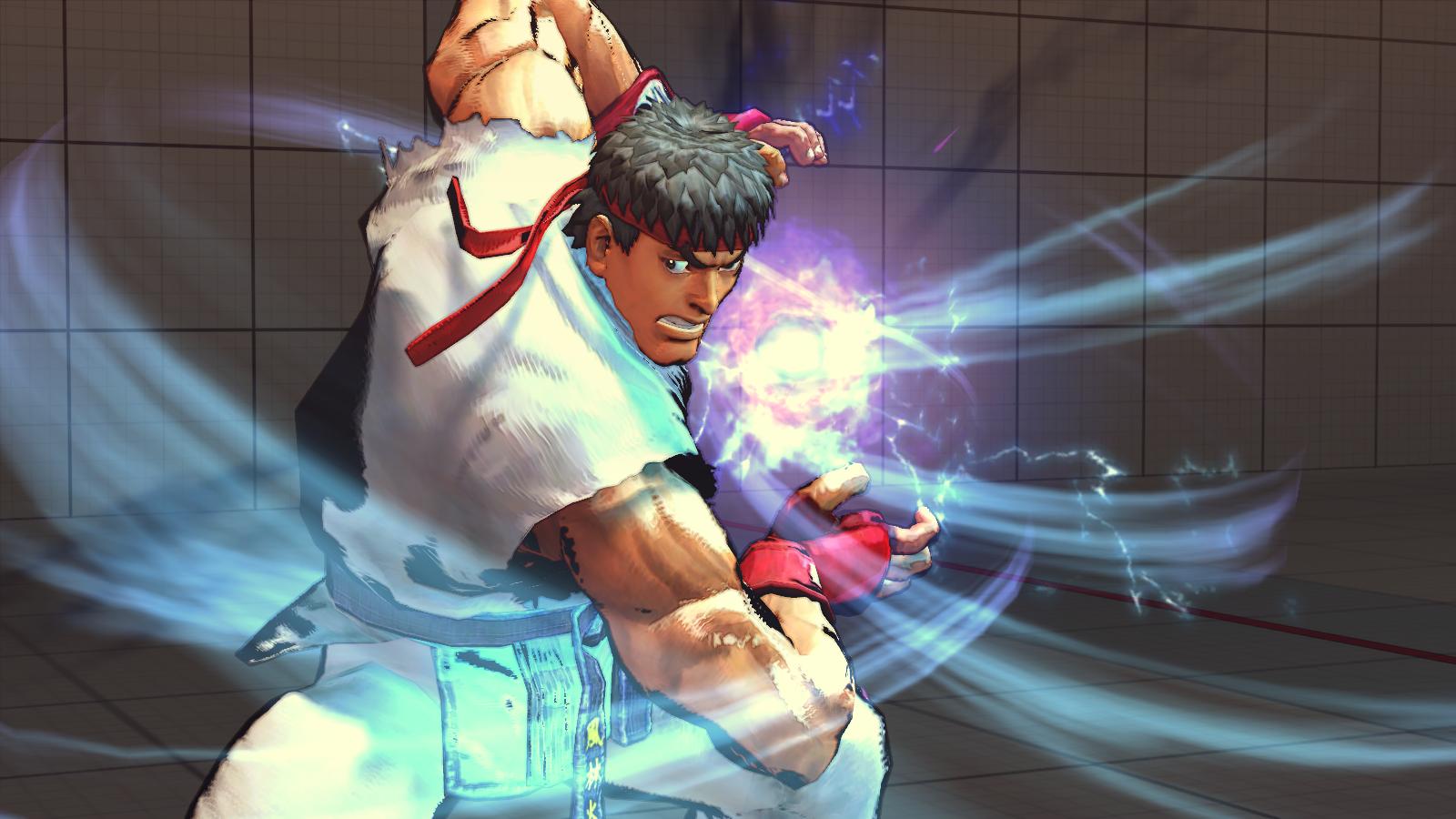
Ryu, one of SF4’s characters, has a really well-designed ultra in his Metsu Hadouken. This ultra is a gigantic fireball that does a great deal of damage if it catches the opponent off-guard. It ticks the most basic comeback mechanism box, in that it allows the player using it to catch up.

Ryu winds up for a Metsu Hadouken in Street Fighter 4

However, the Metsu Hadouken doesn’t do a great deal of work for its player. If he or she just panics and tosses it out there, the opponent can easily block or avoid it. Players need to outwit the opponent and create an opening for this mega-attack, with all the decision-making and strategizing that entails.

The opponent also has decisions to make when the Metsu Hadouken charges up. Experienced players know that there are a limited number of setups that are guaranteed to make the Metsu Hadouken land. Priorities shift as the opponent reevaluates Ryu’s options in light of whether they do or do not lead to the Metsu Hadouden.

Landing or avoiding the attack, however, is just the surface issue.. Would it be better not to use the Metsu Hadouken to catch up, but rather to save it as a way to close out the game after non-ultra-aided comeback? Since the Metsu Hadouken does more damage as one takes more damage, maybe waiting would be best even if there’s a guaranteed setup available right now? Which setups are likely to work against this opponent, in light of his or her behavior and the character he or she is playing? If the opponent knows which setups are most likely to work, what will he or she do in response? The more understanding one has of Street Fighter 4 and its strategy, the more complicated using and defeating the Metsu Hadouken become.

David Sirlin has argued that ultra combos are a problematic element of SF4, and this has led to some internet discussion to the effect that he hates rubber bands in general and ultras specifically. When one goes back to the original source, however, one finds a more nuanced argument: that comeback mechanisms can be good when applied in moderation, that SF4 may need one in light of its overall design, and that there’s a balance between the elegance of designing a game that doesn’t need rubber bands and the advantage of tapping into their appeal. I agree with all of that. My argument is not that catch-up mechanisms are always good, but rather is that if one is going to include a rubber band Ryu’s Metsu Hadouken is a good source of inspiration.

This, then, is a catch-up mechanism done right. It does its job, but only for players who deploy some skill. Both sides have new, difficult decisions to make when the rubber band draws taut. As one improves new layers to the strategy surrounding the mechanism are revealed, no matter which side of the fireball one might be on. The Metsu Hadouken lets players catch up, but it does so in ways that reward skill and good play.

Rubber Bands Done Wrong: Wii Mario Kart’s Blue Shell

There may be no more hated item a player can pick up in all of gaming than the infamous blue shell. Players despise it, and with good reason: the blue shell negates good decisions rather than creating them.

Here’s how it works. Wii Mario Kart is a racing game. The blue shell hunts down whoever is currently in the lead, and stops that player dead in his or her tracks. It’s possible to avoid the blue shell, but it’s exceptionally difficult, so much so that many players don’t think it can be done–indeed, they don’t even try. Getting hit doesn’t ensure that one will fall back in the standings, but anyone who is anywhere nearby will be able to pass. It isn’t uncommon for the leader to drop back to the middle of the pack after a blue shell.

Abandon hope, all ye targeted by the blue shell

Everything the Metsu Hadouken does right, the blue shell does wrong. Are there decisions for the player using it to make? Very few; as a general rule, if one is not currently winning one uses the blue shell as soon as one gets it. Decisions for the leader? Almost none, since the blue shell can only be avoided in specific situations which rarely obtain. Even when they do the decision is completely binary–do you try the trick, or not–and “try” is essentially always the right answer.

There is, of course, a way to be almost completely safe from blue shells: don’t be the leader. In a racing game, however, it seems perverse to incentivize players not to try for first place. Mario Kart doesn’t become more exciting or skill-testing if the players are grinding their way slowly around the track, jockeying for second.

Hence, the effect of the blue shell is to undo the leader’s work while leaving almost no possible response. It punishes racing skill; the better one is, the more

likely one is to be the target of an unavoidable attack that leaves one in 4th place or worse. Blue shells are a rubber band, yes, but in carrying out their function they commit grievous design sins: they discourage good decisions and promote a boring style of play.

If you’re looking at your game and thinking players need a bit of help catching up, a rubber band can be a good way to solve your problem. Just make sure that it makes the game more interesting–for both the followers and the leader. Use it to ratchet up the tension and give players new ways to show their skill.

Game Design vs. Game Theory

First, I just wanted to note the addition of a blog to the links page: Game Design Advance. A number of NYU professors post there, on topics ranging from the expressive meaning (or lack thereof) of game mechanics to lessons game design can bring to the voting process. Most game design discussion revolves around practical considerations; if you’re more interested in the underlying theory of design, I’d encourage you to check it out.

Adding a link on broad game design issues reminds me of an issue that’s come up recently: the difference between game theory and game design. Occasionally when I tell people I’m interested in game design they think I’m an economist, or they tell a joke about my public defense clients being in the Prisoner’s Dilemma. Since the latter, at least, risks sending me off on a tangent about interrogation practices, I think it’s worth clarifying the two terms.

Game theory, as I understand it–and I do not claim to be an expert–is primarily about modeling human behavior. The Prisoner’s Dilemma is a terrible game, but it’s brilliant as a mechanism for explaining why people confess when they would be better off staying quiet. Game theory does sometimes adopt a prescriptive mode, but those efforts rely (again, as I understand it) on building an accurate model.

Game design, on the other hand, is about evoking behavior. It tries to get people to perform certain actions and to experience certain feelings. Those actions might be simple (move a piece on a board) or complex (hit a baseball approaching at 90+ miles per hour), and the feelings might be positive (“this is fun!”) or negative (“this game taught me about a depressing era of history”), but the goal is always to evoke things rather than solely to model real-world behavior.

A designer might, of course, model a historical event as part of the effort to evoke something, and a theorist may want his or her model to make people act or feel in a certain way. The fields overlap. However, they are different enough that I think it’s worth understanding where they diverge. If nothing else, it will protect you from rants about interrogations.

Theory: Taking Mark Rosewater Out of Context

On Monday Mark Rosewater posted his annual “State of Design” article, in which he reviews Magic: the Gathering’s successes and failures for the past year. It’s an interesting read for any Magic player, but as a designer what I think is most fascinating about it are the lessons that could apply to any game. The article has design rules that are still powerful when divorced from their context.

Take, for example, Mr. Rosewater’s conclusion that “[f]lavor is key.” He explains that Magic used the same mechanic (that is to say, a thing cards did) twice: once with a flavorless label, and the second time with a name that evoked ancient Greek mythology. The mechanic was much better received the second time around, in part because players understood what the mechanic represented in the fiction of the game world and got more excited about playing cards with the mechanic as a result. Accessing “chroma” sounded technical and boring, but showing “devotion” and being rewarded for it was fun–even though in both cases players were doing largely the same thing!

Reading Mr. Rosewater’s comments immediately put me in the mind of Over the Next Dune’s rules for keeping searchers on the map. When explained step-by-step, people often find them rather opaque. Say that searchers “bounce like a screen saver,” however, and everyone understands instantly. Picking the right context helps players understand the rules enormously–so much so that I’ve considered switching to a Tron-esque theme just to be able to make the screen savor metaphor more explicit.

Other lessons presented in the article are similar. His self-critique of Magic’s execution of an “enchantment block” is interesting for anyone considering a game with expansions. The discussion on rescuing a failed idea has something to say about every game where the designer’s options are limited. More generally, the fact that Mr. Rosewater criticizes his own work despite the fact that this year saw “the best-selling Magic set of all time” sets a good example.

Mr. Rosewater is a controversial figure; opinions differ on whether he’s saving Magic or smashing it. Whatever one’s opinion of his “New World Order,” however, there can be no denying that he’s learned game design in an environment where sales numbers provide quantitative feedback, with his job staked on his continued success. Hard-won experience like is is always worth considering, and the lessons he has to teach are general enough at the macro level to make figuring out how to apply them to other games time well-spent.

Theory: What to Do If Your Game’s Not Random

Riffing on the idea that the promise of a rare lucky moment is attractive, I thought it might be interesting to look at the fate of VS System–a game where people didn’t get those lucky moments. I should say up front that I only have this story second-hand, but even if it’s wrong it’s still interesting as a thought experiment. It’s a cautionary tale about a game that ended up being unfriendly to new players, and a chance to learn lessons about what to do if your game doesn’t randomly offer new players help.

VS System was a superhero card game. If you wanted to play something Magic-ish, but instead of knights fighting dragons you wanted Captain America fighting Doctor Doom, this was your game. Its crowning achievement may have been its substantial tournament popularity; lots of people got very good at VS System, played it very seriously, and won quite a bit of money in the process.

Part of what made VS System so popular among tournament players was that, even though it was a card game, luck actually had very little to do with the outcome. Better players almost always beat worse players. For heavily-invested players who had spent a lot of time practicing, that was a valuable feature. Their hard work was consistently rewarded.

New players, however, found VS System quite frustrating. Since everyone was better than them, they lost almost every time. They couldn’t hope for a rare lucky moment; no such moment was coming.

Losing is, of course, part of getting better. I have vivid memories of going to the local arcade in Japan once a week and getting trounced for a full year before I managed to win. However, at that point in my life I was dedicated to improving at fighting games. It’s not unreasonable for people to try a game that they’re only casually interested in, get clobbered, and decide that this particular mountain isn’t one they’re interested in climbing.

That was the decision people often made about VS System. Although a dedicated group of old-timers kept the game going, fewer and fewer new players appeared to reinforce their ranks. Tournament players who moved on were not replaced, and ultimately the game folded for lack of sales.

Compare VS System’s experience to Magic: the Gathering. In Magic, the better player wins . . . most of the time. The fall of the cards can give the worse player a chance, creating the openings they need to win. When it happens it makes the better player crazy–but even Mark Rosewater believes the game is better because those moments can happen, and the sales data support him. Magic lets new players get the lucky moment they need once every so often, and as a result it can appeal to a much larger player base.

So, judicious use of randomness can help new players win, and in the process can contribute to keeping a game popular. What if a game has no randomness? Chess has no dice, no cards, nothing that’s outside the players’ control (and I depart from Mr. Rosewater’s view that opening moves are random; a decision made with incomplete information is not random, it is simply risky). Yet, Chess has lasted for a very long time. Diplomacy has a less impressive pedigree, but it’s also a popular game of long standing with no random elements. How do they keep going?

I think there are two key things that non-random games can do to avoid frustrating new players:

Ranked play: Chess’ ELO system helps players find others at the same skill level. Weaker players can avoid being clobbered by playing people at the same ELO–or can opt into a challenge by finding someone at a higher level. Players control how much frustration they experience.

Make it hard to lose quickly: Even an extremely bad Diplomacy player can’t be eliminated in the first few turns. (The writing, admittedly, might be on the wall by then.) Furthermore, the early turns are often when most of the wheeling and dealing at the heart of Diplomacy occurs, so even the newest player gets to experience what the game has to offer and feel like he or she got to participate meaningfully.

I’m sure there are more approaches to this problem, but I feel that these are particularly effective. If your game doesn’t enjoy the luxury of offering rare lucky moments to give new players hope, doing one or both of these will help ensure that they still have a positive experience. That, in turn, will contribute greatly to the long-term health of your game.

Theory: Story Time

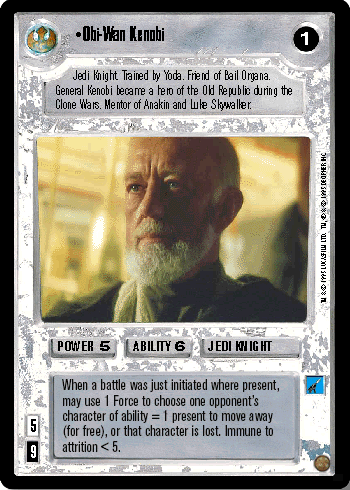
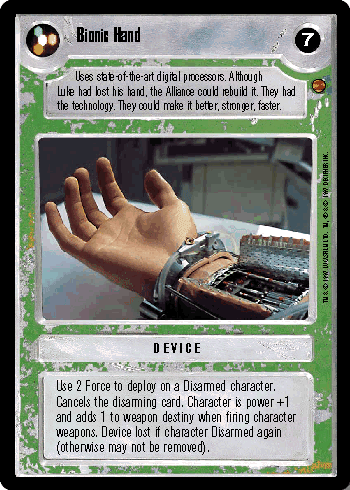
When I was a kid, I saw these two Star Wars cards:

8-13-14 - Obi-Wan Kenobi8-13-14 - Bionic HandTake a look at the numbers in the upper-right corners. They’re used to generate random numbers in-game. Higher is usually better. Mostly they scale from 1-6.

Now, Bionic Hand is pretty useless. IF your opponent is playing the Disarmed card, and IF the situation came up in which that card can be played, and IF your opponent had the card in hand and played it, THEN you can play your Bionic Hand.

But it’s tempting to put it in your deck anyway, because Bionic Hand is a 7.

Obi-Wan Kenobi, on the other hand (no pun intended), is pretty great. Explaining all the ways that he’s great requires some knowledge of the game’s mechanics, so suffice it to say that he’s as awesome as it seems like Obi-Wan Kenobi should be. Obi-Wan is so great that it’s tempting to play multiple copies of him.

But he’s a 1.

These two cards taught me the first game design lesson I ever learned: very powerful things should have some drawback associated with them. Obi-Wan is great once he’s on the table, but he’s terrible if you flip him while generating a random number. Having that weakness prevents Obi-Wan from completely overshadowing cards like Bionic Hand.

Yet, there are more lessons to be found here. Weak things can be interesting if they’re narrowly powerful. Random values can be generated in many ways. The promise of a rare lucky moment is attractive.

I know I’ve been talking about the Star Wars CCG a lot recently. Part of that is because it’s fun to walk down memory lane, but part of it is because the game did a lot right. When looked at critically, it has a lot to teach.

Theory: When Card Advantage Wasn’t

Years ago the second-place collectible card game was Decipher’s Star Wars game. When Decipher lost the Star Wars license an arrangement was put into place allowing players to carry on making cards, which is fascinating from a legal perspective–I’d give a great deal to have been a fly on the wall during those negotiations. However, the game remains interesting from a design standpoint as well. It turns the conventional wisdom regarding card games on its head, and in the process demonstrates that even fundamental ideas about a type of game can be subverted successfully.

In 99% of card-based games, having more cards in hand is almost strictly better than having fewer. Cards give one options in the game, so more cards in hand means more options. Moreover, additional cards ultimately lead not just to more choices, but to better ones; a player with few cards has to improvise with what he or she has, while a player with many cards can select the perfect tool for the job.

The idea that more cards in hand is better is so thoroughly ingrained that Magic: the Gathering players developed a name for it: “card advantage.” Magic players routinely talk about getting card advantage, or ways to achieve card advantage. Card advantage is so commonly discussed that it was featured in a new-player series on the official Magic website. Whole theories of Magic exist to explain why decks that don’t achieve card advantage can possibly win. Even cards that don’t actually add to a player’s hand are understood in terms of the “virtual” card advantage they provide.

Getting more cards is so important in card games that Magic designers built a card that forces a player to voluntarily take on extreme card disadvantage as a wacky puzzle. They created One with Nothing–a card which forces a player to discard his or her own hand–just to intrigue those players who feel that “no card is too bad to find a use for.”

Star Wars turned all of this on its head. Drawing cards in Star Wars is easy, and there’s no maximum hand size. You can draw cards almost to your heart’s content. There’s just one problem: if you draw lots of cards, you’ll lose.

The designers who worked on Star Wars–I regret that I don’t know who they were–achieved this very elegantly. The cards in one’s deck are one’s “life bar;” when they run out, the game is over. Drawing cards, of course, reduces the number of cards in the deck. Hence, drawing cards is powerful, but also dangerous.

(Magic has somewhat the same setup, in that running one’s deck out puts one in danger of losing. However, because it’s unusual for the opponent to be able to attack one’s deck directly it’s much easier to manage one’s card drawing against the size of the deck. Furthermore, most decks don’t have anything like the card-drawing power of a Star Wars deck. Magic therefore lacks this tension in all but very unusual situations.)

Star Wars’ designers took this tension one step further. At the start of each turn, player takes a set number of cards from the top of his or her deck to form a separate pool. Costs of playing cards are paid from that pool. However, one can only draw cards from that pool. Players therefore have to weigh not only how much card drawing is safe, but also how far they can afford to go before they’re limiting what their plays for the turn too severely.

The result of all this is a number of interesting decisions. Is it better to play Darth Vader and lose out on drawing cards for the turn, or to rely on a lowly stormtrooper and refill one’s hand? When one is losing and needs to find a specific card to turn things around, is it better to draw lots of cards–and thereby lower one’s “life bar” a great deal–or to gamble by taking just a few? How does the opponent’s strategy influence that choice?

I imagine that most of the Star Wars CCG’s fans played because of the theme–I know that’s why I did, many years ago. However, under the theme (and the extreme complexity of the rules) there was a very strong design concept. If you get a chance, give the game a try. It’s a much different experience from other card games, and well worth your time.

Theory: What Is a Game?

Is painting a game?

It’s a more interesting question than you might think. Most people intuitively reject the idea. They’ll accept painting as an activity, perhaps as an aesthetic pursuit, but not as a game. Yet, painting has many of the traits we often associate with games: the ability to develop mastery, a requirement that the person doing it make decisions about how to proceed, judges who evaluate success and failure. Depending on what traits one thinks are important in defining a game, painting might make the cut.

What about writing a sonnet? There are rules defining what does and doesn’t count as a sonnet, but most people don’t consider following those rules a “game.” Does that mean rules don’t matter, or just that rules are a necessary–but not sufficient–condition?

There’s academic literature grappling with the question of how to define games. Yet, the question still seems open. Greg Costikyan argues that games require decision-making, but thinks Candy Land is a game even though the players never decide anything. The Wikipedia page on the definition of games (with apologies for citing to Wikipedia) notes that Chris Crawford doesn’t consider car racing a game–but then cites it as an example later. Do all definitions ultimately start with a preconceived notion as to what counts as a game, and then manipulate the definition to include and exclude activities based on those preconceptions? Is the notion of “game” so inherently emotional that trying to compare activities to a Platonic “game” is doomed to failure?

I don’t have the answers. I do, however, have some reading to do.

Prototyping Materials, Part 2: Nicer Cards

Following up on a previous post about building prototypes: what happens when you’re past the 3″ x 5″ card stage, and want to make some really nice cards to show your game off? You could use a service like artscow, but if you want to do the work in-house this thread on Boardgamegeek is an invaluable resource. The materials required aren’t expensive, and the work is fun in a craft-project sort of way.

Theory: Balance Matters for All Skill Levels

The common wisdom about game balance–that it only matters for top-level players–is incorrect. It is true that balance is more important to the outcome in matches between highly skilled players than it is when newer players compete. However, balance has a far greater impact on fun for weaker players than it does for stronger ones. Both groups benefit from balance and are hurt by its absence.

“Balance” is a tricky word in game design. It sweeps in a lot of issues and discussions about different types of games that arguably shouldn’t be directly compared. Here, I’m talking about balance in initial choices: between characters in Street Fighter, champions in League of Legends, interstellar empires in Twilight Imperium, and other situations where players select a set of capabilities before the conflict begins.

Players of these games often argue that balance is only important at high levels of play. The argument goes something like this: in games between low- to mid-skill players, the difference in ability between the players decides who wins. Slight advantages in one’s choice of character/champion/empire are swamped by relative skill. It’s only when both players are quite good that those slight advantages matter.

The flaw in that position is that it assumes balance only affects winning. It also plays a role in determining how much fun the players have. For experienced players the role is smaller. With new and less skilled players, however, balance can be the single determining factor in whether or not they enjoy the game.

Top players, in my experience, derive most of their fun from developing mastery. They like exploring the game, understanding it, practicing it, and demonstrating the skill they gain thereby. Whether they do that with this character or that empire doesn’t matter as much as the play and the results.

I can’t think of a better example of this than Mike Flores’ view of Caw-Blade. For those who don’t play Magic: the Gathering, Caw-Blade was early 2011’s dominant tournament deck. “Dominant” can’t be emphasized enough; Caw-Blade won again and again and again, sweeping all competition before it. In its day Caw-Blade was the only reasonable choice for what to play in a tournament.

Mike Flores, a well-known Magic player with a history of tournament success and writer of many influential articles, loved the Caw-Blade environment. He conceded that Caw-Blade was by far the best deck–but, he pointed out, Caw-Blade vs. Caw-Blade games were extremely skill-intensive and rewarded good play. It didn’t matter to him that there was only one valid deck, because that deck enabled players to show their stuff.

Newer and less practiced players, however, often have neither the experience nor the mindset to mitigate balance issues. They don’t know what the good choices are, and if they find out may not feel able to switch to them. As a result, these players can have frustrating experiences when they encounter high-level play.

This dynamic played out very clearly in the old Star Wars miniatures game. If a player did not have a plan for the “Black-and-Blue” strategy, or really wanted to play the Mandalorians even though they were weak, he or she could lose games in rock-paper-scissors fashion even against an opponent of equal skill. High-level players, and those aspiring to that status, took note of the imbalances and moved on; others just got aggravated.

To be fair, the differences in power between SWM pieces was stark. Games with smaller imbalances are less likely to produce these joyless situations. Even small imbalances, however, can build into commanding leads over time–especially in casual games between friends, where everyone involved is a repeat player and streaks are likely to be noticed.

Balance affects which top-level player wins. However, it can also affect which lower-level player has fun. Thus, balance shouldn’t be seen as irrelevant to new players and the lower ranks on the ladder. It’s important to these groups in different ways, but it’s important to all of them.