Theory: Make Things Appealing

Take a look at this rest stop along the New York Thruway:

ny-thruway-rest-stop
“Pembroke Travel Plaza,” thruway.ny.gov

Wood framing suggests a natural environment, and perhaps a cozy log cabin. It melds well with the stone for a set of calming earth tones. Grass, flowers, and small trees add to the natural atmosphere. This is a rest stop that looks welcoming during a long drive.

Now consider this one, found on the Pennsylvania Turnpike:

pa-turnpike-rest-stop
“Service Plazas – Lawn,” paturnpike.com

While this also has stone and wood framing, the effect is ruined by prominent siding. The multicolored, industrial, garish roof forms a big part of the rest stop’s visual area. Rather than grass or trees, the parking lot extends all the way to the front walk. Overall, this is a rest stop that looks like it probably has dirty restrooms.

How something looks has a tremendous effect on how welcoming it is. When your design is made of inviting objects, people will want to interact with it. By contrast, you have to convince people to try uninviting things.

Brendan Byrne has pointed out that this applies, not just to service plazas, but to more directly game-related things like buttons. Simon has big, happy-looking buttons that are easy to press; they imply a game that’s easy to learn and play.

simon
“Simon,” boardgamegeek.com

Compare that with your average fighting game layout:
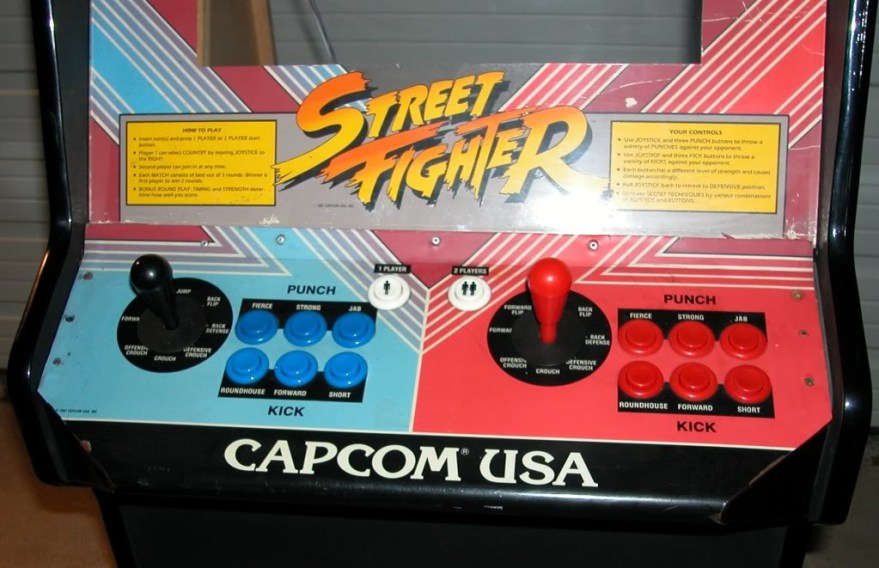
sf-cabinet-layout
Image from forums.arcade-museum.com

I don’t think anyone could look at that without thinking that this game is pretty complicated.

Try to make your game look welcoming. One of the greatest barriers for any designer is simply getting people to try what you’ve built. You’ll find your audience much faster if you don’t have to get them over the hurdle of a system that appears hostile.

Talk on Cooperative Game Design: Following Up

Thanks to all who came out for my talk at the Tech Valley Game Space on Wednesday. I hope those who were there found it informative–certainly, I enjoyed the chance to give it!

When the video of the talk is available, I’ll add a link to it. I’d put up the slide deck, but it’s frankly incomprehensible without the audio. 😉

By the by, the Tech Valley Game Space is a remarkable spot. Housed in a maker space in downtown Troy, NY, it offers access to all manner and hue of equipment. 3D printers are just the start of what it has–and of course, that’s to say nothing of the community. The organizers are knowledgeable, helpful, and doing a lot to foster an independent game design and development community in the area. Stop in if you get the chance.

Again, thanks to everyone who joined us!

Tonight: Talk on Cooperative Game Design

Just a reminder that tonight I’ll be giving a talk on principles of cooperative game design at the Tech Valley Game Space, 30 3rd Street in Troy, NY. The talk is part of the Albany chapter of the International Game Developers Association meeting; the meeting begins at 6:00, with the talk at 7:00. Further details are available at the Tech Valley Game Space website.

Hope to see you there!

Link: Collecting Game Design Blogs


One of the most exciting things about game design is how quickly interest in the topic is spreading. Games are growing, and as they do we’re seeing players become more and more sophisticated about what differentiates the best ones. Increasing access to game developers for major titles is also encouraging people to think about design–if only so that they can convince those devs to make the changes they would prefer.

As interest spreads, so too is game design writing. The Links page has some longer-standing resources. Keith Bergun has now begun collecting design blogs that started in 2016. I’m looking forward to taking a look at them; if you’ve got a suitable blog, please do add it!

Link: Humble GameDev Software Bundle

Humble Bundle is doing another of its game design-relevant software packages. As usual, it’s a great deal. I can’t speak for most of what’s included, but PICO 8 by itself makes the bundle worthwhile.

PICO 8 is a “fantasy console”–a program that enables people to make games, and then runs the games they create. In PICO 8’s case, the goal is to make games that wouldn’t look out-of-place on 8-bit consoles like the original NES. All the necessary tools, from a sprite editor to an audio creator to a programming IDE, are built in; you make games without needing to leave the PICO 8 framework.

One of the joys of game design is exploring the capabilities of new tools, seeing what they offer and feeling out the interesting effects of the constraints they impose. The current Humble Bundle is a wealth of opportunities to do just that; how often do we try to make 8-bit games these days? Give it a look.

How Not to Improve Visuals

I don’t often venture into the realm of graphics and graphic design. Making a game look great is a skill all its own, and I don’t really have it. Nevertheless, being at a design school I’ve at least learned some basics–and the forthcoming visual update to King of Fighters XIV is breaking with one of them. In the process, it’s missing what I think is the major problem with the game’s look.

For reference, here’s a video advertising the graphics changes:

Right away one can see that shadows on characters are deeper. That goes some distance toward making them look less plastic. Only some distance–they still don’t look lifelike–but it’s better.

A subtler issue appears 20 seconds into the video. Watch how Kyo rises into the air. More importantly, note how Kyo lands at 22 seconds in.

It doesn’t look right, does it? To understand why, take a look at this post by Blake Reynolds of Dinofarm Games. He compares Street Fighter III: 3rd Strike’s animation to how characters move in Street Fighter IV, and notes that Third Strike’s animations impart a much stronger sense of motion. Chun-li “looks full of adrenaline and intensity” in Third Strike, whereas in SFIV “the animation is just kind of dead . . . .”

That sense of deadness is the big problem with the landing in King of Fighters XIV. Kyo doesn’t hit the ground, he glides to a halt. (In pseudo-technical terms, Kyo looks like the programmers are moving him with a clamped lerp.) His clothing doesn’t even ruffle. There’s no sense of motion, of a weight coming to a sudden stop–and there’s no feeling of power as a result.

KoFXIV will look better after the update. Unfortunately, it’s still not going to be as compelling as such a long-running and beloved franchise deserves. New lighting can’t substitute for great animation, and KoFXIV still won’t have that.

Frank Lantz on the Immersive Fallacy

One of my formative moments in game design was reading the critique of immersion in Salen and Zimmerman’s Rules of Play. They cite Frank Lantz, director of the NYU Game Center, in pointing out that Star Trek‘s holodeck is not the be-all and end-all of game design. Even if one built the holodeck–the perfectly immersive experience–that would not be a game. It would be, at best, a place in which to have a game. Immersion is not gameplay.

I just found out that the original talk in which Frank Lantz makes this point is available online. Let me urge you to take six minutes and ten seconds to listen to it; I think it will prove valuable for your thinking as well.

And then there Was Everyone

Privateer Press released a much-awaited round of balance errata for Warmachine and Hordes today–but those weren’t the most interesting changes. The real news is that from hereon out, they’ll conduct open playtests of forthcoming models. It’s a neat idea, and an interesting test of how willing the playing (and paying) public is to do testing right.

An integral element of really good playtesting is getting context. What kinds of games does this tester like? Are they more into competitive play, or casual games? Do they tend to win or lose? What’s their favorite game, and why? All of these questions help designers understand and interpret the feedback they’re receiving.

For example, suppose you want to test a character in a fighting game who you think is powerful, but subtle and difficult to use. If a tournament player who regularly defeats pros says “this character is bad,” the character might well be weaker than you expected. By contrast, a tournament player who never gets out of the loser’s bracket saying “this character is bad” isn’t convincing evidence that the character is weak. You might, though, consider it a sign that the character is very complex indeed, so much so that even highly invested players have trouble with them.

Now consider a tester who’s a fan of tournament games . . . but mostly because they’ve developed a crazy, unique style, and they like to show it off . When that tester calls a character “bad,” is it because the character is weak, or because there isn’t enough opportunity for self-expression in their moveset? If you haven’t asked about the tester’s background in games, you won’t even know to explore the issue.

I imagine that Privateer Press’ goal in running open playtests is, at least in part, to get useful data. (There may also be a political objective, whereby players are encouraged to view new models more positively because they had a hand in their creation; I’ll be curious to see whether this works out.) They can do that, but the players need to hold up their–our, I’m one of them–end. Privateer Press has to create surveys, and players must be rigorous about filling them out. Interviews will sometimes be necessary, and everyone involved has to make time for them.

Playtesting isn’t just about gathering information. It’s also about interpreting all of that data. If PP wants help, I’m available. 🙂

An Amusing Note

While I haven’t looked at the paper, this is a lighthearted look at the intersection of listening and gameplay. To me, the striking thing isn’t that listening to AC/DC’s Thunderstruck caused some people to be worse at the classic, challenging dexterity game Operation; it’s that there was anyone who was able to remain unaffected!