Theory: Build a Knowledge Base

This article is interesting, for two reasons. First, it has some Kickstarter-related advice that might be of interest. Second, and perhaps more importantly, it has this to say about good design:

Pro Tip: Play a f*** ton of games before you try to design one.”

While I wouldn’t put it in those terms, I think the message is spot-on. Having a broad familiarity with games helps one avoid reinventing the wheel, and all the struggles along that path.

We’ve been down this road before

A lot of people have made a lot of games. That means that someone has probably at least attempted something similar to what you’re looking to do. In some cases, they discovered something your game would greatly benefit from knowing.

The current mousetrap

In some cases this might be a mechanical innovation that you could put to use. Magic: the Gathering, for example, left-right-left pattern of drafting to a huge new audience.*

(For those unfamiliar with Magic drafts, each player opens a pack, chooses a card from it for her deck, and then passes the remaining cards to the left. Everyone keeps choosing one card and passing until all the cards from all the opened packs are gone. Everyone then opens another pack, but passes to the right for this second round. Finally players go through a third round, passing to the left once again.)

The left-right-left approach makes card picking decisions much trickier than they would be in a left-left-left draft. For example, in a Magic draft a player might intentionally pass cards of a color he doesn’t want to play to the player on his left in round one. Hopefully the player to the left will focus on that color–and will therefore pass cards in some other, more desirable color to the right in round two. Since the left-right-left pattern makes “signaling” in this fashion important, and since signaling makes weighing one’s pick choices quite a bit more interesting, the left-right-left system has been widely adopted (see, e.g., 7 Wonders). If you’re making a card-drafting game, it’s far better to know about that pattern–whether you adopt it or react to it–than to spend hours upon hours figuring it out from scratch, just so you can get to the design stage that someone who’s drafted Magic cards would’ve reached immediately.

The dark paths

It might also be that your idea has been tried before . . . and didn’t work out quite as planned. Learning from past mistakes can save a lot of time and heartache.

One sees this at play every time someone says they want to create a new CCG. Immediately someone points to the endless ranks of failed trading card games. Each of them sought to recapture Magic‘s lightning in a bottle, but were brought low by some combination of complex packaging requirements, enormous distribution costs, overwhelming design challenges, and an inability to develop a player base large enough to generate useful network effects. Better to redirect the design early to a model that’s going to be more workable.

There are warnings to be found in the digital realm as well. Online multiplayer, for example, is exceptionally hard to implement. AAA studios have made it seem like a de rigeur inclusion–but of course, they have AAA resources. Smaller studios and independent designers have run into trouble after promising it, and might want to focus on single-player games while they build up money and expertise. Playing games with shaky online play, or where the “multiplayer” button has been greyed out since release, or even very successful games that have struggled with rocky launches (which is to say, just about every multiplayer game, even those with the backing of huge enterprises) might help developers realize that they should think carefully about whether and when they’ll commit to online play.

On the Shoulders of Giants

Playing lots of games doesn’t mean that one has to go back over old ground endlessly. Nor does it mean the accepted ways of doing things become constraints. Rather, knowing what’s out there makes innovation easier, by enabling one to know which design approaches are actually innovative–and which are well-trod paths, or worse, are rife with land mines. Don’t use play-for-research as a substitute for progress on your own work, but recognize the importance of that research, and make time for it.


*I’m not sure if the pattern originated there, but it may well have.
Unity: Static Batching Timing

An interesting, undocumented aspect of static batching in Unity: static batching occurs between Awake and Start. Objects in the hierarchy at that point will batch; anything created later will not.

This is true even when loading scenes additively. If as the additional scene is loaded in Awake(), and the additional scene contains a script instantiating objects in its Awake(), those objects will undergo static batching if they’re otherwise eligible. If the scene is loaded in Start(), or the instantiation occurs after Awake(), they won’t. There are lots of weird timing issues with additive scene management, but this, at least, seems to work as expected.

I hope that this saves someone out there the hour or so it took us to figure out when we needed to be instantiating environmental objects. 😉

Unity: Shaders and Static Batching

I’ve learned a lot about static batching in Unity today–not least that it has more requirements than appear in the documentation. 😉 Does anyone out there know of good resources on how batching and shaders work (or don’t work) together? Gameobjects in a project I’m working on aren’t batching, and it’s definitely because of the shader.

Theory: Show the Score, Part 2

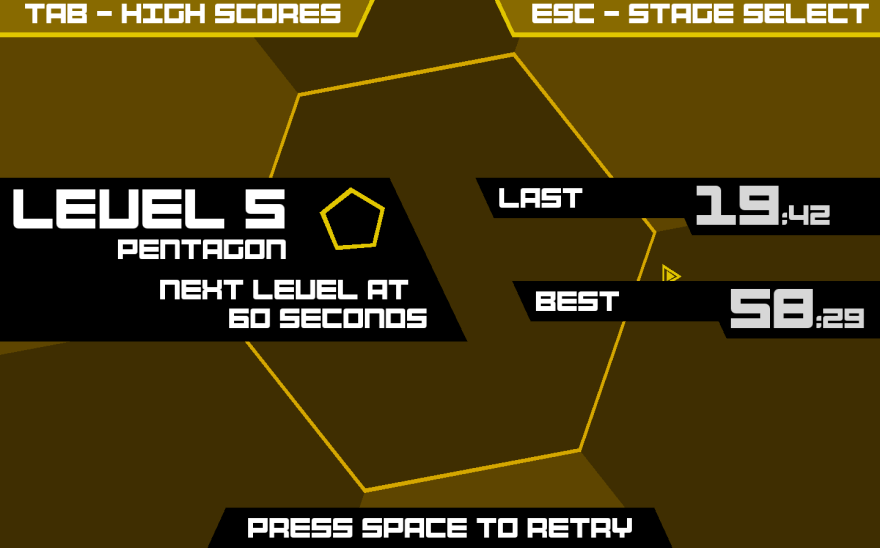
Following up on last time’s post, consider the end-of-game screen from Super Hexagon:

Screen Shot 2016-05-13 at 11.36.47 PM

Every time the player’s game ends, she gets no fewer than three statements of how well she did: the numerical level she reached, the shape she reached, and the number of seconds the game lasted. The latter is compared to her best score, and the game provides information about how to get to the next tier on the leaderboard.

Espgaluda has almost none of that. Players get to see the leaderboard, and that’s it. There isn’t even an appreciable delay before the game switches over to the leaderboard, so that players can check what their score is manually!

If you’re building a high score game, model your end-of-game sequence after the Super Hexagon style. Much of game design is thinking you’re offering enough feedback, and then discovering that you need to give more. That’s as true for scores as it is for anything else; don’t skimp on the score information when play is done.

Theory: Show the Score

A quick lesson I’ve learned from Espgaluda, Cave’s classic bullet hell game: always, always show the player’s final score in a high score game, regardless of whether the player is going to be on the leaderboard. Espgaluda doesn’t pause to tell you your score if you lose without making the high score list, and so one only gets a sense of progress when one reaches a tier on the leaderboard. That’s pretty rough–especially for new players, who most likely aren’t anywhere near a high score but who are learning and could benefit from some positive reinforcement to keep them engaged. Displaying the player’s score gives some valuable extra feedback each and every game.

Intentional Draws Revisited

The perennial challenge of intentional draws just reared its head again, this time in FFG’s X-Wing. I can’t say whether FFG was right or wrong to decide to allow intentional draws; in some ways it comes down to the message they want to send about whether X-Wing tournaments are intended as an extension of casual play or as a separate, competitive way of interacting with the game. What I find more interesting is the following passage in the tournament rulebook:

During Swiss rounds, players may intentionally draw a game so long as a leader is present for any discussion between players prior to the agreement. The leader’s presence is required to prevent any breach of the tournament’s integrity. The leader will not intervene as long as players follow the “Unsporting Conduct” on page 3.

This is an interesting approach to the problem of intentional draws, one that solves some problems while creating others.

First, for reference, here’s the relevant portion of the unsporting conduct passage:

Players are expected to behave in a mature and considerate manner, and to play within the rules and not abuse them. This prohibits intentionally stalling a game for time, placing components with excessive force, inappropriate behavior, treating an opponent with a lack of courtesy or respect, cheating, etc. Collusion among players to manipulate scoring is expressly forbidden. Players cannot reference outside material or information during a round. However, players may reference official rule documents at any time or ask a judge for clarification from official rule documents.

What’s potentially good

Having a “leader” (what in some systems would be called a Tournament Organizer or Judge–someone with rules authority) present has the potential to address concerns about bullying or hassling opponents into accepting an intentional draw. Theoretical arguments in favor of permitting draws generally revolve around the idea that players should be free to do what makes sense within the confines of the tournament structure. A leader’s oversight will hopefully keep the discussion on the ground along such tactical lines.

An official presence also serves to avoid misunderstandings. I remember being presented with a weird hypothetical situation years ago: two players reach differing conclusions about the board state in a game, each concluding that they are sure to win. One silently offers a hand, thinking she is offering a draw. The other shakes in the belief that she was conceding. While that is obviously an extreme situation, there is a lot to be said for a leader clarifying all agreements before results are reported and it becomes difficult to handle a problem.

What’s potentially bad

Understanding how the new rules work demands some analysis. Most intentional draws, after all, are efforts to “manipulate”–or at least change–the tournament scoring. On the face of it, then, the intentional draw and unsportsmanlike conduct paragraphs seem to conflict.

I would argue that the problem is resolved easily enough. Merriam-Webster defines “collusion” as “secret agreement or cooperation especially for an illegal or deceitful purpose.” FFG doesn’t define collusion in the rules document, so we can justifiably fall back on the dictionary definition; in the absence of an explicit statement, we can assume that words carry their normal meanings. With the dictionary definition in mind, it’s clear that the unsportsmanlike conduct passage prohibits secret agreements–e.g., intentional draws worked out away from a leader. The passage is reinforcing the requirements for intentional draws.

Even given that the apparent conflict is resolvable, though, it’s unfortunate that the rules are written in such a way as to allow this question to arise. It would be good to clarify exactly where the boundary between valid intentional draws and improper collusion lies.

Another question is what constitutes a “breach of the tournament’s integrity.” Including that phrase separate and apart from the reference to the unsportsmanlike conduct policy implies that it means something other than what the policy contains. What, though? If the unsportsmanlike conduct policy is not a complete statement of what the leader is there to deal with, the additional requirements would benefit from being laid out clearly; if it is, there’s no need for the possibly-confusing extra verbiage.

An unusual solution

FFG’s approach to intentional draws is, to my knowledge, unique. It’ll be interesting to see what comes of it; I’ll be keeping an eye out for further developments. In the interim, I would encourage FFG to address the issues noted above; with just a little tweaking the policy could be a lot more clear, and thus enjoy the best possible odds of success.

Warmachine Mk. III

I have to admit, I didn’t think Privateer Press was going to rebuild the system for its premier game. The system was showing a bit of wear and tear, but the overall structure had proven sound for tournament play. Errata curbed the biggest issues that emerged. No big changes needed . . .

. . . or so I thought! Privateer Press announced the Mark III rules at the beginning of the week, to be released this June.

The things I’ve heard so far are interesting, most notably that the game will now allow pre-measuring all the time. I’ve had a post on pre-measuring knocking around my head for a while. Sooner or later I’ll have time to write it up. 😉

For now, I’m excited to see what the new edition brings. Here’s to many more nights of toy soldiers and good friends.