Initiative-Based Battle Test

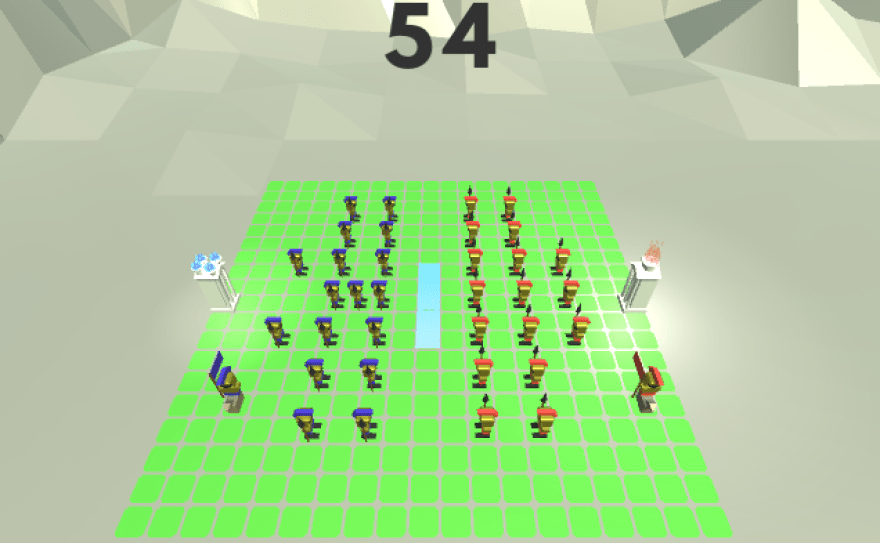
When I played Final Fantasy X years ago, I was taken with its focus on manipulating the turn order during battles. Jockeying to get more turns, and delay the opponent’s, was a great mini-game. Every little victory felt enormous, and was rewarded with the coolest thing possible–more play. Setbacks were punished with similar vigor. The system wasn’t subtle, but the enormous stakes certainly made it engaging!

I’ve long thought that there’s an entire game in that system, just waiting for its time to shine. This prototype (Mac build) is a quick-and-dirty exploration of the concept. There’s a broken strategy right now; can you find it?

Crime Scene Neanderthal at the American Museum of Natural History

This summer I’ve had the privilege of working on the Crime Scene Neanderthal interactive activity at the American Museum of Natural History in New York. CSN casts visitors in the role of a detective who must seek out the origin of mysterious bones unearthed during a construction project. Along the way, visitors learn about the latest scientific discoveries regarding Neanderthals, perform forensic investigations, and explore the Museum’s Hall of Human Origins.

My primary role was in using my playtest-running skills to gather and analyze visitor feedback. Testing games that aspire only to be great games, and activities that need to be both entertaining and educational, had a lot in common. I was very glad to be able to contribute, and I’m looking forward to seeing the final results when CSN formally launches later this year.

If you’re in the New York City area, you can find CSN at a cart in the Museum’s Hall of Human Origins on many weekdays. It’s absolutely free, and will telescope to suit your schedule: you can play for five minutes or for more than 40, as you prefer. Give it a look!

Phalanx3d’s Attract Mode

With some additional feedback put in and a touch of bug fixing, Phalanx3D was ready for another round of playtesting at about noon today. That meant I had time to work on an attract mode–the sequence that plays while an arcade game is waiting for coins.

Traditionally attract modes have featured the game being played comically poorly. Fighting games show off combats in which the martial artists don’t seem able to touch each other; shmups neglect the unique mechanics that make high scores possible. At times one wonders how these displays ever manage to attract anyone. 😉

Originally I set out to replicate that cheerfully terrible play, if only as a matter of historical interest. Attract modes are always like that, after all. Shouldn’t I nod to illustrious arcade forebears?

I couldn’t reconcile myself to the obvious design weaknesses of that approach, though, and I’m now thinking that using the attract mode to teach the game properly is a better bet. That will mean pre-recording solid games that can be used to demonstrate key aspects of play. My expectation is that that will be done by the weekend.

We’re still on pace for a start-of-school release. Further news as events warrant . . . .

Phalanx–Now in 3D

At the beginning of the summer I decided to re-reimplement Phalanx, both to resolve some code architecture problems and to practice some 3D modeling. Since then I’ve been working on it part-time, investing a few hours into the game each week when not on other projects.

Screen Shot 2016-07-27 at 11.03.09 PM

I’m broadly pleased with how things are coming along, but have found the camera to be a real struggle. At high angles the game loses a lot of visceral appeal; too low and it’s impossible to take in the playing field. The camera angle you see here is a functional, but unexciting, compromise.

Currently Phalanx‘s new incarnation is to be released at the end of August, with an appearance on the arcade cabinets at the NYU Game Center. In the service of that goal, it’s time to go back to the grindstone . . . .

Royal Wedding

Royal Wedding (a name that really needs to be changed) draws loose inspiration from the fascinating Crusader Kings IICKII is what Civilization would be if, instead of playing as an eternal and effectively-omnipotent ruler, you played as a specific person with no more than about 40 years of rulership in you. If you want to keep playing after that, you need to arrange to have an heir.

Manipulating royal lines of succession is one of the best parts of CKIIRoyal Wedding runs with that idea of political marriages, following up on CKII‘s example (and a great conversation with my Game Center colleague Alexander King) by putting intense focus on the question of who’s related to who. Your ability to carry out key game functions increases or is constrained depending on whom you have marriage ties with, and how closely those ties bind.

In play, Royal Wedding is to Diplomacy what Dark Moon is to Battlestar Galactica–or at least, I hope so. The intent was to provide the Machiavellian calculation that Diplomacy inspires in a much shorter timeframe. I’ll leave it to the player to decide whether the game succeeds. 🙂

The rules for Royal Wedding can be found here. Print-and-play elements amount only to a few cards, so this is an easy one to assemble. I hope you enjoy it!

Playful: No Plan Survives Contact With the Playtesters

One of Playful‘s core ideas is a steady powering-up over the course of the game. The longer the hide-and-seek goes on, the easier it is for the knight to capture the dragon, and the more the dragon can do to avoid the knight. Since the player needs a final powerup to win, she has to keep the match going even as the stakes rise.

I was aware of one challenge that structure demanded I confront:

1. What should the powerups be? They need to feel powerful and rewarding, be interesting to work with, and yet not unbalance the game.

Frank Lantz brought another one to my attention in testing this evening:

2. How does the game feel without the powerups? In order to make the first powerup–a dash move–impressive, I had made the player really slow without it. While this had the intended effect, it made the early game miserable. Players understood very quickly what they were meant to do, but making it happen took an unnecessarily long time.

I’m grateful for the feedback; this is an issue I hadn’t thought to consider, but it’s vital to players’ first impressions of the game. I’ve now changed the first powerup to a smoke screen rather than a dash, which enabled me to give the dragon more speed at the outset. Hopefully that will improve the experience; of course, only more testing will tell!

 

Playful

There’ve been a couple of posts alluding to the current thesis prototype. Now it has a name:

Screen Shot 2016-07-15 at 11.24.01 PM

Playful is a game about hide-and-seek. Two little kids, who happen to be a dragon and a knight, are chasing each other through a forest. Since the dragon has some natural advantages (most notably the ability to breathe fire), they agree that the dragon can’t go for the win until the knight has spotted the dragon twice. If the dragon can avoid getting tagged in those moments of risk, it’ll be possible to breathe fire on the knight and win the game.

One of my goals with Playful was to explore a form of conflict that isn’t within the violent norm of video games. We as humans compete all the time, but only a very small number of those forms of competition appear in games. I’ve been enjoying bringing kids’ makeshift, balanced-on-the-fly competitions into video gaming.

Playful is also meant to capture the notion of engaging with the risk posed by an opponent rather than controlling the opponent to negate risk; a few of my classmates summarize the idea as “honorable competition,” and I think that’s a good way to put it. Again, this is something we routinely do, giving one player small advantages or imposing limitations to ensure that a game is fun for everyone. Capturing that negotiation has been a lot of fun.

I’ve enjoyed working on Playful enough to want to polish it into something releasable, even if just as an interesting proof of concept. That process is ongoing now. Look forward to it in the coming weeks . . . .