The Case Study: Replacing Terrain Piece 4

Terrain piece 4 needs to go. It doesn’t create interesting situations in play, and it’s difficult to work with. We need to replace it with something that leads to challenging decisions, and preferably the replacement should be a simpler shape that doesn’t raise rules problems.

Of course, saying that the new piece should “lead[ ] to challenging decisions” isn’t very useful by itself. How does a terrain piece do that? We need to develop some new rules that tell us how terrain in Over the Next Dune works before we can figure out what will work well.

1. “Thick” terrain pieces and “thin” ones involve different decisions.

Take a look at piece 6. It’s a 5×3 block. Moving across it vertically will bog a player down for an entire turn, plus part of a second. Getting across it horizontally is . . . well, suffice it to say that that’s not a good tactical move.

In my experience, piece 6 is usually treated as if it just walls off the spaces it occupies. No one wants to go near it, lest they end up in a turn-wasting slog. The decision players make when they look at it is, “how do I get where I’m going, given that I can’t use that part of the board?”

Piece 1, by contrast, is very small–a 5×1 line. Players don’t love crossing it, but they’re willing to do so if they’re already close enough that going around would be slower, or if the searchers make going around unwise. The decision here isn’t about how to avoid the piece, but rather whether to avoid it.

2. Terrain with a variety of widths creates different incentives in different places, and is more interesting as a result.

Piece 5 is as thick as piece 6 in some places, as thin as piece 1 in others. In my experience, those differences in width matter. Where piece 5 is thin, the players consider going over it; where it’s thick, they avoid it. This single piece combines the decisions involved in the other two, and makes each of them more interesting: is this spot thick enough that it should be treated as walled off? Is there a route across the terrain that’s more favorable? It’s much harder to develop a simple rule of thumb regarding piece 5, and that makes the piece a lot more engaging to think about and deal with.

3. Both terrain’s vertical and horizontal lengths are relevant during play.

In general, the solution to terrain in OtND is to shift sideways before getting to it. Piece 5, however, creates a vertical channel as well as a horizontal barrier. It therefore makes the sidesteps that are effective against most terrain pieces tricky. Getting around piece 1 is much harder when piece 5 is in the way.

Terrain piece 3 can do much the same thing. Players are much more inclined to go left around it than they are to go right and cross its vertical length.

Since sidestepping is so effective in general, I think it’s healthy for the game to make it more challenging when an opportunity to do so arises. That means more pieces with a significant vertical dimension.

4. Bigger pieces have more of an impact than smaller ones.

This is probably obvious, but it’s worth noting so that it’s not overlooked. Piece 1 is easy to work around. Piece 6, by contrast, strongly pushes players away. Terrain piece 5’s vertical length affects more decisions than piece 3’s. If the goal is to have a terrain piece matter, making it bigger is a good place to start.

Those rules leave a lot of possibilities. What about something like (pardon the terrible art, please ignore the underscores):
x x x x x
__x x x
____x
__x x x
x x x x x

That’s big, has lots of vertical length, and has different widths at different points that capture both the “thick” and “thin” decisions. We could also make it more complex:

x x   x x
__x x x
____x
__x x
x x x x x

Both of these have a flimsy middle–not as flimsy as the old piece 4’s, but potentially a problem. How about:

x x   x x
__x x x
____x x
____x x
x x x x x

Hm. That looks like it has potential. Let me know what you think, and if there are no serious objections I’ll update the print-and-play file with the new piece.

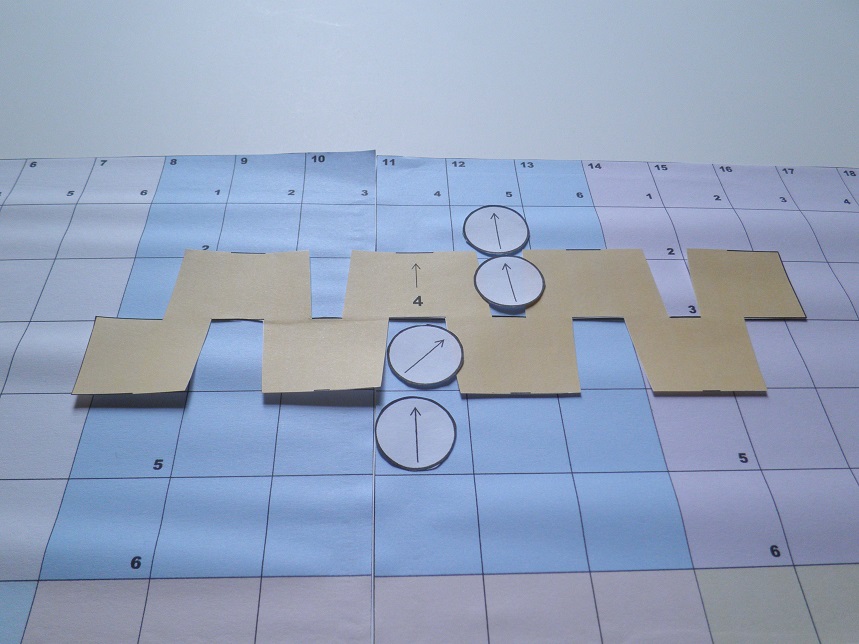
The Case Study: Evaluating Terrain Piece 4

Terrain piece 4, you’re going on trial.

Facts: Terrain piece 4 is a zig-zag of difficult ground:

Terrain Piece 4
Terrain Piece 4

Over the course of many playtest games, this has been the terrain piece with the least impact. Since players can move diagonally and still make progress just as quickly as they would if they moved straight ahead, it’s easy to dodge through the clear spaces left by the zig-zag. No player has ever been hindered by this terrain piece.

By moving diagonally, a player can avoid being slowed by the terrain

In addition, terrain piece 4 can be confusing to new players. Every other terrain piece occupies only the squares it affects. Terrain piece 4, on the other hand, needs reinforcing “crossbars” that extend into neighboring squares. Those crossbars mean that terrain piece 4 half-occupies some squares, leading to questions about whether those squares are clear, difficult terrain, or some hybrid of the two.

With all of that said, terrain piece 4 is visually interesting. Over the Next Dune’s board divides into clear spaces and blocks of rough ground. Terrain piece 4 provides an intermediate texture that mixes clear and rough, making the board feel more realistic.

Issue: Should terrain piece 4 retain its current form, or be changed?

Rules:

1. Decisions players make must be interesting.

2. As a corollary, things that reduce the number of decisions or the interest of those decisions, or that delay getting to the decisions, are disfavored.

Thinking it through: The fundamental problem with terrain piece 4 is that it’s only interesting once: the “a-ha!” moment when a player figures out how to get through it. That opportunity for system mastery is good. After that bit of mastery is achieved, however, terrain piece 4 becomes entirely irrelevant. It never provides an interesting decision again.

None of the other terrain pieces have that problem. Their impact varies–the large piece 6 is more of a challenge to work around than the small piece 1–but they have all continued to create interesting decisions over many plays.

Bringing little interest to the game is a damning critique in and of itself, but the rules problem puts the final nail in the coffin. Explaining how piece 4 works might be worthwhile if it were making the game better; a line or two in the rulebook would be sufficient. Since it’s not, those extra lines are just unnecessary barriers to getting through the rules and on to the game’s interesting decisions.

Piece 4’s aesthetic qualities are nice, but they don’t make up for poor gameplay. OtND’s visuals can easily be improved later when the board and other components get proper artwork. Interest and challenge, on the other hand, are much harder to add. Each game element needs to pull its weight in those areas, and piece 4 is falling short.

Terrain piece 4, then, needs to change–but to what? We’ll take that up next time.

The Case Study: Fewer than Six Turns!?

I’ve been able to sneak in a few more playtest rounds of Over the Next Dune. So far, the win rate for a six-turn game is hovering at about 60%. That’s lower than the rate for longer games, which is good; it suggests that we’re succeeding in increasing the difficulty. Sixty percent is still pretty high, however, and the player powers are yet to be incorporated. OtND is going to have to get harder.

Further reducing the number of turns is tricky business. As the amount of time the players have to reach safety declines, their choices regarding their movement become more and more restricted. (At four turns, every player’s every move would have to be in one of the three forward directions!) So on the one hand, having less time makes the players’ decisions more interesting because each one is very important–but on the other hand, they have fewer options to choose from. Limiting the players too severely risks leaving players feeling like there are not enough strategies available, or like the game is boring simply because it’s impossible to win.

I’m going to try going down to five turns and seeing how that affects play. There’s a point on the dial where we tip over from “interesting challenge” to “frustrating exercise.” Locating it will tell us exactly how much the difficulty can be increased by shortening the game, and how much weight will need to rest on other tools.

The Case Study: Beating the Worst-Case Scenario in Six Turns

Following up on last time, I’ve been testing the worst-case scenario to see if it’s beatable in only six turns. The answer turns out to be yes. It’s consistently taken the full time, but it’s doable.

If anything, having all searchers moving toward the players early has been easier to deal with than having them spread out. Once the players are past the initial wave the worst-case scenario presents, they’re more or less in the clear. The endgame is generally straightforward, with only one or two searchers reaching threatening positions.

While this is good news, it doesn’t mean testing is finished. I still want to make sure that the six-turn limit is sufficiently difficult to serve as “hard mode.” Mathematically the turn limit can’t go much lower, so if this isn’t enough of a challenge I’ll have to add difficulty in some other way.

The Case Study: Testing Shorter Turn Limits

I’ve been testing reduced turn limits as a mechanism for increasing Over the Next Dune’s difficulty, and have been happy with the results. The games have been interesting and fast-paced. Also of note, they’ve been harder. 😉

Tighter turn limits have had the beneficial side-effect of discouraging boring strategies. I didn’t anticipate this, but in retrospect I should have. The end run generally involves at least one turn of slipping to the side without progressing forward, and other slow-boiling approaches to the game tend to rely on waiting while the searchers move to favorable positions. Having fewer turns means players have no choice but to plunge ahead and then figure out how to escape the resulting sticky situations.

I should note that I’m doing this testing without player abilities. Adding those at this point would be putting two independent variables into the same experiment. Solidifying the difficulty levels before adding player powers will help me judge the impact of the powers accurately.

One pattern I’m noticing is that having a searcher move close to the players early makes the six-turn game very difficult; in fact, I haven’t won a game involving that situation yet. That’s a worrisome sign. It’s OK for the game to be more difficult with some setups, but it’s not OK for it to be unbeatable. I’m planning to do some testing akin to what was done for the worst-case scenario to make sure that that isn’t an auto-loss for the players. (Speaking of which, the worst-case scenario will need another look . . . .)

The Case Study: Player Abilities for Testing

So far we’ve got one player ability for Over the Next Dune:

Pop a Tire: If this player token is adjacent to one or more searchers at the start of the Sneak Phase, choose one of those searchers to be affected by terrain during the next Search Phase. (Any time during the next Search Phase that searcher’s movement would cause it to enter one or more squares with terrain in them, the searcher must expend two squares of movement instead of one. If it does not have enough movement remaining to expend two squares of movement, it stops moving.)

We need at least four more to cover all five players. I’m going to run through the untested concepts to see if any of them are workable in light of the rules for player powers. Then we’ll come up with as many brand-new powers as needed.

To keep them firmly in mind, the rules for player powers are to include them when

1. the game benefits from a certain amount of something, but no more;
2. the unique ability provides very different game experiences; and/or
3. the unique ability creates new, interesting decisions.

A player power should not be used if

1. the power would undermine the game’s mechanics; and/or
2. the game is at a complexity limit.

Comparing the old concepts to these rules, it seems like some of them pass and some of them . . . aren’t good avenues to go down.

“Hey, Over Here!”–When a player token would be captured by a searcher, you may instead center that searcher over this player token. This player token, and any other player tokens covered by the searcher, are captured. Direct the searcher “down,” toward the starting line, just as if a player had been captured normally.

I still like this. It provides a decision (should I take one for the team?) that was previously only available when playing the “wall” strategy. A power that makes the game more interesting for the player using it always has some value.

Unfortunately, this ability has the potential to undermine the searcher-tricking mechanic. The “wall” was dangerous in part because it replaced maneuvering the searchers with constant rescues; a player could use this ability to do the same thing anywhere on the board. A gate is needed to prevent this ability from dominating the game:

“Hey, Over Here!”–Once per game, when a player token would be captured by a searcher, you may instead center that searcher over this player token. This player token, and any other player tokens covered by the searcher, are captured. Direct the searcher “down,” toward the starting line, just as if a player had been captured normally.

That isn’t a very interesting gate, I admit. However, I think this ability is very powerful and that a sharp limit is necessary.

Throw Something Shiny–Once per game, when this player token is adjacent to one or more searchers, choose one of those searchers and point it in a direction of your choosing.

Looking at the rules, I don’t think this makes the cut. First, OtND doesn’t need this sort of redirection. Second, being able to choose a searcher’s facing does not provide a substantially different game experience; the player is still fooling the searcher, he or she is just doing it in a different way. Finally, while the decision behind TSS is new it’s not very interesting–there will often be clear good and bad choices, and players will just pick a good one. This power needs to be replaced.

Coordinator–Once per game, when this player token tricks a searcher, the searcher does not capture player tokens it moves over. If the searcher is occupying any player tokens’ spaces when it stops moving, it captures those player tokens.

I don’t love this one either. Again, there’s no reason to include it. This ability is an easy out for difficult situations. OtND doesn’t need that in any amount. Nor is this a different game experience–the players will approach the game the same way, they’ll just have a “get out of jail free” card. Interesting decisions aren’t in the offing either, since players will be able to bail themselves out of otherwise-challenging problems. Off to the scrapheap with this one.

No One Left Behind–Once per game, when this player token is adjacent to another player token, you may choose to move the adjacent player token along with you for your first square of movement using the same rules as apply when tricking searchers.

Here we go. I’m a big fan of this power, because I think it’s most likely to create a different experience. The player with this ability sees a much different board, one with many more options. It’s fascinating to ask what can be done with it.

This power is so neat that I’m inclined to take the gate off of it so as to encourage its use. While the wording’s changing I’d also like to clear up how this power relates to the searcher-tricking rules. I don’t want this to become an easy out, so people who are in trouble should still be in trouble after this ability is used.

No One Left Behind–When this player token is adjacent to other player tokens, you may choose to move one or more of those tokens along with you for your first square of movement using the same rules as apply when tricking searchers. Those tokens will themselves trick searchers during this movement.

OK, that’s two out of four and a total of three powers ready for testing. Not bad, but now we need to come up with two more from scratch. How about:

Hitch a Ride–When an adjacent searcher moves during the Search Phase, this player token may move along with the searcher, always maintaining the same position relative to the searcher.

It’s common in OtND for one player to want to move backward, usually because that happens to be the safest place to trick a searcher toward. However, that player can end up unable to catch up before time runs out. This ability isn’t complex, but it creates decisions by making it possible to go backward late in the game. I suspect there are also other imaginative uses that I’m not seeing right away.

For the last ability, I’m thinking about this:

Caltrops–During each Sneak Phase you may turn one clear square adjacent to you (at any point during your movement) into terrain.

Terrain is generally bad for the players, so being able to create it forces a different approach to the game. This ability also teams up with Pop a Tire in a way that promotes team play, a general rule for OtND.

With that we have five player abilities for testing. Let me know if you see any issues right off the bat, or if you get a chance to try these out!

The Case Study: Player Powers, Take Two

Cooperative games often give each player a unique power: Pandemic makes one player a scientist and another a medic, while Forbidden Desert has one player be good at carrying water while another can dig quickly. Yet, it isn’t necessary for a co-op to do so; Space Alert is a great game, and all of its players are on equal footing. I’ve been interested in bringing unique player abilities into Over the Next Dune, and have even put forward some untested ideas, but before sinking a lot of time into it I want to figure out with confidence whether OtND is in the category of games that benefit from such abilities or the category that doesn’t.

When would one want to add unique player powers to a game? I’ve come up with a couple of possibilities:

1. The game benefits from a certain amount of something, but no more. Pandemic would be easy if everybody had the medic’s ability to cure lots of people in a turn. However, letting one person do that is just enough to keep the players above water when the cards flip the wrong way and disease suddenly spreads all over. A single medic serves as a safety valve without making the game trivial.

2. The unique abilities provide very different game experiences. Playing a Dwarf Trollslayer in Warhammer Quest has little in common with playing a Grey Wizard. Providing such distinctive experiences adds a lot of replayability, since getting tired of one of them doesn’t mean you’re tired of the game as a whole.

3. The unique abilities create new, interesting decisions. Playing the water carrier in Forbidden Desert is neat because in addition to the game’s usual decisions you have to decide how important it is to stay close to oases. Figuring out when it’s safe to go help the team and when you should to stay behind collecting water is tricky. The unique power is valuable in part because it brings that interesting decision to the table.

Looking at that list, I’m struck by the fact that it’s mostly about the powers rather than the game. Do the abilities provide different experiences? Do they create new decisions? It depends on what the abilities are!

We could come at the problem from the other direction. When would one not want unique player powers in a game?

1. Giving players unique capabilities would undermine the game’s mechanics. Diplomacy is a classic game of cooperation (and competition). It’s a wargame where the players’ strengths start out relatively even, so to make progress you have to cut deals. If the players had special abilities they could rely on it might make negotiation less important–and the negotiation is the reason to play.

2. The game is at a complexity limit. Space Alert is played in real-time on a 10-minute clock. Players make mistakes and overlook things, even without having to track the effects of special powers. If people were also trying to manage unique abilities the game could tip from “hilarious barely-controlled chaos” into “impossible and frustrating.”

Over the Next Dune certainly isn’t so complicated that it can’t bear the weight of unique abilities. I’m less certain whether player powers would undermine the game’s central challenge of tricking the searchers. On the one hand, the more tools the players have the less likely they are to take the risk of getting close to searchers to pull them around. On the other hand, it seems like abilities could be created that would increase rather than detract from engagement with the searcher-tricking mechanic.

The best way to resolve that uncertainty is with some testing. How about this as a starting point:

Pop a Tire: If this player token is adjacent to one or more searchers at the start of the Sneak Phase, that searcher is affected by terrain during the next Search Phase. (Any time during the next Search Phase that searcher’s movement would cause it to enter one or more squares with terrain in them, the searcher must expend two squares of movement instead of one. If it does not have enough movement remaining to expend two squares of movement, it stops moving.)

My thought is that this creates a new decision (whether and when to slow down a searcher) and a potentially different game experience (seeking out searchers instead of avoiding them), without adding complexity (players will already know the terrain rules) or undermining the central mechanic (since it increases rather than decreases the mechanic’s use during the game). I also like that, as noted in the first iteration of this ability, it doesn’t empower one player; rather, it helps a player assist the others.

That’s one power, but there can be five players in a game of Over the Next Dune. I’ll be back with more on Monday.

Theory & The Case Study: Gates in Over the Next Dune

I’ve been considering whether to try out gated player abilities in Over the Next Dune. Gating player capabilities would be a substantial change, and unusual for a cooperative game. On the other hand, gates are a commonly-used, proven mechanic. It’s not a trivial decision.

Let’s start at (what I think is) the beginning. Why would one ever use a gate, instead of just letting players deploy their capabilities whenever they want? I can see two reasons:

1. The gate leads to interesting decisions. Mark Rosewater likes to say that “restrictions breed creativity.” Limiting the player’s access to a capability forces the player to think about when to use it, and to find alternative solutions when the capability isn’t available or shouldn’t be employed.

As a quick example, think about Barrier in League of Legends: a protective shield that isn’t available for a few minutes after being used. Since access to the Barrier is limited, players have to make tough decisions about precisely when it will do the most good. They also have to find ways to conserve the Barrier for those key moments, and to protect themselves when the Barrier is “on cooldown.” If players could just throw up the Barrier all the time, those decisions would be lost–and no other decisions would appear to replace them.

2. The gate prevents an ability from dominating gameplay. In some ways this is the inverse of the previous rule: the gate is in place because unlimited use of a player ability makes the game less interesting. RPGs often use gates in this way; powerful abilities would make the early game trivial, so players can’t access them until later.

(There’s also a third reason–to help monetize the game. However, that opens up a can of worms that I’m not looking to address right now.)

Those both seem like good reasons to include gates. Yet, they aren’t universal in cooperative games. Pandemic‘s Scientist doesn’t need to do anything to be able to cure a disease with four cards instead of five; that ability is always “on.” Shadows Over Camelot‘s Sir Bedivere can trade cards in for new ones without earning the privilege. Clearly, gates aren’t for every power or every game.

What considerations, then, militate against gating player powers? Ironically, I find it much easier to think of why a designer would want to limit powers than why the designer wouldn’t. Perhaps that says something about me. 🙂 Here’s what I’ve come up with:

1. The game is unplayable when the ability is not available. Most RPGs don’t limit your capacity to walk around. In fact, I’m not aware of any at all that do. That’s not surprising, because if the player can’t move around the world in an RPG the player can’t do anything at all. Limiting walking would tend to destroy people’s ability to play the game.

2. The game needs something, and the ability provides it best when it is constantly available. League of Legends needs a way to ensure that games move toward their conclusions. A big part of ending a game of League is damage output; players and teams need damage to destroy the opposing team’s defenses and ultimately the enemy base. Thus, the game needs to ensure that teams have reliable access to damage output. If no team can damage objectives, the game cannot progress (setting aside really grindy strategies like letting minions do all the pushing–let’s not go down this road).

League’s need for guaranteed damage is met by “auto-attacks.” Every character can punch, swing a sword, fire arrows, or has some other freely available mechanism for inflicting damage. Since they’re costless, auto-attacks guarantee that the game cannot stall completely. Regardless of the team composition or overall situation, both teams have the theoretical ability to bring down objectives and end the game.

3. You want to encourage a behavior. If players should be doing something in a game, designers can incentivize it by letting players do it no strings attached. Ikaruga, for example, is a “bullet hell” game in which the player(s) can switch colors to absorb enemy fire. The color-switching mechanic made the game an instant classic. Having no limits on switching colors was a good design move, because it encouraged players to try the mechanic out early (desirable because color-switching was the game’s innovative feature) and to do it often thereafter (important because it helped players progress and kept them hooked).

So, two reasons to use gates and three not to. What do they mean for OtND?

To date players have three capabilities in the game: moving, tricking searchers, and rescuing other players. Moving should not be gated. The game is unplayable if players can’t get around the board.

Tricking searchers also should not be gated. It is, at least arguably, the most interesting aspect of the game. Keeping it freely available encourages players to interact with this important mechanic.

Rescuing is already gated by the need for several players to work together. That proved necessary to stop rescuing from dominating gameplay. However, the current limitations appear sufficient; I don’t think more are needed.

What about additional player abilities, then? Things like Pandemic’s Scientist and Shadows’ Sir Bedivere, that are outside the core rules of the game? Do they need to be gated? Should they exist in OtND at all? Let’s take that up next time.

The Case Study & Theory: Gates

Thinking about how to add on to Over the Next Dune raises the question of whether and how to gate player powers. Of course, that begs the question of what a “gate” is. 😉 To avoid definitional confusion, let’s hammer that out.

A gate is something that controls a player’s access to in-game capabilities. The classic example is mana, as seen in League of Legends or the Final Fantasy games. A player uses up mana each time he or she employs a special ability, and when the mana is gone the player cannot use special abilities until it recharges. Ammunition is also a gate; it limits how much the player can use a certain weapon before having to switch or seek out more ammo.

Gates do not have to be numbers. Many role-playing games, for example, control players’ power via progress through the storyline. As the player explores new areas, meets new people, and learns new things, the player gets new capabilities.

Gates can go one way or bi-directional. One-way gates result in permanent changes. For example, in Burnout Paradise access to new cars is generally gated by completing races. Once you complete the race associated with a car, you have access to that car forever. Mana and ammunition are usually bi-directional gates; you can run out and lose access to a power, but replenishing the resource takes you back through the gate and enables you to use it again.

I believe that that’s a reasonably complete discussion of what gates are. They also have some properties that aren’t definitional but that I feel are worth putting forward:

Gates can be thought of in either direction. This is kind of a weird one, and it’s usually not relevant, but it can be useful. All gates can be described as having something or not having the opposite. For example, in Battletech firing weapons builds up heat. You can think of heat as the gate (too much is bad) or coolness as the gate (not enough is bad). It doesn’t matter, from a theoretical perspective, which approach you take.

Admittedly, this can get kind of silly. You could say that “lack of mana” is the gate, and that a player can use a certain ability because his or her lack of mana has been kept below a certain threshold. It’s a lot easier, though, to say that the player has enough mana.

Basically, this is like flipping an equation to put the variable you’re solving for on the left. It doesn’t really change anything, but if you’re accustomed to a certain presentation it might help you understand what’s going on.

Out-of-game gates are ineffective. Experience has shown that players cannot be limited by resources outside the rules of the game. Money and physical difficulty are two examples of out-of-game gates which have been proven not to work.

Money. If your game is popular, you will have a subset of players who will spend whatever they need to to get a competitive advantage. Magic: the Gathering was originally designed to use card rarity as a gate, on the thinking that players would be limited by their collections. Over time it became clear that tournament players assembled complete collections regardless of the cost. Magic still uses rarity for various design purposes, but not to balance constructed-deck tournament play.

Physical difficulty. It does not matter how difficult a physical task is; if it will help players win, some of them will put in the necessary time to be able to do it reliably. Fighting games often use precise timing as a gate, demanding that players time their moves to 1/60th of a second in order to get the longest combos and the most damage. Many, many players have practiced enough to hit those 1/60th of a second windows routinely.

From here we need to think about whether OtND should use gates at all. I’ll get into that next time.

The Case Study: Updated Print-n-Play & Video In the Works

A short update today:

– I’ve updated the Print-n-Play file to reflect the changes in the latest set of rules. If you catch any errors, let me know.

Over the Next Dune – Print and Play – 6-27-14

– Part of the reason why this update is brief is because I’m working on a how-to-play video for Over the Next Dune. Have thoughts on what I should include? Leave them in the comments!