Theory: Environment-Influencing Games

When we previously talked about games with an environmental element, the discussion focused on how the great outdoors could affect play. The game would change based on the weather or the season, with the components taking account of the ambient temperature. However, feedback doesn’t need to be one-way, with the state of the world driving the game. It’s possible for the influence to run in both directions, with the world altering the game—and the game encouraging players to influence the world.

Imagine as an example a civilization-building game. New technologies in this hypothetical game would be based on the actual progress of human knowledge. Traveling to other worlds might be a victory condition, just like it is in the Civilization series—but the technology to accomplish that wouldn’t be available just by spending a certain number of turns researching jet propulsion. It would need to be achieved by actual scientists.

The incentives that would create are, I think, really neat. It’s a game where success involves both good play and finding ways to contribute to NASA’s Journey to Mars program. Winning the game requires getting involved in an amazing real-world feat.

Now, I’m not a rocket scientist and I’m not sure how much of a contribution I could really make to space exploration. However, a game like this needn’t be quite so lofty. In the spirit of thinking globally and acting locally, it could be designed to look for things the player could more readily impact.

Envision something like Batman: Arkham City, except based on the player’s home town. (Or perhaps some other town—a pre-set map of New York City or Paris, or some such.) The overall conditions in the video game version of the city are based on conditions in that city. If the real-world city doesn’t have enough homeless shelters, the video game city doesn’t have enough either, and player won’t be able to cure poverty; a poor EMT dispatching system will limit the help the player can receive in-game. Building a virtual utopia demands building the necessary infrastructure in one’s own community.

Maybe that’s still too big, too hard to see the impact. What about a space-trading game where the amount of space debris is based on the condition of a local park? Less litter in the park means fewer pieces of debris. Getting good at dodging through space is valuable, but to really make money and move up the leaderboards you have to keep your park clean so that you can have lots of ships flying safely on autopilot. Or spread to a new system by taking on a new park. The rarest minerals and most exotic trade goods are in the hardest-to-reach places, so you’ll want to choose one with a lot of litter to be cleaned . . . .

Going down this path involves lots of design problems. From a technical point of view, how would that last game know how much litter is in a park? Coming at it from a design perspective, what fun in-game activity is the player engaged in, so that the whole exercise isn’t just a transparent effort to get people to clean up a public space? (Not that transparent efforts to get people to clean public spaces are bad, but we’re trying to make a game here.)

Nevertheless, I’m really excited to explore this avenue of design. Games are so often viewed as a centripetal force, pulling players into fictional spaces and drawing them away from the greater realm of human accomplishment. I have to think that there’s potential in games that could serve in the opposite role, flinging players out into the world with the goal of making it better.

Theory: Essential Wargames for Designers

Following up on last Wednesday’s post, here are five wargames that have something interesting to teach designers. Playing any one of these represents time and money well-spent.

Wargames As Exemplars of Board Game Design: Twilight Struggle

Defying the notion that board games and wargames are separate entities, Twilight Struggle is, as of this writing, both the #1 rated board game and the #1 rated wargame on Boardgamegeek. It features a superb marriage of mechanics and theme; complex but intuitive rules that fade into the background during play; rich strategy that continues to be interesting over many plays; and quality components (especially in later printings, when the game’s success allowed for a nicer board). In other words, Twilight Struggle has the things one wants any good board game to have.

Perhaps the great lesson of Twilight Struggle is that the fundamental rules of board game design are more powerful even than we thought. One might reasonably question whether principles often stated in terms of deck-builders and worker-placement games are applicable outside the subgenres that are currently prominent in the market. Twilight Struggle demonstrates that some rules of design really are applicable to the full range of board games, and that adhering to them (or at least, breaking them only consciously and for a specific purpose) consistently leads to good results.

Incomplete Control: Memoir ‘44

Most board games assume away problems of communication and coordination. Cave-people in Stone Age always go where players tell them to go and do what they tell them to do. Pandemic’s medic never has to worry about whether his support staff will fly to the wrong city, or quit their jobs rather than entering a country where a dread disease has taken hold.

What if a designer seeks to capture realistic human behavior, where misunderstandings, mistakes, and outright refusals are part of the experience? It’s time for that designer to look toward wargames. They have been finding ways to introduce uncertainty and the fog of war into the open-information environment of a board game for years.

Memoir ’44 presents one such solution: rather than moving any piece she wishes the player uses randomly-drawn cards to activate units. If no card in hand can move a unit, that unit is conceptually out of control: maybe its radio has been destroyed and messages aren’t getting through, or the soldiers are panicking and won’t come out of their foxholes. It’s an easy-to-learn, elegant system that shows how modeling the human element adds to a design.

Solo Gaming: D-Day at Omaha Beach

Requests for a “solitaire mode” and questions about whether a game works with only a single player are seen in many board games’ forums. That’s not surprising; we’ve all had games we loved that our playgroups weren’t keen on, or been hankering for a round of something long after all opposition has gone to bed. Sometimes it’s nice just to be able to give in to analysis paralysis, really thinking through the complexities of a difficult decision without feeling guilty about making others wait. Being able to play without other people is a valuable feature.

Wargames have long been a hotbed of solo gaming innovation. The tradition can easily be traced back to 1973 with The Fall of Rome; miniatures games were doing it even earlier, and doubtless these are only the tip of an iceberg hidden by the mists of time. For designers who want to tap into this deep vein of knowledge, D-Day at Omaha Beach is considered a shining star, a brilliant game constructed from the ground up as a solo experience.

Learning by Doing: Squad Leader

Squad Leader has a tutorial so good that it’s a worthy game unto itself. Anyone who’s designing a game complex enough to warrant an introductory mode or scenario should play it, just to see what a really good one can do. You can find more discussion about why SL’s tutorial is amazing here.

Asymmetric Multiplayer: Fire in the Lake

Historically many wars have involved nations (players) with widely disparate economic and military capabilities (starting positions), available technologies (powers), and objectives (victory conditions). Wargames have had to model those asymmetric situations, and in the process wargame designers have put a lot of thought into how to do it well. The results go far beyond a certain species being better at propulsion technology, or a character having a really good fireball.

Fire in the Lake is a stand-in here for the entirety of GMT’s COIN series of games—Fire in the Lake, A Distant Plain, Cuba Libre, and Andean Abyss. Each of them is a game about four different factions. The factions all have their own abilities and goals—but every faction is on a team with another, whose interests only partially align. Far from treating asymmetric powers as simply a way to introduce some diversity and keep the game fresh, the COIN series thus uses asymmetries to create vital gameplay dynamics: the tension between the international coalition and Afghanistan’s government in A Distant Plain, or the I-need-you-but-you’re-bad-for-me relationship between the dictatorship and the crime lords in Cuba Libre. Playing these games is an eye-opening experience that shows what asymmetry can really do.

Getting the Goods

I’ve tried, in composing this list, to stick to reasonably available games. Wargames often have short print runs, and their prices can ascend toward the level of collector’s items very quickly. Even when in print they can cost close to $100; low volume means each unit has to carry a high margin, after all.

Nevertheless, I would urge designers to seek these games out. They all offer valuable lessons. What’s more, they’re all good games that deserve a spot on your shelf. You might find them engaging, or frustrating, or informative, or difficult, or any of many other things. You won’t find them to be wastes of your time or money.

Something Completely Different: Weather-Influenced Board Games

Organic food advocates point out that being able to eat any fruit or vegetable at any time of year is a new phenomenon. For most of history, foods rotated in and out of season, available only when they were ripe. What if games tried a similar dynamic?

Sports, of course, already do this. Baseball is great during the spring, summer, and fall, but is nigh-unplayable in winter. (American) Football is tremendous fun in wet, mucky weather, but all that equipment gets uncomfortable when it’s hot. Hockey, when played outdoors, demands temperatures below freezing.

Yet, there’s no reason why the change of seasons can only influence physical games. A board game, for example, could use temperature-sensitive ink for its board; imagine a survival game whose board only appears when it’s very cold. Having to bundle up to play the game might really help set the mood!

Or perhaps the pieces themselves are temperature-sensitive, so that the game is different depending on when it’s played. A wargame about ancient Greece, for example, might model the changing roles of the era’s soldier-farmers using that technique; when it’s warm the pieces are ready for combat, but as the temperature cools they lose interest in combat and have to return to the home front. There’s a market for grand-scale games like World in Flames; how much more epic would a game about the Peloponnesian War be, if it actually played out over the course of a year?

These games might not even be playable in some places, owing to the local climate, whereas they would often be playable in others. Is that frustrating, or is it awesome? I can see a lot of valid concerns, but I can also imagine great stories coming out of people going to the Grand Canyon or the Great Pyramids in order to get the right environment to play a game.

Certainly, these would be niche products. It’s hard to imagine a game store shutting off the heat so that the players can get down to the sub-zero temperatures that activate Ice Floe Survival’s board, or parents letting their kids mess with the thermostat in order to speed up their game of Real-Time Ancient Greek Conflict. Still, I feel like there are interesting results to be found pushing out the boundaries of “what can influence a game” in this way. Is anybody already doing something like this?

Theory: Every Designer Should Play a Wargame

Once every so often I see a list of “board games every designer should play.” They’re often very good, with lots of quality games that can teach valuable lessons. However, I’ve noticed that they rarely include wargames—and that’s an important oversight. Love them or hate them, wargames have a long history and have had significant influence outside their genre. New designers should play at least one.

Fundamentally, wargames are board games. Hex-and-counter affairs played on a map are obviously so—a physical board to play on comes in the box! Miniatures games are as well; their tables serve as the board, the minis as the meeples. There’s no definitional reason to treat wargames as their own separate thing.

Given that they’re part of board games, we might ask: are they important enough that every person interested in board game design should have to spend time with one? They can be long, after all, and demanding to learn. One could get through most of the games in this very good list in the time it would take to play D-Day.

The answer is a resounding “yes, it’s worth it.” For both historical and mechanical reasons, a designer needs to understand at least the broad strokes of how wargames operate.

Historically, for a long time wargames were a huge part of “grown-up” board gaming. If you were a tween or older, in the United States, and were interested in board games, your options were pretty much chess, trivia/party games, and wargames. Any designer who wants to be a student of the art, to understand where we’ve been so as to better see where we can go, would benefit from exploring such an important force in board gaming’s history.

That exploration is particularly important because wargames have had a tremendous influence on other genres. Dungeons & Dragons, for example, was directly inspired by squad-level wargames, and through D&D wargames continue to have influence on the RPG industry. One sees their guiding hand particularly clearly in the many RPGs that have much more extensive rules for combat than for social interaction, even though at least one experienced industry figure argues that simulating the real- (or fictional-) world behavior of different weapons shouldn’t matter when role-playing. Without knowing wargames, a designer can’t recognize the places where other types of games imitate them.

Mechanically, ideas from wargames are at the core of lots of board games. Area control, perhaps the quintessential wargame goal, is now a routine and broadly employed design tool. Up Front was building tableaux with cards in the early 1980s. There’s some wargame in lots of board games’ DNA.

Of course,wargames exert some of their influence by teaching how not to do things. Rolling a single die, with the flat probability distribution that implies. Tiny, hard-to-manage pieces. Unattractive counters. Heavy, motivation-sapping rulebooks.

Still, a game—or a genre—need not be perfect to be foundational. Wargames have been, and continue to be, important to designers. Lists of vital games for them to try would benefit from including one.

Theory: Doing RPS Right

Rock-paper-scissors (“RPS”) dynamics are sometimes held up as fundamental to game design, a core principle that makes balance possible. Taking rock-paper-scissors too far, however, can lead to reductive games that are only interesting during character selection. It’s vital to understand that what’s interesting and valuable isn’t the RPS, but the interesting decisions a good RPS setup can contribute to.

The Story So Far

To my knowledge, the popularity of RPS comparisons in game design started with an article on Sirlin’s old website. It’s worth reading the article in full (and I’d love to see it preserved on the redesigned site), but his core argument went something like this: rock-paper-scissors, as we all played it as children, has little to no strategy because there’s no basis for preferring one move over another. The opponent is probably choosing more or less at random, so there’s no way to predict what he or she will do, and you’ll just have to play randomly, too. However, it’s possible to inject strategy into rock-paper-scissors by giving each move different payoffs; if rock is worth 2 points and everything else is worth 1, you know that both players want to play rock, and you can use that knowledge to craft a plan.

Sirlin followed up with another article, this one on how RPS is implemented in fighting games. Again, it’s excellent and well worth your time (and also worth preserving). While I can’t trace the spread of its ideas, I can say that this article was extremely influential among fighting game players, and that in the years since its publication I’ve seen its arguments and conclusions repeated many times. I think it’s fair to say that after this article, RPS was off and running.

Today, RPS has become ingrained in game design thinking. However, saying that RPS with differing payoffs can be interesting doesn’t mean that it’s always going to be executed correctly. In particular, it’s not great when the only meaningful RPS decision is made early.

RPS Done Right: Interesting Decisions that Support More Interesting Decisions

Go back to Sirlin’s second article for a moment. He describes a series of situations in which both players make a choice, and one of them just loses. Attack beats throw, period, with the attacker doing damage and the thrower accomplishing nothing. It’s a hard counter, just what we would expect from RPS: rock doesn’t sort of beat scissors, it SMASHES scissors and gets ALL THE POINTS.

However, that decision isn’t the be-all and end-all of the match. Rather, a match will involve many such choices. Indeed, much of the interest of the game comes from the choices building on each other: “last time he went for the throw and got me, I think he’ll try that again even though it doesn’t do as much damage as an attack.” Evaluating moves becomes a multi-layered process, as one judges not just their value in the abstract (rock is worth 2 points) but also how the opponent seems to be responding to those values (this opponent is being tricky by playing lots of paper).

We see the same building of decisions in other good RPS games. Starcraft, for example, has units that beat other units—but players build many units over the course of a game, and can expect to skirmish several times before the match is decided. As a result, players will make a number of important and engaging building decisions. Over the course of a game one might shift gears in response to what the opponent is building, feint, condition the opponent to expect one thing before building something else, and otherwise make interesting choices throughout the game’s duration.

Magic has only one RPS decision, but it still uses that choice as a springboard for more decisions later. It does this by incorporating RPS into an important, but not definitive, early choice.

It used to be said that there were three broad strategies in Magic, and that they interacted in RPS fashion:

Aggro (“aggression”) beat Control, because it won before control could lock down the game.

Control beat Combo, because control stopped combo from assembling its Rube Goldberg victory condition.

Combo beat Aggro, because aggro didn’t stop combo from assembling the Rube Goldberg machine.

While the model spoke in definitive terms, however, making the right choice at deck selection (e.g., playing aggro against someone who was playing control) never actually decided the game. Rather, it provided an advantage which had to be carried through in play. The player on the winning side of the RPS decision still had to manage random card draws and the opponent’s resistance, which could still be potent even coming from a position of disadvantage. Making a good RPS choice thus offered advantage but guaranteed nothing, and so the game’s in-play decisions remained meaningful.

RPS Done Wrong: One and Done

For a contrast to Starcraft, Magic, and other good RPS implementations, consider a fighting game where some characters beat other characters RPS-style. That might be balanced. If Ryu beats Zangief, Zangief beats Dhalsim, and Dhalsim beats Ryu, then everyone has about an equal chance of losing and the game is fair.

However, that game has only one important decision: which fighter to choose. It’s all downhill after that, as one plays out the inevitable result of the character select RPS. None of the decisions in the actual game are very interesting, because Ryu is just going to clobber Zangief no matter what their players do.

Weighted RPS mechanics, then, are not an inherent good. They can in fact be very dangerous, locking in results and turning the rest of the game into going through the motions. If RPS is going to be used, it’s critical that the game not hinge on a single, early RPS choice, but rather that the RPS decisions create further interesting decisions as the game goes on.

This problem is not strictly theoretical. Several miniatures wargames have wrestled, or are wrestling, with the problem of an early RPS choice that dominates the game.

Minis games’ RPS issues revolve around how in-game armies are built. Broadly speaking, minis games have a system wherein heavy armor (tanks, flying tanks, whatever the game’s setting has) is largely invulnerable to infantry; infantry is good at dealing with anti-armor specialists; and anti-armor specialists destroy heavy armor. As a result, games can be decided as soon as the players show each other their armies; if one player has way more tanks than the other player has anti-armor specialists, the tank player will pretty much have the run of the field. It’ll be particularly egregious because that game will probably still take two hours to finish; two hours is a long time to have no interesting decisions.

We’ve seen a number of solutions to this problem over the past decade: allowing pieces to serve in more than one role so that players can always use all three of rock, paper, and scissors, for example, or trying to opt out of the RPS situation entirely by flattening the differences between armor and infantry. I’m sure we’ll be seeing more in the future. Even if the problem is entirely solved, however, its persistence over many years will stand as a reminder that leaning on the RPS tripod can leave a designer flat on the floor.

Keep Your Eyes on the Prize

Rock-paper-scissors isn’t the ultimate in game design; it isn’t even a good summation. What it can be, if done right, is a source of fascinating choices for players. The key to using RPS well is to always keep focus on the decisions, asking whether the RPS is making them more interesting—or less relevant.

Theory: Maintain Theme from Beginning to End

The second edition of the Star Trek CCG (“2E”) hit on the brilliant approach of dividing its cards by the narratives they participated in rather than by in-character citizenship. Unfortunately, 2E then shoehorned those thematic factions into mechanics that often didn’t reward thematic play. Flat experiences often resulted, with each one a reminder that a game must follow through on its theme, from beginning to end.

2E’s great insight was that players should be “Deep Space Nine” players instead of “Federation” players. One benefit of that approach was that characters could be subdivided by show rather than by in-character rules; as a Deep Space Nine player one would have access to Deep Space Nine’s main cast without needing to worry about whether Captain Sisko, of the Federation, would work with Garak, a Cardassian. They worked together on the show, they ought to work together in the game, and now they clearly could. Divvying up characters in this fashion solved a lot of problems.

Approaching the game by show instead of by in-universe political affiliations also opened up a tremendous opportunity to reinforce the Star Trek theme: different factions could interact with the game’s mechanics in different ways, each appropriate to their respective stories. Overall the game would be a funnel design, with all players trying to be the first to score 100 points. How they got to that point, however, would depend in part on what the faction was about within the narrative.

Many of 2E’s cards reflect this effort to make the factions’ play look and feel like the stories they appeared in. The Next Generation, which emphasized building bridges with other cultures, gets cards that benefit the player while also extending a helping hand to the opponent. Deep Space Nine often had themes of frontier survival, and thus its cards allow players to protect their resources.

"Disadvantage into Advantage" is a classic Next Generation card that benefits both players; "Medical Teams" shows off the Deep Space Nine theme of seeking safety in dangerous places
“Disadvantage into Advantage” is a classic Next Generation card that benefits both players; “Medical Teams” shows off the Deep Space Nine theme of seeking safety in dangerous places.

Even when playing a faction ostensibly based on an in-universe political group rather than a show as a whole, the designers still import a great deal of story feel into the experience. Players taking on the role of the Dominion, a repressive civilization that served as a Deep Space Nine antagonist, have cards that slow the game down for everyone. Decks based on the hyper-mercantilistic Ferengi accumulate face-down cards as wealth, which they can then use to “buy” various advantages.

So far, so good. The factions were thematic, both in the people available to them and in what their cards do. If the mechanics kept pushing the theme, we might well be looking at the definitive Star Trek game.

Frustratingly, the mechanics didn’t.

Much of the fault can be laid at the feet of the scoring system. 2E is a race to 100 points. All of the themes have to work within that context—and some of them just don’t make sense there.

Take, for example, The Next Generation decks built around mutual understanding and helping others, expressed through cards that benefit both players. If those cards actually provided any significant assistance to the opponent, the race would probably be unwinnable for the Next Generation player. It’s hard to take first in a sprint when you keep turning around to give other runners a push, after all. Hence, what those cards usually do is provide a benefit that looks symmetrical, but which only the Next Generation player will be in a position to use. The “help” offered to the opponent is more like a booby-prize, and the theme of cooperation is undermined.

On the opposite side of the spectrum, playing the Dominion feels weird when the goal is to complete missions and build up toward a goal. The Dominion was staid, reactionary, intolerant; its role on the show was to object to change so strongly that it resisted new ideas with violence. Yet, in 2E the Dominion has to progress, and progress along the same axis as a Next Generation crew that spends its time learning from other cultures.

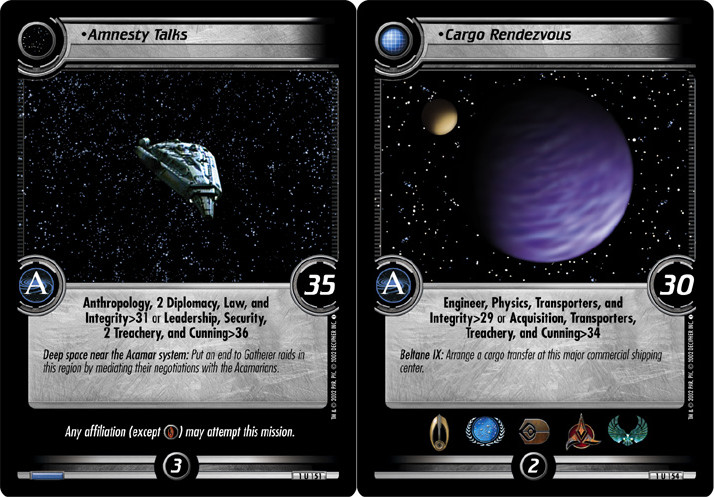
The primary means for getting points—completing missions—was also a problem, in several respects. First, the missions tended to be things the characters might do in-universe: investigate a mysterious space probe, respond to a distress call, etc. As a result, while most cards were driven by narrative the actual stuff one did with the cards was all about in-character simulation. That led to odd, athematic moments like Klingons participating in amnesty talks or organizing a cargo rendezvous; I’m sure there are Klingons who do those things, but they don’t fit the role of the Klingon Empire in the story, and after playing a bunch of cards meant to “feel Klingon” it was unfortunate to then use them to do un-Klingon-feeling things.

Are these what a game about the Klingon Empire should involve?
These missions are worth points for Klingon players, but they don’t reinforce any narrative theme relating to the Klingons.

Second, the interaction between missions and the people carrying them out didn’t build narrative the way the individual cards did. Star Trek, like any good story, involves character development. However, the missions don’t capture character development in any way. Missions and characters are both static in the game; if the characters can’t complete a mission, the solution is not for them to grow as people but rather to go get some other (also static) crewmembers who already have the requisite skills and attributes. Reading the cards one gets the feeling of the stories told on the show, but actual play doesn’t feel like a story at all.

(Perhaps it feels like a bad story, where we never transition from Act I to Act II because the main characters never get invested and just wander away when the going gets tough. That, of course, isn’t much of an improvement.)

Third and finally, the fact that players bring their own missions twisted certain faction themes based on interaction. The Maquis in the fiction were separatists who wanted to defend their territory, but 2E players naturally tended to stick to their own missions. As a result, the signature Maquis card is one that “defends” an opponent’s mission, locking him or her out of it. It seems that the Maquis in the game developed an expansionist streak.

Romulan decks also suffer from the BYOGalaxy dynamic. The Romulan Star Empire is always spoiling for a fight—but the Romulans are portrayed as cunning counter-punchers who rarely make the first move. Most opponents will never offer the provocation the Romulans are looking for, of course, because they’re content to stay amongst their own missions. Romulan players therefore have to go roaring over to the opponent’s side of the table Klingon-style.

In the end, then, 2E feels like Star Trek during deck-building, but loses that feeling in play. Themes are baked into the cards, but the funnel of missions and racing to 100 points turns some of those themes into mirror universe versions of themselves.* Even where a faction’s theme survives the funnel, the actions players take during the game feel less like being a Starfleet captain and more like being a quartermaster.

2E thus gave with one hand and took with the other; players would put down cards that felt very Star Trek, but then would have to use those cards in ways that undermined the theme of the game. The result was a game that started strong, but didn’t fully capture the Star Trek experience. Hence, all these years later, 2E stands as an object lesson that a game needs to deliver on its theme throughout the player’s engagement with it.

* You knew I was going to reference the Mirror Universe!

Theory: Dividing Cards by Narrative Instead of In-Universe Rules

About a decade ago Decipher—at the time an important player in CCGs—launched the second edition of its Star Trek game. When it did, its designers made two critical design decisions. One was superb; the other tended to undermine the first. Today we’re going to talk about the good decision: separating factions by narrative rules rather than in-universe ones.

In both of its editions the Star Trek CCG featured cards representing people from the Star Trek universe. Players assembled a crew by playing cards, and then flew about the galaxy completing missions. Each mission was worth points, and the first player to 100 points won.

The Star Trek CCG’s first edition (“1E”) divided its personnel according to Star Trek’s fiction. Romulans could only work with other Romulans as a rule; Cardassians were found in crews with other Cardassians; the Dominion kept to itself, running fully Dominion-staffed vessels. Federation citizens, including most of the main cast of the Star Trek TV shows, were happy to team up—Captain Kirk and Mr. Tuvok were both members of Starfleet, after all—but generally speaking the game prevented them from teaming up with non-Federation citizens, like Klingons or the Bajorans.

Looking at this from an in-character perspective, it all makes sense. The average Romulan might well never even meet a non-Romulan, so it’s perfectly reasonable for him or her only to be found on Romulan starships. Most Klingons in space are members of the Klingon military, which is presented as all-Klingon on the show; a player taking the part of the Klingon Empire might therefore reasonably have an all-Klingon crew. The Dominion is an insular society which does not welcome outsiders aboard its spacecraft. As for the Federation personnel, there’s no in-universe reason why Captain Sisko wouldn’t team up with Captain Picard or Captain Janeway, but there’s probably some Starfleet regulation about giving a Kazon the run of the ship.

However, the in-character approach had three critical problems. First, it did a lousy job of imitating the shows. The Next Generation had citizens of other interstellar nations appear as allies as often as they appeared as enemies, if not more; at various points its major characters worked with the Klingons, the Romulans, the Cardassians, the Bajorans, and even a Borg. Deep Space Nine doubled down on that idea, putting its Federation crew in constant contact with the Bajorans, the Ferengi, and later the Klingons and Romulans. Captain Sisko and his faithful team even worked with the deadly Dominion from time to time. By restricting characters’ ability to work together, 1E created a Balkanization that had nothing to do with the source material.

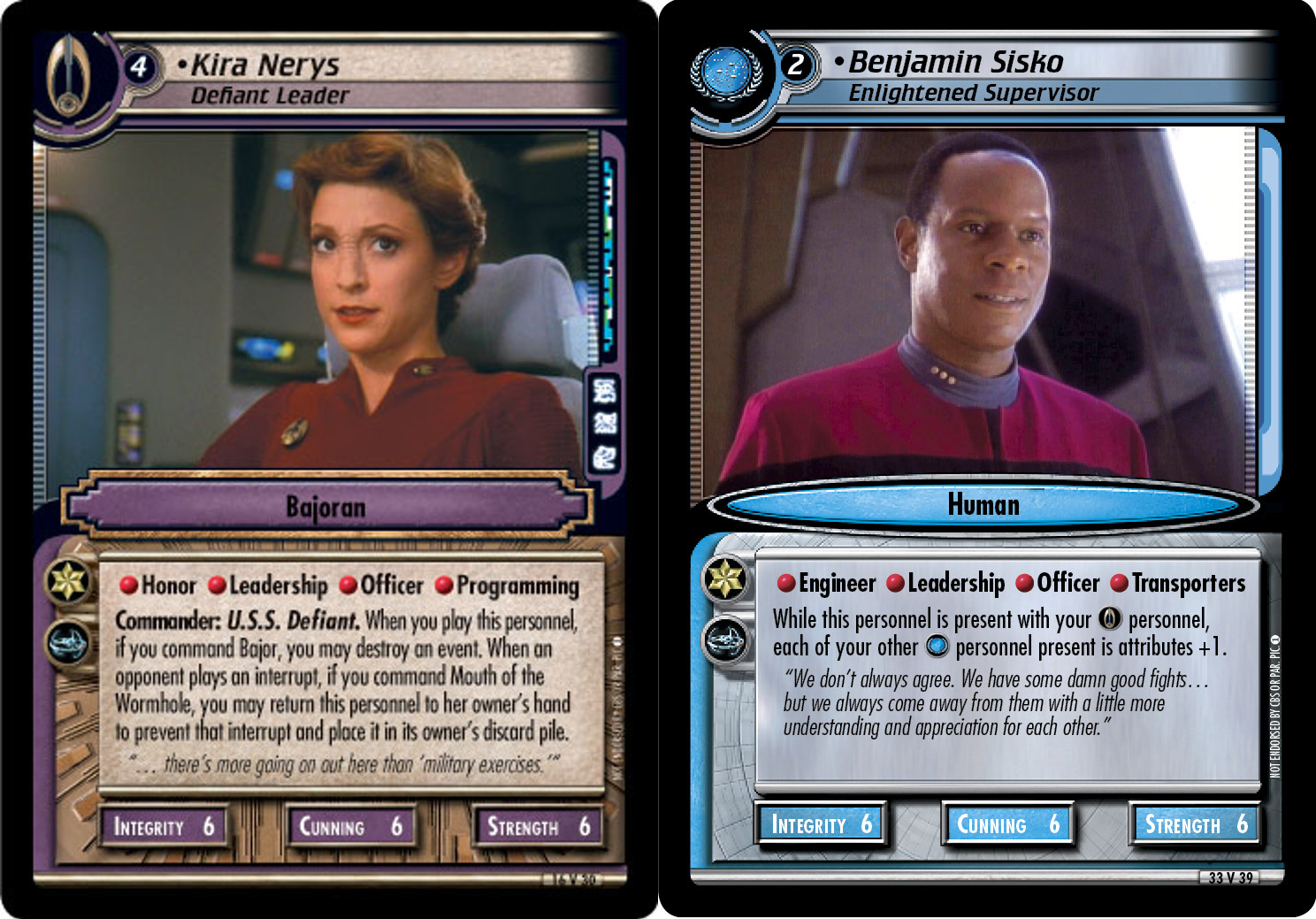
These two characters not only worked together every day, the character on the left viewed the one on the right as the messiah of her religion. Nevertheless, in 1E they could not normally be part of the same crew.

The second problem grows out of the first: 1E lost touch with the themes of Star Trek. Any given episode of Trek will involve a sci-fi problem—a moon that has to be put back in its orbit, computerized tools attaining sentience, etc.—but the point is always a human lesson: one about learning to work with people from other cultures, or how we might confront real-world issues.

Separating the characters into political affiliations and then enforcing that separation made it difficult to address those themes. The game couldn’t say much about finding common ground because it prevented groups from interacting!

Third and finally, 1E tended to elide the differences between shows. Since nothing in-universe would stop the Next Generation and Deep Space Nine crews from mixing and matching, nothing in the game did either. Nor was it particularly difficult to get luminaries from the original series and Voyager into the mix. Ultimately this led both to thematic weirdness (“Captain Sisko doesn’t seem like he’d approach this mission based on a Next Generation episode the way Captain Picard did, but the cards don’t allow for that”) and gameplay problems (the Federation could create high-powered crews, and so other factions had to be given similar power in other areas, creating difficult-to-balance asymmetries).

With the second edition of the game (“2E”) Decipher took a different tack: it replaced in-universe political affiliation with out-of-character narrative grouping as the arbiter of who could work together. Thus, rather than being a “Federation player,” one might be a “Deep Space Nine” player, able to play all of the characters who were a part of that show’s main cast or who were regular guest-stars no matter what planet they came from or what government they worked for.

2E fixes the problem with the "DS9" icons to the left of the text box; since both characters have the icon, they can easily be played in the same deck even though they work for different in-universe governments.
2E fixes the problem with the “DS9” icons to the left of the text box; since both characters have the icon, they can easily be played in the same deck even though they work for different in-universe governments.

Although it might seem simple in retrospect, that single move did much to resolve 1E’s problems. The constant cultural intermingling seen on the shows was easily incorporated, so the game became a better simulation. People who didn’t seem to have much in common could team up again, restoring some much-needed thematic power. Finally, the Federation got some reasonable sub-divisions, which took pressure off of the designers.

2E began with a single, brilliant idea: a game about TV shows could be based, not on the fictional universe’s rules, but on the audience’s experience as they watch. Running with that concept helped 2E resolve many of the issues which had plagued the previous edition. Unfortunately, it did not avoid every land mine—as we’ll discuss on Wednesday.

The Case Study: See for Yourself

Following up on the last post, today League of Gamemakers posted an excellent comparison of dice and cards as design tools. I was particularly struck with the idea of drafting dice, which I didn’t think of when writing Monday’s post but which is a great way to manage randomness. Be sure to give Mr. Caputo’s article a look.

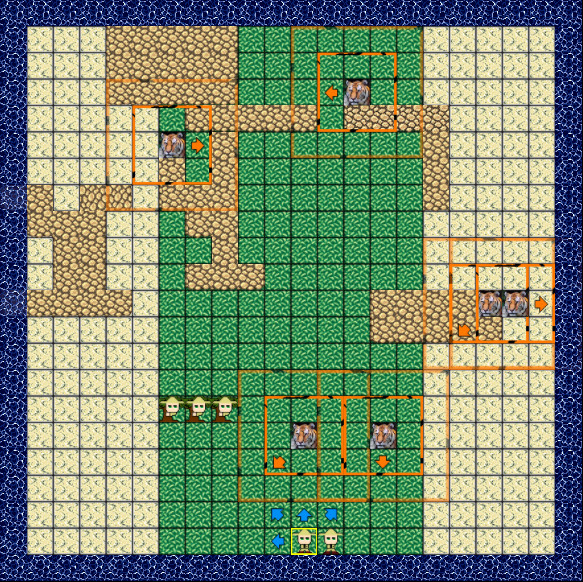
I also wanted to follow up on this post regarding the status of Over the Next Dune. A picture is worth a thousand words, so:

4-8-15 - OtND AlphaThe rules enforcement is almost complete; all that’s left is players leaving paths in the sand. While the art is simple, it beats the strictly-abstract print-and-play by a country mile. Every day sees a few more bugs squashed. I was hoping to have the alpha version available by the end of the week; that might not be feasible, but we’re definitely getting there.

Theory: Mitigating Randomness

So you’ve decided to use dice, or some other randomizer, to help shape your game experience. You’ve thought carefully about what the odds of success for different actions should be, and have calibrated the randomizer accordingly. However, you’re finding the results unsatisfactory; perhaps the occasional bad roll is too devastating, or players are getting into unwinnable positions early through unlucky dice rather than bad play. Below are some tools you can use to mitigate the effects of randomness, keeping the excitement of an unpredictable outcome without the risk that dice will dominate the game.

Change the odds for key rolls

If something is critically important—because it’s the culminating move in a strategy, for example, or because it’s necessary for the game to progress—shift the odds so that that specific roll is more likely to succeed. Players naturally get frustrated when a game’s randomizer undoes their hard work at the final moment, or even worse when it stymies the game completely (the “I need to make this Investigation roll to find the clue, but I keep failing” problem). Twisting the odds toward the players at key junctures retains the tension inherent in the possibility of failure, but makes it unlikely that an actual failure (or worse, repeated actual failure) will inhibit their fun.

Broadly speaking, there are three ways to push the odds in the players’ favor:

  1. Roll more dice

As you roll more dice there are more opportunities to outweigh bad results. The average result when rolling two dice is 7, but if one of those dice comes up as a 1 the total result is probably going to be low. By contrast, rolling three dice means that even if one of them lands on 1 the other two will probably still get the total to or above 7. Rolling more dice while looking for the same end result thus leaves open the possibility of failure, but makes it less likely.

Warmachine implements this concept to great effect. It allows players to expend a resource to roll more dice when trying to hit a target, without changing the math that determines the total the player needs. This allows players to improve their chances on vital rolls, reducing the risk that a single unlikely fall of the dice will decide the game while promoting simplicity by keeping the math consistent.

Adding dice to control randomness works even in systems that don’t rely on totals. For example, role-playing games sometimes count the number of dice that meet or exceed a certain threshold value—say, one might roll ten six-sided dice and count all the dice that came up with a 4 or better. Even though there’s no totaling of values here, rolling more dice still helps, since one has more opportunities to get those 4+s.

  1. Roll the dice more times

One’s odds of succeeding on a roll go up substantially if one is allowed to roll the dice again, especially on “easy” rolls. Allowing the players to roll a second (or third, or fourth . . . ) time can thereby act as a safety valve against unexpected and/or undesirable results.

Heroclix uses this approach. The results of an attack in Heroclix are based on a single roll. Each roll can lead to a hit, or a miss, or an unusually damaging hit, or a miss so severe that it reflects damage back on the attacker! As one can imagine, the outlier results can be devastating, especially “critical misses;” wasting a turn setting up an attack that instead results in damage to one’s own piece is often a game-ending setback.

To limit how often those crushing failures occur, Heroclix is liberal about allowing players to re-roll their dice. There are many ways to get the ability to do so, or to get access to a limited variant (e.g., the ability to re-roll a die that lands on 1). Critical misses therefore end up being very rare. Furthermore, when they do happen they are usually the result of a strategic decision to forego re-rolling in order to get some other advantage, so they feel like a justified outcome rather than being struck down by random chance.

  1. Change the goal

Perhaps the most obvious means of shifting the odds in the players’ favor, this may also be the most dangerous. It’s easy enough: if the players normally need to roll a 7, make it so that they need to roll a 6 or a 5.

Unfortunately, this seemingly simple approach can be complicated in play. First, it can introduce memory issues when the change is not directly followed by the roll. This issue comes up in many miniatures games: piece A can increase the defense of one of its friends, B or C. By the time it comes to the opponent’s turn it’s not always easy to remember whether A made B harder to hit, or C, or neither of them. By contrast, picking up an extra die or re-rolling a bad result both happen at the moment of roll, and so memory issues generally are not present.

Second, changing the goal can significantly add to the game’s mental overhead. It’s much easier to look at a lousy roll and decide to re-roll it than it is to do math. Adding a step to calculating the goal—or even worse, making the players calculate the goal when normally they wouldn’t have to at all—can be trying.

Changing the goal, then, is a technique to use with caution. Forego it if the game already involves significant calculations, or if the game otherwise involves no calculations. Outside of those circumstances, think about whether another solution would provide the same in-game benefits.

Remove the worst results

If a certain possibility is going to be bad for the game, consider removing it entirely. There’s no need to be content with “this unfortunate thing won’t happen often;” as the designer, you can make it happen never.

The example of this that sticks out in my mind is the Combat Resolution Table in Avalon Hill’s classic wargames. CRTs generally looked something like this:

Roll 1-1 2-1 3-1
1 A eliminated A eliminated Exchange
2 A eliminated A back 2 Exchange
3 A back 2 Exchange D back 2
4 Exchange Exchange D back 2
5 D back 2 D back 2 D eliminated
6 D eliminated D eliminated D eliminated

The CRT’s X-axis is the odds in the battle, while the Y-axis is the attacker’s roll. Thus, if the attacker and defender are of equal strength (1-1), then a roll of 1 means the attacker’s entire force is eliminated while a roll of 6 eliminates all defending units. If the attacker has double the defender’s strength (2-1), the table changes so that there are more of the results favorable to the attacker, and so on.

CRTs could be a bit unwieldy; they changed the goal in a calculation-heavy context, with all the mental load that implies. One had to total up the attacker’s strength, then the defender’s, divide the former by the latter, and then check the table to find out how high one actually needed to roll to win the battle. Playing games with a CRT could involve a lot of basic arithmetic (which, in retrospect, may in part be why my father suggested them when I was little).

The trouble was worthwhile, however, because CRTs allowed the designers at Avalon Hill to encourage good play by removing the worst results. Attacking at even odds is easy, but the CRT allows an even-odds attacker to be eliminated wholesale. 3-1 attacks, by contrast, are rather trickier to set up, so players who manage it are rewarded by having the possibility of total defeat taken off the table.

Avalon Hill’s wargames were games of maneuver, and it would have been a problem if players had maneuvered skillfully and then been crushed regardless. They might have been confused as to what was expected, or even concluded that sound tactics were not to be used. By using CRTs that protected players from bad results after they managed their troops well, Avalon Hill’s designers made sure that the game was consistent in encouraging strong play.

Put outlier results behind multiple rolls

Sometimes a game would benefit from an outcome being rare—rarer than one can achieve through a single roll. In that case, it can be useful to require multiple rolls to get that result. With each successive roll that needs to succeed (or fail), the odds that a player will get through all the rolls diminish.

Warhammer 40,000 uses this technique to give battlefield primacy to important models like unique characters and giant futuristic battle-robots. It needs to be possible to take these centerpiece models off the table, but 40K’s designers have concluded that to emphasize their power and importance it should be quite difficult. As a result, damaging such models involves many rolls in sequence: one to hit, then a roll to see if they were hit hard enough to do damage, then a further roll to see if their armor saves them, and then a final roll for an “invulnerable save” to see if a force field or their own doggedness keeps them going. It’s very difficult for an attacker to get all of those rolls to work out as he or she needs—a friend of mine once had a character survive multiple turns of an opponent rolling hundreds of dice against him—and so these centerpiece models are subject to some risk while generally being very safe even when they lead from the front.

Choose from a pre-set list of results

It’s possible to manage, not just how likely a result is, but how often it can occur overall. For example, a game can produce random results by having players draw from a deck of cards rather than rolling dice. By adding and subtracting cards from the deck, the designer can control not just the odds of getting a 7 or an 11, but how many 11s it’s possible to have during a game.

Forbidden Desert uses this strategy. During the game a sandstorm swirls around the players; it gets worse over time, and will eventually bury them. If the storm rose too quickly it would be patently impossible to win—and not much fun. It’s easy to imagine that happening if, for example, the storm got worse on every roll of 6 on a die; inevitably someone will have the unlucky game where they roll a bunch of 6s in a row, and will walk away irritated.

The game avoids that problem by using a deck with a limited number of “Storm Picks Up” cards. Since the players will go through the deck multiple times during the game, and the storm can’t get too strong on any one trip through it, there is no danger that the storm-rises result will occur too often.

Choose from one of several lists of results

An outgrowth of the previous technique, here the game has different pre-set lists of results for different events/points in the game/etc. Players get a random result from a list appropriate to the situation.

Many games do this, but I think an especially strong example is Through the Ages. Through the Ages is a civilization-building game in which players buy cards representing noteworthy elements of their civilizations—inventions, an important person, etc. Each card is available in limited quantities, controlling how often it appears in the game.

Even that level of control, however, is insufficient for Through the Ages’ purposes; it would be frustrating if the random draw of cards gave a player whose civilization is in the 1900s options like basic agriculture and bronze weapons. As a result, the cards are subdivided into three decks, each appropriate to an historical era. This still provides a random draw, but the draw is guaranteed to generate options that at least have the potential to be impactful given the stage of the game.

Allow some tasks to be accomplished without randomness

If accomplishing something is absolutely vital to the game, should it be rolled for at all? It may be better simply to assume success and reserve uncertainty for matters where failure doesn’t bring the game to a screeching halt.

The GUMSHOE role-playing system follows this line of thinking to make sure that games simulating an investigation work. Essentially, GUMSHOE provides that player-detectives can never miss vital clues entirely; if something they need to know is present they will always find it, no rolling required. This ensures that, like a good mystery novel, the players get to the end with the all the pieces of the puzzle. Also like a good mystery novel, the challenge is in recognizing them for what they are, and putting them together correctly!

The problem of must-succeed situations can also be resolved in other ways; for example, players might be asked to roll just to see how well they succeed (the worst result of failure having been removed). However, assuming success and moving on will always have the benefits of simplicity for players and predictability for the designer. Neither of those should be undervalued.

Make failure as interesting and fun as success

The brass ring of randomness mitigation, here there’s no frustration because all possibilities are awesome. Randomness is still present, but there’s no need to go out of the way to control its effects; the effects are positive for the game as a whole no matter how the dice turn up.

Very few games even try to follow this road, but when it works the results are impressive. For example, the (sadly) short-lived Marvel Heroic Roleplaying used a system in which high rolls were more likely to result in success, but rolls of 1 could be a source of “Plot Points” which give the players extra capabilities. As a result, even bad rolls were good—just on a different axis.

Don’t leave fun to random chance

Adding an element of chance can do a lot for a game—but it can take over the game if incautiously implemented. The techniques above can help take control of randomness, mitigating its potential downsides. Give them a try when your game needs the Goldilocks amount of uncertainty–not too little, not too much, just right.

Theory: Theme As a Mechanism for Discouraging Optimization

It’s generally understood that tournament players of card games will gravitate toward optimal decks and strategies. However, last year a fascinating situation arose in which the players of Legend of the Five Rings (“L5R”) chose not to optimize, and ultimately forced designers to alter the game around that preference. In the process L5R demonstrated that it’s possible to get players not to play the best cards and decks, if a powerful theme creates an adequate incentive to do otherwise.

By way of background, L5R is a card game which goes to great efforts to simulate life in a world inspired by mythic Japan and dynastic China. Battlefields are replete with samurai, while in palaces courtiers jockey for influence. The victory conditions are meant to capture a range of ways in which one might attain respect and power in such a setting: conquering opponents’ lands is one option, but players can also achieve dominance in court or become a religious leader. Players are encouraged to be loyal to one particular “clan,” following it like one might follow a sports team, and to represent it in tournaments. Everything about the game is designed to create a “you are there” feeling, immersing the player in the game world.

In last year’s tournament season one clan was extremely strong, putting up more than its share of victories. That led to a great deal of discussion about where the clan’s strength came from. Some argued that the clan’s cards were too good–a design flaw in the game. Others suggested that the problem lay with the players, who neglected cards that would rein that clan in.

Ultimately the game’s designers gave both sides some credit as they announced errata meant to level the playing field. They conceded that the powerful clan “ha[d] come out of the gates far too strong.” However, they also noted that players were not doing everything they could to maximize their chances of defeating the front-runner. “[P]eople are generally not preparing their decks for fighting [the powerful clan],” they said, citing cards that “are fantastic . . . yet are seeing very little play.”

It’s unusual, in my experience, for game designers to have the problem that tournament players aren’t well prepared. In the age of information, it’s usually the other way around: good strategies propagate quickly, are studied intensively, and counter-strategies then appear promptly. (Alternatively, sometimes it’s determined that no possible counter-strategies exist, and that errata are needed–but the problem in that case still is not insufficient preparation.) How is it that L5R’s tournament players bucked the trend, and were so unready that the designers had to take action?

Certainly, one contributing factor is that relatively less data comes out of L5R tournaments than those of other games. However, players who wanted to know could easily find examples of the strong clan’s best decks. While not the wealth of information that comes out of, for example, Magic: the Gathering events, the data available was enough to point out the utility of the “fantastic” cards that players didn’t use.

Some have also argued that the “fantastic” cards actually weren’t all that good, or that it was too onerous to use them, or at least that it was too onerous to use them in the numbers necessary to hold back the strong clan. L5R’s design team, however, is generally drawn from those skilled at the game. Indeed, its lead designer was once its winningest tournament player. Under those circumstances I’m inclined to hew to their opinion on how good cards are, and how realistic it is to include them in one’s deck.

If the issue wasn’t that players couldn’t find answers for the strong clan, and wasn’t that the answers didn’t exist, what was it? The answer, I think, lies in L5R’s intense focus on theme. Its players are encouraged to choose a clan that appeals to them, to pursue a victory condition that they like, and even to use or not use particular cards as a means of personalizing their experience. Thus, there are devoted players of the Scorpion Clan, players who always try to win by enlightenment and eschew military victories, and players who won’t use cards that are associated with the “Shadowlands” because those cards represent evil forces in the game’s setting. Mark Rosewater would say that it’s a very “Johnny” game. Telling these players that they have to build their deck a certain way in order to compete is often going to be futile. Players who have been hooked by the promise of immersion and even self-expression will not want to break their suspension of disbelief to do something as “game-y” as running athematic meta cards.

To be clear, I’m not criticizing those players. I’ve played L5R on and off for about two decades because I enjoy the personalized experience too. I don’t love using athematic cards in my decks any more than anyone else. My goal here is to understand why people don’t play them, not to rake anyone over the coals for passing them up.

Nor is it my intent to criticize L5R’s designers. It was completely rational to expect that tournament players would optimize in the pursuit of victory. Their decision not to was unpredictable to say the least.

Unpredictable, but interesting. Players’ refusal to change their decks to react to the tournament environment was a problem for L5R, but a superb lesson for game design generally. Even in a tournament setting, L5R showed us, it is possible to get players to forego advantages and play sub-optimal strategies. The competing incentives provided by theme can outweigh the desire to win.