Theory: Focusing on Characters’ Methods in Superhero Games

I have a full-to-bursting shelf of my favorite comic books: Superman: Peace on Earth, Christopher Priest’s run on Black Panther, some Walt Simonson Thor, several Captain America storylines. My collection of great superhero games is, to my dismay, much smaller. I try new ones out whenever I can, but few make the grade. Most miss the fundamental rule of a great superhero game: simulate, not just what the character does, but how the character does it.

Lots of games simulate what superheroes do. In fact, most of these games don’t even involve superheroes! From classic side-scrolling beat-’em-ups like Streets of Rage to the most recent Mario game, one can readily find protagonists who protect people by punching and throwing fireballs.

Hence, to make a recognizable superhero game one can’t simply focus on what comic book characters do. Instead, one has to bring out a particular character’s methods. Batman and Street Fighter’s Ryu are both martial artists, but Batman is differentiated by his detective work and his reliance on fear and surprise to overcome enemies. Captain America and Paragon Shepard from Mass Effect are both . . . well, paragons, but only Cap fights with a shield while giving inspiring speeches.

Really capturing that superhero feeling, then, requires designers to look to the methods. A Batman game that’s just walking from the left side of the screen to the right while hitting people will feel generic no matter how many references and in-jokes are packed in. By contrast, a Batman game where the player emerges from the shadows to terrify “superstitious and cowardly” villains will drip with Batman flavor.

There are a few superhero games that I feel really bring this out. First, take a look at Captain America and the Avengers, an early-’90s arcade game.

No one could deny that there’s a lot of Avengers-ness packed in there. The player controls Iron Man, who’s helped out by Wasp and Quicksilver, fighting Crossbones and the Red Skull, while the Grim Reaper (in his distinctive Marvel Comics horned helmet) jeers on a screen in the background. After defeating the Red Skull Wonderman arrives in a Quinjet to whisk the player away to safety. There are more Avengers references in less than 10 minutes of play than there are in some issues of the Avengers!

Yet, the gameplay here is completely generic. The first sequence is a classic side-scrolling shooter, with Iron Man in place of Gradius’ space ship. What follows is a beat-’em-up that owes much to classics like Double Dragon.

Compare that with Batman: Arkham Asylum. Arkham Asylum puts its players in Batman’s shoes, and asks them to use Batman’s tools. Players must sneak around gun-toting thugs to take them by surprise, lay traps, and win fistfights with perfectly-timed blocks and counters. At every step players feel like Batman–not because the character is on the screen or his name is heard, but because the player is thinking the way Batman would think and solving problems the way Batman would solve them.

I have a lot of affection for both of these games, but only one scratches the superhero itch. Arkham Asylum says “you are Batman.” It’s just about the closest one can come to being in a comic book.

With Captain America and the Avengers, on the other hand, my affection is born of nostalgia for types of gaming rarely seen since the decline in arcades in the U.S. It reminds me of playing NES games with friends. Its skin-deep superhero-ness just isn’t much of a draw; when I’m looking for a comic book experience I look elsewhere.

There are more superhero games that follow Captain America and the Avengers’ example than there are in Arkham Asylum’s mold–and many of them are a lot of fun. Only those that follow Arkham Asylum in simulating the character’s methods, though, really have a comic book feel. Designers going for that feel should keep its example in mind.
Something Completely Different: Alternate Mana in Magic

I was going to put up a discussion about how Rock Band succeeds in being fun even when the players are losing, but then I saw the #AlternateMana posts on Twitter and got inspired. Changing the way players get mana–the resource required to play cards–in Magic: the Gathering messes with the fundamental building blocks of the game. Pushing that to an extreme could end one up with a game that still has cards and mana costs and timing rules and all the other elements of Magic, but that’s nevertheless a very different experience.

How about some of these:

Mana is acquired by building a house of cards. The different colors of mana each have a different size and shape of card associated with them, which make some combinations easier and some more difficult (e.g., the red cards and the blue cards are shaped such that they’re stable when used separately, but do a poor job of reinforcing each other). Getting more mana requires building the house higher.

Mana is produced by the overall amount of Magic in the area. The more Magic is being played, the more total mana is available. Some cards’ costs can only be paid at large events; PTQs and GPs aren’t just noteworthy because of the players and the prizes, but because they’re big enough to allow Griselbrand Unleashed to hit the table.

Mana is allocated by a group, which may or may not be made up of people playing in the same game. At the start of each turn, players explain what they want to do and what they need to achieve it. The group then divides the mana up according to whose speech impressed them more. (Imagine how different Commander would be if you had to get people to give you mana by explaining why your deck’s gameplan is fun for the whole table.)

Mana comes from real-world locations. Traveling to a new place and playing Magic there permanently gives the player access to that location’s mana. Get more by further “attuning” to that location: sightsee, become proficient in the local language, etc.

Mana is captured in wargame fashion; it comes from spaces on a board, and players gain mana by taking and holding those spaces.

Mana is a flow, represented by flowing water on the table. Players gain mana by using their cards to divert the flow. (Sleeving cards suddenly becomes very important.)

Mana is acquired through a music equalizer, with sound in different ranges generating different kinds of mana. Players get the mana they need by finding (or playing?) a song that quite literally hits the right notes.

Mana is generated by emotion; to get a certain color of mana, a player must find evidence of a specific emotion in the world via news stories. To get more mana, the player needs to get better at searching up information. Bonus mana comes from finding it in other languages, from different countries, etc. The metagame is influenced, not just by the card pool, but also by the state of the real world.

Now I really want to design games that involve building houses of cards and redirecting water. If only there was a 25th hour in the day . . . .

Lines of Questioning: Coding

I’m always torn when I’m coding. On the one hand, I very much enjoy it. On the other hand, it feels like I have to pause the theoretical aspect of the design work in order to code; the game is here, and I want to take it there, but first I have to get the digital version of the game to where the paper version of the design already is.

Building a strong foundation is important, and I think Lines of Questioning will benefit a great deal from a strong digital implementation. If nothing else, distribution to playtesters will be enormously easier! However, it does mean–in the short term–putting hours toward Unity and C# instead of hammering on the gameplay.

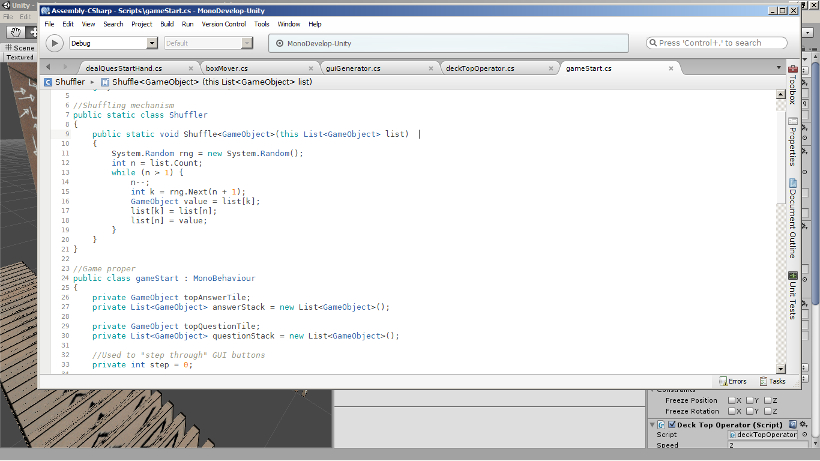
12-1-14 - Unity ScreenshotI’d best get back to working out what the most efficient way to deal out opening hands of tiles is. (The current front-runner is: move an object which is just the tile back, flip it, replace it during the flip with an object whose texture is the front face of the tile, repeat.) Wish me luck. 🙂