Theory: Making Barriers into Benefits

When someone purchases FFG’s X-Wing, this is what comes in the box.

Image from Boardgamegeek

When someone purchases a box of Warmachine, he or she gets this:
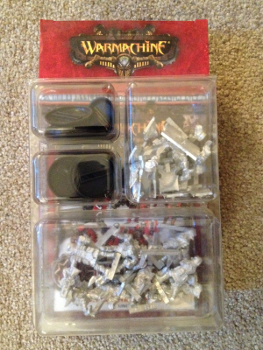
12-31-14 - Warmachine BoxLooking at those pictures, one would expect Warmachine to be the province of the hardest of the hardcore, true grognards–but it is instead, as of last time I saw sales figures, the second most popular miniatures game on the market. Part of that is simply because Warmachine is a superbly designed game. Part, however, is that Warmachine turns its barrier to entry into a strength, using it to generate engagement with the game.

Every game has barriers to entry. Usually they must be purchased, sometimes at great expense. Rules must be read. The game must be set up on the table, which is easy enough in the case of something like Tsuro but which can be quite laborious in the case of wargames and RPGs.

In general, these barriers to entry are undesirable. They prevent people from buying, playing, and enjoying a game. Minimizing them is thus usually viewed as strictly beneficial. Designers try to make rules easier to learn and publishers look for simpler, less expensive components, all in the name of lowering these barriers.

X-Wing is a superb and successful example of that process in action. The minatures are ready-to-play right out of the box, fully assembled and painted to a standard much higher than most players could achieve on their own. While the game is not exactly cheap, lots of starships are available at the $10 impulse-buy price point online. FFG has done as much as possible to make getting into the game painless.

Warmachine, on the other hand, makes few concessions. Its miniatures come unpainted and in pieces. Most boxes of Warmachine minis don’t even have an instruction manual; one is expected to figure out that this piece goes here and that these arms are bent just so such as to fit those torsos. It’s not uncommon for miniatures to have flaws straight out of the box requiring non-trivial modeling skill to fix; from the beginning of the game to today, people have been fixing the “Khador gap.”

One might expect that all of this would render Warmachine the nichest of niche games. Instead, however, it’s enormously successful, begging the question of how an expensive game that requires tremendous amounts of setup could ever overcome its barriers to entry. Warmachine is a superb game, yes–but many superb games fail for lack of players willing to invest in them. That alone did not propel the game to the heights it has now achieved. How did Warmachine manage its barriers to become a key player in the miniatures space?

The answer is that Warmachine’s greatest barrier–the tabula rasa nature of its pieces–is a strength in the eyes of a substantial proportion of the player base. They become an artistic outlet; one is not just going to field pikemen, one is going to field one’s very own pikemen, with paint schemes and poses chosen in accordance with one’s taste. Many players end up involved the game just for the painting, playing only rarely as a way to show off their work.

Personalizing the miniatures in that way invites other forms of creativity, such as biographies and backstories chronicling the achievements of one’s troopers. Ultimately all of this can even feed back to the tabletop, with players devising campaigns in which rivalries between their armies are settled and new ones created. Again, these opportunities to craft something unique are the result of what would otherwise be a barrier to entry, and are an important draw for many players.

Not every game can do what Warmachine does, but it’s a possibility for more games than one might think. What if Agricola required players to build little parts of houses, instead of just using tiles? Would that lead to a greater sense of ownership over the homes, and more incentive to play? Would players be less likely to shake their heads at the depth of chess and give the game up if they painted the black squares on the board themselves?

Barriers to entry are always going to be a problem. However, it’s possible to approach them imaginatively, and ask how they can be used to encourage player investment.

Now you’ll have to excuse me–I have some pikemen to paint.
Status Report

I’m wrapped up in end-of-year lawyer stuff, so I thought I’d use this update to provide a quick overview of where Law of Game Design’s projects are.

Over the Next Dune: the case study which was the focus of this blog for most of the year is not forgotten! Design work has been paused while I try to get enough playtesters in the room at the same time; it turns out that testing a game designed for five players is no joke.

To break that logjam, I’ll be working more aggressively to get Over the Next Dune to the table in 2015. A massive component upgrade is in the works, and will help with that quite a bit; the old components were very simple (and thus easy to change), but were almost completely abstract and did nothing to sell the theme. “Let’s try this game involving a number of circles and some squares” is a pitch that only another designer could love. The new components will be easier to work with and more attractive to the eye, which I hope will make the game more appealing to testers.

Lines of Questioning: this is my current focus, and I’ve been very pleased with how the game is working out. Feedback so far has been positive and the game plays well. There’s still lots of room for further refinement, but I feel that Lines of Questioning’s foundation is very strong.

In related news, the digital implementation of Lines of Questioning is coming along nicely. At the moment the game is in an alpha state; it’s playable, but not feature-complete. The road ahead is well-mapped, so I expect steady progress on this front. Unity 4.6’s new UI tools, in particular, are a tremendous boon.

Narrative-driven miniatures game: an older concept, but something I keep simmering on the back burner. Recently I started thinking about mapping power-ups to a three-act structure, gating power by having players guide a “leader” figure through the things a character in a three-act story must do. That would cast players in a different light than most minis games; rather than being a general or a battlefield combatant, the player would serve as author. Perhaps, just as authors must put their characters through the wringer, the player would then want to throw some curveballs at her own troopers?

More than anything else, this is the game that makes me wish for a 25th hour in the day.

Game for parents with toddlers: I haven’t been able to put as much time as I would like into this one, not least because the digital implementation for Lines of Questioning is eating into time that might otherwise have been devoted to it. With that said, I have more out-of-nowhere ideas for this game than I do any other. This is very rapidly becoming my “wake up in the middle of the night with an insight” game.

Moving forward, the priorities are:

1. Lines of Questioning, digital implementation: reach a feature-complete state and build an appealing digital experience.

2. Lines of Questioning, ongoing design work: continue testing and find the ideal variant.

3. Over the Next Dune, component revamp: build an attractive, functional prototype for OtND.

4. Over the Next Dune, testing: get OtND to the table more often, putting the current version of the game through its paces.

Theory: Making Losing Fun – Pinball

One way to study how to make losing fun is to look at games that can’t, techncially, be “won.” Take pinball, for example. There’s no winning a pinball table; one never beats the game. In a sense, a pinball player is always losing, trying to accomplish as much as possible before inevitable defeat. Yet, good pinball games are just as much fun as they ever were, because pinball designers have mastered the use of sub-goals to create satisfying experiences.

A reliable mechanism for making a game fun even for a player who’s losing is to provide subsidiary goals. Such goals give players who aren’t going to win–in the case of something like pinball, can never win–something to aim toward and take pride in. They beat the boss/saw the next cutscene/got the Steam achievement/etc., and that feels good.

To work, these goals need to be independent of winning, measurable, and desirable. Being unrelated to winning is central; the player isn’t winning, but we want the player to be able to achieve these goals anyway. Measurability contributes to the player’s satisfaction by enabling the player to say decisively “I did X” without the benefit of an ending cinematic. Finally, desirability prevents these goals from feeling like booby prizes.

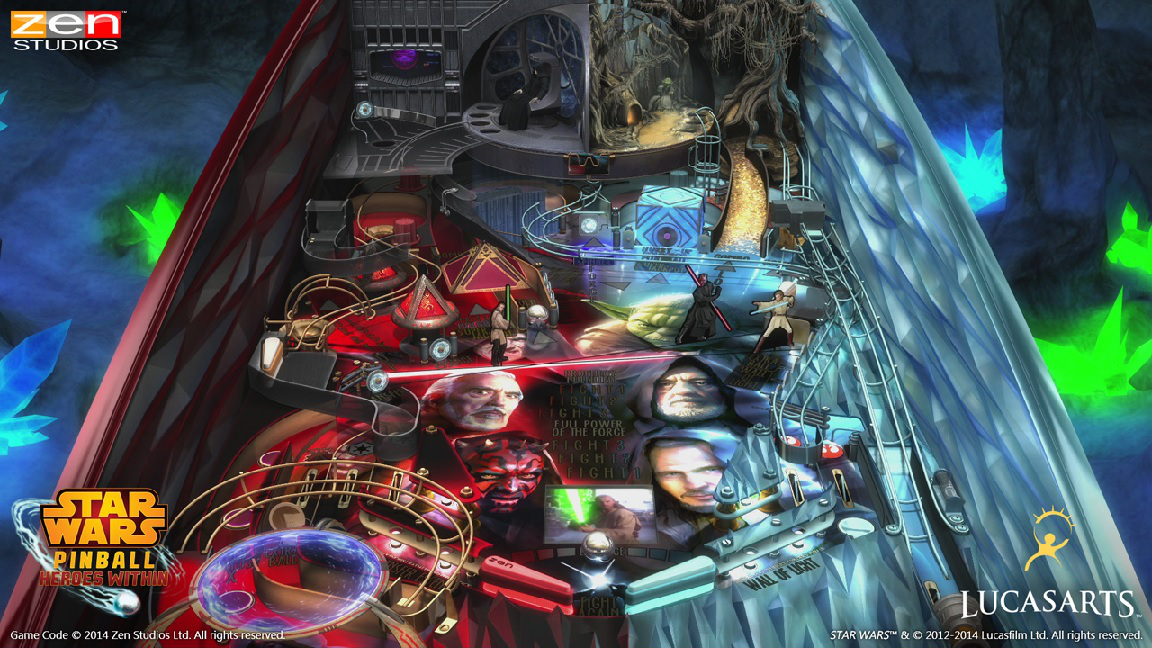
Modern pinball games have huge numbers of these goals. Consider this table, from Pinball FX2:

12-26-14 - Balance of the Force PinballIt’s hard even to know where to begin. Starting from the lower-right:

Every time the player starts the game by launching the ball down the wire ramp along the right side of the table, she can choose how hard to hurl the ball. Getting just the right amount of force causes the ball to fall onto the table at the exact end of the ramp, a “skill shot” worth lots of points. That (a) has nothing to do with winning–the ball ends up on the table either way, (b) is easily measured–the game announces skill shots prominently, and (c) is desirable, in that it improves one’s score.

See the ramp in the upper-right, that leads into a tree? Hitting that ramp several times starts a special game mode, with the opportunity to score lots of points. Hitting the ramp to start the special mode is, again, (a) independent of winning, (b) measurable, and (c) desirable for the points gained thereby.

At the center-top are Yoda’s hut and the Emperor’s throne room. They aren’t just for show. It’s possible to get the ball up there–a goal unto itself–to play a mini-game in which the player uses a smaller set of flippers to hit the ball into targets, with success being worth points. This particular table doesn’t do a perfect job of being (b) measurable here–it’s a bit difficult to tell how the mini-game’s reward works–but (a) one doesn’t have to win to get it and (c) if the player knows about the reward it’s certainly desirable.

Listing all the things to do on this table would at least triple the length of this post. See the “fights” listed in the center of the board, near the front? Each of those is an activity unto itself. The cutouts of Darth Maul, Qui-Gon Jinn, and Obi-Wan Kenobi are part of one of those fights; the goal is to hit Darth Maul with the ball while avoiding the Jedi. The pyramid to the left can be lowered to create a ramp that jumps the ball toward the upper-left platform. You get the idea.

The closest I come to being a pinball wizard is listening to The Who. However, I’ve never had an unenjoyable game of pinball. The constant flow of new sub-goals, all of them independent of winning, measurable, and desirable, keeps me engaged despite the fact that every single round of pinball ends–usually quickly, in my case–in “Game Over.”

Lines of Questioning: A New Variant

Holiday time means time for playtesting. I’ve been fiddling with a promising variant of Lines of Questioning, tweaking numbers here and there to see if I can get it to a satisfactory state. While I haven’t succeeded quite yet, I think it’s getting there.

Two weeks ago we had identified four issues with Lines of Questioning:

1. The lawyer’s tiles are handled differently from the witness’ when lines end; this makes learning the game more difficult.
2. Picking up the lawyer’s tiles sometimes feels bad, as though the player’s effort has been wasted.
3. It’s often best for the lawyer to create a series of brief, two-tile lines, which takes away some of the fun of wrangling a longer line.
4. The endgame often involves the witness stacking tiles in the corners while the lawyer just stays away, having nothing to do but keep her distance.

A rule change addressed number 3:

Check whether the lawyer’s line can continue at the end of step 2. If not, the line ends immediately and the lawyer’s topmost tiles are removed. After this happens, start a new lawyer’s line the next time you reach step 1.

That wasn’t a perfect solution, since it reinforced problems 1 and 2. Lawyer tiles were still being picked up, and their ending was being treated differently from the witness’ tiles. In fact, it doubled down on problem 1 by making the end of the witness’ and lawyer’s lines as different as possible; now whether the line ended was being checked before the witness played and drew, but after the lawyer played and drew. Ouch!

For all its weaknesses that solution did seem to work, so I decided to leave it in place and look for answers elsewhere. If the rules for ending lines had become much more complex, perhaps it would be possible to simplify other parts of the rules. Problem 1 would still exist, but it would be less of a barrier to learning the game because it would be the only barrier; the player could invest all of his energy in learning that one tricky area.

To that end, I’ve been trying out a variant that works like this. Play the game as normal (the rulebook is here), except:

1. Follow the rule change noted above.

2. Do not use the the rules for off-topic witness answers. Just ignore section II.g of the rulebook, and all references to it. Answer tiles are never added to the lawyer’s hand of questions by any means.

Playtesters overwhelmingly cite the off-topic answers rule as the hardest thing to learn in the game. Omitting it cuts the mental overhead required to play drastically.

3. Replace the first two paragraphs of section II.e, regarding how to win, with this:

You win by revealing four key facts. To reveal a key fact, you must build a stack of tiles in a corner space at least four-high, in this pattern from top to bottom:

Answer tile
Question tile
Answer tile
Question tile

It is not harmful to have more tiles in the corner, but tiles outside that pattern do not count toward revealing the key fact. (So, for example, if the bottom tile of the stack in a corner is an answer tile, that tile does not help reveal that corner’s key fact.)

Remember that the normal rules for playing a tile apply in the corners just the same as in any other space. In particular, answer tiles may not be played on top of other answer tiles.

Everyone has an intuitive sense that a question-answer-question-answer pattern is “normal.” The current rules, which allow (for example) an answer-answer-answer-answer stack to reveal a key fact, feel “game-y”–so much so that some playtesters assumed the “normal” pattern must be required, even though it’s (a) harder and (b) nowhere in the rules! This variant brings the game in line with expectations, again reducing the mental overhead involved in playing.

Removing the exception allowing answer tiles to be played on top of each other when the witness starts a new line also simplifies the game. Having the rules regarding how tiles are played apply consistently makes the new line rules much easier to learn.

Last but by no means least, this variant beats the stuffing out of problem 4. The lawyer has to be involved until the very end.

4. Replace the second paragraph of section II.f, regarding starting new witness lines, with this:

If you cannot continue the witness’ line in step 3, begin a new one by placing an answer tile in the first corner where an answer tile can legally be played, starting with the lower left and proceeding clockwise. (Remember that answer tiles cannot be played on top of other answer tiles!) This new tile must follow all the normal rules for playing answer tiles.

This final change brings this part of the rules in line with the previous change: no more stacking answer tiles on top of answer tiles in the corners.

Playing this variant is a very different experience. It’s much easier to keep track of what’s going on; the ministerial aspects of the game are greatly simplified. Winning, however, is enormously more difficult. Keeping control of the witness is a challenge, and the endgame is a tightrope walk, with few spaces available and each new tile critical.

If you’ve got some time over the next few days, give this variant a try. Either way, have a happy holiday!

Theory: Marvel Contest of Champions and 2D Fighting With Few Controls

I like fighting games and I like comics, so I couldn’t resist giving Marvel Contest of Champions a try. If nothing else, I wanted to know what the control scheme was like; after years of playing fighting games on an arcade joystick, my thinking on how to control a game like that had gotten stale. To my surprise, I discovered that MCoC’s tap-and-swipe system works better than it seems like it would. There’s only so many things you need to build a legitimate fighting game, and tapping and swiping enable all of them.

MCoC is a 2D fighting game. That means each player controls a martial artist, and those martial artists fight back and forth on a flat plane. In this case the martial artists are Spider-Man and Captain America instead of practitioners of karate and muay thai, but the colorful characters don’t change the underlying gameplay.

2D fighting games have two core concepts that make them work: the attack-block-throw relationship and controlling space. MCoC features both.

Fundamentals of 2D fighting games

Almost every 2D fighting game I’m familiar with–I would go so far as to say every 2D fighting game released in the last 25 years except one–has rock-paper-scissors at its core.

Blocking (rock) nullifies the damage from attacking (scissors)
Attacking (scissors) does damage to an opponent who is trying to throw (paper)
Throws (paper) inflict damage on a blocking (rock) opponent

Much of the strategy in 2D fighting games comes from manipulating opponents into making the wrong choices, so that their damage is nullified by timely blocks and they are not blocking when the time comes for one’s own attacks. That manipulation is possible because the different choices have different payoffs; knowing what the opponent wants to do makes it possible to get into his head, predict his moves, and bait out the moves you want him to make.

2D fighting games also involve a battle to control space. When Ryu throws a fireball in Street Fighter, he takes control of the lower part of the screen; since the game occurs on a flat plane, the opponent cannot advance while the fireball is approaching. Thus, Ryu’s fireball prevents the opponent from taking the offensive. By controlling space, Ryu controls the game.

Not all 2D fighting game characters have fireballs, but they all have ways to control space. The player’s goal is to use each character’s unique tools to assert control over space, take control of the game thereby, and turn that advantage into a victory.

This video, made by David Sirlin, is a great visual explanation of controlling space. Take a look; the relevant discussion begins at 0:58.

The fundamentals in Marvel Contest of Champions

Everything one would expect from a 2D fighting game exists in MCoC. The rock-paper-scissors relationship is firmly in place; MCoC uses “heavy attacks” in place of throws, but the effect–damage inflicted on a blocking opponent–is the same. So too is the struggle to control space in evidence, with Iron Man’s repulsor beams standing in for Ryu’s fireballs.

What’s striking is how few “buttons” MCoC needs to accomplish those things. Movement is thoroughly simplified; players can only shift toward and away from the opponent by swiping left or right, with no jumping, sidestepping, or other movement options. Yet, “toward” and “away” are enough to create space for oneself and reduce the opponent’s space. Hitting the opponent is also very basic–tap, swipe, or tap and hold–but that’s enough to enable attacking and throwing, which are all that’s needed.

In some respects MCoC reminds me of Divekick, the “art game” of the fighting game world. Divekick is the one modern 2D fighting game without rock-paper-scissors; it’s all about controlling space, with a total focus on jumping into the air and positioning oneself to dive down on an opponent who’s trying to do the exact same thing. Although they play very differently, both games are about stripping away the cruft that has affixed itself to the 2D fighting genre in order to explore the essentials of how such games work.

(Well, MCoC is also about incentivizing spending using a freemium model.)

I’m always fascinated by the question of the most minimal thing that would count as a game. Divekick and MCoC are interesting because they push that boundary within a specific genre: they’re both trying to find the smallest number of elements one can include in a 2D fighting game while retaining the strategy and fun. The fact that they both use minimal controls to do so is surely interesting . . . .

Prototyping Materials: Chipboard

So you’ve designed a board game. It’s working out pretty well, well enough that you want to make a nice copy–something you can show to people and have them focus on the game, rather than on managing terrible components. You need a material that’s strong enough to stand up to play, thin enough to stack and shuffle, and weighty enough to have a good feel.

You need chipboard.

Chipboard is my new favorite prototyping material. It’s heavier than cardstock or other papers, so it’s better for things like tiles that need to stay in one place during a game. I’ve also found it very sturdy; a copy of Lines of Questioning I built out of chipboard almost a month ago is almost good as new after many tens of games, with only a single tile “marked” by a damaged edge. At least one professionally-produced game in my collection has held up less well.

In addition, putting art on chipboard is trivially easy. Get the art printed on label stock, and then affix it to the chipboard before cutting. The label stock will adhere to the chipboard without any difficulty, and both stock and board can then be cut at the same time to give a tidy edge.

Perhaps most importantly, chipboard materials work well in play. 1/16″ thick chipboard is strong–it won’t bend by accident–but is still thin enough to stack without getting unwieldy. Furthermore, it feels great in the hand. One playtester specifically called out the satisfying heft of chipboard tiles as contributing to Lines of Questioning’s experience.

Unfortunately, the material isn’t entirely easy to work with. Chipboard is too strong to cut with scissors. You’ll want a rotary cutter, a steel ruler with a cork bottom to guide the cutter, and a self-healing mat to protect whatever table you’re cutting on. (All of those things are available at local craft stores.) Be certain to wear eye protection–safety glasses are about $2 at hardware stores–and kids should get help from their parents.

Still, the effort and minor up-front expenses are small prices to pay. Chipboard is inexpensive, durable, and well-suited to boards and tiles. If you’re looking for something nice to build a game out of, give it a look.

Theory: Mapped Endgames

Many games come to a point where one player is in control, and will win if she can avoid missteps. While such mapped endgames are to some extent scripted, they can still be fun. The keys are to use those last moments as a reward for previous displays of skill, and to keep them short.

“Mapped endgame” is a term that I feel captures the common situation in which a player sees what he needs to do to win, and is completely in control of whether or not he is ultimately successful. The other players cannot stop him; he will only lose if he makes a mistake that lets them back into the game. The situation is “mapped” because the player knows what course to take to reach victory.

It’s important to recognize that in a mapped endgame, the player is still making decisions and those decisions still matter. Falling dominoes are not a mapped endgame. The person setting up the dominoes has relinquished control at that point; much like the final cinematics at the end of a video game, the gameplay (to the extent that setting up dominoes is a game, a definitional issue which needn’t detain us here) is already over. Mapped endgames occur while the game is in progress, and require the player to keep things on course.

While this may smack of autopilot, mapped endgames can be interesting and even exciting. Even if one is clearly going to win a car-racing game, the rush of speed can still be thrilling. A close-fought strategy game can reach a mapped endgame yet still be tense; the player in the dominant position has to make every move precisely correctly while the opponent(s) choose positions from which they can best take advantage of the slightest weakness.

Of course, a mapped endgame done wrong is a painful grind. The winning player acts by rote while the other players suffer through irrelevant decisions. Concessions become likely as everyone starts to agree that the game is “really” over even if there’s technically more to do.

Fortunately, it’s easy to distinguish good mapped endgames from bad ones. The good ones–the ones that will be fun and interesting as players go through the final moves–follow two design rules.

1. A fun mapped endgame is a reward for skilled play. Tichu was the first game where I saw mapped endgames consistently enough to recognize them as a distinct element in a game’s design. Despite happening often, though, Tichu’s mapped endgames aren’t boring. Rather, they’re hard-earned payoffs.

For those who have never played, Tichu is a card game with some similarities to Hearts. Players go around and around the table playing higher-value cards and sets of cards, with the highest winning all the cards played. While certain cards are worth points, the big gains come from predicting at the start of the hand that one will be able to play all of one’s cards first–and then successfully doing it.

Of course, it’s not easy to make those called shots. Doing so requires a strong hand, but even more than that it demands constant attention and the ability to think several moves ahead. Making several strong plays early can leave one’s hand too weak to finish out; failing to track the cards being played can leave one uncertain about whether someone still has the ace that will beat one’s king. Going out first with other players dedicating their entire hands to preventing it is demanding to say the least.

Fortunately, the effort involved is well-rewarded. Putting the available information together to figure out what’s in the opponents’ hands, and then determining the exact right order in which to play one’s cards, creates a feeling like one has had a little taste of enlightenment. The endgame is completely mapped out, but the player drew the map herself, and every step along its indicated path is a vindication of the player’s effort.

Tichu’s mapped endgames, then, are a part of its fun. The player worked hard to reach the top of the mountain, and now gets to stand on the summit. Even if one is just going through the motions, the ease of the final moves marks out as special the difficult work that went before.

2. Mapped endgames should be brief in real-world time. Power Grid is a great game with one flaw: it can involve a mapped endgame that is completely joyless. The problem is not that the endgame is reached too early, or that it can be reached without skill. Rather, the issue is that it just plain takes forever.

In Power Grid every player controls an electric company, with the goal of having the largest network of cities. There are random elements in the game, but for the most part the results of one’s actions are completely predictable. Expanding to city A will cost $B and earn $C; expanding to X will cost $Y and make $Z.

Early on and for most of the game, there’s enough going on to make putting a fine point on those calculations largely unnecessary. Expanding to A might earn $2 more than expanding to X, but another player is heading toward X and it might be worth shutting him out. Then there’s the possibility of expanding to J, which would open the way to an area where no one else is operating. If nuclear energy becomes cost-effective all three of those might easily be within reach, and the question will be whether expanding to cities R, S, and T is worthwhile. Play keeps moving because the players are thinking about these big-picture concerns, and don’t need to spend time optimizing each move.

Unfortunately, that dynamic falls apart on the very last turn. If the last player to move is in a position to win, then that player will have no uncertainties to weigh or long-term plans to take into account. All she will have to do is find the single best move currently available.

That might sound simple, but a great many things factor into that decision: cash on hand, the number of cities one’s company can power, the state of the market, other players’ possible moves, etc. As a result, this last turn can take an enormous amount of time. I played a game of Power Grid in which the last player took half an hour for the last decisions in the last turn–and, given the number of things to consider, was justified in doing so.

Power Grid’s mapped endgame is one turn long, perhaps only one phase of one turn. It is, nevertheless, boring, because it plays out so slowly. Other players just sit and wait while the last player tries every possible combination of actions to make sure she has found the best one.

What’s worse, the time the other players are spending is just time waiting to see if they get clobbered. There’s nothing they can do to change which move is best, or to stop the last player from finding it. They just have to wait to see if she does. And wait. And wait.

It’s worth comparing Power Grid’s mapped endgames to Tichu’s. Once a player knows what to do to win the hand, the process can play out in seconds. Everyone realizes that that player is in control, makes the plays they have to make, and the hand is swiftly over. Play then resumes with a new hand that puts everyone back in the game.

I still play Power Grid, and I enjoy it every time. I’ve met people who won’t and don’t, however, and it’s often because they don’t want to sit through that last turn. Given how frequently I run into people with that viewpoint, I’ve come to feel that it’s important to avoid replicating the misstep in Power Grid’s design, and to make sure mapped endgames play out quickly.

Mapped endgames can be like Tichu’s, a fun interlude. They can also be like Power Grid’s, an unfortunate and off-putting artifact of a game’s design. To keep your game on the right side of that line, stick to the two key rules: make players earn mapped endgames, and keep them short.

Lines of Questioning: Playtesting Update & Possible Rule Change

The law has been gobbling up my time, so just a short update today. Playtesting on Lines of Questioning is continuing apace. Several variants have been shot down, but each one has provided useful information. In particular, they’ve consistently shown that the change intended to discourage repeated two-tile lines is working well.

That change concerns how the lawyer’s lines end. Currently, the rule is that one checks whether the lawyer’s line can continue at the beginning of step 1 of the turn; if not, the lawyer’s tiles that are topmost in their respective squares are removed and a new line begins. The new rule is: check whether the lawyer’s line can continue at the end of step 2. If not, the line ends immediately and the lawyer’s topmost tiles are removed. After this happens, start a new lawyer’s line the next time you reach step 1.

“Whether the line can continue” means, in this context, whether the lawyer could make another play right at that moment. It’s not sufficient that by the time step 1 comes around again the lawyer would be able to place another tile; the lawyer needs to be able to legally place another tile at the end of step 2, or the lawyer’s line ends.

If you get a chance, try this out and let me know how it goes!

Lines of Questioning: Learning from Failed Experiments

I’ve been getting a great deal of playtest feedback on Lines of Questioning over the last few days. As always, that’s both very exciting and a source of new challenges. Feedback highlights problems, which then demand new solutions.

Previous playtesting revealed two issues with Lines of Questioning:

1. The lawyer’s tiles are handled differently from the witness’ when lines end; this makes learning the game more difficult.
2. Picking up the lawyer’s tiles sometimes feels bad, as though the player’s effort has been wasted.

My hope was that these could easily be fixed by leaving the lawyer’s tiles on the board when the lawyer’s line ends. The two types of tiles would be treated similarly, and the feed-bad moment would be gone. Further testing suggested that the change made the game easier, but that could be all right.

Unfortunately, as testing continued some dynamics that weren’t all right started to appear. “Seeding” every corner with a lawyer’s tile had become risk-free; Where once setting down lawyer tiles that the witness would not reach for some time courted disaster if all of those tiles were removed, now that work was guaranteed to stick around. No-risk progress made the game quite a bit less exciting.

What was worse, it became clear that the lawyer’s and witness’ lines could be run completely independently. With removal, players needed to use the witness’ tiles to “lock in” the lawyer’s tiles. That created a tension between separating the lines (to get each where it most needed to go) and keeping them together (to avoid losing progress). Without removal, that tension–and the decisions it created–were gone.

No-risk seeding of lawyer tiles and independent lines worked together to create a third unpleasant dynamic: the lawyer’s lines grew shorter and shorter. With no incentive to keep lines going (and the opportunity to reposition as a strong incentive to end them instead), lawyer’s lines trended toward two-tile affairs. The first would be placed next to a corner, and the second would end the line in the corner. Since the line had ended, the player could then start a new lawyer’s line adjacent to the following corner and repeat. This approach was effective while completely undermining the fun of wrangling the lawyer’s line–and “good yet unfun” is never a combination a game designer wants to see.

Since a number of playtesters had said that they’d like to see a no-removal design, I decided to keep hammering on the idea by taking out the off-topic witness answer mechanic. The idea was that without the ability to play answer tiles, the lawyer’s tiles would build up and ultimately become a hindrance unless the player brought the lines together, solving the independence problem. In addition, that version of the game would lack the two hardest rules for new players.

Unfortunately, that approach also turned out to have serious problems. First, the lawyer tiles didn’t build up enough in practice to force the lawyer’s line toward that of the witness. The lawyer and witness could still play independent games.

A second, new problem also started to crop up: it became increasingly clear that there were situations in which the lawyer was worse than useless. Once every corner with an unrevealed fact had a lawyer’s tile on top (which would never be removed), the lawyer could not contribute to scoring and just had to stay out of the way. That was interesting, after a fashion, but hardly thematic; in a game about an attorney questioning a witness, the attorney wasn’t participating in the questioning!

The “base” game, without these modifications, also has endgames in which the lawyer’s best move is to stay clear. However, the off-topic answers mechanic means that those situations end very quickly as the witness’ stack of tiles runs down. Without that mechanic the lawyer might have to keep to herself for quite a while, which made the strategy unpalatable.

Faced with these results I decided to revert the game to its original state. Removing lawyer tiles had turned out to be more important to the game than I had realized, and I was ready to get back to a version of the game with that rule in place. However, even after resetting the changes I felt the experiments had highlighted two points that should be addressed:

3. Seeing the proliferation of short lines emphasized to me how often they appear in general. A standard opening, for example, is to have both lawyer and witness begin next to a corner. The lawyer then gets into the corner and the witness follows; even if the lawyer’s line ends, the player has locked in two tiles in a corner. Quick two-tile lines of this sort are easy to set up, have little cost, and are prominent in the lawyer’s game even when removal is in effect. They’re teetering right on the edge of “good yet unfun,” and should probably be weaker.
4. While it’s thematic for the lawyer to hem the witness in, it’s not good when the lawyer sets the trap and then has nothing to do during the endgame. The lawyer needs to be more involved in the final revelations.

Having all of this playtest data is great, and seeing these issues now is going to result in a much better final product. The trick, of course, is that the playtest data doesn’t say what fixes will work. 😉 I have an idea in mind for (3) at the very least, and will keep you updated as I go.

Lines of Questioning: Playtesting Change to Lawyer Tiles

Sometimes your game surprises you. When I started testing leaving the lawyer’s tiles on the board in Lines of Questioning, I thought I was fixing some problems while incidentally making the game harder. It increasingly appears, however, that this change is making the game easier instead. To be honest, I’m kind of pleased by that result; it emphasizes just how tricky and interesting game design really is.

Relatively early on in Lines of Questioning’s design, I started treating the lawyer’s tiles differently from the witness’. The witness’ tiles stayed on the board when the witness’ line ended. By contrast, when the lawyer’s line ended the lawyer’s tiles were removed. I liked this for thematic reasons, and also because it created sudden changes in the board state that a savvy player could use to advantage.

Yet, there were two issues with that rule. One I saw coming: the game was more difficult to learn. Players tended to want to the two kinds of tiles, which are similar in many respects, to work the same way in this area as well. Removing one kind of tile but not the other was confusing.

Playtesters confirmed that that was a problem, but they brought a second issue to my attention as well. Seeing tiles disappear just plain felt bad. They felt like their effort had gone to waste.

Since my suspicions about increased difficulty had been confirmed and an additional problem with the rule had been raised, I decided to try testing Lines of Questioning without special treatment for lawyer tiles. They would stay on the board after the lawyer’s lines ended, building up just like the witness’. No more would effort be wasted, and there would be one consistent rule to learn.

Having played Lines of Questioning many times, I thought I knew exactly what this would do to the game’s difficulty. Strategies that revolved around keeping the lawyer’s and witness’ lines separate would get weaker, since the buildup of lawyer tiles would push the lawyer’s line closer to the witness’. Other strategies would be unaffected.

After some testing, however, it appears that I may have been completely wrong. Keeping the lawyer’s and witness’ lines separate is still pretty easy; the board, even at four spaces by four spaces, provides enough real estate to keep the lawyer and witness apart. Using the lines together, on the other hand, has become even easier. The lawyer’s line can be directed into corners with impunity, putting lawyer tiles in place for later with the confidence that they’ll remain even if the lawyer’s line comes to a halt.

The fact that this change isn’t having the effects I expected doesn’t mean it’s bad. It solves the issues it was meant to solve, and might therefore remain in place. I’m just struck by the reminder that game design always has surprises in store.