Theory: What Is a Game?

Is painting a game?

It’s a more interesting question than you might think. Most people intuitively reject the idea. They’ll accept painting as an activity, perhaps as an aesthetic pursuit, but not as a game. Yet, painting has many of the traits we often associate with games: the ability to develop mastery, a requirement that the person doing it make decisions about how to proceed, judges who evaluate success and failure. Depending on what traits one thinks are important in defining a game, painting might make the cut.

What about writing a sonnet? There are rules defining what does and doesn’t count as a sonnet, but most people don’t consider following those rules a “game.” Does that mean rules don’t matter, or just that rules are a necessary–but not sufficient–condition?

There’s academic literature grappling with the question of how to define games. Yet, the question still seems open. Greg Costikyan argues that games require decision-making, but thinks Candy Land is a game even though the players never decide anything. The Wikipedia page on the definition of games (with apologies for citing to Wikipedia) notes that Chris Crawford doesn’t consider car racing a game–but then cites it as an example later. Do all definitions ultimately start with a preconceived notion as to what counts as a game, and then manipulate the definition to include and exclude activities based on those preconceptions? Is the notion of “game” so inherently emotional that trying to compare activities to a Platonic “game” is doomed to failure?

I don’t have the answers. I do, however, have some reading to do.

The Case Study: Replacing Terrain Piece 4

Terrain piece 4 needs to go. It doesn’t create interesting situations in play, and it’s difficult to work with. We need to replace it with something that leads to challenging decisions, and preferably the replacement should be a simpler shape that doesn’t raise rules problems.

Of course, saying that the new piece should “lead[ ] to challenging decisions” isn’t very useful by itself. How does a terrain piece do that? We need to develop some new rules that tell us how terrain in Over the Next Dune works before we can figure out what will work well.

1. “Thick” terrain pieces and “thin” ones involve different decisions.

Take a look at piece 6. It’s a 5×3 block. Moving across it vertically will bog a player down for an entire turn, plus part of a second. Getting across it horizontally is . . . well, suffice it to say that that’s not a good tactical move.

In my experience, piece 6 is usually treated as if it just walls off the spaces it occupies. No one wants to go near it, lest they end up in a turn-wasting slog. The decision players make when they look at it is, “how do I get where I’m going, given that I can’t use that part of the board?”

Piece 1, by contrast, is very small–a 5×1 line. Players don’t love crossing it, but they’re willing to do so if they’re already close enough that going around would be slower, or if the searchers make going around unwise. The decision here isn’t about how to avoid the piece, but rather whether to avoid it.

2. Terrain with a variety of widths creates different incentives in different places, and is more interesting as a result.

Piece 5 is as thick as piece 6 in some places, as thin as piece 1 in others. In my experience, those differences in width matter. Where piece 5 is thin, the players consider going over it; where it’s thick, they avoid it. This single piece combines the decisions involved in the other two, and makes each of them more interesting: is this spot thick enough that it should be treated as walled off? Is there a route across the terrain that’s more favorable? It’s much harder to develop a simple rule of thumb regarding piece 5, and that makes the piece a lot more engaging to think about and deal with.

3. Both terrain’s vertical and horizontal lengths are relevant during play.

In general, the solution to terrain in OtND is to shift sideways before getting to it. Piece 5, however, creates a vertical channel as well as a horizontal barrier. It therefore makes the sidesteps that are effective against most terrain pieces tricky. Getting around piece 1 is much harder when piece 5 is in the way.

Terrain piece 3 can do much the same thing. Players are much more inclined to go left around it than they are to go right and cross its vertical length.

Since sidestepping is so effective in general, I think it’s healthy for the game to make it more challenging when an opportunity to do so arises. That means more pieces with a significant vertical dimension.

4. Bigger pieces have more of an impact than smaller ones.

This is probably obvious, but it’s worth noting so that it’s not overlooked. Piece 1 is easy to work around. Piece 6, by contrast, strongly pushes players away. Terrain piece 5’s vertical length affects more decisions than piece 3’s. If the goal is to have a terrain piece matter, making it bigger is a good place to start.

Those rules leave a lot of possibilities. What about something like (pardon the terrible art, please ignore the underscores):
x x x x x
__x x x
____x
__x x x
x x x x x

That’s big, has lots of vertical length, and has different widths at different points that capture both the “thick” and “thin” decisions. We could also make it more complex:

x x   x x
__x x x
____x
__x x
x x x x x

Both of these have a flimsy middle–not as flimsy as the old piece 4’s, but potentially a problem. How about:

x x   x x
__x x x
____x x
____x x
x x x x x

Hm. That looks like it has potential. Let me know what you think, and if there are no serious objections I’ll update the print-and-play file with the new piece.

Prototyping Materials, Part 2: Nicer Cards

Following up on a previous post about building prototypes: what happens when you’re past the 3″ x 5″ card stage, and want to make some really nice cards to show your game off? You could use a service like artscow, but if you want to do the work in-house this thread on Boardgamegeek is an invaluable resource. The materials required aren’t expensive, and the work is fun in a craft-project sort of way.

The Case Study: Evaluating Terrain Piece 4

Terrain piece 4, you’re going on trial.

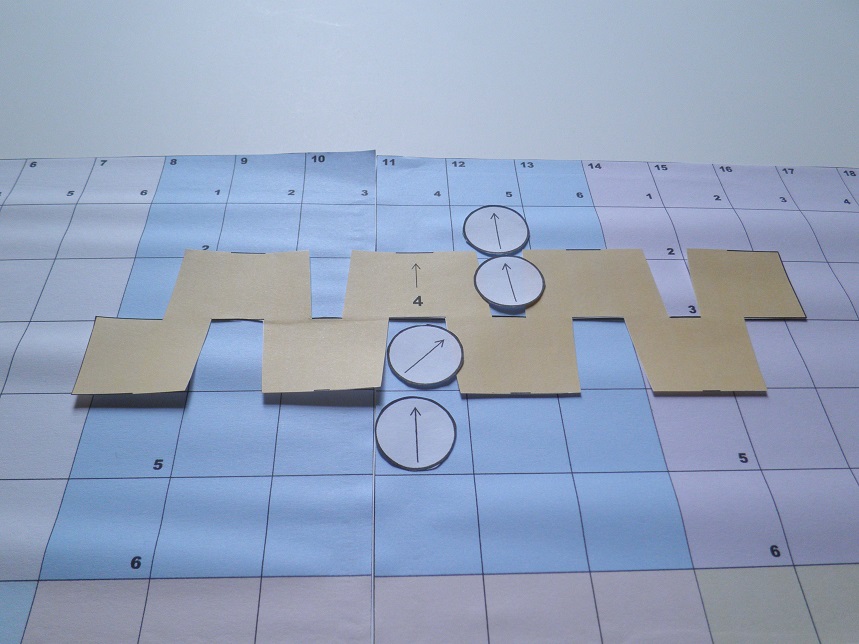
Facts: Terrain piece 4 is a zig-zag of difficult ground:

Terrain Piece 4
Terrain Piece 4

Over the course of many playtest games, this has been the terrain piece with the least impact. Since players can move diagonally and still make progress just as quickly as they would if they moved straight ahead, it’s easy to dodge through the clear spaces left by the zig-zag. No player has ever been hindered by this terrain piece.

By moving diagonally, a player can avoid being slowed by the terrain

In addition, terrain piece 4 can be confusing to new players. Every other terrain piece occupies only the squares it affects. Terrain piece 4, on the other hand, needs reinforcing “crossbars” that extend into neighboring squares. Those crossbars mean that terrain piece 4 half-occupies some squares, leading to questions about whether those squares are clear, difficult terrain, or some hybrid of the two.

With all of that said, terrain piece 4 is visually interesting. Over the Next Dune’s board divides into clear spaces and blocks of rough ground. Terrain piece 4 provides an intermediate texture that mixes clear and rough, making the board feel more realistic.

Issue: Should terrain piece 4 retain its current form, or be changed?

Rules:

1. Decisions players make must be interesting.

2. As a corollary, things that reduce the number of decisions or the interest of those decisions, or that delay getting to the decisions, are disfavored.

Thinking it through: The fundamental problem with terrain piece 4 is that it’s only interesting once: the “a-ha!” moment when a player figures out how to get through it. That opportunity for system mastery is good. After that bit of mastery is achieved, however, terrain piece 4 becomes entirely irrelevant. It never provides an interesting decision again.

None of the other terrain pieces have that problem. Their impact varies–the large piece 6 is more of a challenge to work around than the small piece 1–but they have all continued to create interesting decisions over many plays.

Bringing little interest to the game is a damning critique in and of itself, but the rules problem puts the final nail in the coffin. Explaining how piece 4 works might be worthwhile if it were making the game better; a line or two in the rulebook would be sufficient. Since it’s not, those extra lines are just unnecessary barriers to getting through the rules and on to the game’s interesting decisions.

Piece 4’s aesthetic qualities are nice, but they don’t make up for poor gameplay. OtND’s visuals can easily be improved later when the board and other components get proper artwork. Interest and challenge, on the other hand, are much harder to add. Each game element needs to pull its weight in those areas, and piece 4 is falling short.

Terrain piece 4, then, needs to change–but to what? We’ll take that up next time.

The Case Study: Fewer than Six Turns!?

I’ve been able to sneak in a few more playtest rounds of Over the Next Dune. So far, the win rate for a six-turn game is hovering at about 60%. That’s lower than the rate for longer games, which is good; it suggests that we’re succeeding in increasing the difficulty. Sixty percent is still pretty high, however, and the player powers are yet to be incorporated. OtND is going to have to get harder.

Further reducing the number of turns is tricky business. As the amount of time the players have to reach safety declines, their choices regarding their movement become more and more restricted. (At four turns, every player’s every move would have to be in one of the three forward directions!) So on the one hand, having less time makes the players’ decisions more interesting because each one is very important–but on the other hand, they have fewer options to choose from. Limiting the players too severely risks leaving players feeling like there are not enough strategies available, or like the game is boring simply because it’s impossible to win.

I’m going to try going down to five turns and seeing how that affects play. There’s a point on the dial where we tip over from “interesting challenge” to “frustrating exercise.” Locating it will tell us exactly how much the difficulty can be increased by shortening the game, and how much weight will need to rest on other tools.

The Case Study: Beating the Worst-Case Scenario in Six Turns

Following up on last time, I’ve been testing the worst-case scenario to see if it’s beatable in only six turns. The answer turns out to be yes. It’s consistently taken the full time, but it’s doable.

If anything, having all searchers moving toward the players early has been easier to deal with than having them spread out. Once the players are past the initial wave the worst-case scenario presents, they’re more or less in the clear. The endgame is generally straightforward, with only one or two searchers reaching threatening positions.

While this is good news, it doesn’t mean testing is finished. I still want to make sure that the six-turn limit is sufficiently difficult to serve as “hard mode.” Mathematically the turn limit can’t go much lower, so if this isn’t enough of a challenge I’ll have to add difficulty in some other way.

The Case Study: Testing Shorter Turn Limits

I’ve been testing reduced turn limits as a mechanism for increasing Over the Next Dune’s difficulty, and have been happy with the results. The games have been interesting and fast-paced. Also of note, they’ve been harder. 😉

Tighter turn limits have had the beneficial side-effect of discouraging boring strategies. I didn’t anticipate this, but in retrospect I should have. The end run generally involves at least one turn of slipping to the side without progressing forward, and other slow-boiling approaches to the game tend to rely on waiting while the searchers move to favorable positions. Having fewer turns means players have no choice but to plunge ahead and then figure out how to escape the resulting sticky situations.

I should note that I’m doing this testing without player abilities. Adding those at this point would be putting two independent variables into the same experiment. Solidifying the difficulty levels before adding player powers will help me judge the impact of the powers accurately.

One pattern I’m noticing is that having a searcher move close to the players early makes the six-turn game very difficult; in fact, I haven’t won a game involving that situation yet. That’s a worrisome sign. It’s OK for the game to be more difficult with some setups, but it’s not OK for it to be unbeatable. I’m planning to do some testing akin to what was done for the worst-case scenario to make sure that that isn’t an auto-loss for the players. (Speaking of which, the worst-case scenario will need another look . . . .)

The Case Study: Updated Print-n-Play

Just a short update today:

I’ve updated the print-n-play file to make terrain piece #4 a bit easier to work with. At this point I’m starting to question whether it plays well enough to justify the engineering and rules issues the zig-zag shape creates.

Over the Next Dune – Print and Play – 7-11-14

I’ve also added Alexander “Xelnath” Brazie’s blog to the Links page. If you haven’t seen it before I would urge you to check it out. I love its structured approach and clear design rules; no other design blog I’ve seen (this one included!) provides so much valuable information so quickly.

Theory: Balance Matters for All Skill Levels

The common wisdom about game balance–that it only matters for top-level players–is incorrect. It is true that balance is more important to the outcome in matches between highly skilled players than it is when newer players compete. However, balance has a far greater impact on fun for weaker players than it does for stronger ones. Both groups benefit from balance and are hurt by its absence.

“Balance” is a tricky word in game design. It sweeps in a lot of issues and discussions about different types of games that arguably shouldn’t be directly compared. Here, I’m talking about balance in initial choices: between characters in Street Fighter, champions in League of Legends, interstellar empires in Twilight Imperium, and other situations where players select a set of capabilities before the conflict begins.

Players of these games often argue that balance is only important at high levels of play. The argument goes something like this: in games between low- to mid-skill players, the difference in ability between the players decides who wins. Slight advantages in one’s choice of character/champion/empire are swamped by relative skill. It’s only when both players are quite good that those slight advantages matter.

The flaw in that position is that it assumes balance only affects winning. It also plays a role in determining how much fun the players have. For experienced players the role is smaller. With new and less skilled players, however, balance can be the single determining factor in whether or not they enjoy the game.

Top players, in my experience, derive most of their fun from developing mastery. They like exploring the game, understanding it, practicing it, and demonstrating the skill they gain thereby. Whether they do that with this character or that empire doesn’t matter as much as the play and the results.

I can’t think of a better example of this than Mike Flores’ view of Caw-Blade. For those who don’t play Magic: the Gathering, Caw-Blade was early 2011’s dominant tournament deck. “Dominant” can’t be emphasized enough; Caw-Blade won again and again and again, sweeping all competition before it. In its day Caw-Blade was the only reasonable choice for what to play in a tournament.

Mike Flores, a well-known Magic player with a history of tournament success and writer of many influential articles, loved the Caw-Blade environment. He conceded that Caw-Blade was by far the best deck–but, he pointed out, Caw-Blade vs. Caw-Blade games were extremely skill-intensive and rewarded good play. It didn’t matter to him that there was only one valid deck, because that deck enabled players to show their stuff.

Newer and less practiced players, however, often have neither the experience nor the mindset to mitigate balance issues. They don’t know what the good choices are, and if they find out may not feel able to switch to them. As a result, these players can have frustrating experiences when they encounter high-level play.

This dynamic played out very clearly in the old Star Wars miniatures game. If a player did not have a plan for the “Black-and-Blue” strategy, or really wanted to play the Mandalorians even though they were weak, he or she could lose games in rock-paper-scissors fashion even against an opponent of equal skill. High-level players, and those aspiring to that status, took note of the imbalances and moved on; others just got aggravated.

To be fair, the differences in power between SWM pieces was stark. Games with smaller imbalances are less likely to produce these joyless situations. Even small imbalances, however, can build into commanding leads over time–especially in casual games between friends, where everyone involved is a repeat player and streaks are likely to be noticed.

Balance affects which top-level player wins. However, it can also affect which lower-level player has fun. Thus, balance shouldn’t be seen as irrelevant to new players and the lower ranks on the ladder. It’s important to these groups in different ways, but it’s important to all of them.