The Case Study: Good, Better, Best in the Worst-Case Scenario

Last time we were searching for new resources with which to make OtND’s worst-case setup an actually interesting game (as opposed to merely theoretically winnable). The first place I looked was to an area of the rules that’s been bothering me for a while: what happens when a player gets caught. As matters stood getting caught flatly ended the game, and the worst-case scenario makes it very likely that someone will be caught. Yet, if getting caught was not a guaranteed loss but rather a resource, an opportunity to make a trade between short-term safety and long-term victory, that would make the worst-case setup more manageable while also potentially adding interest to any game in which a player makes a mistake. I decided to follow this line of thinking to see where it went, and I think the result is a substantial improvement both to the immediate problem and to the game as a whole.

The facts: For reference, the existing rule is:

The players lose if:

1.    Any player is caught by a searcher, represented by a searcher occupying the same square as the player’s token.

I wrote the rule this way for two reasons. First, it incentivizes the players to help each other. If player A’s fate is tied to player B’s, player A is more likely to work together with player B by tricking searchers and so forth. Second, it’s straightforward, and saving complexity here offered the opportunity to add it elsewhere.

However, as time has gone on I’ve increasingly come to feel that this approach might not be much fun. It’s stressful to feel like any mistake will have dire consequences, not just for you, but for others as well. Moreover, when someone gets caught it could prompt post-game recriminations. The fun of a game needs to extend to afterwards as well; if the game is entertaining during play but the experience turns sour as soon as it ends, it’s not fun overall.

The worst-case scenario is so bad because not everyone can be saved from getting caught, and if even one player is caught the game is over. Previously I was trying to find a way to let all the players escape, but it’s possible to attack the problem from the other angle. What if the consequences for getting caught were reduced?

The issue: How can the rules relating to players getting caught by the searchers be modified so as to avoid the problems with the existing rule, while also improving the players’ chances in the worst-case scenario?

The rules:

1. The game should be fun.
2. Players should have to work together.
3. The players’ decisions should be interesting.

Thinking it through: As it stands OtND glosses over “sending the prisoner to the rear”–once someone gets caught the game is over. However, what if that was actually played out, so that the players have an opportunity to rescue their teammate? That could be fun (everyone loves a chase scene), the implementation can encourage teamwork, and–if done right–it would be interesting.

I tried this out and I’m happy to say that it worked very well. Here’s an overview the new system (the new rulebook below has some additional details):

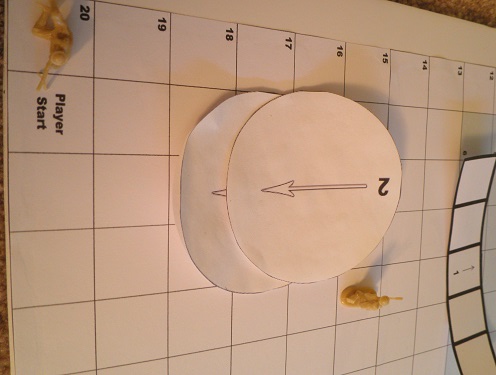
If a searcher occupies the same square as the player’s token, the player has been caught. The searcher immediately stops moving, and the player’s token is put on the searcher’s center square. (If multiple players are caught at the same time, put all of their tokens on the searcher’s center square. This is an exception to the normal rule that player tokens cannot occupy the same square.) Turn the searcher so that it faces directly “down” toward the players, away from the players’ goal. A caught player cannot be caught again; other searchers ignore caught player tokens.

While caught, a player does not participate in the sneak phase. During the search phase, other players can rescue those who have been caught by having two or more player tokens adjacent to the searcher who caught the player(s). As soon as that happens (even during a player’s movement), the caught player places his or her player token on any space adjacent to the searcher who caught him or her. The caught player then takes an available turn order card, and plays out his or her turn normally. (If multiple players are rescued at the same time, they take turn order cards in player order. For example, if the second and fourth players are caught, the second player takes a turn order card and then the fourth player.)

If a searcher with one or more caught players reaches row 20, those squad members are beyond saving and the players lose.

There are several things about this that I really like. Players still have to work together, now both to avoid getting caught and to get free after the fact. Furthermore, in playtesting the decisions surrounding the rescues were engaging; picking just the right path to rescue someone while still making good use of the turn by progressing toward friendly lines and/or moving the searcher into a more favorable location was tricky and interesting. Last but not least, it was just plain fun to go save somebody from a dire fate.

Since part of the exercise is to resolve the worst-case scenario, I did a focused playtest on it with the new rule. The game turned out much, much better. Figuring out how to arrange matters so that rescues on turn 2 would be feasible, and then carryout out the rescues, was tense and exciting.

All of the testing so far has been in solo games, but I suspect that the new approach will also go a long way toward solving the post-game-blame problem. Now responsibility for a loss gets spread around; the player who got caught is on the hook for being in the searcher’s way, but the others share some fault for not getting the person out. Everyone is in a bit of a glass house, and will hopefully be less inclined to throw stones.

It must be admitted that there are two weaknesses to the new system. One is that it expands one line in the rulebook into three paragraphs. That doesn’t make the change unacceptable, but complexity creep is definitely something to keep an eye on.

The second concern is that this is a “lose a turn” mechanic: captured players can’t play until someone rescues them. I really, really hate losing turns. One doesn’t have much fun playing a game when one isn’t actually playing!

With that said, two factors make me willing to give it a go here. The major one is that no player will ever be captured very long. Since the searchers turn back right away, players will most likely have one to two turns in which to rescue their teammate. Either the captured player gets back into the game promptly, or the game ends–either way, the captured player is not left twiddling his or her thumbs.

Second, as Zileas mentions in his discussion of anti-fun patterns, it can be OK to dip into a poor mechanic if the cost is outweighed a substantially greater payoff. Losing turns is a lousy mechanic indeed, but I think this use of it makes the game a lot more fun. The benefits accrue, not just in the worst-case scenario, but every time there would otherwise have been post-game unpleasantness.

I’ve attached a revised set of rules below. If you get a chance, take them for a spin and let me know what you think.

Over the Next Dune – Rules – 2-21-14

Theory: Zileas’ List of Game Design Anti-Fun Patterns

One thing I greatly respect about Riot Games, makers of League of Legends, is that they design according to rules. I don’t think they structure their analysis quite like I am on this blog, but the fundamental approach of logic-ing out problems through comparison to established principles is very similar.

Below is a list, originally posted in 2010, of some of the rules Riot’s VP of Game Design uses. I’m reposting them here because I like to keep them handy, and as food for thought. Don’t worry if you aren’t familiar with LoL, DotA, or the other games referenced–the rules are stated in a way that doesn’t rely on the examples.

* * *

I’ve been asked a few times, “Why don’t you do stuff like Rupture (from DOTA Bloodseeker) in LoL?”

I usually respond — Rupture contains several basic design ‘anti-patterns’. I thought I’d post for the benefit of those who are interested what strong anti-patterns I am aware of.

So… Here are a few that come to mind…. Note that you can find an example of each of these somewhere in our game at some intensity level. Sometimes this is just bad design. Sometimes this is because we got something else in exchange. Design is an optimization — but these anti-patterns are of negative design value, so you should only do them if you get something good in return.

To be clear, LoL has a number of abilities that use these anti-patterns. Sometimes it’s because we got something good in return. Sometimes it’s because we made design errors. However, we generally avoid them nonetheless, and certainly use them a lot less than other games in our genre.

Note: All WoW examples refer to original and BC WoW, not cataclsym.

Power Without Gameplay
This is when we give a big benefit in a way that players don’t find satisfying or don’t notice. The classic example of this is team benefit Auras. In general, other players don’t value the aura you give them very much, and you don’t value it much either — even though auras can win games. As a REALLY general example, I would say that players value a +50 armor aura only about twice as much as a +10 armor aura… Even though +50 is 5x better. Another example would be comparing a +10 damage aura to a skill that every 10 seconds gives flaming weapons that make +30 damage to all teammates next attack (with fire and explosions!). I am pretty sure that most players are WAY more excited about the fiery weapons buff, even though the strength is lower overall.

The problem with using a “power without gameplay” mechanic is that you tend to have to ‘over-buff’ the mechanic and create a game balance problem before people appreciate it. As a result, we tend to keep Auras weak, and/or avoid them altogether, and/or pair them on an active/passive where the active is very strong and satisfying, so that the passive is more strategic around character choice. For example, Sona’s auras are all quite weak — because at weak values they ARE appreciated properly.

Burden of Knowledge
This is a VERY common pattern amongst hardcore novice game designers. This pattern is when you do a complex mechanic that creates gameplay — ONLY IF the victim understands what is going on. Rupture is a great example — with Rupture in DOTA, you receive a DOT that triggers if you, the victim, choose to move. However, you have no way of knowing this is happening unless someone tells you or unless you read up on it online… So the initial response is extreme frustration. We believe that giving the victim counter gameplay is VERY fun — but that we should not place a ‘burden of knowledge’ on them figuring out what that gameplay might be. That’s why we like Dark Binding and Black Shield (both of which have bait and/or ‘dodge’ counter gameplay that is VERY obvious), but not Rupture, which is not obvious.

In a sense, ALL abilities have some burden of knowledge, but some have _a lot more_ — the ones that force the opponent to know about a specific interaction to ‘enjoy’ the gameplay have it worst.

Good particle work and sound — good ‘salesmanship’ — will reduce burden of knowledge (but not eliminate it). We still would not do Rupture as is in LoL ever, but I would say that the HON version of Rupture, with it’s really distinct sound effect when you move, greatly reduces the burden of knowledge on it.

In summary, all mechanics have some burden of knowledge, and as game designers, we seek to design skills in a way that gives us a lot of gameplay, for not too much burden of knowledge. If we get a lot more gameplay from something, we are willing to take on more burden of knowledge — but for a given mechanic, we want to have as little burden of knowledge as possible.

Unclear Optimization
This is a more subtle one. when players KNOW they’ve used a spell optimally, they feel really good. An example is disintegrate on Annie. When you kill a target and get the mana back, you know that you used it optimally, and this makes the game more fun. On the other hand, some mechanics are so convoluted, or have so many contrary effects, that it is not possible to ‘off the cuff’ analyze if you played optimally, so you tend not to be satisfied. A good example of this is Proudmoore’s ult in DOTA where he drops a ship. The ship hits the target a bit in the future, dealing a bunch of damage and some stun to enemies. Allies on the other hand get damage resistance and bonus move speed, but damage mitigated comes up later. Very complicated! And almost impossible to know if you have used it optimally — do you really want your squishies getting into the AOE? Maybe! Maybe not… It’s really hard to know that you’ve used this skill optimally and feel that you made a ‘clutch’ play, because it’s so hard to tell, and there are so many considerations you have to make. On the other hand, with Ashe’s skill shot, if you hit the guy who was weak and running, you know you did it right… You also know you did it right if you slowed their entire team… Ditto on Ezreal’s skill shot.

Use Pattern Mis-matches Surrounding Gameplay
I won’t go into too much detail on this, but the simple example is giving a melee DPS ability to a ranged DPS character — the use pattern on that is to force move to melee, then use. This does not feel good, and should be avoided. I’m sure you are all thinking — but WoW mages are ranged, and they have all these melee abilities! Well… Frost Nova is an escape, and the various AEs are fit around a _comprehensive_ different mage playstyle that no longer is truly ‘ranged’ and is mechanically supported across the board by Blizzard — so the rules don’t apply there ;p

Fun Fails to Exceed Anti-Fun
Anti-fun is the negative experience your opponents feel when you do something that prevents them from ‘playing their game’ or doing activities they consider fun. While everything useful you can do as a player is likely to cause SOME anti-fun in your opponents, it only becomes a design issue when the ‘anti-fun’ created on your use of a mechanic is greater than your fun in using the mechanic. Dark Binding is VERY favorable on this measurement, because opponents get clutch dodges just like you get clutch hits, so it might actually create fun on both sides, instead of fun on one and weak anti-fun on another. On the other hand, a strong mana burn is NOT desirable — if you drain someone to 0 you feel kinda good, and they feel TERRIBLE — so the anti-fun is exceeded by the fun. This is important because the goal of the game is for players to have fun, so designers should seek abilities that result in a net increase of fun in the game. Basic design theory, yes?

Conflicted Purpose
This one is not a super strong anti-pattern, but sometimes it’s there. A good example of this would be a 500 damage nuke that slows enemy attack speed by 50% for 10 seconds (as opposed to say, 20%), on a 20 second cooldown. At 50%, this is a strong combat initiation disable… but at 500 damage it’s a great finisher on someone who is running… but you also want to use it early to get the disable — even though you won’t have it avail by the end of combat usually to finish. This makes players queasy about using the ability much like in the optimization case, but it’s a slightly different problem. If the ability exists for too many different purposes on an explicit basis, it becomes confusing. this is different from something like blink which can be used for many purposes, but has a clear basic purpose — in that place, players tend to just feel creative instead.

Anti-Combo
This one is bad. This is essentially when one ability you have diminishes the effectiveness of another in a frustrating manner. Some examples:
– Giving a character a ‘break-on-damage’ CC with a DOT (yes, warlocks have this, but they tuned it to make it not anti-combo much at all)
– With Warriors in WoW — they need to get rage by taking damage so that they can use abilities and gain threat — but parry and dodge, which are key to staying alive, make them lose out on critical early fight rage. So, by gearing as a better tank, you become a worse tank in another dimension — anti combo!
– With old warrior talent trees in WoW, revenge would give you a stun — but stunned enemies cannot hit you and cause rage gain… So this talent actually reduced your tanking capability a lot in some sense! Anti-combo!

False Choice — Deceptive Wrong Choice
This is when you present the player with one or more choices that appear to be valid, but one of the choices is just flat wrong. An example of this is an ability we had in early stages recently. It was a wall like Karthus’ wall, but if you ran into it, it did damage to you, and then knocked you towards the caster. In almost every case, this is a false choice — because you just shoudln’t go there ever. If it was possible for the character to do a knockback to send you into the wall, it wouldn’t be as bad. Anyhow, there’s no reason to give players a choice that is just plain bad — the Tomb of Horrors (original module) is defined by false choices — like the room with three treasure chests, all of which have no treasure and lethal traps.

False Choice — Ineffective Choice
Similar to above, except when you give what appears to be an interesting choice that is then completely unrewarding, or ineffective at the promised action. An older version of Swain’s lazer bird had this failing… Because the slow was so large, you could never run away in time to de-leash and break the spell and reduce damage, and in cases you did, you’d just dodge 20% of the damage at a big cost of movement and DPS — so running was just an ineffective choice.

Or We Could **** the Player!!1111oneoneone
This is where you straight up screw over the player, usually with dramatic flair, or maybe just try to make the player feel crappy in a way that isn’t contributing to the fun of the game. These range in severity, but examples usually are spawned because the designer is a pretentious wanker who likes to show what a smart dude he is and how stupid the player is. I do not respect designers who engage in this pattern intentionally, and encourage any design lead out there to immediately fire any of your staff that does. I do understand that it can happen inadvertently, and that you might cause some of this stress on purpose in an RPG for character development.. And of course, I love you WoW team despite the ‘playing vs’ experience of Rogue and Warlock, as you DO have the best classes of any MMO, and they look even better in Cataclysm…. But, on Bayonetta, did the developers really think the stone award was a good idea? But I digress…

Very Severe: The original tomb of horrors D&D module is the worst in existence. Good examples are the orb of annihilation that doesnt look like one and instakills you and all your gear if you touch it, and the three treasure chests where each has no loot and deadly traps and no clues that this is the case.

Severe: There’s a popular wc3 map in China where you enter a bonus round, and have a 2% chance of just straight up dying rather than getting cool loot.

Situationally Moderate:Horrify + fear kiting from a competent warlock who outgears you in WoW. Guess what? You die before getting to react, while watching it in slow motion!

Mild: Stone award in Bayonetta. So… you barely get through the level for the first time, then get laughed at by the game with a lame statue of the comic relief character, and a mocking laugh. Please — maybe a bronze award and a 500 pt bonus might be more appropriate? The player might have worked VERY hard to get through the level, espec on normal and higher difficulties.

Non-Reliability
Skills are tools. Players count on them to do a job. When a skill is highly unreliable, we have to overpower it to make it ‘satisfying enough’. Let me give you an example: Let’s say Kayle’s targeted invulnerability ult had a 95% chance of working, and a 5% chance of doing nothing when cast. We’d have to make it a LOT stronger to make it ‘good enough’ because you could not rely upon it… and it would be a lot less fun. Random abilities have this problem on reliability — they tend to be a lot less satisfying, so you have to overpower them a lot more. Small amounts of randomness can add excitement and drama, but it has a lot of downsides. There are other examples of non-reliability, but randomness is the most obvious one. Abilities that require peculiar situations to do their jobs tend to run into the same problems, such as Tryndamere’s shout that only slows when targets are facing away from him.

The Case Study: A Little Less Worst Case

Following up on the last post, I did some focused playtesting on limiting starting searchers to row 11 rather than row 12. These tests still presented the worst-case “wall of approaching searchers,” but because of the new starting position the searchers did not actually reach the players after the first search phase. I was hoping that the changed start would make even this most difficult opening interesting for the players. Unfortunately, the results were mixed at best.

On the one hand, trying to find a way to trick the searchers and get to safety actually was pretty interesting. I was pleased about that. A situation that had been devoid of gameplay (because the players couldn’t escape no matter what they did) now had decisions to make.

However, as time went on I became more and more disappointed with the solutions I was reaching. So far as I can tell, there is still no way for the players to trick the searchers so that they are safe going into turn two. At most the players can get to a point where they have a chance. Depending on how the searcher movement cards come out, the players might get lucky and escape–or they might not.

What’s worse, it really is a matter of the players getting lucky. Owing to the makeup of the searcher movement card deck, it is probable* that at least one of the searchlights will turn. With the limited amount of real estate in which the players can work on turn one, it is extremely difficult for them to be safe from these unpredictable turns. As a result, the players are unlikely to make it through the turn even if they make logical decisions–the risk is high and can’t be reduced very much.

Again, if there’s a solution that I’m just not seeing please let me know! However, assuming that that isn’t the case I have to declare this experiment to be only a very marginal success. Certainly, the players are no longer guaranteed to lose, and that was a key goal. The overriding rule, however, is that the players should be making interesting decisions, and right now that first turn still feels pretty doomed. It just takes a little longer for the doom to arrive.

In looking for another solution, I was inspired by this discussion on the League of Legends community beta. For those who don’t play LoL, the argument is about an in-game character named Yasuo. As of this writing, Yasuo is considered very powerful. The first post argues that Yasuo is inherently too good because he doesn’t have to worry about two resources which LoL commonly uses to control how often characters can use their special powers. Posts further down propose that Yasuo players have to manage other resources which are unusual and less immediately visible, and so he is more limited than he first appears.

Without getting into who’s right,** the notion of finding a new resource is an interesting one. Fiddling with the physical spaces on the board isn’t working well, but there might be metaphorical space elsewhere in the rules. I started down that road a little bit in saying previously that I didn’t want to give the players an additional thing they could do, and that’s still true, but in retrospect I closed off that line of thinking too early. There may be other ways the game could change to help players caught by the worst-case setup.

I’m going to take the next little while to poke at the rules and see where a change could be made to make tough starts more interesting. I’ll give an update on Friday.

On a completely different note:

While looking for ways to get out of the worst-case start I realized that it might be easier if players could move their tokens through each other. I’ve always played the game as if that wasn’t permitted, but the rules aren’t explicit on the point. When I next update the rules I’ll put that in.

I did check to see if players could escape to safety by moving through each other; I think the answer is still no.

* My math skills are decidedly rusty, but here’s my thinking. There are 60 searcher movement cards in the deck, with seven left turns and seven right turns. In the worst-case scenario, turn one involved all six searchers moving forward, so there are 54 cards left, 40 of which are straight movements and 14 of which are turns. The probability of drawing a turn is 14/54, or approximately 26%. As each search phase involves drawing six cards, with the odds of drawing a turn getting higher as straight movements are drawn out of the deck, the probability of getting a turn in those six is fairly good.

** Is it OK if I get into it just a little bit? I think Yasuo is a fascinating design because he’s all about using unusual resources. Every LoL champion can use minions as a resource in some respects (e.g., as a source of gold), and some can even use them as a source of mobility on rare occasions (e.g., Katarina shunpo’ing to a minion as an escape). However, Yasuo uses minions to fuel both his mobility and his short-term damage (by keeping his E revved up) to a greater extent than any other champion. He also uses his teammates’ abilities as a resource in a very direct way, since his ult is only reliable when used in coordination with a teammate who can consistently knock a valuable target airborne; this is different from, say, Miss Fortune, who wants teammates to CC targets but who can do without. Yasuo even made being able to walk around an important resource; Stattik Shiv did it first, but I didn’t see much interest in that item until Yasuo came along to synergize with it.

It might be that Yasuo is too good, but if he is there are ways to fix the problem. He’s still worthwhile for the new ideas he brings to the table.

The Case Study: Worst-Case Setup

One thing I like to do when playtesting a game with variable starting positions is a focused test on the worst-case setup. If an extremely slanted start of the game is still interesting and fun, that’s a good sign. If not, there’s a problem to be addressed.

Over the Next Dune has a variable setup, and I’ve found that the initial arrangement of the searchers heavily impacts the difficulty. If the searchers are coming quickly for the players, they need to work hard just to survive to the next turn; when the searchers start farther away the players have more time to get into ideal positions. Either one can be interesting; so far, so good.

However, since I was always testing a random setup I had only ever had one or, at most, two searchers driving toward the players at the beginning of the game. What if all of them started as close to the players as possible, and immediately moved closer?

I rigged up the following starting positions:

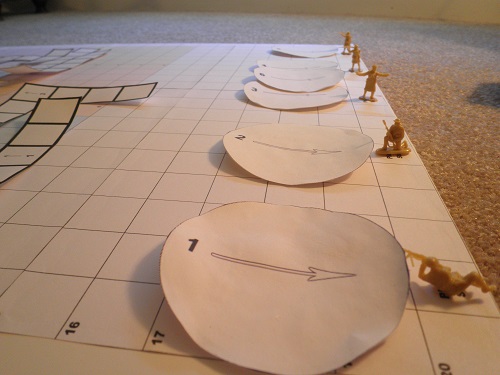
That’s searchers at (12, 2), (12, 6), (12, 10), (12, 12), (12, 14) and (12, 18), all facing in direction 1–straight toward the starting line.

Assuming the worst possible search phase for the players on turn one, wherein each searcher moves directly toward the players, the game ends up here:

Every player has a searcher directly in front of him or her. The only safe moves are sideways.

Even at this point, there are actions the players can take. For example, the player on the far left (at the bottom of the pictures) can move sideways and trick the searcher in front of the next player over into following him or her back to the corner. That frees up the next player to save them both:

However, after messing around with it for a little while I don’t think all of the other players can get free. There’s just too much real estate to cover. For the last player in line to save the other two he or she would have to move a minimum of six spaces just to get to searcher #3 (from column 18 to column 12) in front of the middle player, which is impossible. The middle player is in the same boat trying to save the player on the end. The player in between them could free either one, but can’t move far enough to save both. If the player in between saves one then that player can return the favor, but someone is still out in the cold.

If there’s a solution I’ve missed, please let me know. Assuming there’s not, however, the game has a weakness: there is a possible setup in which the players automatically lose. That’s antithetical to the rule for OtND that players should make interesting decisions. In this setup, the players’ decisions are meaningless!

The facts: Under the setup rules as they stand, it is possible for every player to have one or more searchers directly in front of, and immediately adjacent to, him or her after turn one’s search phase. When this occurs it is impossible for all of the players to move to safety during the sneak phase; at least one player will certainly be caught. As a result, when this combination of setup and searcher movement obtains the players are guaranteed to lose regardless of what they do.

The issues:

1. How can the game be altered so that the players cannot be in a situation where all of them have searchers immediately and directly in front of them after turn one’s search phase?
2. Should any alteration be made to address issue #1?

Raising the second issue might seem heretical for a game designer–if there’s a problem, why shouldn’t something be done about it? However, I feel that it’s worth taking into account that this is a focused test to see what happens in a very unlikely situation. The vast majority of players will never encounter this unwinnable scenario; I’ve played OtND many times and it never happened until I intentionally caused it. If fixing the issue turns out to cause more problems than it solves, it may be that the best course is just to let the matter lie.

The rule (for issue #1): Decisions players make during a game of Over the Next Dune must be interesting.

Thinking it through: There are two routes one could go down in giving the players decision-making power in this situation: either the players can be given a new tool that makes the unwinnable setup manageable, or the setup rules can be altered so that the configuration which takes away their decisions can’t occur.

Right from the start I’m not keen on creating a new player power. It adds complexity to the most basic aspect of the game–avoiding and manipulating the searchers–which will make it harder for new players to learn the rules. Furthermore, making the fundamentals of the game more complex will make it harder to add nifty “chrome” elements later. Each additional moving part the chrome has to interact with will add to the difficulty of fitting in the new element, and the more challenging the basic game is to learn the less chrome will be desirable. I think, at least preliminarily, that it will be possible to add to the game in a way that makes for more, and more interesting, decisions; if possible, I want to preserve space for those additions.

I’m also reluctant to give the players a new tool because it could easily have unintended consequences. An option for players that’s perfectly fair when it’s being used to fix the unwinnable setup on turn one might turn out to be be so strong on turn eight as to make victory trivial. Playtesting could find those consequences, of course, but it’s important to prioritize. Testing a player power designed to mitigate a problem that will arise in an infinitesimal fraction of games takes time away from other ideas that will be of greater benefit.

So, what about changing the initial setup? It seems like the ability of the players to make interesting decisions can be preserved simply by moving the searchers back a little bit at the start of the game: In addition to re-rolling 1s on the twelve-sided die that’s used to place the searchers, 12s could also be re-rolled. Under that rule the searchers could get no further than row 18 during the first search phase, which means that they would never be adjacent to and “locking down” a player on his or her starting square. No matter where the searchers start or what they do, each player will always have the chance at a helpful move during turn one and a loss will never be guaranteed.

The weakness of that solution is that while it gives players a little bit of room to breathe, it still leaves them at the mercy of the searcher movement cards. Imagine doing the same test as above, but the searchers start at row 11 instead of row 12 before moving straight at the players. Under this new setup the players would be able to escape into the channels between the searchers. However, those spaces are only safe if the searchers keep going straight or move away. If the players happen to draw a card that angles a searcher closer, that’s it–one or more players get caught. There might be some optimization to do in terms of minimizing the number of auto-lose draws, but that’s only an interesting decision once or twice. (Of course, this whole scenario is so unlikely that it shouldn’t happen to a player more than once or twice over the course of many, many games.)

Other options include setting a flat limit on how close the searchers can get to the players on turn one and altering the searcher-facing rules so that searchers close to the players can’t start out rushing toward them. The former feels arbitrary and intellectually unsatisfying; setting a cap that has nothing to do with the other movement rules is a pretty obvious bodge. The latter, for its part, poses a risk of clustering the searchers at the “top” of the map so as to make the early game boring and the endgame impossibly difficult. I’m not thrilled with either of those options, though they’re on the table for further consideration.

As of now I’m going to put some energy into testing the “re-roll 12s” change. I’ll be looking for those unintended consequences, as well as checking to make sure it actually fixes the problem it was intended to address. More on this next time.

Tidying Up

Over the past week I’ve noticed some things about the blog that were a bit rough around the edges. Today I’m going to take a bit of time to tidy them up.

First and foremost, new rules and a revised print-and-play file are available for Over the Next Dune. These take into account the changes to the communication rules in the last post, and also include some other minor fixes. As always, if you have the opportunity to play the game please let me know how it goes and what I can improve.

Over the Next Dune – Rules – 2-14-14

Over the Next Dune – Print and Play – 2-14-14

Second, I’m revisiting the post on postulates a little bit. On re-reading I felt that it was a bit unclear; there was too much showing of work and not enough organized presentation. The new version will be, I hope, a little bit better.

Third and finally, I’m fixing a couple of typos in old posts. I suspect no one but me cares too much about them, but if you caught them before and can’t find them now, you’re not going crazy. 😉

The Case Study: Communication Rules

Recent posts have been very theory-heavy–and that’s not making progress on Over the Next Dune! Let’s get back into the swing of things by taking a look at a concrete problem that’s come up.

Most of my playtests have been solo games; the solo boardgame market is underserved, and I want OtND to work well in that mode. However, I also want its cooperative play to sing. To that end I’m planning a group playtest in just a few weeks.

In getting ready for that session I’ve been taking another look at the communication rules. They’ve always been a bit bodged together, and now’s a good opportunity to focus on them and get them right.

The facts: Here’s where the player communication rules stand as of the 2/5/14 ruleset (Over the Next Dune – Rules – 2-5-14):

“In general, players may not communicate with each other about the game. (Conceptually, the players are sneaking through the night with Axis soldiers nearby; they cannot have conversations!) Of course, it is perfectly permissible to ask another player to pass the chips or to flip the next searcher movement card. The only thing the players cannot do is discuss strategy.

The one exception is that players may talk at the beginning of the sneak phase about when they would like to move. In doing so, the players may say only when they want to move (e.g., “I want to move first,” “I want to move after Jen”). Players may not say why.”

I believe that these rules are functional; one could play the game this way, and it would work. Yet, they also seem lacking thematically. If the players need to be quiet, why is this discussion OK? It’s a very “game-y” moment where the theme falls away and the mechanics reign.

The problem is exacerbated by the fact that there’s no limit on how much talking goes on. So long as the players aren’t discussing strategy in detail, they can argue endlessly about who moves when. Moreover, the debate is likely to be fruitless since no one can explain why they want to go when they do. Frustration is apt to result.

The issue: What form should the player communication rules take so that unnecessary disputes over turn order are avoided while keeping discussion to a minimum?

The rules:

1. It must not be possible for one player to dictate other players’ actions. Whatever the rules are, they must protect each player’s autonomy.
2. The rules for player communication must reinforce the theme of the game.

Thinking it through: The current rules do a good job of keeping each player separate and allowing them to make their own decisions. The concern is simply that they’re not thematically appropriate. It would be great if we could keep the good while eliminating the bad.

The good here is the limit on strategic discussion. Preventing players from saying why they want to go in a certain order controls each player’s ability to influence the others. Everyone is able to come up with his or her own plan for the turn.

What’s bad is the endless go-round of people arguing over turn order. It breaks the theme and it’s just plain unpleasant. Keeping the discussion of turn order brief will help evoke the feeling of people sneaking quietly through the night and will move the game along at a brisk pace.

So, the best system would be one that limits strategic communication, but still allows players to come to a conclusion quickly. One solution would be to allow just enough strategic discussion to give players reason to accept other views on turn order without allowing so much that one player can lay out a complete plan for everyone.

The most straightforward way to achieve this limit is by imposing a number–“you can say up to three words.” However, any number chosen will be, and feel, arbitrary. There’s no reason why this many words will never get a player caught but one more word does. To make it thematic, the amount of talking should determine the amount of danger.

Danger in OtND is measured, in my experience, by the distance from a player to the searchers and by the future paths of the searchers–searchers far away and facing in the wrong direction are not threatening, while those close and headed straight for you are quite disconcerting! To tie talk to danger, it seems like talking should influence one of those two things.

It would be thematically sensible for talking to affect the searchers’ facing; if a player talks too much the searchers will turn toward the player and move to investigate. However, in trying out a rule wherein the players could attract the searchers’ attention I found that it can be hard to point the searchers toward players when the searchers can only turn 45 degrees at a time. For example, when a player is a “knight’s move” away from a searcher (i.e., one square over and two down), the searcher can’t point directly toward the player. Figuring out when the searcher should face straight down in that situation, and when it should face diagonally down, turned out to be pretty irksome. I’d rather not follow that road again if there’s another way.

If direction is out, what about distance? The rule could be something like this:

“At the start of the sneak phase, the first player chooses when he or she would like to move–first, second, third, etc. The other players then choose in descending order.

Players may give suggestions and discuss these choices. However, each word a player speaks moves the closest searcher one square closer to that player. (To move the searcher closer, move it so that the number of spaces between the player and the searcher’s center square is reduced. If there are multiple places where the searcher could move to to be closer to the player, the player decides which of those squares it moves to. If multiple searchers are equally distant from the player, move them all closer.)”

(It’s true that this rule requires rules establishing who is the “first player.” That’s pretty simple; I’m not worried about that minimal amount of additional complexity.)

Unfortunately, this rule has some immediate problems. First, it could potentially allow a player to dictate to other players, at least to the extent of commanding a turn order. What’s worse, players receiving the message might find it stressful to determine what a cryptic one- or two-word statement means. “You first”–OK, but why? This could be a recipe for nasty post-game arguments about who was responsible for a botched plan.

Furthermore, this rule is vulnerable to being gamed. Two players whose closest searcher is between them could have a complete conversation simply by talking in turns, pulling the searcher back and forth. In all probability that situation would be very rare, but it would be pretty silly when it came up.

Last but not least, this rule still has some thematic issues. Why can players across the map talk to each other as easily as players right next to each other? Why does only one searcher respond no matter how long and loud someone speaks?

That rule doesn’t seem great. However, it indirectly points toward another approach. Rather than limiting discussion by restricting what each player can say, what about restricting who can talk to who? A weakness of the previous rule (players can athematically communicate across the board) could inspire a better solution:

“At the start of the sneak phase, the first player chooses when he or she would like to move–first, second, third, etc. The other players then choose in descending order.

Players may discuss their choices with any other player(s) whose tokens are directly adjacent. They cannot speak to or communicate with other players, or even to players whose tokens are directly adjacent at any time other than the start of the sneak phase.”

(I think this will require a more rigorous definition of player tokens in the main rules, but that’s fine.)

I like this for a couple of reasons. It’s thematic; if someone is right next to you you can whispher to them just briefly, but otherwise you have to stay quiet. Since the players aren’t realistically going to be able to form a big group, no one player can dominate. (I suppose the players could form a bucket brigade of information, but that seems like a difficult, nifty strategy rather than an abuse case that needs to be stopped.) The turn order selection keeps the process moving; two or three players might have a discussion about what to pick, but everyone else will just choose.

Of course, “I like this” is completely different from “this is actually good.” 😉 Only testing can determine whether or not the latter is the case. I’ll report back on this issue when I have more data.

What We’re Doing: Underlying Principles

Today was going to be about awkward rules. However, I realized that while I’ve talked a lot about using legal analysis, I haven’t really explained how it works to readers who aren’t familiar with it. I want to remedy that, and in the process discuss in a bit more detail what is driving this blog. We’ll come back to awkward rules in a little while.

At its most fundamental level, legal analysis works like this: there are some facts. Those facts give rise to an issue–the legal question you want to answer. To do so, you go back through the annals of the law to find the rule(s) applicable to your issue. The you compare the facts to the rule(s) to get an answer; the answer is called a “holding,” but it’s basically an answer. That answer/holding may end up being used as a rule in future cases.

So, for example, suppose John Doe takes someone’s car without that person’s permission, joyrides it around town, and crashes it into a tree. If you had absolutely no pre-existing knowledge of the law, that might give rise to the issue “do these facts make out a criminal offense?” (We all know John Doe stole the car, but again, suppose you had no knowledge of the law whatsoever.) Your research might reveal, depending on one’s jurisdiction, a rule that looks something like “taking another person’s property without that person’s permission, intending not to give it back, is theft.” With that rule one might conclude, based on the facts at hand, that John Doe committed the offense of theft; he took the car without permission, and joyriding it dangerously suggests that he did not intend to return it.

There are many pitfalls in this process. First, one must correctly identify the legally relevant facts. You have to know that Jon Doe’s particular name doesn’t matter; if you think it does and spend all your time looking for rules specifically about John Doe you aren’t going to get anywhere. (Of course, there are occasions when John Doe’s identity does matter–think of signs in subways specifically noting that there are extra penalties for harming a transit worker. Sometimes you need some knowledge of the rules in order to detect the relevant facts.)

Second, the issue must be framed correctly. To give an example from Over the Next Dune’s development, for a long time it was possible for the players to get close to their goal with the searchers far behind them. The searchers would rarely catch up, and so the endgame was very easy. I cast the problem as “how can the searchers be kept relevant throughout the game,” which first led me to try various ways to let the searchers “respawn” in more relevant positions and then, when those proved unsatisfactory, to reduce the size of the board. The latter solution worked well, but I only tried it because I had stated the issue broadly. If I had considered the issue to be “how can the searchers respawn to be relevant throughout the game,” I would have kept going down a futile path.

Third, the rule has to be correct. If your calculator thinks that 2 + 2 = 5, it will give you wrong answers no matter how carefully you frame the question and input the numbers.

The problem I’ve seen in game design is that there are lots of facts and issues, but very few reliable rules. Even the rules which are commonly propounded are, to use a term from my college days, under-theorized; we don’t understand them well enough to know their limits and proper use.

Let me give a quick example. Mark Rosewater, lead designer of Magic: the Gathering, once made a list of rules for game design to teach to kids. One of the rules was that a game should have inertia; it should move toward an ending. That’s clearly true for Magic, but players of role playing games like Dungeons and Dragons might disagree. Role playing gamers often look back fondly on long campaigns, and see keeping their games going as a virtue; these games don’t want to move toward an ending, they want to keep going indefinitely. Similarly, I know people who have sunk hundreds of hours into various Elder Scrolls games, exploring and adding to their homes/castles/wizard’s towers/etc. Those players would be happiest if the game never ended–if it had an infinite amount of interesting stuff to see.

Do those examples mean Mark Rosewater is wrong? He’s an incredibly successful designer, having shepherded a brilliant game–and it is brilliant, as even its detractors (who often focus on its collectible distribution rather than its gameplay) generally agree–for many successful years. We should hesitate to say he’s mistaken.

I think the real problem is that Mr. Rosewater’s rule isn’t applicable to all games. In legal terms one might say that didn’t identify all the relevant facts; the case presented was about making a marketable game intended for relatively short individual plays, but he just presented it as being about games. His rule is right–so long as one understands it thoroughly and knows when to apply it.

My goal for this blog is to improve our understanding of the rules that are already out there, and to develop new rules where they are needed. In doing so, I’m standing on the shoulders of giants–and yes, Mark Rosewater is one of them–who went before me. I’m not sure if I’ll ever see farther than they have, but my hope is that by using a legal analytic structure I will be able to see clearly, and to impart what I’ve seen effectively.

Theory: Game Design Postulates

I said last time that “awkward rules are bad” felt like a postulate. After some further consideration, I believe I was mistaken in seeing a postulate there. However, it did get me thinking about underlying ideas in game design; just because awkardness-is-bad might not be a postulate doesn’t mean there aren’t any.

Now, I haven’t taken a math course for a very long time. However, in my memory (and a very brief internet search seems to agree), a postulate is something that can’t be proven through logic, but is so self-evident that it can be assumed as a foundational matter. In Euclidian geometry, a line can be drawn between any two points because it’s sensible for that to be true; one can’t prove it by building up from something else, but it’s so intuitive that there’s no cause to dispute it.

By contrast, “awkward rules are bad” is not as foundational as the properties of a line in geometry. A game can work with awkward rules. Furthermore, it’s not self-evident that awkwardness in rules is a problem. I grew up playing Avalon Hill wargames, and at the time I found their somewhat arcane rules charming. I enjoyed the challenge of figuring the game out, and when I had succeeded I felt like I had joined a select group who were initiated into a secret (admittedly the secrets were things like “how the wind rules interact with artillery smoke to block line of sight over the battlefield,” but still). Nor can I say that the proposition is inherently unprovable. If awkward rules are a problem, there ought to be reasons why and examples showing it.

With that said, I would like to lay down two things that I think really are postulates:

1. Fun is the goal. My interest here is in creating fun games. This blog isn’t about things like the prisoner’s dilemma; that’s a game, true, and it has fascinating implications for the field of game theory, but it’s not meant to be entertaining. My objective is to make fun games, and to understand better how one goes about doing so.

2. A game is defined by its rules. When one plays by different rules, intentionally or unintentionally, one is playing a different game. Monopoly is an enormously different experience when one puts money under Free Parking; strategies that work in a fighting game played without a timer will surely fail when the timer is turned on. (Seriously, turn the timer on. The designers included it for a reason. I can tell you from experience that the game will be better.) To participate in, understand, evaluate, and ultimately learn from a game one must play it by its rules; otherwise one is studying some other game.

The second postulate shows why the rulebook for Over the Next Dune needs to reflect how it is actually played, an idea I tripped on a bit in the last post. If OtND has any value (and I hope it does!), I want people to play it. If they are playing some other game they are not getting the value I want them to receive. In fact, I am concerned that they will get much less, because the game they are playing has not been tested and may very well be terrible. (OK, Over the Next Dune might also currently be terrible; part of the project here is to make it better!) Making sure that the rulebook is correct will help guide players to what I anticipate will be a good experience.

Neither of these postulates, however, directly addresses the issue of awkward rules. We’ll take that up in the future.

The Case Study: Playtest of Feb. 5, 2014

I usually divide playtests into two categories: general and focused. General playtests are exactly what they sound like; everyone plays the game, and then gives feedback on issues that arose. Focused playtests are for answering a specific question about the game: does this work, is that clear, what if we did it thusly?

This playtest was a focused one, with the question being are the written rules working? It’s difficult to get enough distance from what I know about the game to be sure that I’m not filling in rules issues with my own knowledge. I wanted to make sure that the written rules are correct.

To that end, I played this solo round following the rules as written, step by step. Doing so revealed some minor issues. I also lost, but surely that just means the game is a worthy challenge. 😉

Starting with the setup, I realized that the rules referenced yellow squares which existed in a previous version of the terrain. In addition, the rules directed that players should put down terrain beginning with the “first” shaded area, without defining which one comes first. (It doesn’t actually matter what order the shaded areas get their terrain, but I didn’t want a new player to be confused.) I updated the rules to reflect the current look of the terrain and to specify that the first piece of terrain goes in the upper-left area.

After setup the board had a good spread of terrain, with the right side being a bit harder to get through. The searchers were, for the most part, close to the player tokens and facing toward them. That arrangement of searchers always makes for a tense early game, since the searchers are on top of the players right away.

On turn one the players mostly just shifted on the starting line, trying to get into good positions to deal with the oncoming searchers. At the end of the turn another problem reared its head: the turn tracker was being moved both at the start of the search phase and at the end of the sneak phase, such that at the end of turn one the turn track was actually on turn three!

It was clear that one of the two times when the turn marker moved had to go. However, picking which one it should be was a bit tricky. I put the turn counting at the end of the sneak phase because I wanted players who took too long to hit the “game over” space at the end of turn 10. Otherwise, the players would start a turn 11 that would not actually be played out, which seemed awkward. On the other hand, I felt that moving the turn marker at the beginning of the turn was easier to remember.

This kind of question–one where there are good reasons to go both ways–is ripe for the tools of legal analysis. Looking back at our rules, the only one that seemed like it might be relevant is that “the decisions must be interesting.” While the rule didn’t answer the question directly, it at least reminded me of what the priority was. I needed to make the choice that would support making interesting decisions.

The awkwardness of players losing on turn 10.5 was unfortunate. However, it didn’t particularly affect the game. Players would get 10 chances whether the end-of-game condition was met at the end of the 10th or before the 11th. I didn’t want players to feel like they’d been cheated out of a turn, but most players would probably be more focused on the 10 turns they got than on the one turn they didn’t. Indeed, I imagine that the vast majority of players will just learn it as “after 10 turns you lose,” without worrying about the technicalities.

By contrast, forgetting to move the turn marker is a serious problem. OtND is balanced around the players having 10 turns. If they get 11 or 9 because they lose track, the game could end up being significantly easier or basically unwinnable. Either way, the decisions become a lot less interesting; they’re either trivial because it’s an easy victory or irrelevant because the players can’t reach their goal no matter what they do.

Framed in that way, the answer was clear: players should move the turn tracker at the beginning of the turn, when they’re less likely to forget to do it. I removed the contradictory line in the rules, and changed the turn tracker slightly to make turn 1 work smoothly (the turn tracker now begins on a “start” line so that when the tracker moves at the beginning of turn 1 it’s correctly moving to 1).

Sadly for our heroes, they were discovered on turn 3 when I failed to account for a possible right turn by one of the searchers. However, before that point there had been some careful positioning and a bit of tricking a searcher, so on the whole I was pleased with how the game went.

Looking over this playtest, what particularly strikes me is the number of unstated design rules I followed. I cared about an awkward rule–but why? There’s no rule that says awkwardness is bad. I wanted the rules to reflect the game correctly, but that’s not a stated design rule either. My goal was to make OtND better, and I think this playtest did, but it’s also highlighted for me how many “postulates” are operating in the background as I work on the game. On Friday I’ll start trying to bring some of them to the forefront.

The updated files are:

Over the Next Dune – Rules – 2-5-14

Over the Next Dune – Print and Play – 2-5-14

The Case Study: How We Got Here

To fully understand where we are, I think it’s worth talking about how Over the Next Dune has evolved so far. My hope is that this will explain how certain decisions were made, show why they were made, and make discussion about the game more productive since everyone will know where we’ve been.

In its original form the game was quite a bit different. First and foremost, there was no grid–players moved using rulers, as in a miniatures wargame. After a number of playthroughs, I found that this had several problems. The players and the searchers often overlapped, and keeping the various pieces in the right place on the board (with no grid, there was no way to be sure things were back when they belonged after they were jostled) was very difficult. In addition, it was hard to get the angles right–when a searcher had to turn 45 degrees it was more likely to end up turning 40 or 50. The problem was small, but it did sometimes impact the game.

Relying on measurements also made evaluating the effects of rule changes difficult. For example, when I was trying to figure out exactly how close the searchers could be to the players at the start of the game, I found that very small errors could make a big difference–8 inches might seem appropriate, but only because during the test I had accidentally set the searcher up at 8 1/8 inches away, and that extra 1/8 of an inch had saved a player three turns in. Between measuring imprecision and the problem of slightly incorrect angles, I found that I couldn’t reliably say whether a change had made the game easier or harder. It was impossible to discount the possibility that the in-game effects I was seeing were simply the result of a missed measurement at a key moment.

Perhaps most damning, the freeform board wasn’t making decisions more interesting. The players were doing all same the things they do in the current version of Over the Next Dune–dodging or tricking searchers, rescuing each other from trouble, racing for the finish line–but they were doing it more slowly because measuring and moving was so laborious. One of the rules for OtND is that its decisions have to be interesting; as a corollary, players should be focused on making those decisions rather than on physically managing the game. I put OtND on a grid starting with the 22nd playtest game, and haven’t looked back.

The second major change between the game’s original form and its current incarnation is that OtND was originally about infiltrating a trench in World War I–and that trench was guarded. Players tried to get into an irregularly shaped trench on the other side of the board while avoiding guards who patrolled the trench. To win, players had to either get everyone into the trench or eliminate the guards by sneaking up behind them.

Having guards as part of the game actually did add something to it. About midway through the game, players had to start thinking about how they were going to approach the trench. They then had to maneuver to enter the trench at just the right spot while also avoiding the searchers (which, in this version of the game, were searchlights). Furthermore, players pressured by the turn limit and approaching searchers at times had to jump into the trench at risky points, which could be exciting. Overall, the guards added a distinctive endgame.

Unfortunately, managing the guards caused the game to take a great deal longer. There was a whole separate deck of cards that moved the guards; between working with the deck and just pushing the guards around, the time to play a game almost doubled. (Currently, I find that players who know the game can play OtND in about 25 minutes; with the guards, the game took 40 or more). Again, interesting decisions were being obscured by downtime.

What was worse, however, was that while the endgame was distinctive it wasn’t always interesting. Once a player understood how the guards moved (e.g., they’re 75% likely to stand still and 25% likely to move; if the guard moves he will end up at this spot facing in this direction) it was easy to tell where the right place to enter the trench was. Moreover, if a player entered the trench at a risky point his or her fate was generally just down to the card flip; there was a 75% chance that the player got away with it and a 25% chance that the player got caught, and there wasn’t much the player could do about it. (Building on the previous discussion of counterplay, there wasn’t any play here–the player did something and then there was a 25% chance that the opponent hit the “no” button.)

I spent a long time trying to make the guards work. Ultimately, however, I found that I couldn’t get them and everything else right at the same time. As a result, I removed the guards from the game entirely. I’m hoping to add them back in in the future, when the core gameplay is locked in.

The irregular, curving trench created its own problems. At the most prosaic level, searchers tended to get stuck in the bends; this was pretty silly and also spawned lots of corner-case rules for getting them back out. On the whole it made for fewer interesting decisions (players don’t need to work hard to avoid a stuck searcher) and added delays between those decisions. However, the greater sin was that the curved trench encouraged players onto specific paths. Since getting into the trench was part of winning, players almost always went for the places where the trench bent outward (i.e., closer to their starting line). This game element was very definitely violating the “multiple ways to win” rule. I got rid of the curling trench, and so far it hasn’t been missed.

Initial setup was also a lot different when the game was just getting started. Originally the searchers (there were fewer at the time) were arranged around the edge of the board, and moved inward. This was easy to set up, which was good; one got on to making decisions quickly. However, it was also pretty predictable. Since the searchers were pressing toward the center, it was usually best for players to shift sideways at first and then inward as the searchers passed each other and started back out toward the edges. Over the course of many games this emerged as the dominant strategy.

Dominant strategies are inimical to having lots of ways to win, so I went back to the drawing board. First I tried adding more searchers to cover the areas where players were inclined to go; this proved only to change the best path rather than getting rid of best paths entirely. Next I fiddled with the starting orientations of the searchers so that it was more dangerous to move down the sides. However, the unpredictable movements of the searchers (which were necessary to making them interesting in play) meant that they were bad for reliably discouraging a single strategy.

In the end I decided that this was one place where adding more complexity was necessary, which led to the current randomized setup for searchers. I’ve been pleased with the results; in tests since, no best path across the map has emerged. Unfortunately, setup is now quite a bit longer. I’m not sure yet whether the setup time can be cut back down, or whether it just has to be accepted as an investment in a good game experience.

Terrain has also changed a lot. Originally, it was concepted as barbed wire–a single line that players had to sacrifice some movement to cut through. In that form, however, terrain created “congo lines” where one player cut and everyone else followed that player’s path. That might have been realistic, but it wasn’t very interesting.

The current form of terrain is intended to solve that problem. It simulates rough patches of ground that slow the players down but that the searchers–who don’t have to be sneaky and who can therefore use jeeps/trucks/motorcycles/etc.–can just pass over. There’s nothing any one player can do about it, so there’s no need to follow in someone else’s path; each player can individually decide what route is best. I think the new terrain is working as a mechanism for promoting interesting decisions and for creating multiple ways to win, and also as a way of putting weight on the no-communication rule.

I would be remiss if I didn’t mention that there are some whole game mechanics that have been cut out. Originally actions would create “noise” that would attract the guards; when the guards went noise went with them. Specialized equipment was in the original plans, but I have yet to find a way to implement it that is not just adding complexity for little gain. At one point players could intentionally attract the attention of searchers, causing the searchers to turn toward them. There have been lots of experiments that didn’t pan out, though each was informative.

I have my complete notes from each playtest game. If there’s interest I’ll post them, but this hits the highlights of the past and I’d like to move forward. On Wednesday I’ll put up detailed notes on a new solo playtest game.