The end run has been a problem for a long time. Is that good enough to call it resolved?
Facts: As above.
Issue 1: Is the end run still a dominant strategy?
Issue 2: Is the end run an interesting strategy to play?
Rule: Decisions the players make must be interesting.
Thinking it through: Based on these numbers, the “end run” no longer appears to be the dominant strategy. It actually lost five out of ten games, which is quite a bit worse than just going up the middle!
My feeling is that tracking weakens the end run in two ways. First, it’s hard to keep track over the course of a turn of all the angles and possible turns searchers might make. It’s easy to miss something, and end up making a critical mistake that either ends the game or puts the players in an extremely difficult position. Second, the need to avoid making dangerous trails slows progress–especially when using “the wall.” Put those together, and you end up with a good chance of tripping up without much time to recover.
Anecdotes aren’t evidence, but I’ll venture to say that the feel of the end run matches the data in this regard. The wall sounds foolproof, but it’s no joke to make it work in practice. Balancing the need to stick close for rescues with the need to make progress up the board is tricky.
What I especially like about this solution (and this plays into issue 2) is that the end run is a lot more interesting than it used to be. How the players move is important; managing trails is a unique and challenging part of the game. This is especially true when searchers close in and it’s necessary to trick them out of the way without creating a trail that will lead them right back to the group. In addition, there’s much more tension in the race forward; players are much more likely to be captured, and as a result the group moves more slowly. The ending can be a nail-biter.
Overall, then, I’m marking this a success. It may be that further playtesting will show that the end run is still too good, or that there’s a specific way to approach it that breaks the game. For now, though, it looks like this is a solved problem.
I’ve been playtesting “the wall” in Over the Next Dune. Since I haven’t finished all of the games I don’t want to report data just yet, but thus far the wall has sometimes put up great results, sometimes been iffy, and on one occasion imploded hilariously. I’m hoping to have the testing done by the end of this week or the beginning of next, and will let you know the results.
Adding rescues to Over the Next Dune also added sacrifice plays to the game’s strategic repertoire. One simply protects a group of player tokens by putting one of them in front of a searcher. The searcher catches that player and stops, leaving the rest of the group unscathed. Everyone else then makes the rescue next turn.
None of that is especially objectionable, though it is “gamey.” So long as it’s better to avoid being caught entirely, it’s OK to include letting someone get caught as an emergency backup plan. Prior to adding tracking to OtND, I felt that that condition was met; once every so often the sacrifice play was useful, but in general it was better not to get caught.
The tracking mechanic may have changed the power balance between those two strategies. It enables one player to use his or her track to create a “wall” that protects the other players. Searchers encountering the wall will chase after its maker, never going after the other players. As a result, those players are free to make low-risk rescues. If this approach works to its best effect, it would allow a single player token to serve as the sacrifice over and over again. That would make things pretty boring; one player’s job would be limited to moving forward while getting captured, and the other four would be in no significant danger of ever being caught.
The searcher will hit the “wall” and capture the sacrificed player token; the rest of the players will be fine, and can attempt a rescue during the sneak phase
I haven’t yet determined whether this strategy is too good. Eliminating direction markers as searchers move over them will help by disassembling the wall; the next searcher to come along won’t be fooled. However, it might be that the wall provides enough safety to keep the end run going strong. I’m testing it, and will report back with the results.
I’ve been testing having players leave tracks as a solution for the dominance of the end run. So far it’s working well. The end run seems to be quite a bit more difficult, and the consequences of the tracks are impossible to ignore.
As is always the way in testing, I’ve found some circumstances where the rules as written lead to weird outcomes. Two minor revisions fix the problems; I’ve bolded them below.
Whenever a player token leaves any space in columns 1-5 or 16-20, the player must place a direction marker in the space from which the token departed, facing the direction in which the token went. Whenever a searcher covers one or more spaces which are marked in this way, it immediately turns to face the direction marked. (If the searcher has more than one direction to choose from, it chooses the direction in the space closest to the “top” of the board. If multiple spaces with a direction marked in them are equally close to the “top” of the board, the searcher chooses the direction in the space closest to the center of the board among those options.) If the searcher has not yet finished moving, it continues moving in the new direction.Whenever a searcher covers one or more direction markers, it removes those markers after making any necessary change in facing.
(This solves a problem whereby searchers could get stuck at the edge of the board; they would try to move away, encounter a direction marker pointing back toward the edge, turn around to face the edge again, and just bounce back and forth. Oops!)
If a player leaves a space which already has a direction marker, remove the old marker and replace it with a new one showing the direction in which the player’s token left the space.
A searcher with a captured player token ignores direction markers.
(Once a player is captured, the rest of the team is supposed to be on a clock. If the searcher with the captured player goes off to try to make more captures, it could remove the intended time pressure.)
It’s not enough to theorize that a fix will work; one has to experiment to find out. I’m running that experiment now; another ten games with the now-familiar setups, seeing if allowing the searchers to track the players resolves the end run. I’ll report the results soon.
Following up on the idea of tracking the players’ movement, I’ve added a page to the print-and-play file with markers for the trail. There are a lot of markers there, probably more than are needed. Don’t feel obliged to cut them all out!
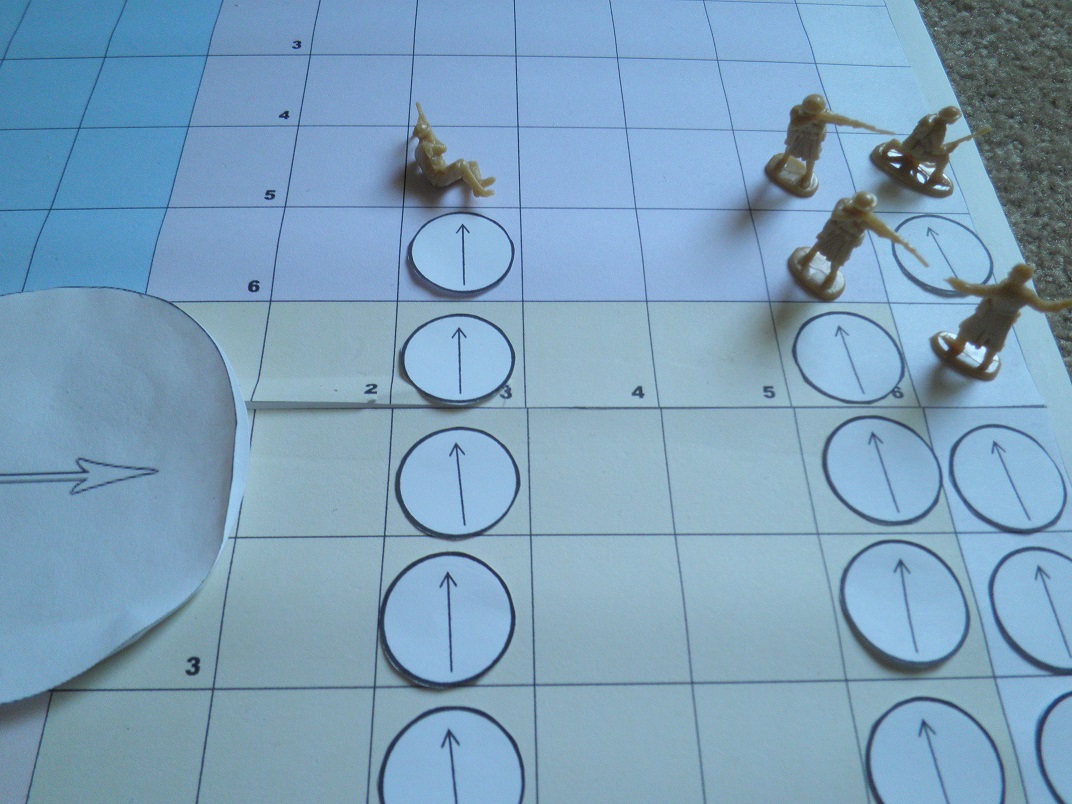
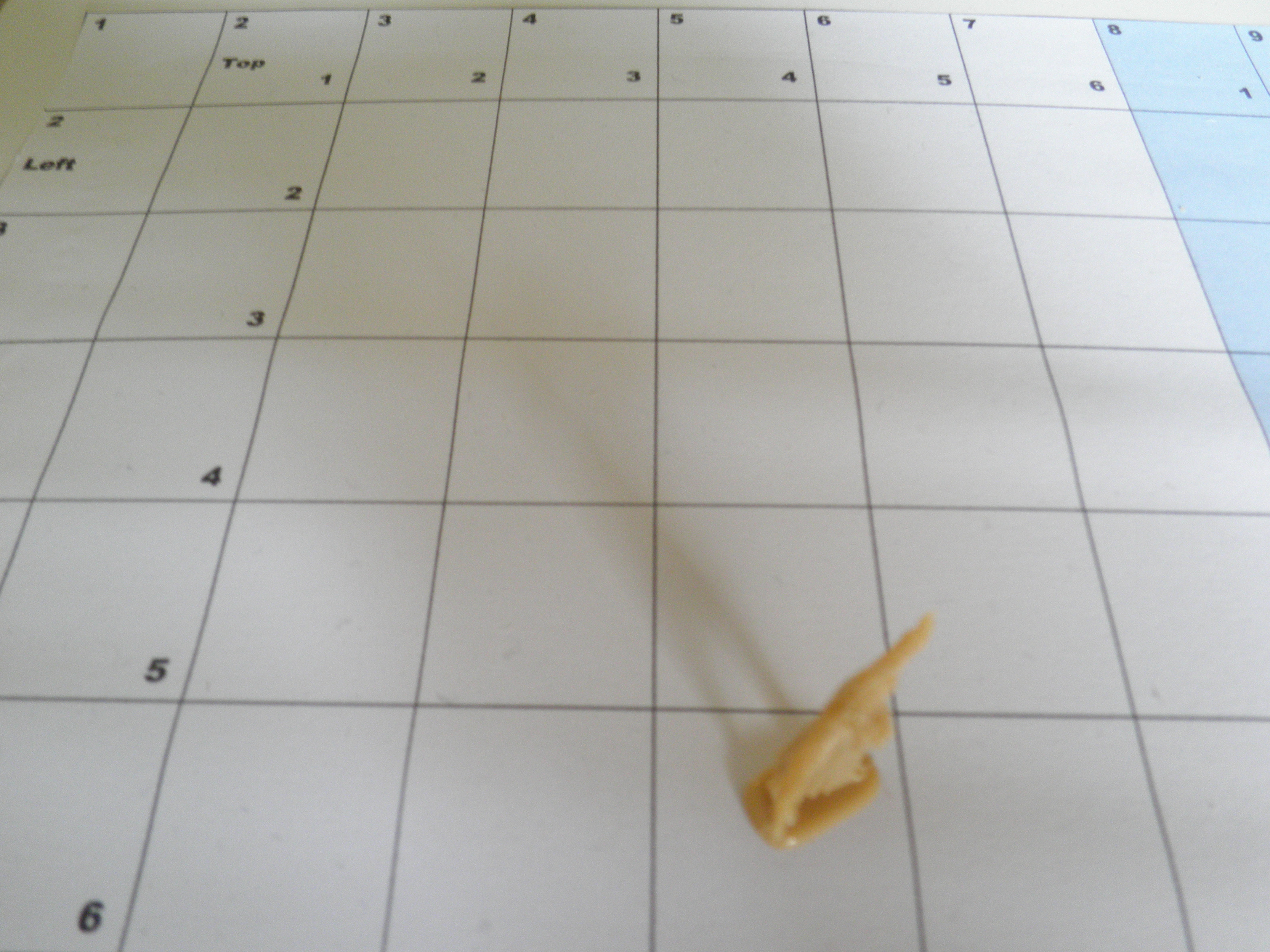
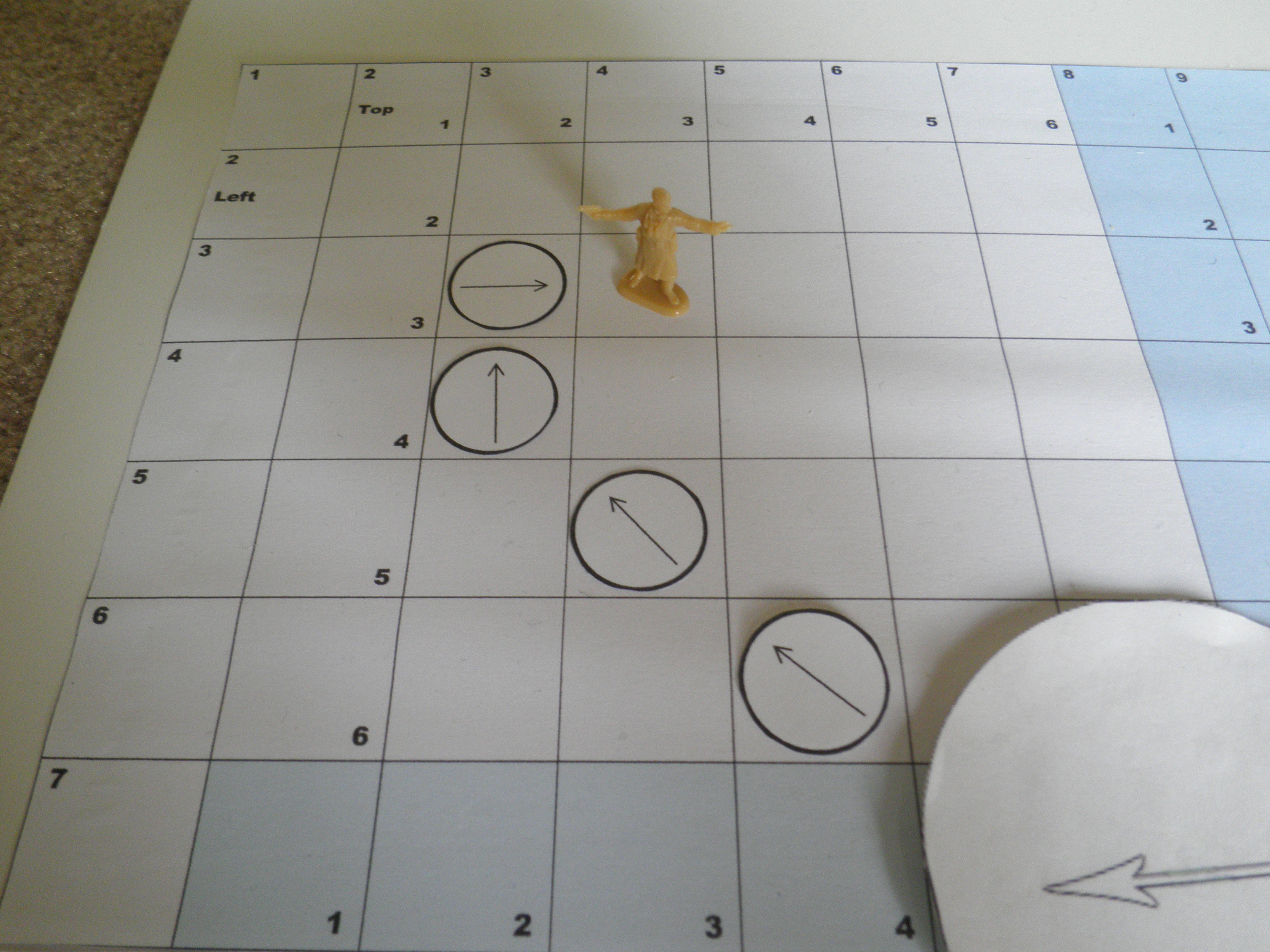
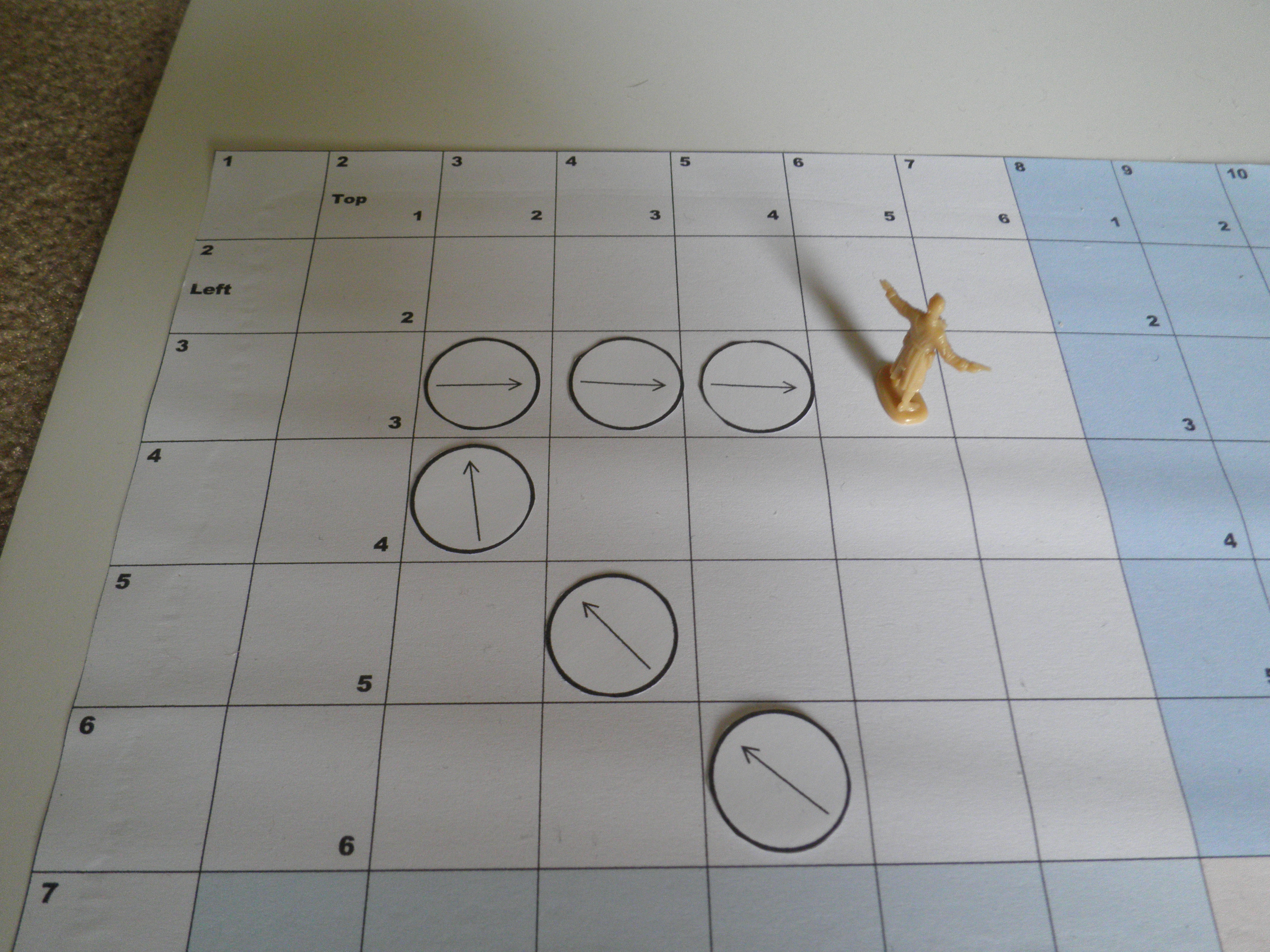
I also thought the tracking rules might be hard to understand just from the text. Thus, I took some photos of how they’re meant to play out in practice.
The player starts here.The player moves out of the first square; the marker shows the direction in which the player moved.The player keeps moving, the markers keep tracking.As the player turns, the trail turns as well.The trail always turns to follow the player.The searcher approaches, facing in direction 3–to the left.The searcher encounters the trail and turns to face in the direction it indicates.As the searcher moves, it encounters the trail marker pointing in a different direction. It turns to face in the new direction.If the trail looks like this . . . .The searcher moves forward, hits three markers at the same time, and relies on the one “topmost” and closest to the center–the one at (5,3). It turns right, the direction of that marker.
Sorry about the iffy pictures, but I hope they’re helpful!
(Sorry about the late-in-the-day update; my day job has been very busy.)
Last time I went through the results of the latest playtesting project, which showed (at least preliminarily) that the end-run strategy in Over the Next Dune is still both too strong and not very much fun to play. Although that’s regrettable, it’s not really surprising–the end run has been powerful and boring throughout the game’s history to date. Time to have another go at fixing it once and for all.
Issue: How can the end run be made both less effective and more interesting, without increasing the power of strategies that involve moving up the middle of the board?
I’m pretty sure that this is a complete statement of the issue. Playtesting has revealed that going up the middle of the board is a strong approach that wins most of the time. If that strategy gets easier the game could become trivial. Whatever is done to fix the end run, it cannot have that sort of collateral damage.
As regards the end run itself, there are really two things that need doing. It has to be made weaker as a way to win the game, and it has to be made more engaging. Right now the game is in the deeply regrettable position of having a dominant strategy which is boring to play. Fixing just the strategy’s dominance still leaves it boring, an ineffective and joyless trap for those who haven’t tried it before. Addressing the boring-ness without reducing the strategy’s power makes a game that’s fun but lacks replay value, worth playing only for so long as it takes to master the best approach. Both problems have to be dealt with.
Rules: The rules for OtND’s design; the most important of them for this purpose is that the decisions players make must be interesting.
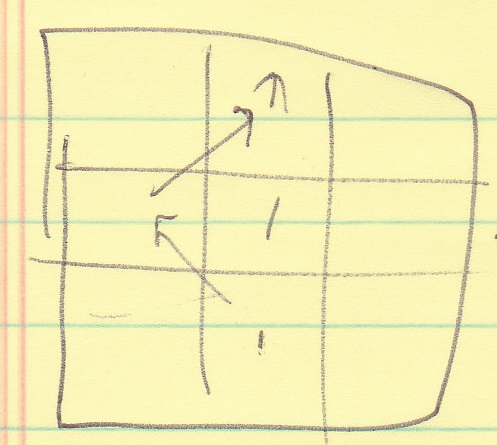
Thinking it through: Over time I’ve found that the fundamental challenge the end run poses is that it exposes a weakness of dividing the board into a grid. The grid allows players using the end run to move just as quickly as players going up the middle. This diagram shows what I mean (warning: terrible art ahead):
A player who moves to the side with his or her first move gets to the second row, just like the player who goes straight ahead.
Since the board is a grid, and diagonal movement has the same “cost” as orthogonal movement, players can shift to the side without losing forward progress. As searchers tend to be found more often in the center of the board than at its edges, going sideways makes players safer. Thus, it’s natural to go sideways: in terms of winning and losing, it’s all upside. Players who move to the sides get safety and lose nothing.
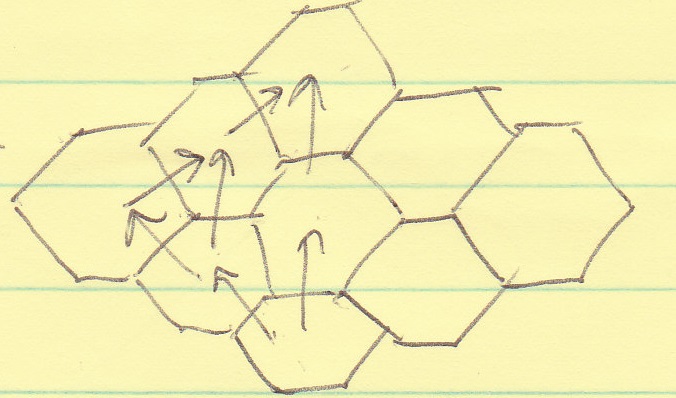
One possible solution would be to divide the board differently. Using hexagons rather than blocks, for example, would make sideways movement slower:
The player who moves straight ahead gets to the other end of the board in two moves; the player who sticks to the edge needs four.
Changing the board to make the end run take a much longer amount of time could end its dominance as a strategy. Searchers will not trouble the player often, but even minor disruptions could cost the player too much time. It would become a risky play.
I fiddled with that solution for a little while, but ultimately discarded it. Part of the trouble was that it made the rules for searcher “bouncing” a lot less intuitive. Right now just about everyone is comfortable with how searchers move once they see it in action; having lots of right angles makes it easy. Hexagons, by contrast, turned out to need weird rules right from the get-go just to stop the searchers from continuously moving back and forth.
The bigger issue, however, was that changing the length of the board edges did nothing to make the end run more interesting. Players at the edge would still rarely have to deal with a searcher; indeed, they would probably have to do so even less often than before! It would just take longer to do something boring, which might be fair but surely isn’t fun.
Given that the problem seemed to be with the shape of the board, I considered trying to attack the problem from another angle: instead of increasing the length of the edges, reduce the length if one moves through the middle. The idea was to combine some of the middle spaces into “giant” spaces. If this worked, it would indirectly make the edges longer:
It takes six moves to get off the board from the edge, but only five when moving through the giant space in the middle.
Unfortunately, this concept also didn’t get off the ground. It threatened to strengthen moving up the middle, which is good enough (and possibly far too good) as-is. Furthermore, it didn’t make the edges that much more interesting. If the searchers also treat the giant spaces as a single space (which had its own rules strangeness) they’ll get to the edges a bit more often. That doesn’t add much. To get them to the edges frequently the giant spaces will have to appear in several places and/or be very large, which would make balancing the middle strategy a nightmare. Quite possibly, it would prove impossible to make both the end run and going up the middle interesting strategies.
At this point I knew I didn’t want to mess with the board. It was hard, and it broke things. 😉 However, figuring out those possibilities brought home the centrality of the searchers to me. The searchers are the challenge in the game; they’re why players have to make difficult decisions; they are, in a very real sense, what makes the whole exercise count as a game. To make the end run harder, I needed to make it harder for players at the edges to deal with searchers. To make it more interesting, I needed to up the ante on those confrontations.
My first thought was just to have lots more searchers. That would make it more likely that players at the edges would confront multiple searchers, a situation in which end-runners often fare poorly. However, it would also increase the game’s “overhead” dramatically, slowing play. Adding time between interesting decisions is regrettable at best.
Another possibility was to have searchers appear on the sides of the board–to make the edge not really the edge, with a conceptual space beyond it from which searchers might appear. However, that basically amounted to “if you are at the edges you may randomly get caught.” That’s not interesting; it’s just unpredictable punishment. There’s no counterplay.
The idea of more realistic searchers, though, put me on to something that I really liked. What if the searchers could follow the players’ trail when they’re at the edges?
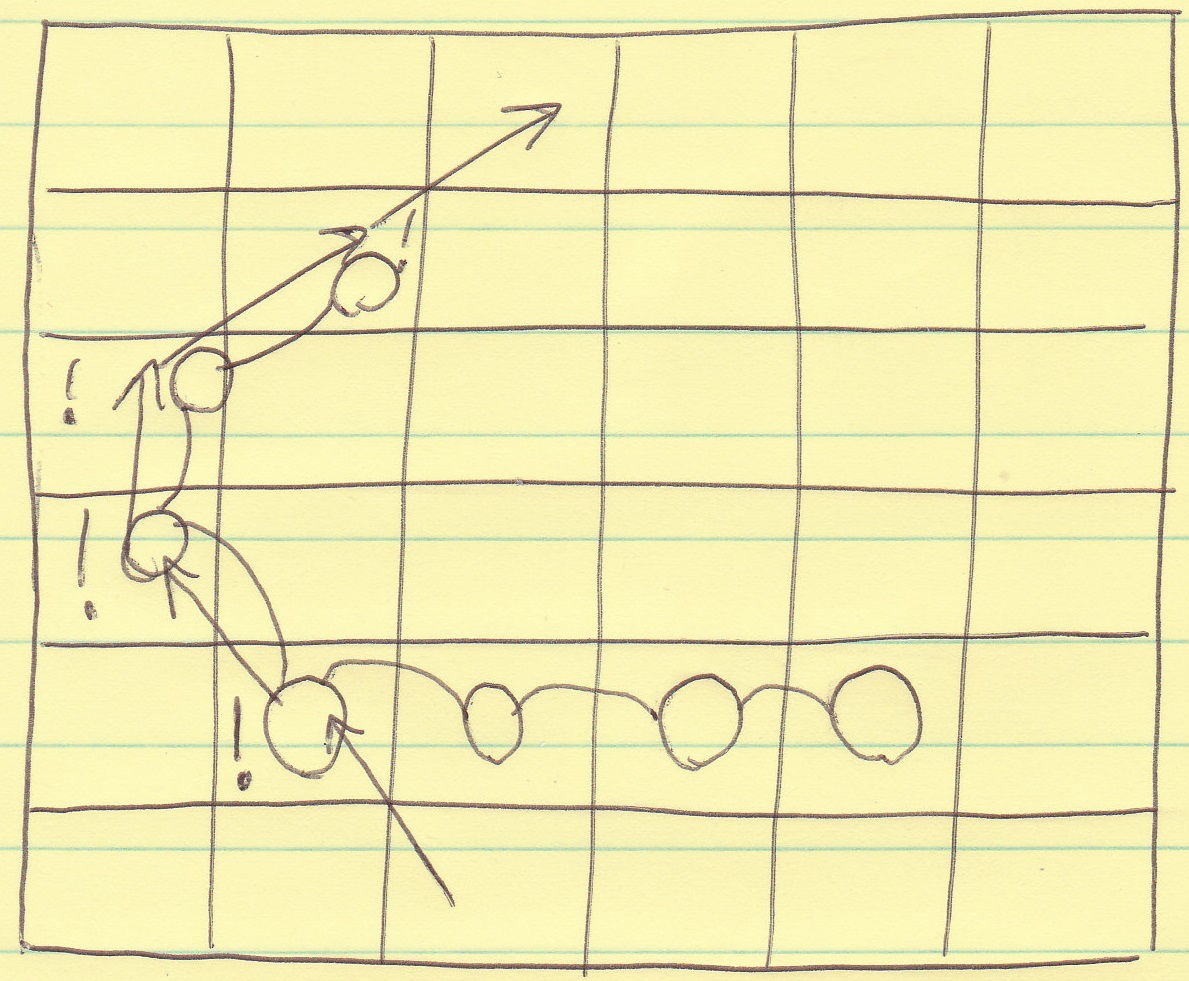
The searcher spots the player where the exclamation marks appear, and turns to follow.
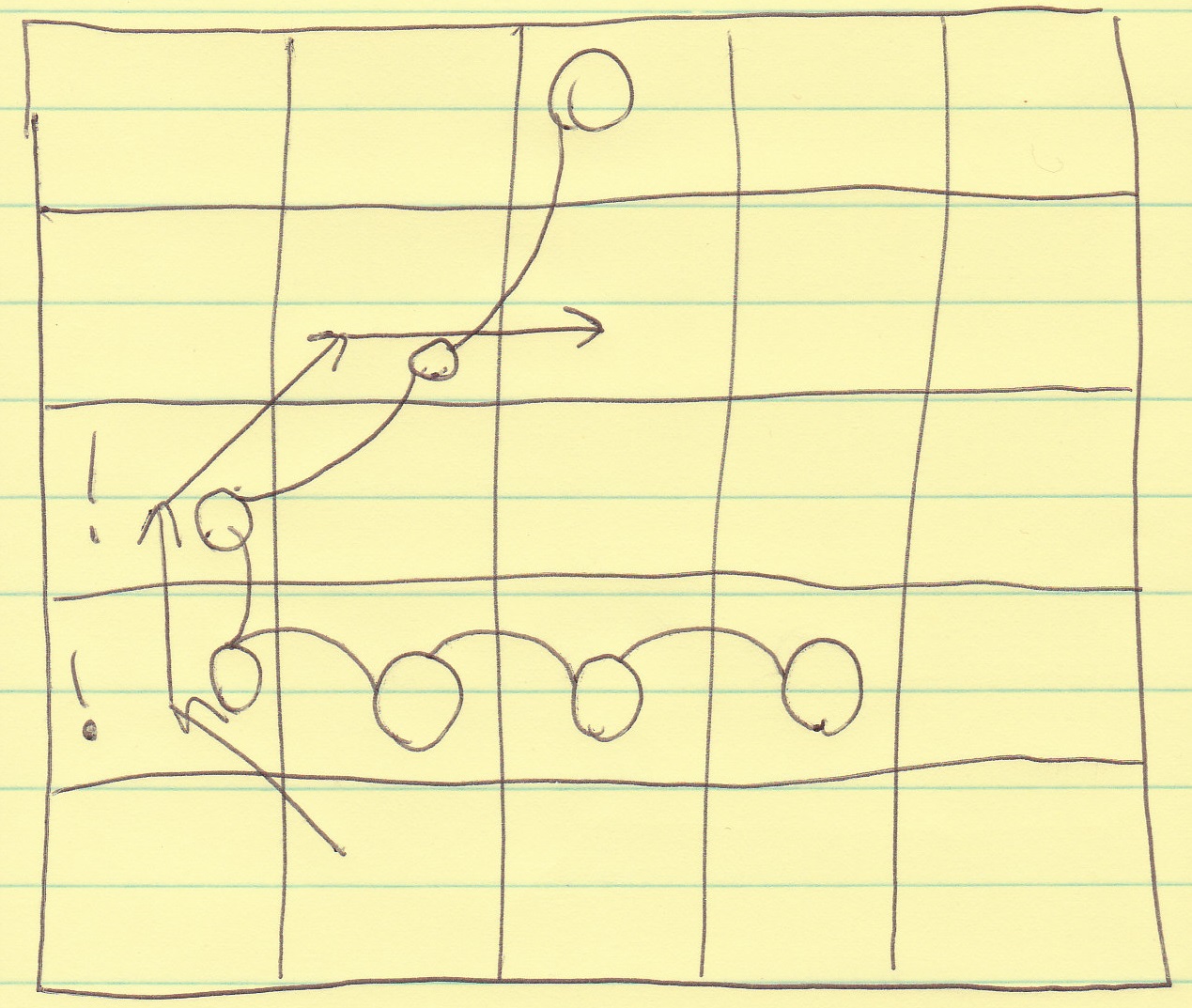
It would work like this: when the players move to the sides of the board, they enter special terrain in which they have to mark their paths. Searchers follow those paths, chasing after the players. (Conceptually, perhaps the edges have wet sand that retains tracks, or something else the searchers can use to follow the players’ movements.) They continue to follow until the players move out to a “trackless” space in the center of the board, at which point they resume moving normally.
The searcher chases, but the player moves to a “trackless” space and the searcher keeps going in the wrong direction.
I’m pretty sure that this solves both problems. It makes the end run weaker, because players who just go up the side of the board can now find themselves in a race with searchers who move faster than they do. It makes the end run more interesting, because players have to choose their paths carefully, knowing that they’re leaving trails that can be used against them later. Finally, it doesn’t make the up-the-middle strategy better.
As a first draft of the rules:
Whenever a player token leaves any space in columns 1-5 or 16-20, the player must mark the direction in which the token goes. Whenever a searcher covers one or more spaces which are marked in this way, it immediately turns to face the direction marked. (If the searcher has more than one direction to choose from, it chooses the direction in the space closest to the “top” of the board. If multiple spaces with a direction marked in them are equally close to the “top” of the board, the searcher chooses the direction in the space closest to the center of the board among those options.) If the searcher has not yet finished moving, it continues moving in the new direction.
If a player leaves a space which already has a direction marker, remove the old marker and replace it with a new one showing the direction in which the player’s token left the space.
If you get a chance to try this out, let me know–I’m very interested to hear about how it works out for you.
A while ago I set out to test whether end-runs in Over the Next Dune are better than just running up the middle. It proved necessary to be more specific about my definitions and to make sure I was testing both strategies in the same environments. Having done that and played the games, here are the results:
Game Middle End-Run
1 W/8/1 W/7/0
2 W/7/2 W/7/0
3 L/3/2 L/5/5 On replay, middle strategy: L/6/6
4 W/8/3 L/3/2 On replay, end-run: W/6/0
5 L/6/3 W/7/0
6 W/6/1 L/7/3 (But winnable for the end-run with different play?)
7 W/6/0 W/5/0
8 W/9/3 W/9/0
9 W/9/4 W/5/0
10 W/8/3 L/4/1
Before getting into the nitty-gritty, I think it’s worth being frank about the weaknesses of this experiment. The sample size is not large. Dave Sirlin makes a compelling case, however, for the argument that a relatively small number of plays can be sufficient for testing purposes if the players involved know what they’re doing. I believe that I have as much experience with Over the Next Dune as anyone does, so I’m going to conclude that the sample size is enough to be useful.
In addition, this wasn’t a proper double-blind experiment. I had at least some knowledge of how the searchers would move going into the end-run games, since I was setting up the searcher movement decks. While I tried not to take advantage of that information, I’m sure I was subconsciously influenced at times. There’s no easy way to sort out when that was, so it may just be that this problem has to be accepted.
Keeping those weaknesses in mind–and proceeding from the assumption that they don’t completely undermine the results–what does the data say?
1. The end-run was often better. In six of the ten games, the end-run strategy won faster, with fewer players captured, or both. That number goes up to seven if one adds game four, where I played the end-run poorly the first time out (and knew it). There were only two games where the end-run lost and the middle strategy won. Furthermore, the end-run won game five handily after the middle strategy lost.
2. The middle strategy is workable. Although it had to work harder, the middle strategy won 80% of its games. (Whether that’s too high is a separate question, albeit one that does need to be addressed.) The challenge being presented is not that going up the middle is doomed and terrible; it’s that players can pretty consistently get a better result by shifting sideways.
3. The end-run still isn’t as interesting. Admittedly, this is a more subjective conclusion. However, I feel that it’s an accurate one. I had hoped that starting the players in the center of the board would add a lot of decision-making to the end run. It did add some, but in practice it’s not as much as I would’ve liked. Going up the middle is hard and involves a lot of tricking searchers; the end run is mostly just not standing in the wrong place.
4. The end-run doesn’t like confronting multiple searchers. I noticed this one in the games the end-run strategy lost. Put simply, players at the edge of the board have little space to work with. When several searchers close in at once, it’s hard for them to trick those searchers into safe positions. By contrast, players in the middle of the board can often find a way to stay alive, even if it means putting a player in harm’s way to buy time for the group.
5. The end-run doesn’t like splitting up. This is intuitively obvious, but it’s good to have test results for confirmation. When the players split up to use both edges of the board they’re much more vulnerable. Rescues become difficult or even impossible to arrange.
The end-run has been too strong for a while. On Monday I’ll walk through a full analysis of the next attempt at a fix. Of course, that means I have to figure out what the next attempt will be–but every attorney knows that filing deadlines are great motivators. 😉
Following up on the current effort to playtest the “end run” strategy:
I’m currently playing the non-end run games. Once those are done I’ll go back through and use the same setups to play the end run.
I’d be happy if the playtesting were going faster, but doing the experiment right has meant slowing down. Normally I can easily finish a solo game of Over the Next Dune in 30 minutes (which is useful information–it’s the kind of thing that goes on the side of a box!). Unfortunately, the extra record-keeping involved in recording the setups makes the games take significantly longer. As a result, it’s harder to fit them in around other obligations.
I’ll come back to this topic in two weeks, hopefully with final results.






 The Law of Game Design