On the list of things I didn’t think to consider before starting at what is, technically, an art school: color schemes!
I’m not entirely happy with the orange in the center or the light green, but I this is getting closer to a spaghetti western feel–something suitable for the OK Corral . . . .
Time is jealous. It’s given you exactly what it thinks you’re supposed to have. Under no circumstances should you be getting more.
Yours has run out–but you have a way to slip extra right out of time’s back pocket. You can only take a little at a go. 2.1 seconds a try, at best. Reach for more, and time will put you in your place by skipping you right over.
Now you have to play for your life, with the next few seconds as the stakes. Play your cards right, and you can change your history. Play your cards wrong, and you won’t have the chance to worry about the house’s edge.
I realized a while ago that this site’s design is . . . perhaps weighted more toward function than form. Earlier in the week I also got feedback to that effect from one of NYU’s visual design professors. While it’s validating to have been right, it also seems I have some work to do. 😉
I’m going to be spending some time working on the site. Expect unannounced changes to its look, although the content and format will most likely remain the same. As always, let me know what you think of the new iterations!
As promised, a quick prototype for Guitar Zero: a cheerfully silly (and surprisingly mechanically intensive) match-3 game.
You’re performing for a crowd that doesn’t expect much of you. Find matches in the shape of power chords, and you’ll build up your multiplier–but also the fans’ expectations. Disappoint them too many times when they’re getting excited, and they’ll boo you off the stage! Get enough points before you’ve played fifty chords/made fifty matches to win.
Guitar Zero is a test of how one might keep players challenging themselves as their skill level increases. You can reach the end with little difficulty–but you won’t win that way. Succeeding requires taking on some risk. To get a truly great score, you’ll need to put yourself to the test.
One of the hardest things to figure out, when I was just starting to design games, was the workflow. What was the to-do list? How would I know when I had done a good job at any given step?
This series of tweets by famed tabletop designer Eric Lang offers one possible answer. He explains what design-and-development system made famous by Wizards of the Coast looks like when done properly. It’s a valuable set of guideposts for those looking for a way to structure their design experience.
I suspect that many people have developed the essentials of H.G. Wells’ Little Wars on their own. At its core, one tries to knock over the other player’s toy soldiers with a projectile before they do the same to yours; I played a similar game with my father as a child, and I’m sure I’m not the only one. Committing simple rules to print, though, helps emphasize Wells’ central idea: “[t]hings should happen, and not be decided.”
We take it for granted that things are decided in games, usually by a system constructed for the purpose. Yet, there’s something remarkable about resting on “what happens” instead of “what the rules tell us happened.” It feels natural and immediate; the toy soldier is out of play because he was knocked over. How could it be otherwise?
It couldn’t. There’s no intermediate step to Little Wars combat, no opportunity for the excitement to dribble out of the resolution process. Our intuition tells us the soldier is lost, and instantly he is.
There are lots of other things to say about Little Wars. Charles Pratt accurately pointed out that its playful, toylike quality defuses the concern for precision that can make miniatures games fiddly; whether that trooper got knocked 1/16″ or 1/8″ to the left when he was tapped accidentally is irrelevant, because it’s the same challenge to hit him with a projectile either way. Little Wars is also a melding of dexterity and tactical play in a way that disappears from the strategy genre thereafter. It’s got as much in common with modern basketball and American football as it does with Warhammer.
Yet, I can’t get away from the sense of immediacy as the truly gripping element of Little Wars. “Things should happen, and not be decided.” How many games could follow that advice? How often could the system be refined, or cut away, to enable things to happen?
For another 14 hours, you can pick up a whole lot of GameMaker content on Humble Bundle. Everything I said the last time this happened is still true: GameMaker is powerful, yet still great for beginners, and the source code included with the bundle’s upper tiers is great as a learning resource. If you’re interested in getting started with digital design, the $15 bundle on offer here is an excellent way to go.
I use the same sites over and over in my prototypes, and while I credit individual contributors there’s rarely a chance to mention the sites as a whole. Let’s rectify that here.
Freesound.org is a great resource for sound effects. It’ll rarely have exactly what you want, but it probably has something close enough to be worth editing into the right form.
If you’re looking for music rather than effects, the Free Music Archive is just the ticket. Aesthetic preferences make it harder, in my experience, to find “just right” music than SFX–and of course, editing music is more difficult as well. Nevertheless, it’s a valuable resource.
Art isn’t trivial to come by, but I get a lot of use out of Game-icons.net. Easy-to-parse and attractive is what I want for prototypes.
Font Squirrel has become my go-to site for typographical assistance. It gets bonus points for making it easy to tell up front how the different fonts are licensed.
All of these sites have been very helpful to me. I highly recommend giving them a look; I expect you’ll find them the same.
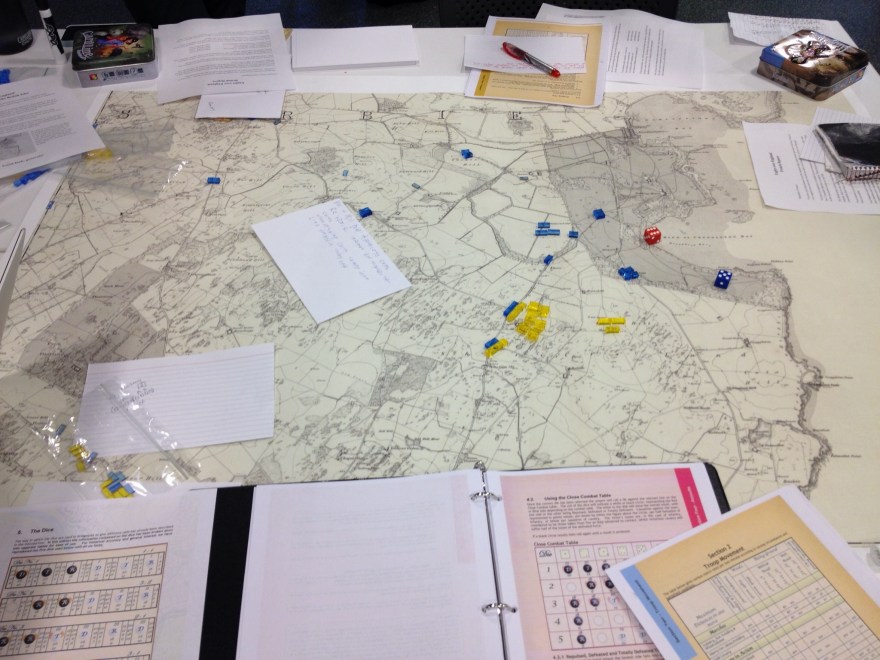
Yesterday I had the opportunity to act as the umpire in a round of the original, 1824 Kriegsspiel. It was an eye-opening experience. Without a doubt, the Kriegsspiel–originally built as a training exercise for Prussian military officers, and later adopted as a hobby pastime–is the most disturbing wargame I’ve ever played.
The Kriegsspiel in progress.
Many wargames are, and feel like, a chess variant. Pieces move in abstract units: hexes, inches, or centimeters. Health, too, is handled abstractly, often through hit points. One feels oneself engaged with a harmless intellectual exercise.
By contrast, the Kriegsspiel measures everything in human terms. Movement and firing ranges are expressed in paces. Losses are tallied using an abstract system which immediately relates to the actual number of soldiers harmed. Everything about the game emphasizes that it is a simulation, not of fantastical battles, but of human conflict.
This careful effort to translate game functions to human scales lends the kreigsspiel a grim air. Chess variants were its immediate ancestors, but the kriegsspiel lacks their sense of remove. After totaling up the precise number of cavalrymen undone by an infantry volley, one feels an urge to shudder and walk away from the table.
The kriegsspiel has a number of design lessons to teach. Perhaps the greatest of them, though, is the power of choosing the terms in which one expresses the scales used to measure game effects. Abstract scales create an abstract feel. Scales based firmly on lived experience produce a very different sense.


 The Law of Game Design