The Case Study: Playtesting Project – Results

The playtesting project is finished! I’ve attached my notes from the games at the end of this post. For each game terrain pieces are listed from the top-left colored area to the bottom-right colored area (e.g., in the first game piece 1 was centered at column 4, row 2 in the grey area, then piece 5 was centered at column 6, row 4 in the dark blue area, etc.). The searchers are listed as (column),(row) to (initial direction). In game one, for example, the first searcher was at column 2, row 4 facing in direction 3 (“left” relative to the player).

Based on these games I’m changing the rules in four ways. The first three are just fixes to clarify what happens in unusual situations. However, the fourth is a bigger change that will require additional testing. For the first three, which are akin to FAQ entries, I’ll use the Q/A/D format–a question, its answer, and some discussion. The third will get a longer treatment.

Q. When a player token moves off the board, does that move a searcher adjacent to the token?

A. A player token moving off the board does not move any adjacent searchers. Searchers only follow player tokens that are moving to a space on the board.

D. In the absence of this rule it was possible to conclude that when a player leaves the board at a diagonal, a searcher would try to follow the player as best as possible by moving sideways. That’s an interesting idea, but I don’t think it really adds any interest; the number of cases in which that would be helpful is very small. Furthermore, what would the rules be like? “Players leaving the board must determine the constituent vectors of their movement . . . .” It seemed better to say that searchers give up on player tokens that have reached friendly lines.

Q. If there are not enough player tokens left on the board to rescue captured teammates, is it necessary to play the game out?

A. When one or more players have been captured and there are not enough uncaptured player tokens left on the board to free them, the game immediately ends in a loss for the players.

D. It’s senseless to make players continue when the game has already been decided.

Q. Can a player “trick” (drag) a searcher into another player’s square? If so, what happens? Is the other player captured?

A. Players may not trick searchers such that the searcher will move into another player’s square.

D. There might be times when it would be tactically advantageous to do this, but I think it’s overwhelmingly more likely to occur as a result of sheer error. The result is apt to be irritated players. Better just to say it can’t happen, so that if it does there’s cause in the rules to rewind the game.

Rule change: Three player tokens must be adjacent to a searcher to rescue a captured player, rather than two.

This one deserves a bit more discussion:

Facts: During the playtest two troubling dynamics emerged. First, under the current rules Over the Next Dune is pretty easy. In fact, it’s so easy that one can play very casually and do fine. It’s not generally necessary to think too hard about one’s decisions, because one can always turn things around with a couple of friends nearby. When the game is too easy, interest in the decisions drops.

Second, I noticed after a while that it was often viable to split up. Since only a small group was necessary for a rescue, it was OK to form into two small groups and make “end runs” up the sides of the map. When players do that, it tends to turn the game into a fairly simple race. To the greatest extent feasible I want to push players into the middle, where there will usually be more terrain, more searchers, and more decisions to make.

Issue 1: What should be done to increase OtND’s challenge?
Issue 2: What should be done to encourage players to stay together in the middle of the map, rather than going for “end runs” up the two sides?

Rule: The decisions players make should be interesting through the end of the game.

Thinking it through: I’m collapsing the two issues because I’m pretty sure that they share a root cause: rescues only require two players. Making them so easy has reduced the consequences for mistakes too far, and it has allowed players to split up while retaining the possibility of rescuing a teammate. Ratcheting up the number of players involved in a rescue should make the game harder and turn splitting up into a serious decision rather than an all-upside strategy.

It’s possible that this change will undo the rescue rule’s ability to resolve the worst-case scenario. I’ll be testing that soon.

It’s also possible that we’re losing the madcap games where captures and rescues chain together to make a wild experience. That’s not the normal mode of play, nor is it strictly intended, but it is fun. I’ll try to keep watch to see if that kind of game can’t occur under the new rule.

While the playtesting project is over, testing continues–just without a fancy name. 🙂 As always, let me know how your games are going!

OtND Playtesting Project Fed.-Mar. 2014

The Case Study: Cards v. Dice

The playtesting project involves playing a lot of Over the Next Dune, which means setting the game up over and over. Unfortunately, OtND’s setup is a bit lengthy. I’ve been looking for ways to cut that time down, and one method under consideration is replacing the searcher movement cards (which have to be shuffled, a process which many find lengthy and somewhat challenging) with dice. For example, instead of drawing a searcher movement card players could just roll a die–on a 1 the searcher turns left, on a 6 it turns right, and 2-5 it would go straight ahead.

Facts: Currently, OtND uses a deck of 60 searcher movement cards to determine whether each searcher turns during the search phase. The deck has seven left turns, seven right turns, and 46 straight-aheads, which results in about an 11% chance of each turn and about a 77% chance of moving straight ahead. In testing, these odds have produced enough turns to add an exciting danger of the searchers turning without rendering their movement completely unpredictable.

Beyond controlling the searchers’ movement the cards provide information on how the searchers have already moved. As a result, players are able to make more informed judgments as the game progresses as to how the searchers will move in the future.

While it is not their intended function the searcher movement cards also serve as a perfectly good game clock. If the turn marker has become unreliable (e.g., because the table was jostled or there is some question as to whether it was moved when it was supposed to be), one can still tell when the game ends by when the searcher movement cards run out. Six cards a turn taken from a 60 card deck means that the deck runs out in 10 turns, which is also when the game is over.

Searcher movement cards are also occasionally handy to keep track of which searchers have already moved in a given search phase. If there are 23 discarded cards, the players know that this is the fourth search phase (six cards per search phase for the previous three turns), and that searcher number six is next to move (the five extra cards mean that searchers one, two, three, four, and five have already moved).

Although they are working well once the game begins, the searcher movement cards do add to the game’s setup time. In addition, some players find shuffling the cards inconvenient or even difficult.

It is possible to replace the searcher movement cards with dice, and to retain approximately the same odds of turning. For example, the odds of the results of two dice summing to five or 10 are each about 11%. Writing the rule as “roll two dice; if the sum is five the searcher turns left, if it is 10 the searcher turns right, and if the sum is anything else the searcher goes straight ahead” would produce almost the same rate of searcher turns as the current system.

However, using dice would make it impossible to predict the searchers’ future behavior from previous turns. The odds of the searcher turning would be the same for each individual roll, instead of changing as cards are used from the deck.

In addition, dice would not be able to imitate the game clock and which-searchers-have-moved functions that the searcher movement cards can serve.

Issue: Should dice replace the searcher movement cards as the means of determining whether and in which direction searchers turn?

Rules:

1. Decisions players make should be interesting throughout the game.
2. As a corollary, players should start making those interesting decisions as soon as possible.

Thinking it through: Switching to dice has some pretty serious costs. I very much like how the cards reward players for staying invested and revisiting the odds of various turns as the game goes on. Losing that would be disappointing to say the least. After all, such information-tracking was important enough to justify making the discard pile available to the players.

From the game design ivory tower keeping track of turns and which searcher is about to move is a lesser blow. However, in practice I’ve found that it’s easy for a momentary distraction to result in players losing their place in the game. That isn’t anyone’s fault or a criticism; it’s natural for a group of friends to pause their game as they chat about something, or for a parent to need to give attention to his or her child, or for other interruptions to occur. Having an easy way to get back on track is very valuable in the real world.

Using dice is only justified, then, if the greater ease of setup outweighs everything else. I just don’t think that one advantage can carry the weight. It’s true that it gets one to the meat of the game faster, but the time gained is minimal. What’s worse, the meat ends up being less satisfying, since one no longer gets the added interest of working with the changing odds. Players eat sooner, but the meal’s not as good.

It’s common, in law, for different rules or parts of rules to pull in different directions. Sometimes the only thing one can do is balance them out as best one can. For the moment, I feel that the balance is in favor of the searcher movement cards. If that changes, I’ll mention it, and if you disagree, feel free to let me know in the comments.

The Case Study: Hotfixes and Information Tracking

During the playtesting project two rules issues have come up. Below are the questions, the answers, and an updated rulebook. I’m going to steal Quirkworthy‘s Q/A/D format for these–a there’s a Question, an Answer, and some Discussion.

Q: What is terrain piece 4’s actual shape? Does it include the clear spaces between the spaces with terrain in them?

A: Piece 4 includes only the spaces marked as terrain. It does not include the clear spaces.

D: Piece 4 is fun, but it does cause some issues. As matters stand it’s inconvenient to cut out and not at all sturdy. I considered putting a border around it so that it could be handled as one giant piece, but that created two problems. First, it would require expanding the rules on overlapping terrain to deal with terrain that includes clear spaces–does the clear space or the difficult terrain “win?” Second, it would call for rules for two different kinds of borders–those that actually impact movement and those that are merely defining the edges of the terrain piece.

Neither of those rule changes would have to be elaborate, but I would prefer to avoid adding complexity just to make piece 4 easier to manage. I think the better solution here is to take another look at the print-and-play file to see if there’s a way to give piece 4 a bit more structural integrity.

Q: Is the discard pile for searcher movement cards public information? Can I look through the discard to see what cards are out of the deck?

A: Yes, the discard pile for searcher movement cards is public information. It is legal to look through it at any time.

D: This is a difficult question, and the answer could have gone either way. What follows is how I came to the conclusion I did, but I’m especially interested in hearing people’s views on this subject.

A fundamental rule of Over the Next Dune is that players should be making interesting decisions. The most fundamental decisions players make are where to move and what path to follow in getting there. It is vital that those decisions be as engaging as possible.

One way in which I am trying to make those decisions interesting is allowing players to “play the odds” with regard to searcher movement. Since the searchers are most likely to go straight ahead and less likely to turn, players can take intelligent risks. If you can’t get to a completely safe place, it’s still possible to choose a safer spot by going to a location where the searcher would have to turn to catch you. Picking the best spot under the circumstances is a (hopefully) interesting part of the challenge.

Similarly, if you are trying to trick a searcher in order to save a teammate, the relative odds of the searcher moving forward or turning affect where to drag the searcher. I’ve found it interesting to try to find the safest location for my teammates based on what the searcher is likely to do next.

Knowing what searcher movement cards have already come out affects these decisions. If four left turns are gone and no right turns are, the searchers are significantly more likely to turn right in the future, and that impacts where and how the players should move. I think it’s a positive that as the game goes on the odds change–as discussed last time, it keeps things interesting.

However, players can only revisit their decisions based on new information if they actually have the information. In this case, that means they have to know what searcher movement cards have been used. There are three ways for them to get that data: remembering, tracking it by writing it down, and being able to check the discard.

Remembering the cards is a skill; I have known players who were very good at that sort of thing, and it gave them a real advantage. However, it is not a skill that OtND needs to test. Thematically, I see no reason why soldiers sneaking behind enemy lines would be counting how many times their pursuers turned left. (Admittedly, I’ve never had to escape from behind enemy lines. Maybe I’m wrong?) From a gameplay perspective, I don’t want a player who is good at remembering to dictate to other players, or to have other players trying to cede their decision-making to the player with a strong memory.

Writing down the information just seems awkward and irksome. In competitive Magic: the Gathering it helps avoid confusion and prevent cheating, but this is a cooperative game with less potential for error and lower incentives to seek unfair advantage. It’s an unfortunate necessity there; we don’t need to go down that path here.

That leaves allowing players to look at the discard. I feel that this solution has two key benefits. First, it is effective. Players can only make interesting risk-re-evaluating decisions if they have the necessary information, and letting players check the discard accomplishes that. Second, it encourages players who can’t remember or didn’t track the discarded cards to seek out and use that information. In my experience, players who don’t recall what’s in a discard pile frequently just give up and ignore the discarded cards entirely. As a result, they don’t go through the re-evaluation. I want players to revisit the odds of the searchers moving in different ways over the course of the game, and letting them find out what has been discarded will encourage them to do so.

It is true that allowing players who do not remember or track the contents of the discard to check it could slow down play. My suspicion, however, is that this will not be a serious problem. I expect that most players will only check the discard when an exact count is vital; those who value the information most, and who might have the greatest inclination to look through the discard pile, will probably also be paying close attention to the cards as they come out and will therefore have the least need to do so.

Based on that reasoning I am currently saying that the discard is open information. Again, however, I am not wedded to that position. If you disagree, let me know!

Over the Next Dune – Rules – 3-5-14

The Case Study: Playtesting Project

I was writing a whole long post about adding “chrome” to OtND, which was predicated on the idea that the core game is in a good place–challenging but never unwinnable. However, as I wrote I realized that while I certainly thought the game was meeting that standard, I didn’t have data to back up that conclusion. For a long time I kept careful notes on whether or not the players won, and how many turns the game lasted. Recently, however, the rules have been changing and I’ve stopped tracking that data.

It’s time to get back on the horse.

For the next two weeks I am going to play at least one game of OtND each day, noting how the game ended (win, lose by capture, lose by time) and on what turn. At the end of those two weeks I’ll tally up the information and discuss the results.

If you’re interested in participating, please feel free to log your games as well. They can be put in the comments to this post, or sent directly. Having more players involved will be a great help in ensuring that I’m working from accurate data.

The Case Study: Thematic Mismatch

Writers sometimes say that they didn’t make their characters act in a certain way; rather, the character him- or herself let the writer know what needed to happen next. Games, I’ve found, can do the same. One means for the game to be like this, but it becomes clear that the plan is not a perfect fit; the game wants to be like that.

I’m trying to figure out whether Over the Next Dune is in that place. Currently, the capture-and-rescue rules seem to be working very well. However, the play is undermining the theme. After a rescue the searcher just kind of keeps going–surely the Axis soldiers would be a bit more attentive. Furthermore, rescue missions can lead to a sequence where two or even three players are captured and rescued in turn, lending the whole situation a bit of a Keystone Kops feel. The mechanics have stopped lining up with the gritty narrative of desperate Allies and dangerous Axis.

I hate to alter the rules having just gotten them to a satisfactory state, so I’m tempted to look to the theme instead. At this moment I’m considering embracing the Keystone Kops notion. Playing out an escape from a comical jailhouse, running wildly about the prison yard while Benny Hill music plays in the background, might actually be a lot of fun. OtND has never been a detailed simulation; rather than trying to fit it into a wargame mode, it might be more fun if the the game ran with its broad-strokes, almost cartoonish approach.

On the other hand, “criminals fleeing” could be a controversial theme–and I’m not sure playing it for laughs will resolve detractors’ concerns. (Of course, war is also a theme that should be handled with some care.) Picking a narrative for OtND that offends is certainly going to make it less fun for some.

This isn’t a question that needs to be finalized right away; there are lots of backstories that could fit a game about sneaking around, and the mechanics are not so tied to the theme that the details have to be set in stone in advance. For now, I’m going to keep an eye out for situations where OtND’s gameplay isn’t matching its theme, and I’ll be trying to listen for what the game might have to say about narratives that would work better. If OtND says something to you about this, please let me know. 🙂

The Case Study: Good, Better, Best in the Worst-Case Scenario

Last time we were searching for new resources with which to make OtND’s worst-case setup an actually interesting game (as opposed to merely theoretically winnable). The first place I looked was to an area of the rules that’s been bothering me for a while: what happens when a player gets caught. As matters stood getting caught flatly ended the game, and the worst-case scenario makes it very likely that someone will be caught. Yet, if getting caught was not a guaranteed loss but rather a resource, an opportunity to make a trade between short-term safety and long-term victory, that would make the worst-case setup more manageable while also potentially adding interest to any game in which a player makes a mistake. I decided to follow this line of thinking to see where it went, and I think the result is a substantial improvement both to the immediate problem and to the game as a whole.

The facts: For reference, the existing rule is:

The players lose if:

1.    Any player is caught by a searcher, represented by a searcher occupying the same square as the player’s token.

I wrote the rule this way for two reasons. First, it incentivizes the players to help each other. If player A’s fate is tied to player B’s, player A is more likely to work together with player B by tricking searchers and so forth. Second, it’s straightforward, and saving complexity here offered the opportunity to add it elsewhere.

However, as time has gone on I’ve increasingly come to feel that this approach might not be much fun. It’s stressful to feel like any mistake will have dire consequences, not just for you, but for others as well. Moreover, when someone gets caught it could prompt post-game recriminations. The fun of a game needs to extend to afterwards as well; if the game is entertaining during play but the experience turns sour as soon as it ends, it’s not fun overall.

The worst-case scenario is so bad because not everyone can be saved from getting caught, and if even one player is caught the game is over. Previously I was trying to find a way to let all the players escape, but it’s possible to attack the problem from the other angle. What if the consequences for getting caught were reduced?

The issue: How can the rules relating to players getting caught by the searchers be modified so as to avoid the problems with the existing rule, while also improving the players’ chances in the worst-case scenario?

The rules:

1. The game should be fun.
2. Players should have to work together.
3. The players’ decisions should be interesting.

Thinking it through: As it stands OtND glosses over “sending the prisoner to the rear”–once someone gets caught the game is over. However, what if that was actually played out, so that the players have an opportunity to rescue their teammate? That could be fun (everyone loves a chase scene), the implementation can encourage teamwork, and–if done right–it would be interesting.

I tried this out and I’m happy to say that it worked very well. Here’s an overview the new system (the new rulebook below has some additional details):

If a searcher occupies the same square as the player’s token, the player has been caught. The searcher immediately stops moving, and the player’s token is put on the searcher’s center square. (If multiple players are caught at the same time, put all of their tokens on the searcher’s center square. This is an exception to the normal rule that player tokens cannot occupy the same square.) Turn the searcher so that it faces directly “down” toward the players, away from the players’ goal. A caught player cannot be caught again; other searchers ignore caught player tokens.

While caught, a player does not participate in the sneak phase. During the search phase, other players can rescue those who have been caught by having two or more player tokens adjacent to the searcher who caught the player(s). As soon as that happens (even during a player’s movement), the caught player places his or her player token on any space adjacent to the searcher who caught him or her. The caught player then takes an available turn order card, and plays out his or her turn normally. (If multiple players are rescued at the same time, they take turn order cards in player order. For example, if the second and fourth players are caught, the second player takes a turn order card and then the fourth player.)

If a searcher with one or more caught players reaches row 20, those squad members are beyond saving and the players lose.

There are several things about this that I really like. Players still have to work together, now both to avoid getting caught and to get free after the fact. Furthermore, in playtesting the decisions surrounding the rescues were engaging; picking just the right path to rescue someone while still making good use of the turn by progressing toward friendly lines and/or moving the searcher into a more favorable location was tricky and interesting. Last but not least, it was just plain fun to go save somebody from a dire fate.

Since part of the exercise is to resolve the worst-case scenario, I did a focused playtest on it with the new rule. The game turned out much, much better. Figuring out how to arrange matters so that rescues on turn 2 would be feasible, and then carryout out the rescues, was tense and exciting.

All of the testing so far has been in solo games, but I suspect that the new approach will also go a long way toward solving the post-game-blame problem. Now responsibility for a loss gets spread around; the player who got caught is on the hook for being in the searcher’s way, but the others share some fault for not getting the person out. Everyone is in a bit of a glass house, and will hopefully be less inclined to throw stones.

It must be admitted that there are two weaknesses to the new system. One is that it expands one line in the rulebook into three paragraphs. That doesn’t make the change unacceptable, but complexity creep is definitely something to keep an eye on.

The second concern is that this is a “lose a turn” mechanic: captured players can’t play until someone rescues them. I really, really hate losing turns. One doesn’t have much fun playing a game when one isn’t actually playing!

With that said, two factors make me willing to give it a go here. The major one is that no player will ever be captured very long. Since the searchers turn back right away, players will most likely have one to two turns in which to rescue their teammate. Either the captured player gets back into the game promptly, or the game ends–either way, the captured player is not left twiddling his or her thumbs.

Second, as Zileas mentions in his discussion of anti-fun patterns, it can be OK to dip into a poor mechanic if the cost is outweighed a substantially greater payoff. Losing turns is a lousy mechanic indeed, but I think this use of it makes the game a lot more fun. The benefits accrue, not just in the worst-case scenario, but every time there would otherwise have been post-game unpleasantness.

I’ve attached a revised set of rules below. If you get a chance, take them for a spin and let me know what you think.

Over the Next Dune – Rules – 2-21-14

The Case Study: A Little Less Worst Case

Following up on the last post, I did some focused playtesting on limiting starting searchers to row 11 rather than row 12. These tests still presented the worst-case “wall of approaching searchers,” but because of the new starting position the searchers did not actually reach the players after the first search phase. I was hoping that the changed start would make even this most difficult opening interesting for the players. Unfortunately, the results were mixed at best.

On the one hand, trying to find a way to trick the searchers and get to safety actually was pretty interesting. I was pleased about that. A situation that had been devoid of gameplay (because the players couldn’t escape no matter what they did) now had decisions to make.

However, as time went on I became more and more disappointed with the solutions I was reaching. So far as I can tell, there is still no way for the players to trick the searchers so that they are safe going into turn two. At most the players can get to a point where they have a chance. Depending on how the searcher movement cards come out, the players might get lucky and escape–or they might not.

What’s worse, it really is a matter of the players getting lucky. Owing to the makeup of the searcher movement card deck, it is probable* that at least one of the searchlights will turn. With the limited amount of real estate in which the players can work on turn one, it is extremely difficult for them to be safe from these unpredictable turns. As a result, the players are unlikely to make it through the turn even if they make logical decisions–the risk is high and can’t be reduced very much.

Again, if there’s a solution that I’m just not seeing please let me know! However, assuming that that isn’t the case I have to declare this experiment to be only a very marginal success. Certainly, the players are no longer guaranteed to lose, and that was a key goal. The overriding rule, however, is that the players should be making interesting decisions, and right now that first turn still feels pretty doomed. It just takes a little longer for the doom to arrive.

In looking for another solution, I was inspired by this discussion on the League of Legends community beta. For those who don’t play LoL, the argument is about an in-game character named Yasuo. As of this writing, Yasuo is considered very powerful. The first post argues that Yasuo is inherently too good because he doesn’t have to worry about two resources which LoL commonly uses to control how often characters can use their special powers. Posts further down propose that Yasuo players have to manage other resources which are unusual and less immediately visible, and so he is more limited than he first appears.

Without getting into who’s right,** the notion of finding a new resource is an interesting one. Fiddling with the physical spaces on the board isn’t working well, but there might be metaphorical space elsewhere in the rules. I started down that road a little bit in saying previously that I didn’t want to give the players an additional thing they could do, and that’s still true, but in retrospect I closed off that line of thinking too early. There may be other ways the game could change to help players caught by the worst-case setup.

I’m going to take the next little while to poke at the rules and see where a change could be made to make tough starts more interesting. I’ll give an update on Friday.

On a completely different note:

While looking for ways to get out of the worst-case start I realized that it might be easier if players could move their tokens through each other. I’ve always played the game as if that wasn’t permitted, but the rules aren’t explicit on the point. When I next update the rules I’ll put that in.

I did check to see if players could escape to safety by moving through each other; I think the answer is still no.

* My math skills are decidedly rusty, but here’s my thinking. There are 60 searcher movement cards in the deck, with seven left turns and seven right turns. In the worst-case scenario, turn one involved all six searchers moving forward, so there are 54 cards left, 40 of which are straight movements and 14 of which are turns. The probability of drawing a turn is 14/54, or approximately 26%. As each search phase involves drawing six cards, with the odds of drawing a turn getting higher as straight movements are drawn out of the deck, the probability of getting a turn in those six is fairly good.

** Is it OK if I get into it just a little bit? I think Yasuo is a fascinating design because he’s all about using unusual resources. Every LoL champion can use minions as a resource in some respects (e.g., as a source of gold), and some can even use them as a source of mobility on rare occasions (e.g., Katarina shunpo’ing to a minion as an escape). However, Yasuo uses minions to fuel both his mobility and his short-term damage (by keeping his E revved up) to a greater extent than any other champion. He also uses his teammates’ abilities as a resource in a very direct way, since his ult is only reliable when used in coordination with a teammate who can consistently knock a valuable target airborne; this is different from, say, Miss Fortune, who wants teammates to CC targets but who can do without. Yasuo even made being able to walk around an important resource; Stattik Shiv did it first, but I didn’t see much interest in that item until Yasuo came along to synergize with it.

It might be that Yasuo is too good, but if he is there are ways to fix the problem. He’s still worthwhile for the new ideas he brings to the table.

The Case Study: Worst-Case Setup

One thing I like to do when playtesting a game with variable starting positions is a focused test on the worst-case setup. If an extremely slanted start of the game is still interesting and fun, that’s a good sign. If not, there’s a problem to be addressed.

Over the Next Dune has a variable setup, and I’ve found that the initial arrangement of the searchers heavily impacts the difficulty. If the searchers are coming quickly for the players, they need to work hard just to survive to the next turn; when the searchers start farther away the players have more time to get into ideal positions. Either one can be interesting; so far, so good.

However, since I was always testing a random setup I had only ever had one or, at most, two searchers driving toward the players at the beginning of the game. What if all of them started as close to the players as possible, and immediately moved closer?

I rigged up the following starting positions:

That’s searchers at (12, 2), (12, 6), (12, 10), (12, 12), (12, 14) and (12, 18), all facing in direction 1–straight toward the starting line.

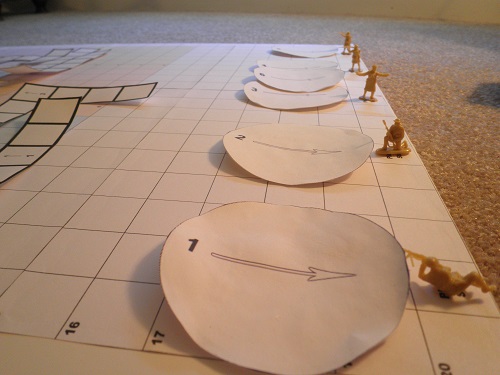
Assuming the worst possible search phase for the players on turn one, wherein each searcher moves directly toward the players, the game ends up here:

Every player has a searcher directly in front of him or her. The only safe moves are sideways.

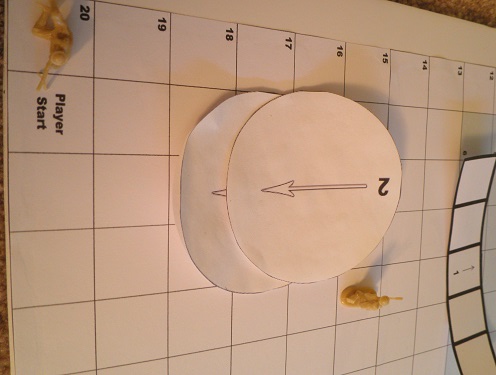
Even at this point, there are actions the players can take. For example, the player on the far left (at the bottom of the pictures) can move sideways and trick the searcher in front of the next player over into following him or her back to the corner. That frees up the next player to save them both:

However, after messing around with it for a little while I don’t think all of the other players can get free. There’s just too much real estate to cover. For the last player in line to save the other two he or she would have to move a minimum of six spaces just to get to searcher #3 (from column 18 to column 12) in front of the middle player, which is impossible. The middle player is in the same boat trying to save the player on the end. The player in between them could free either one, but can’t move far enough to save both. If the player in between saves one then that player can return the favor, but someone is still out in the cold.

If there’s a solution I’ve missed, please let me know. Assuming there’s not, however, the game has a weakness: there is a possible setup in which the players automatically lose. That’s antithetical to the rule for OtND that players should make interesting decisions. In this setup, the players’ decisions are meaningless!

The facts: Under the setup rules as they stand, it is possible for every player to have one or more searchers directly in front of, and immediately adjacent to, him or her after turn one’s search phase. When this occurs it is impossible for all of the players to move to safety during the sneak phase; at least one player will certainly be caught. As a result, when this combination of setup and searcher movement obtains the players are guaranteed to lose regardless of what they do.

The issues:

1. How can the game be altered so that the players cannot be in a situation where all of them have searchers immediately and directly in front of them after turn one’s search phase?
2. Should any alteration be made to address issue #1?

Raising the second issue might seem heretical for a game designer–if there’s a problem, why shouldn’t something be done about it? However, I feel that it’s worth taking into account that this is a focused test to see what happens in a very unlikely situation. The vast majority of players will never encounter this unwinnable scenario; I’ve played OtND many times and it never happened until I intentionally caused it. If fixing the issue turns out to cause more problems than it solves, it may be that the best course is just to let the matter lie.

The rule (for issue #1): Decisions players make during a game of Over the Next Dune must be interesting.

Thinking it through: There are two routes one could go down in giving the players decision-making power in this situation: either the players can be given a new tool that makes the unwinnable setup manageable, or the setup rules can be altered so that the configuration which takes away their decisions can’t occur.

Right from the start I’m not keen on creating a new player power. It adds complexity to the most basic aspect of the game–avoiding and manipulating the searchers–which will make it harder for new players to learn the rules. Furthermore, making the fundamentals of the game more complex will make it harder to add nifty “chrome” elements later. Each additional moving part the chrome has to interact with will add to the difficulty of fitting in the new element, and the more challenging the basic game is to learn the less chrome will be desirable. I think, at least preliminarily, that it will be possible to add to the game in a way that makes for more, and more interesting, decisions; if possible, I want to preserve space for those additions.

I’m also reluctant to give the players a new tool because it could easily have unintended consequences. An option for players that’s perfectly fair when it’s being used to fix the unwinnable setup on turn one might turn out to be be so strong on turn eight as to make victory trivial. Playtesting could find those consequences, of course, but it’s important to prioritize. Testing a player power designed to mitigate a problem that will arise in an infinitesimal fraction of games takes time away from other ideas that will be of greater benefit.

So, what about changing the initial setup? It seems like the ability of the players to make interesting decisions can be preserved simply by moving the searchers back a little bit at the start of the game: In addition to re-rolling 1s on the twelve-sided die that’s used to place the searchers, 12s could also be re-rolled. Under that rule the searchers could get no further than row 18 during the first search phase, which means that they would never be adjacent to and “locking down” a player on his or her starting square. No matter where the searchers start or what they do, each player will always have the chance at a helpful move during turn one and a loss will never be guaranteed.

The weakness of that solution is that while it gives players a little bit of room to breathe, it still leaves them at the mercy of the searcher movement cards. Imagine doing the same test as above, but the searchers start at row 11 instead of row 12 before moving straight at the players. Under this new setup the players would be able to escape into the channels between the searchers. However, those spaces are only safe if the searchers keep going straight or move away. If the players happen to draw a card that angles a searcher closer, that’s it–one or more players get caught. There might be some optimization to do in terms of minimizing the number of auto-lose draws, but that’s only an interesting decision once or twice. (Of course, this whole scenario is so unlikely that it shouldn’t happen to a player more than once or twice over the course of many, many games.)

Other options include setting a flat limit on how close the searchers can get to the players on turn one and altering the searcher-facing rules so that searchers close to the players can’t start out rushing toward them. The former feels arbitrary and intellectually unsatisfying; setting a cap that has nothing to do with the other movement rules is a pretty obvious bodge. The latter, for its part, poses a risk of clustering the searchers at the “top” of the map so as to make the early game boring and the endgame impossibly difficult. I’m not thrilled with either of those options, though they’re on the table for further consideration.

As of now I’m going to put some energy into testing the “re-roll 12s” change. I’ll be looking for those unintended consequences, as well as checking to make sure it actually fixes the problem it was intended to address. More on this next time.

Tidying Up

Over the past week I’ve noticed some things about the blog that were a bit rough around the edges. Today I’m going to take a bit of time to tidy them up.

First and foremost, new rules and a revised print-and-play file are available for Over the Next Dune. These take into account the changes to the communication rules in the last post, and also include some other minor fixes. As always, if you have the opportunity to play the game please let me know how it goes and what I can improve.

Over the Next Dune – Rules – 2-14-14

Over the Next Dune – Print and Play – 2-14-14

Second, I’m revisiting the post on postulates a little bit. On re-reading I felt that it was a bit unclear; there was too much showing of work and not enough organized presentation. The new version will be, I hope, a little bit better.

Third and finally, I’m fixing a couple of typos in old posts. I suspect no one but me cares too much about them, but if you caught them before and can’t find them now, you’re not going crazy. 😉

The Case Study: Communication Rules

Recent posts have been very theory-heavy–and that’s not making progress on Over the Next Dune! Let’s get back into the swing of things by taking a look at a concrete problem that’s come up.

Most of my playtests have been solo games; the solo boardgame market is underserved, and I want OtND to work well in that mode. However, I also want its cooperative play to sing. To that end I’m planning a group playtest in just a few weeks.

In getting ready for that session I’ve been taking another look at the communication rules. They’ve always been a bit bodged together, and now’s a good opportunity to focus on them and get them right.

The facts: Here’s where the player communication rules stand as of the 2/5/14 ruleset (Over the Next Dune – Rules – 2-5-14):

“In general, players may not communicate with each other about the game. (Conceptually, the players are sneaking through the night with Axis soldiers nearby; they cannot have conversations!) Of course, it is perfectly permissible to ask another player to pass the chips or to flip the next searcher movement card. The only thing the players cannot do is discuss strategy.

The one exception is that players may talk at the beginning of the sneak phase about when they would like to move. In doing so, the players may say only when they want to move (e.g., “I want to move first,” “I want to move after Jen”). Players may not say why.”

I believe that these rules are functional; one could play the game this way, and it would work. Yet, they also seem lacking thematically. If the players need to be quiet, why is this discussion OK? It’s a very “game-y” moment where the theme falls away and the mechanics reign.

The problem is exacerbated by the fact that there’s no limit on how much talking goes on. So long as the players aren’t discussing strategy in detail, they can argue endlessly about who moves when. Moreover, the debate is likely to be fruitless since no one can explain why they want to go when they do. Frustration is apt to result.

The issue: What form should the player communication rules take so that unnecessary disputes over turn order are avoided while keeping discussion to a minimum?

The rules:

1. It must not be possible for one player to dictate other players’ actions. Whatever the rules are, they must protect each player’s autonomy.
2. The rules for player communication must reinforce the theme of the game.

Thinking it through: The current rules do a good job of keeping each player separate and allowing them to make their own decisions. The concern is simply that they’re not thematically appropriate. It would be great if we could keep the good while eliminating the bad.

The good here is the limit on strategic discussion. Preventing players from saying why they want to go in a certain order controls each player’s ability to influence the others. Everyone is able to come up with his or her own plan for the turn.

What’s bad is the endless go-round of people arguing over turn order. It breaks the theme and it’s just plain unpleasant. Keeping the discussion of turn order brief will help evoke the feeling of people sneaking quietly through the night and will move the game along at a brisk pace.

So, the best system would be one that limits strategic communication, but still allows players to come to a conclusion quickly. One solution would be to allow just enough strategic discussion to give players reason to accept other views on turn order without allowing so much that one player can lay out a complete plan for everyone.

The most straightforward way to achieve this limit is by imposing a number–“you can say up to three words.” However, any number chosen will be, and feel, arbitrary. There’s no reason why this many words will never get a player caught but one more word does. To make it thematic, the amount of talking should determine the amount of danger.

Danger in OtND is measured, in my experience, by the distance from a player to the searchers and by the future paths of the searchers–searchers far away and facing in the wrong direction are not threatening, while those close and headed straight for you are quite disconcerting! To tie talk to danger, it seems like talking should influence one of those two things.

It would be thematically sensible for talking to affect the searchers’ facing; if a player talks too much the searchers will turn toward the player and move to investigate. However, in trying out a rule wherein the players could attract the searchers’ attention I found that it can be hard to point the searchers toward players when the searchers can only turn 45 degrees at a time. For example, when a player is a “knight’s move” away from a searcher (i.e., one square over and two down), the searcher can’t point directly toward the player. Figuring out when the searcher should face straight down in that situation, and when it should face diagonally down, turned out to be pretty irksome. I’d rather not follow that road again if there’s another way.

If direction is out, what about distance? The rule could be something like this:

“At the start of the sneak phase, the first player chooses when he or she would like to move–first, second, third, etc. The other players then choose in descending order.

Players may give suggestions and discuss these choices. However, each word a player speaks moves the closest searcher one square closer to that player. (To move the searcher closer, move it so that the number of spaces between the player and the searcher’s center square is reduced. If there are multiple places where the searcher could move to to be closer to the player, the player decides which of those squares it moves to. If multiple searchers are equally distant from the player, move them all closer.)”

(It’s true that this rule requires rules establishing who is the “first player.” That’s pretty simple; I’m not worried about that minimal amount of additional complexity.)

Unfortunately, this rule has some immediate problems. First, it could potentially allow a player to dictate to other players, at least to the extent of commanding a turn order. What’s worse, players receiving the message might find it stressful to determine what a cryptic one- or two-word statement means. “You first”–OK, but why? This could be a recipe for nasty post-game arguments about who was responsible for a botched plan.

Furthermore, this rule is vulnerable to being gamed. Two players whose closest searcher is between them could have a complete conversation simply by talking in turns, pulling the searcher back and forth. In all probability that situation would be very rare, but it would be pretty silly when it came up.

Last but not least, this rule still has some thematic issues. Why can players across the map talk to each other as easily as players right next to each other? Why does only one searcher respond no matter how long and loud someone speaks?

That rule doesn’t seem great. However, it indirectly points toward another approach. Rather than limiting discussion by restricting what each player can say, what about restricting who can talk to who? A weakness of the previous rule (players can athematically communicate across the board) could inspire a better solution:

“At the start of the sneak phase, the first player chooses when he or she would like to move–first, second, third, etc. The other players then choose in descending order.

Players may discuss their choices with any other player(s) whose tokens are directly adjacent. They cannot speak to or communicate with other players, or even to players whose tokens are directly adjacent at any time other than the start of the sneak phase.”

(I think this will require a more rigorous definition of player tokens in the main rules, but that’s fine.)

I like this for a couple of reasons. It’s thematic; if someone is right next to you you can whispher to them just briefly, but otherwise you have to stay quiet. Since the players aren’t realistically going to be able to form a big group, no one player can dominate. (I suppose the players could form a bucket brigade of information, but that seems like a difficult, nifty strategy rather than an abuse case that needs to be stopped.) The turn order selection keeps the process moving; two or three players might have a discussion about what to pick, but everyone else will just choose.

Of course, “I like this” is completely different from “this is actually good.” 😉 Only testing can determine whether or not the latter is the case. I’ll report back on this issue when I have more data.