Theory: Show the Score, Part 2

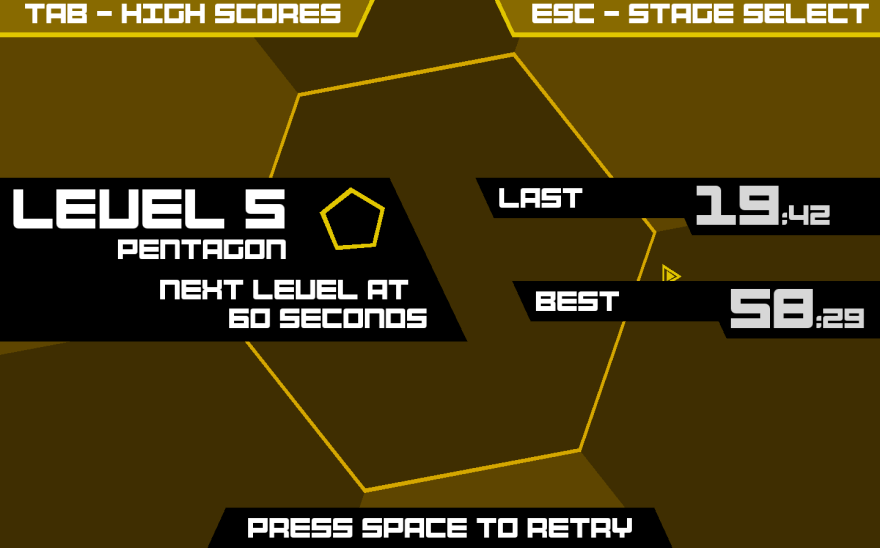
Following up on last time’s post, consider the end-of-game screen from Super Hexagon:
Screen Shot 2016-05-13 at 11.36.47 PM

Every time the player’s game ends, she gets no fewer than three statements of how well she did: the numerical level she reached, the shape she reached, and the number of seconds the game lasted. The latter is compared to her best score, and the game provides information about how to get to the next tier on the leaderboard.

Espgaluda has almost none of that. Players get to see the leaderboard, and that’s it. There isn’t even an appreciable delay before the game switches over to the leaderboard, so that players can check what their score is manually!

If you’re building a high score game, model your end-of-game sequence after the Super Hexagon style. Much of game design is thinking you’re offering enough feedback, and then discovering that you need to give more. That’s as true for scores as it is for anything else; don’t skimp on the score information when play is done.

Theory: Show the Score

A quick lesson I’ve learned from Espgaluda, Cave’s classic bullet hell game: always, always show the player’s final score in a high score game, regardless of whether the player is going to be on the leaderboard. Espgaluda doesn’t pause to tell you your score if you lose without making the high score list, and so one only gets a sense of progress when one reaches a tier on the leaderboard. That’s pretty rough–especially for new players, who most likely aren’t anywhere near a high score but who are learning and could benefit from some positive reinforcement to keep them engaged. Displaying the player’s score gives some valuable extra feedback each and every game.

Embiggen

With the new Marvel movie just out, this is an especially propitious time to try out Embiggen. (Bonus points to those who get the reference.)

Embiggen is a game about being a protagonist. You are a character in a story. You have to face challenges that are tough, but not crushingly so, building up until you become strong enough to overcome your antagonist. Taking on overwhelming challenges will weaken you; so too will bullying opponents who aren’t at least your equal.

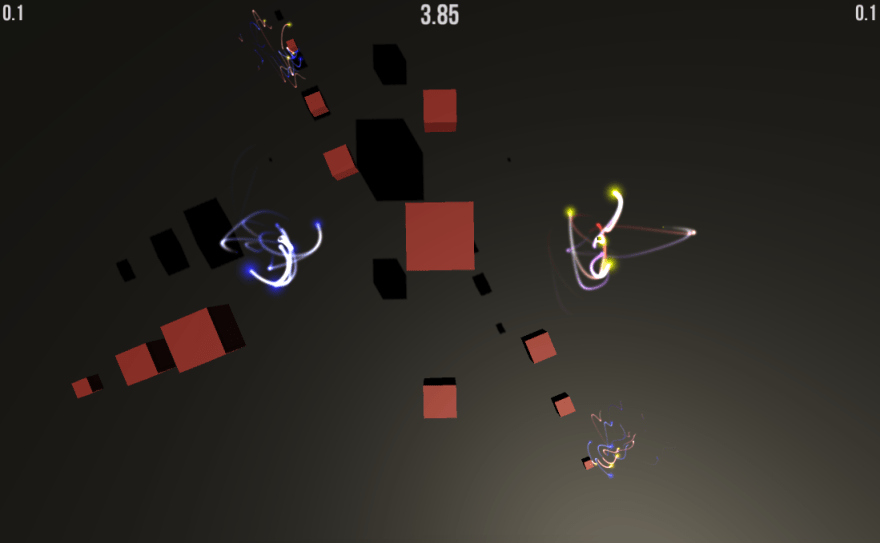
In game terms, you’ll play as one of two spheres, blue or yellow. Collecting red cubes that have a trail of your color causes you to grow. If you contact a sphere that doesn’t have such a trail, you’ll shrink. The game ends whenever the players come into contact; the larger player grows based on the size of the smaller, and that larger player wins.

You can get a high score simply by collecting as many red cubes as possible. To really scale up, though, you need to make your opponent gigantic as well. Every time you collect a red cube, it starts to rotate around you; not only can you use them for defense, you can also contact your opponent with them to increase your opponent’s scale. That way they’ll be more valuable when you ultimately collect them.

Embiggen is very much a prototype, and it shows in weird behaviors. For example, it’s entirely possible to grow, suddenly be in contact with something that shrinks you, and immediately become smaller than you were at the get go! In addition, Unity is a bit touchy when it comes to controllers, and while there are some debug controls it’s not currently possible to play the game fully with them.

Nevertheless, Embiggen has led to some very interesting gameplay. I hope you’ll give it a try, and let me know what you think.

Embiggen is for Mac, and requires two PS4 controllers.

Intentional Draws Revisited

The perennial challenge of intentional draws just reared its head again, this time in FFG’s X-Wing. I can’t say whether FFG was right or wrong to decide to allow intentional draws; in some ways it comes down to the message they want to send about whether X-Wing tournaments are intended as an extension of casual play or as a separate, competitive way of interacting with the game. What I find more interesting is the following passage in the tournament rulebook:

During Swiss rounds, players may intentionally draw a game so long as a leader is present for any discussion between players prior to the agreement. The leader’s presence is required to prevent any breach of the tournament’s integrity. The leader will not intervene as long as players follow the “Unsporting Conduct” on page 3.

This is an interesting approach to the problem of intentional draws, one that solves some problems while creating others.

First, for reference, here’s the relevant portion of the unsporting conduct passage:

Players are expected to behave in a mature and considerate manner, and to play within the rules and not abuse them. This prohibits intentionally stalling a game for time, placing components with excessive force, inappropriate behavior, treating an opponent with a lack of courtesy or respect, cheating, etc. Collusion among players to manipulate scoring is expressly forbidden. Players cannot reference outside material or information during a round. However, players may reference official rule documents at any time or ask a judge for clarification from official rule documents.

What’s potentially good

Having a “leader” (what in some systems would be called a Tournament Organizer or Judge–someone with rules authority) present has the potential to address concerns about bullying or hassling opponents into accepting an intentional draw. Theoretical arguments in favor of permitting draws generally revolve around the idea that players should be free to do what makes sense within the confines of the tournament structure. A leader’s oversight will hopefully keep the discussion on the ground along such tactical lines.

An official presence also serves to avoid misunderstandings. I remember being presented with a weird hypothetical situation years ago: two players reach differing conclusions about the board state in a game, each concluding that they are sure to win. One silently offers a hand, thinking she is offering a draw. The other shakes in the belief that she was conceding. While that is obviously an extreme situation, there is a lot to be said for a leader clarifying all agreements before results are reported and it becomes difficult to handle a problem.

What’s potentially bad

Understanding how the new rules work demands some analysis. Most intentional draws, after all, are efforts to “manipulate”–or at least change–the tournament scoring. On the face of it, then, the intentional draw and unsportsmanlike conduct paragraphs seem to conflict.

I would argue that the problem is resolved easily enough. Merriam-Webster defines “collusion” as “secret agreement or cooperation especially for an illegal or deceitful purpose.” FFG doesn’t define collusion in the rules document, so we can justifiably fall back on the dictionary definition; in the absence of an explicit statement, we can assume that words carry their normal meanings. With the dictionary definition in mind, it’s clear that the unsportsmanlike conduct passage prohibits secret agreements–e.g., intentional draws worked out away from a leader. The passage is reinforcing the requirements for intentional draws.

Even given that the apparent conflict is resolvable, though, it’s unfortunate that the rules are written in such a way as to allow this question to arise. It would be good to clarify exactly where the boundary between valid intentional draws and improper collusion lies.

Another question is what constitutes a “breach of the tournament’s integrity.” Including that phrase separate and apart from the reference to the unsportsmanlike conduct policy implies that it means something other than what the policy contains. What, though? If the unsportsmanlike conduct policy is not a complete statement of what the leader is there to deal with, the additional requirements would benefit from being laid out clearly; if it is, there’s no need for the possibly-confusing extra verbiage.

An unusual solution

FFG’s approach to intentional draws is, to my knowledge, unique. It’ll be interesting to see what comes of it; I’ll be keeping an eye out for further developments. In the interim, I would encourage FFG to address the issues noted above; with just a little tweaking the policy could be a lot more clear, and thus enjoy the best possible odds of success.

This Week: Some Small Prototypes

I feel like I should have lots to talk about. After all, I’m working all the time. 😉

Unfortunately, all of the work is very much at the “in progress” stage. There’s plenty going on, but it’s foundational. Games will emerge down the line . . . when these projects are much further along.

In the interim, getting to post Pray for Rain was a lot of fun. Over the course of this semester I’ve done a bunch of prototypes of similar or slightly smaller scale, and I’ll post a few of them over the coming week. Some of them taught me some very interesting lessons; hopefully they’ll be of interest to you as well.

So, my apologies for the rather brief posts recently, and brace yourself for some slightly silly, slightly buggy, and generally offbeat micro-games. 😉