Lines of Questioning: Tiles with Text?

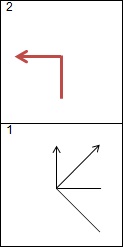
Right now Lines of Questioning uses simple tiles with prominent arrows. They’re unexciting, but very easy to read during play.

11-5-14 - Lines of Questioning - Tiles with ArrowsWhen I first had the idea that’s evolved into Lines of Questioning, I envisioned tiles that were a little more interesting. They would actually have a line of questioning on them, with the text indicating where the tile began and ended. Something like this:

11-5-14 - Lines of Questioning - Tiles with TextAs I work on the game, I’ve become torn on this kind of tile. On the one hand, these bring more thematic power, and theme is central to Lines of Questioning. On the other hand, the arrows have an immediate clarity that text lacks. Players will have to invest more effort in processing these tiles, and may not find it easy to tell where the line ends when the board state is complex.

My preferences in art run toward ink paintings, pencil sketches, and other monochromatic works, so I know that I have a pre-existing bias toward the bold, black-and-while arrows that might be coloring my opinion. For that reason–and because I’m not a graphic designer, and am far outside my comfort zone–I’d like to throw the question of the tiles open for discussion. Arrows? Words? More color? Less? Let me know what you think.

Lines of Questioning: Halloween Variant

There’s a lot of costuming that goes into being a lawyer. Attorneys have differing opinions on what to wear in the courtroom; some want an extremely conservative, formal look that can’t offend anyone, while others aim toward a striking appearance that makes one the center of attention. Much effort is put into defendants’ clothing, especially in criminal trials, and most especially when the defendant is being held without bail and doesn’t have access to his or her full wardrobe. Everyone in the courtroom is on display to a greater or lesser extent, and dresses accordingly.

Since it’s Halloween, how about a Lines of Questioning variant that deals with the rare–but memorable–occasions when courtroom costuming goes wrong?

Unprofessional Attire

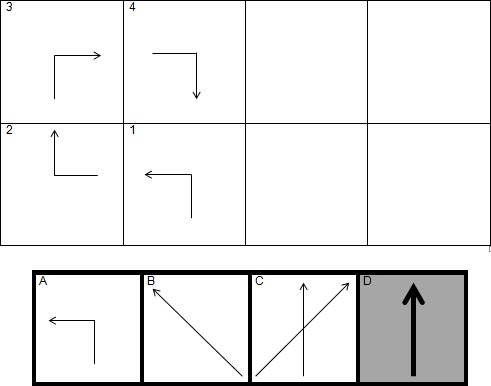
Whenever a tile is played in the line of questioning that is not adjacent to the last tile in the witness’ line of answers, flip a coin. If the coin comes up heads, the just-placed tile becomes the last tile in the line of questioning as normal. If it comes up tails, flip the just-placed tile face-down; the space it was played in is open for both types of tile, and the line of questioning does not advance. (Use the last face-up tile in the line of questioning as the last tile in that line.)

On a busy trial day it can be hard to take as much care with one’s clothing as one should. Hurrying lawyers have been known to let their ties fall into the sink, or to drop their lunch in their laps. To make matters worse, courtrooms are often old and somewhat battered, with bits and ends that can snag and tear. I remember one attorney ripping his suit jacket on a nail head protruding from the courtroom doorway moments before opening arguments.

Not only are these situations embarrassing, they can cause a tactical problem. The jury is might well be distracted as they try to figure out what left a stain that sickly shade of green. It can be hard to keep them focused, and if the jury isn’t listening then the critical facts the lawyer is bringing out are apt to go unheard.

This variant seeks to capture that dynamic by making it harder to advance the line of questioning. As long as things are interesting and seem to be rolling along, represented by the lawyer and witness playing tiles close together, the jury stays engaged and everything is fine. If matters bog down, however, the jury’s attention wanders and the attorney starts having to go over the same points to make sure the jury heard them.

From a game design perspective, I like that this variant introduces uncertainty into whether the line of questioning will progress. Normally the question is where and how the line advances; a failure to move forward at all is a new and different problem, one that I think will change how the line of questioning is built. Is it now best to keep it in the middle, so as to avoid having the line “stall out” along the edge? Perhaps it would be better to just let the line of answers take the lead, using the line of questioning to shore up the corners as it can? It’s a fresh problem, and the novelty brings some additional interest to the decisions.

As always, I’m curious to hear your experiences with this variant. If you get a chance to try it, let me know. I’ll be testing it as well, and will get back to you with the results.

Happy Halloween!

Theory: Include “How to Start” In Your Rules (and a Lines of Questioning Update)

I’ve done a thorough revision of Lines of Questioning’s rules based on current feedback. (you can find the new version here). The full changelog is below, but there’s one I feel is especially important: the rules now explicitly state how to start the game. Few “modern” board games (or whatever term one wants to use) do that, but I think it’s important. Saying “here’s what to do to kick things off” really helps people who have less experience with board games as a whole.

I learned this the hard way years ago, when some friends and I were just getting into board games and decided to try Shadows Over Camelot. Shadows’ rulebook does what many games do: it explains the steps one takes during a turn, and assumes it will be clear that to start playing one just launches into those steps.

For my friends and I, that assumption did not hold true.

Let me set the stage for you. In the room are two law students (both of whom are now lawyers), a Ph.D. student (now a scientist), and an engineer. All of these people have at least a passing acquaintance with board and role-playing games. Every single page of the rulebook has been read out loud. The engineer says “OK . . . how do we start?”

There’s a pause.

Rulebook pages flip.

A cricket starts chirping.

In retrospect, this was completely hilarious. A cricket chirped during an uncomfortable silence! It was a perfect sitcom moment, in real life! The whole thing was worth it, just as a story!

However, from a rulebook design perspective this was a disaster. After thoroughly perusing the rules, the players didn’t know how to start playing. Shadows Over Camelot almost went back in the box without so much as being tried. (Which would have been a shame–my friends and I went on to have many hours of fun with the game.)

Among the skills board gamers learn is reading board game rulebooks. We gain the ability to take rules and translate them into what the game looks like during play. In the process, we learn to make certain leaps: if the game proceeds in turns, and every turn begins with X, we should start the game by doing X.

New board gamers don’t have that rule-processing skill. Help them out by spending a line or two explaining how to start playing. They’ll appreciate it, and their positive experiences will come back to you in repeat customers and positive reviews.

– – –

Other changes:

– The numbered tiles have been removed; they added some complexity without a concomitant improvement in gameplay. With that change, the goal is now to proceed around the board clockwise, building a stack of tiles four-high (with an answer tile on top) in each of the four corners in sequence.

– The rules were changed to clarify that when an answer tile is played on top of the last tile in the line of questioning, that does not cause an answer tile to be added to the question hand.

– Being unable to play a tile when you need to do so is now a loss condition (this fixes a bug with the Something to Hide variant, in which it was possible to need to start a new line of answers but be unable to do so).

– Many rules have been rewritten and reorganized to make the game easier to learn.

Lines of Questioning: Adding Difficulty

The more I play Lines of Questioning, the easier it gets. That’s a good thing–but like so many good things, it means more work. 😉

I’m pleased to find Lines of Questioning getting easier because it suggests that the game’s decisions are meaningful. If they weren’t–if all paths were equally good, and the player’s in-game choices were largely irrelevant–one would expect win rates to be constant over time. A win rate that improves with experience indicates that players can influence their chances of victory by learning to make better decisions, which necessarily means that those decisions matter.

However, the fact that skill is rewarded is a two-edged sword. It also means that the game could become less enjoyable over the long term, as players attain greater levels of mastery and the challenge wanes. This is where the work comes in: it’s necessary to provide ways for players to crank up the difficulty.

Fortunately, there’s no need to start with a blank slate. Lines of Quesioning’s fundamental design rule is that the game should evoke the experience of a lawyer questioning a witness. That rule doesn’t need to be treated solely as a constraint; it can also be a source of inspiration. If the game should be more difficult, and needs to capture an experience, what’s a more difficult version of that experience? What are some situations where it’s harder to get necessary information from a witness?

– the witness lacks some key information

– the witness lacks some key information–and doesn’t want to admit it

– the witness is consciously hiding something

– the witness is wrong about something, and the lawyer must demonstrate that, preferably getting the witness to agree

– the witness wants to say something, and is inclined to blurt it out even if it’s not germane to the questions being asked

– the witness is being offensive to the judge and/or jury

– the witness gives lengthy answers that obscure the point

– the witness gives lengthy answers that unnecessarily give opposing counsel material to work with

– the witness responds to an important question by invoking the Fifth Amendment right against self-incrimination

– the judge is in a hurry

– the jury is distracted

That’s a good list to start from. It includes a number of situations that both make the lawyer’s job more difficult and are interesting to deal with; since “difficult” and “interesting” are exactly what Lines of Questioning needs, they have a lot of promise. I’m especially gripped by the notion of simulating a witness with something to hide, or who’s lying and has to be brought around to the truth; both situations are challenging and fascinating in the courtroom, and–if properly implemented–could bring those same traits to Lines of Questioning’s play.

Proper implementation is, of course, the tricky part. I’m going to try this first:

Something to Hide (a variant for players seeking a greater challenge)

Randomly choose one of the corner spaces. Answer tiles cannot be played in that space unless they are played directly on top of a question tile. If the witness must play in that space (e.g., because the witness’ line of answers cannot continue), the witness instead plays on the next unclaimed corner.

My thinking about this rule goes like this: Testing has shown that hemming in a corner with answer tiles and then ending the line of answers is a powerful strategy. It causes the line of answers to restart in a corner, have nowhere to go, and restart again in the same place the next turn, building up toward claiming the corner. This rule makes that approach much more difficult, since the line of answers will now “escape” the corner.

In addition, the rule has thematic appeal. Requiring that the tiles come out in layers, question-answer-question-answer, suggests that the witness will only talk about his or her dark secret after the lawyer asks directly about it, and won’t expound further on the point until the lawyer asks a follow-up question.

Of course, testing may reveal that this isn’t the change we want. There’s only one way to find out!

As always, I hope you’ll join me in trying this change. You can find the print-and-play version of Lines of Questioning, with the base rules and everything you need to play, here:

Lines of Questioning – 10-14-14

Cutting everything out takes less than half an hour, and the game plays in 15 minutes.

Lines of Questioning: FAQ Updates

I don’t know if a picture is really worth a thousand words–as a lawyer, I’m kind of partial to words–but I can’t deny that sometimes a diagram is called for. Explaining Lines of Questioning’s movement rules is one of those times, so I’ve added a bunch of diagrams to the FAQ posted below.

Behind the scenes I’ve been hammering away at a web implementation of the game. Currently it’s just a web-based version of the real-life experience, all placeholder graphics and built-in GUI buttons, but it’s playable. I’ll keep at it, and hope to have . . . let’s call it an alpha release . . . before too long.

Lines of Questioning: FAQ

I thought it would be useful to share the answers to some questions that have come up while playtesting Lines of Questioning:

Q. Some tiles have two entrances and two exits/arrows. Do I need to go “straight” from the entrance to the arrow across from it?

A. Nope! It’s OK to turn and place the next tile using the other arrow.

When there are multiple exits, you only have to use one . . .
. . . and you can change directions rather than following your previous path

Q. Regarding the tiles with two entrances: do they need to have arrows pointing to both exits in order to place them?

A. No; choose one to use to keep the line going, and ignore the other.

Tile 3 is legal; it is not necessary for both entrances to be used

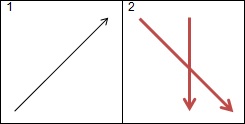
Q. Can I keep a line going by “bouncing” off the edge of the board with a diagonal arrow?

A. Yes! It’s perfectly OK, and often tactically useful, to do this. In fact, it can be required for the witness’ tiles; sometimes this will be a way to keep the witness’ line going.

Tile 2 is a valid way to continue the line from tile 1

Q. The difference between how the lawyer’s tiles and the witness’ tiles are placed is kind of confusing.

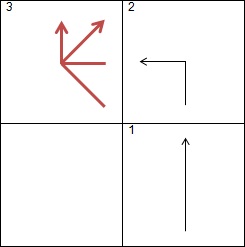
A. For both, you have to keep the line going if you currently can. When putting down a tile from the lawyer’s hand in Step 1, it is OK to choose a tile that will make it impossible to keep the line going next turn. When putting down a tile from the witness’ hand in Step 3, you must–if possible–choose a tile that currently leads to at least one space where the witness will be able to play next turn. If none of the tiles in the witness hand will do that, you can choose any of the tiles in the witness hand to play.

These diagrams show some common (and not-so-common) situations, and how they work:

10-24-14 - Lines of Questioning - Choice of Tiles 1If this is the lawyer’s hand, you could play A or C. A will end the line of questioning by running into the edge of the board, but that’s fine.

If this is the witness’ hand, you must play C. The diagonal exit makes it possible for the witness to continue into space 3. You would have to play C even if you did not already have a tile like B that could continue the line; it is enough that C leads to a space where the line could theoretically continue.

10-24-14 - Lines of Questioning - Choice of Tiles 2The lawyer in this example is almost stuck–but has one of the witness’ answer tiles in her hand. Since answer tiles can play over question tiles, you must continue the lawyer’s line of questioning by playing the answer tile (D) in space 1. You must do this even though it will necessarily end the line of questioning.

10-24-14 - Lines of Questioning - Choice of Tiles 3None of the tiles in the witness’ hand can be used to extend the line into space 3 such that the witness will have somewhere to play the following turn. You still have to continue the witness’ line of answers into space 3, but can choose which tile to play.

On the next turn–assuming no answer tile is played that makes continuing the witness’ line possible–start a new line for the witness in the corner with the number tile you are currently working to claim. (Yes, it’s legal to choose tile A so as to guarantee that it will not be possible to continue the witness’ line. Shifting the lines around the board is part of the fun!)

Lines of Questioning: Behind the Rules

Although Lines of Questioning looks like an abstract, it was inspired in many respects by my experiences in and around the courtroom. Both in overall structure and specific rules, it seeks to put players in a lawyer’s shoes, bringing out the excitement–and the challenge–of examining a witness. In particular, Lines of Questioning asks players to confront a key courtroom dynamic: the attorney’s limited control over the witness’ answers.

(Before going on, I just want to offer a reminder that nothing here is legal advice. I’m going to talk about some legal principles based on my own experience, but that experience does not extend across, and is not applicable to, all jurisdictions and issues. If you have a question about how the law impacts your own life, absolutely do not rely on what you see here! Contact an attorney who can help you directly; the disclaimer page has more about how to get started.)

When a lawyer questions a witness, she generally has a set of goals. These might be facts for the witness to admit (“yes, I took a bag of money in a dark alley”), opinions for the witness to give (“the probability of that happening is less than 10%”), or just statements for the witness to make (“anteaters are weird”). Each of these goals is a brick the lawyer plans on using to build toward the desired outcome in the case.

The difficulty is that the witness is not a puppet. Witnesses have their own goals. They might want to hide embarrassing facts, or at least be uncomfortable addressing certain issues in public. On the flip side, they may want to help–and be willing to depart both from the questions asked and the rules of evidence to make sure the jury hears what the witness thinks they really need to know.

More subtly, witnesses may shade their answers, trying not to lie but also not telling the entirely unbiased truth. Even a witness who considers herself an honest person knows that she has been called by a side, and the psychological urge to help that side can be difficult to resist. One of my law school professors, a litigator of great accomplishment, opined that “every witness lies;” in his view, the adversarial nature of court proceedings almost compelled witnesses to adopt a fighting-for-my-side mindset, and to answer questions accordingly.

Even a completely honest witness can present challenges. Fading memories may undermine witnesses’ recollection of vital facts. Attempts to recount stressful or frightening situations are made more difficult by the emotion of the moment. (Studies have shown that, contrary to popular belief, scary situations are not “etched into” memory; we tend instead to focus very specifically on the danger, and our unconscious minds manufacture other details later based on what we think must have happened.). Sometimes witnesses just misspeak, get confused, don’t understand a question, or otherwise throw up roadblocks even though they are making a good-faith effort.

I chose Lines of Questioning’s play-both-sides structure because I feel that it captures the interplay between attorney and witness. Skillful questioning gives some control over what the witness says (represented by allowing the player to choose the witness’ tiles), but can only get responses that the witness is willing and able to give (represented by the limited choice of tiles available at any particular time). Just as would be true in the courtroom, LoQ’s players set goals and attempt to direct the the witness, but have to be ready to work with what the witness gives them.

Currently the available “question” tiles are also limited. This is a departure from Trust Me, which made all question pieces available for thematic reasons; if the player is the lawyer, why shouldn’t she be able to ask any question at any time? I went in this direction for two reasons:

1. It led to better gameplay. Trust Me devolved into an exercise in finding the optimal choice. By having only a limited range of options, and being uncertain about what options will be available in the future, it is enormously less likely that there will be an identifiable strictly-best move in Lines of Questioning. The choice of what to play now involves a complex weighing of competing factors–the desired length of a line of questions (or answers), how the tile moves the line relative to one’s objective, whether a placement will run the answer tiles out more quickly, and more–all in a constantly-changing environment. It’s extremely difficult–perhaps impossible–to sort that out so as to be able to say that one option is clearly better than the others, and so the decisions are enormously more interesting.

2. It’s not strictly true that a lawyer can ask any question at any time. From a rules-of-evidence perspective, some questions are disallowed except under specific circumstances. From a strategic perspective, jumping from topic to topic will quickly frustrate the jury. Limiting the available question tiles seemed like a good way to represent these contextual restrictions on what question a lawyer can ask next.

So far I’ve been satisfied with Lines of Questioning’s overall structure. It both plays well and feels right. The mechanics and theme reinforce each other, and the experience is stronger as a result.

Of course, that structure needs to include an end point–and legal realities impacted Lines of Questioning in that area as well. Victory, in the game as in the courtroom, requires the lawyer to meet her goals by building up to and getting key statements. The vertical aspect of LoQ’s play was directly influenced by the “building up” metaphor, with the lawyer getting more information about a topic until finally the key fact is revealed or the critical statement made.

Sometimes the attorney never gets there, however, and LoQ needed to include the possibility of defeat. A lawyer in the courtroom might fall short because because the witness doesn’t have important information, or because the witness is avoiding questions and otherwise being recalcitrant. The judge might simply decide that the amount of time being spent is not commensurate with what the witness has to offer, and tell the attorney to wrap it up. These possibilities are reflected by having the player lose when tiles run out; if the witness tiles are exhausted she has nothing more to say, and if the lawyer tiles are depleted the questioning has taken too long and the judge instructs her to move on.

LoQ’s strangest rule–drawing witness answer tiles into the question tile hand–also got a lot of thematic input. A product of both gameplay and thematic requirements, this rule solved two problems in a single blow and has turned into something pretty neat.

From a gameplay perspective, LoQ benefits from giving the player more control over the course of the game. It lends a good narrative flow; the player starts out weak but with lots of time, and ends up strong but needing to hurry. As I worked on the game I was looking for ways to ramp the player’s capabilities up as the game went on.

From a thematic point of view, I wanted to capture the push and pull between lawyers and reluctant witnesses. When witnesses evade questions, they deny lawyers the information they’re asking for. However, they risk giving lawyers power; a lawyer who needs help getting straight answers can appeal to the judge for assistance, and the judge can require the witness to respond accurately and concisely. Ironically, then, evasive witnesses can end up admitting more than they would have if they had just been frank, since lawyers may end up asking them pointed questions with the judge’s backing. This dynamic is interesting and in some respects counter-intuitive, and I very much wanted to represent it if I could.

Putting answer tiles in the “lawyer hand” addressed both needs. Giving the player-as-lawyer the ability to use answer tiles builds up the player’s control by making it easier to direct the line of questioning, to play over existing tiles, and ultimately to claim the objectives. Having the player gain those tiles only when the witness tiles are being placed far away–conceptually, when the witness is off-topic–enabled this mechanic to represent a lawyer’s ability to get a damaging admission out of an evasive witness.

Admittedly, not every rule in LoQ is driven by theme. There’s no thematic reason why hands are three tiles, or why the board is four squares on a side–those are driven strictly by gameplay needs. Still, I’ve tried to pack the game with the feeling of the courtroom, even in its small details. (Don’t get me started on the back-and-forth I’ve had with myself over whether it’s more or less thematic for question tiles to be removed when a line of questioning ends. 😉 ) If you get a chance, give it a try and let me know what you think. An updated PDF is below.

Lines of Questioning – 10-14-14

Lines of Questioning

As promised in last week’s comments, here’s a print-and-play version of Trust Me’s successor, Lines of Questioning:

Lines of Questioning – 10-13-14

Lines of Questioning is a solo board game that tries to capture the experience of questioning a witness in the courtroom. You know what you need the witness to say, and you have some control over what the witness talks about . . . but witnesses aren’t puppets. They have their own views and agendas, and you’ll need to work with what the witness gives you in order to win.

Over the Next Dune taught me that big print-and-play files are off-putting, so Lines of Questioning is very lean. The file linked above has both the rules and the stuff to cut out. The game ‘s components just barely extend onto four pages, and you can have the whole game ready to go in 15 minutes or less.

Many aspects of Line of Questioning were informed by my own experiences in and around the courtroom. On Wednesday I’ll talk a little bit about how I imported legal rules–and legal realities–into the game.