Theory: Mapped Endgames

Many games come to a point where one player is in control, and will win if she can avoid missteps. While such mapped endgames are to some extent scripted, they can still be fun. The keys are to use those last moments as a reward for previous displays of skill, and to keep them short.

“Mapped endgame” is a term that I feel captures the common situation in which a player sees what he needs to do to win, and is completely in control of whether or not he is ultimately successful. The other players cannot stop him; he will only lose if he makes a mistake that lets them back into the game. The situation is “mapped” because the player knows what course to take to reach victory.

It’s important to recognize that in a mapped endgame, the player is still making decisions and those decisions still matter. Falling dominoes are not a mapped endgame. The person setting up the dominoes has relinquished control at that point; much like the final cinematics at the end of a video game, the gameplay (to the extent that setting up dominoes is a game, a definitional issue which needn’t detain us here) is already over. Mapped endgames occur while the game is in progress, and require the player to keep things on course.

While this may smack of autopilot, mapped endgames can be interesting and even exciting. Even if one is clearly going to win a car-racing game, the rush of speed can still be thrilling. A close-fought strategy game can reach a mapped endgame yet still be tense; the player in the dominant position has to make every move precisely correctly while the opponent(s) choose positions from which they can best take advantage of the slightest weakness.

Of course, a mapped endgame done wrong is a painful grind. The winning player acts by rote while the other players suffer through irrelevant decisions. Concessions become likely as everyone starts to agree that the game is “really” over even if there’s technically more to do.

Fortunately, it’s easy to distinguish good mapped endgames from bad ones. The good ones–the ones that will be fun and interesting as players go through the final moves–follow two design rules.

1. A fun mapped endgame is a reward for skilled play. Tichu was the first game where I saw mapped endgames consistently enough to recognize them as a distinct element in a game’s design. Despite happening often, though, Tichu’s mapped endgames aren’t boring. Rather, they’re hard-earned payoffs.

For those who have never played, Tichu is a card game with some similarities to Hearts. Players go around and around the table playing higher-value cards and sets of cards, with the highest winning all the cards played. While certain cards are worth points, the big gains come from predicting at the start of the hand that one will be able to play all of one’s cards first–and then successfully doing it.

Of course, it’s not easy to make those called shots. Doing so requires a strong hand, but even more than that it demands constant attention and the ability to think several moves ahead. Making several strong plays early can leave one’s hand too weak to finish out; failing to track the cards being played can leave one uncertain about whether someone still has the ace that will beat one’s king. Going out first with other players dedicating their entire hands to preventing it is demanding to say the least.

Fortunately, the effort involved is well-rewarded. Putting the available information together to figure out what’s in the opponents’ hands, and then determining the exact right order in which to play one’s cards, creates a feeling like one has had a little taste of enlightenment. The endgame is completely mapped out, but the player drew the map herself, and every step along its indicated path is a vindication of the player’s effort.

Tichu’s mapped endgames, then, are a part of its fun. The player worked hard to reach the top of the mountain, and now gets to stand on the summit. Even if one is just going through the motions, the ease of the final moves marks out as special the difficult work that went before.

2. Mapped endgames should be brief in real-world time. Power Grid is a great game with one flaw: it can involve a mapped endgame that is completely joyless. The problem is not that the endgame is reached too early, or that it can be reached without skill. Rather, the issue is that it just plain takes forever.

In Power Grid every player controls an electric company, with the goal of having the largest network of cities. There are random elements in the game, but for the most part the results of one’s actions are completely predictable. Expanding to city A will cost $B and earn $C; expanding to X will cost $Y and make $Z.

Early on and for most of the game, there’s enough going on to make putting a fine point on those calculations largely unnecessary. Expanding to A might earn $2 more than expanding to X, but another player is heading toward X and it might be worth shutting him out. Then there’s the possibility of expanding to J, which would open the way to an area where no one else is operating. If nuclear energy becomes cost-effective all three of those might easily be within reach, and the question will be whether expanding to cities R, S, and T is worthwhile. Play keeps moving because the players are thinking about these big-picture concerns, and don’t need to spend time optimizing each move.

Unfortunately, that dynamic falls apart on the very last turn. If the last player to move is in a position to win, then that player will have no uncertainties to weigh or long-term plans to take into account. All she will have to do is find the single best move currently available.

That might sound simple, but a great many things factor into that decision: cash on hand, the number of cities one’s company can power, the state of the market, other players’ possible moves, etc. As a result, this last turn can take an enormous amount of time. I played a game of Power Grid in which the last player took half an hour for the last decisions in the last turn–and, given the number of things to consider, was justified in doing so.

Power Grid’s mapped endgame is one turn long, perhaps only one phase of one turn. It is, nevertheless, boring, because it plays out so slowly. Other players just sit and wait while the last player tries every possible combination of actions to make sure she has found the best one.

What’s worse, the time the other players are spending is just time waiting to see if they get clobbered. There’s nothing they can do to change which move is best, or to stop the last player from finding it. They just have to wait to see if she does. And wait. And wait.

It’s worth comparing Power Grid’s mapped endgames to Tichu’s. Once a player knows what to do to win the hand, the process can play out in seconds. Everyone realizes that that player is in control, makes the plays they have to make, and the hand is swiftly over. Play then resumes with a new hand that puts everyone back in the game.

I still play Power Grid, and I enjoy it every time. I’ve met people who won’t and don’t, however, and it’s often because they don’t want to sit through that last turn. Given how frequently I run into people with that viewpoint, I’ve come to feel that it’s important to avoid replicating the misstep in Power Grid’s design, and to make sure mapped endgames play out quickly.

Mapped endgames can be like Tichu’s, a fun interlude. They can also be like Power Grid’s, an unfortunate and off-putting artifact of a game’s design. To keep your game on the right side of that line, stick to the two key rules: make players earn mapped endgames, and keep them short.
Lines of Questioning: Playtesting Update & Possible Rule Change

The law has been gobbling up my time, so just a short update today. Playtesting on Lines of Questioning is continuing apace. Several variants have been shot down, but each one has provided useful information. In particular, they’ve consistently shown that the change intended to discourage repeated two-tile lines is working well.

That change concerns how the lawyer’s lines end. Currently, the rule is that one checks whether the lawyer’s line can continue at the beginning of step 1 of the turn; if not, the lawyer’s tiles that are topmost in their respective squares are removed and a new line begins. The new rule is: check whether the lawyer’s line can continue at the end of step 2. If not, the line ends immediately and the lawyer’s topmost tiles are removed. After this happens, start a new lawyer’s line the next time you reach step 1.

“Whether the line can continue” means, in this context, whether the lawyer could make another play right at that moment. It’s not sufficient that by the time step 1 comes around again the lawyer would be able to place another tile; the lawyer needs to be able to legally place another tile at the end of step 2, or the lawyer’s line ends.

If you get a chance, try this out and let me know how it goes!

Lines of Questioning: Learning from Failed Experiments

I’ve been getting a great deal of playtest feedback on Lines of Questioning over the last few days. As always, that’s both very exciting and a source of new challenges. Feedback highlights problems, which then demand new solutions.

Previous playtesting revealed two issues with Lines of Questioning:

1. The lawyer’s tiles are handled differently from the witness’ when lines end; this makes learning the game more difficult.
2. Picking up the lawyer’s tiles sometimes feels bad, as though the player’s effort has been wasted.

My hope was that these could easily be fixed by leaving the lawyer’s tiles on the board when the lawyer’s line ends. The two types of tiles would be treated similarly, and the feed-bad moment would be gone. Further testing suggested that the change made the game easier, but that could be all right.

Unfortunately, as testing continued some dynamics that weren’t all right started to appear. “Seeding” every corner with a lawyer’s tile had become risk-free; Where once setting down lawyer tiles that the witness would not reach for some time courted disaster if all of those tiles were removed, now that work was guaranteed to stick around. No-risk progress made the game quite a bit less exciting.

What was worse, it became clear that the lawyer’s and witness’ lines could be run completely independently. With removal, players needed to use the witness’ tiles to “lock in” the lawyer’s tiles. That created a tension between separating the lines (to get each where it most needed to go) and keeping them together (to avoid losing progress). Without removal, that tension–and the decisions it created–were gone.

No-risk seeding of lawyer tiles and independent lines worked together to create a third unpleasant dynamic: the lawyer’s lines grew shorter and shorter. With no incentive to keep lines going (and the opportunity to reposition as a strong incentive to end them instead), lawyer’s lines trended toward two-tile affairs. The first would be placed next to a corner, and the second would end the line in the corner. Since the line had ended, the player could then start a new lawyer’s line adjacent to the following corner and repeat. This approach was effective while completely undermining the fun of wrangling the lawyer’s line–and “good yet unfun” is never a combination a game designer wants to see.

Since a number of playtesters had said that they’d like to see a no-removal design, I decided to keep hammering on the idea by taking out the off-topic witness answer mechanic. The idea was that without the ability to play answer tiles, the lawyer’s tiles would build up and ultimately become a hindrance unless the player brought the lines together, solving the independence problem. In addition, that version of the game would lack the two hardest rules for new players.

Unfortunately, that approach also turned out to have serious problems. First, the lawyer tiles didn’t build up enough in practice to force the lawyer’s line toward that of the witness. The lawyer and witness could still play independent games.

A second, new problem also started to crop up: it became increasingly clear that there were situations in which the lawyer was worse than useless. Once every corner with an unrevealed fact had a lawyer’s tile on top (which would never be removed), the lawyer could not contribute to scoring and just had to stay out of the way. That was interesting, after a fashion, but hardly thematic; in a game about an attorney questioning a witness, the attorney wasn’t participating in the questioning!

The “base” game, without these modifications, also has endgames in which the lawyer’s best move is to stay clear. However, the off-topic answers mechanic means that those situations end very quickly as the witness’ stack of tiles runs down. Without that mechanic the lawyer might have to keep to herself for quite a while, which made the strategy unpalatable.

Faced with these results I decided to revert the game to its original state. Removing lawyer tiles had turned out to be more important to the game than I had realized, and I was ready to get back to a version of the game with that rule in place. However, even after resetting the changes I felt the experiments had highlighted two points that should be addressed:

3. Seeing the proliferation of short lines emphasized to me how often they appear in general. A standard opening, for example, is to have both lawyer and witness begin next to a corner. The lawyer then gets into the corner and the witness follows; even if the lawyer’s line ends, the player has locked in two tiles in a corner. Quick two-tile lines of this sort are easy to set up, have little cost, and are prominent in the lawyer’s game even when removal is in effect. They’re teetering right on the edge of “good yet unfun,” and should probably be weaker.
4. While it’s thematic for the lawyer to hem the witness in, it’s not good when the lawyer sets the trap and then has nothing to do during the endgame. The lawyer needs to be more involved in the final revelations.

Having all of this playtest data is great, and seeing these issues now is going to result in a much better final product. The trick, of course, is that the playtest data doesn’t say what fixes will work. 😉 I have an idea in mind for (3) at the very least, and will keep you updated as I go.

Lines of Questioning: Playtesting Change to Lawyer Tiles

Sometimes your game surprises you. When I started testing leaving the lawyer’s tiles on the board in Lines of Questioning, I thought I was fixing some problems while incidentally making the game harder. It increasingly appears, however, that this change is making the game easier instead. To be honest, I’m kind of pleased by that result; it emphasizes just how tricky and interesting game design really is.

Relatively early on in Lines of Questioning’s design, I started treating the lawyer’s tiles differently from the witness’. The witness’ tiles stayed on the board when the witness’ line ended. By contrast, when the lawyer’s line ended the lawyer’s tiles were removed. I liked this for thematic reasons, and also because it created sudden changes in the board state that a savvy player could use to advantage.

Yet, there were two issues with that rule. One I saw coming: the game was more difficult to learn. Players tended to want to the two kinds of tiles, which are similar in many respects, to work the same way in this area as well. Removing one kind of tile but not the other was confusing.

Playtesters confirmed that that was a problem, but they brought a second issue to my attention as well. Seeing tiles disappear just plain felt bad. They felt like their effort had gone to waste.

Since my suspicions about increased difficulty had been confirmed and an additional problem with the rule had been raised, I decided to try testing Lines of Questioning without special treatment for lawyer tiles. They would stay on the board after the lawyer’s lines ended, building up just like the witness’. No more would effort be wasted, and there would be one consistent rule to learn.

Having played Lines of Questioning many times, I thought I knew exactly what this would do to the game’s difficulty. Strategies that revolved around keeping the lawyer’s and witness’ lines separate would get weaker, since the buildup of lawyer tiles would push the lawyer’s line closer to the witness’. Other strategies would be unaffected.

After some testing, however, it appears that I may have been completely wrong. Keeping the lawyer’s and witness’ lines separate is still pretty easy; the board, even at four spaces by four spaces, provides enough real estate to keep the lawyer and witness apart. Using the lines together, on the other hand, has become even easier. The lawyer’s line can be directed into corners with impunity, putting lawyer tiles in place for later with the confidence that they’ll remain even if the lawyer’s line comes to a halt.

The fact that this change isn’t having the effects I expected doesn’t mean it’s bad. It solves the issues it was meant to solve, and might therefore remain in place. I’m just struck by the reminder that game design always has surprises in store.

Theory: Focusing on Characters’ Methods in Superhero Games

I have a full-to-bursting shelf of my favorite comic books: Superman: Peace on Earth, Christopher Priest’s run on Black Panther, some Walt Simonson Thor, several Captain America storylines. My collection of great superhero games is, to my dismay, much smaller. I try new ones out whenever I can, but few make the grade. Most miss the fundamental rule of a great superhero game: simulate, not just what the character does, but how the character does it.

Lots of games simulate what superheroes do. In fact, most of these games don’t even involve superheroes! From classic side-scrolling beat-’em-ups like Streets of Rage to the most recent Mario game, one can readily find protagonists who protect people by punching and throwing fireballs.

Hence, to make a recognizable superhero game one can’t simply focus on what comic book characters do. Instead, one has to bring out a particular character’s methods. Batman and Street Fighter’s Ryu are both martial artists, but Batman is differentiated by his detective work and his reliance on fear and surprise to overcome enemies. Captain America and Paragon Shepard from Mass Effect are both . . . well, paragons, but only Cap fights with a shield while giving inspiring speeches.

Really capturing that superhero feeling, then, requires designers to look to the methods. A Batman game that’s just walking from the left side of the screen to the right while hitting people will feel generic no matter how many references and in-jokes are packed in. By contrast, a Batman game where the player emerges from the shadows to terrify “superstitious and cowardly” villains will drip with Batman flavor.

There are a few superhero games that I feel really bring this out. First, take a look at Captain America and the Avengers, an early-’90s arcade game.

No one could deny that there’s a lot of Avengers-ness packed in there. The player controls Iron Man, who’s helped out by Wasp and Quicksilver, fighting Crossbones and the Red Skull, while the Grim Reaper (in his distinctive Marvel Comics horned helmet) jeers on a screen in the background. After defeating the Red Skull Wonderman arrives in a Quinjet to whisk the player away to safety. There are more Avengers references in less than 10 minutes of play than there are in some issues of the Avengers!

Yet, the gameplay here is completely generic. The first sequence is a classic side-scrolling shooter, with Iron Man in place of Gradius’ space ship. What follows is a beat-’em-up that owes much to classics like Double Dragon.

Compare that with Batman: Arkham Asylum. Arkham Asylum puts its players in Batman’s shoes, and asks them to use Batman’s tools. Players must sneak around gun-toting thugs to take them by surprise, lay traps, and win fistfights with perfectly-timed blocks and counters. At every step players feel like Batman–not because the character is on the screen or his name is heard, but because the player is thinking the way Batman would think and solving problems the way Batman would solve them.

I have a lot of affection for both of these games, but only one scratches the superhero itch. Arkham Asylum says “you are Batman.” It’s just about the closest one can come to being in a comic book.

With Captain America and the Avengers, on the other hand, my affection is born of nostalgia for types of gaming rarely seen since the decline in arcades in the U.S. It reminds me of playing NES games with friends. Its skin-deep superhero-ness just isn’t much of a draw; when I’m looking for a comic book experience I look elsewhere.

There are more superhero games that follow Captain America and the Avengers’ example than there are in Arkham Asylum’s mold–and many of them are a lot of fun. Only those that follow Arkham Asylum in simulating the character’s methods, though, really have a comic book feel. Designers going for that feel should keep its example in mind.

Something Completely Different: Alternate Mana in Magic

I was going to put up a discussion about how Rock Band succeeds in being fun even when the players are losing, but then I saw the #AlternateMana posts on Twitter and got inspired. Changing the way players get mana–the resource required to play cards–in Magic: the Gathering messes with the fundamental building blocks of the game. Pushing that to an extreme could end one up with a game that still has cards and mana costs and timing rules and all the other elements of Magic, but that’s nevertheless a very different experience.

How about some of these:

Mana is acquired by building a house of cards. The different colors of mana each have a different size and shape of card associated with them, which make some combinations easier and some more difficult (e.g., the red cards and the blue cards are shaped such that they’re stable when used separately, but do a poor job of reinforcing each other). Getting more mana requires building the house higher.

Mana is produced by the overall amount of Magic in the area. The more Magic is being played, the more total mana is available. Some cards’ costs can only be paid at large events; PTQs and GPs aren’t just noteworthy because of the players and the prizes, but because they’re big enough to allow Griselbrand Unleashed to hit the table.

Mana is allocated by a group, which may or may not be made up of people playing in the same game. At the start of each turn, players explain what they want to do and what they need to achieve it. The group then divides the mana up according to whose speech impressed them more. (Imagine how different Commander would be if you had to get people to give you mana by explaining why your deck’s gameplan is fun for the whole table.)

Mana comes from real-world locations. Traveling to a new place and playing Magic there permanently gives the player access to that location’s mana. Get more by further “attuning” to that location: sightsee, become proficient in the local language, etc.

Mana is captured in wargame fashion; it comes from spaces on a board, and players gain mana by taking and holding those spaces.

Mana is a flow, represented by flowing water on the table. Players gain mana by using their cards to divert the flow. (Sleeving cards suddenly becomes very important.)

Mana is acquired through a music equalizer, with sound in different ranges generating different kinds of mana. Players get the mana they need by finding (or playing?) a song that quite literally hits the right notes.

Mana is generated by emotion; to get a certain color of mana, a player must find evidence of a specific emotion in the world via news stories. To get more mana, the player needs to get better at searching up information. Bonus mana comes from finding it in other languages, from different countries, etc. The metagame is influenced, not just by the card pool, but also by the state of the real world.

Now I really want to design games that involve building houses of cards and redirecting water. If only there was a 25th hour in the day . . . .

Lines of Questioning: Coding

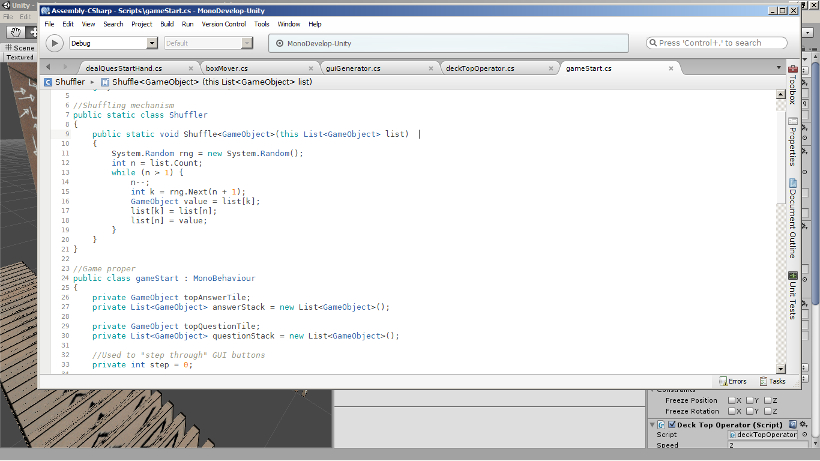
I’m always torn when I’m coding. On the one hand, I very much enjoy it. On the other hand, it feels like I have to pause the theoretical aspect of the design work in order to code; the game is here, and I want to take it there, but first I have to get the digital version of the game to where the paper version of the design already is.

Building a strong foundation is important, and I think Lines of Questioning will benefit a great deal from a strong digital implementation. If nothing else, distribution to playtesters will be enormously easier! However, it does mean–in the short term–putting hours toward Unity and C# instead of hammering on the gameplay.

12-1-14 - Unity ScreenshotI’d best get back to working out what the most efficient way to deal out opening hands of tiles is. (The current front-runner is: move an object which is just the tile back, flip it, replace it during the flip with an object whose texture is the front face of the tile, repeat.) Wish me luck. 🙂

Lines of Questioning: A Quality of Life Addition

I like elegance in design, and part of that is wrapping as many functions as possible into its pieces. The stacks of tiles in Lines of Questioning also serve as its turn track; the corners of the board are both places to play and a way to keep score. Whenever the game needed something, I tried to find a way to handle it with existing components.

Sometimes, though, the game needs something that the current pieces can’t provide. Playtesting Lines of Questioning has revealed one: a way to note the last-played tiles. The ends of the lines are important, which means it’s important to be able to remember where they are after the lines lengthen and twist back on themselves. It’s also valuable to have a visual reminder when the last tiles in the lines are not adjacent. Some kind of token at the ends of the lines would answer both of those needs, but neither the board nor the tiles can act in that role.

In the digital version of the game I’m working on, there are markers that automatically follow the lines as they grow. A nicely-produced physical version might employ cubes, meeples, or (at one playtester’s suggestion) little wooden gavels. For the print-and-play currently available, coins are a good size.

If you’ve been having trouble keeping track of what’s happening as Lines of Questioning progresses, try using tokens at the ends of the lines. They reduce the memory overhead quite a bit.

(A quick poll: Gavels? Or something else? I’m tempted to try something like a legal pad for the attorney and a Bible for the witness, but many witnesses choose not to swear on a Bible anymore . . . .)

Lines of Questioning: Revised Rulebook

Showtime! Lines of Questioning’s new rulebook is now available:

Lines of Questioning 11-26-14b

I’m always interested in more feedback. Right now I’m particularly looking for people’s thoughts about:

1. The diagrams. Are they helpful?

2. The rules without associated diagrams. Which ones would you have liked to see a diagram for?

3. The FAQ. The intent of the FAQ is that it supplements the rules by making unusual interactions clear, but that those interactions can be correctly worked out without the FAQ. In other words, there should be no rules found only in the FAQ. Do you feel that either of the questions in the FAQ can’t be answered without reference to it?

Thanks for your thoughts, on these or other issues. For those celebrating Thanksgiving tomorrow, have a happy holiday!

Lines of Questioning: Updates Across the Board

Lines of Questioning is currently undergoing a lot of changes–none of which, ironically, affect core gameplay very much. These include:

New art: while it’s good to have rules when handling art in DIY fashion, it’s even better to get a talented artist to help out. Lines of Questioning now has a new board and tiles–and they’re amazing! I just need to check one last thing with the artist, and then I’ll be ready to show them to you.

Revamped rulebook: over the past few weeks I’ve asked playtesters to learn Lines of Questioning entirely from the rulebook, and got their feedback on what was missing or unclear. Their comments have helped make the rules, by conservative estimate, one zillion percent clearer. A revised rulebook is almost done; it has more and better explanations, to say nothing of a number of example diagrams.

Alternative approach to question tiles: this one is more gameplay-related. One interesting piece of playtester feedback was that discarding question tiles when the lawyer’s line ends was a strong feel-bad moment. I’m getting ready for another playtesting project to see what happens if question tiles are never discarded.

PC implementation: it’s getting closer! I have a version that works, but it isn’t fully rules-enforced. Once it’s over that hurdle, I’ll consider it ready for a beta release.

I’m very pleased with how Lines of Questioning is shaping up. Aesthetically it’s going to be leaps and bounds ahead of where it was–there’s just no comparison. Playtesters have given positive feedback about the design (which feels good) and have expressed that they’d like some things changed (which energizes the project like nothing else). New players will shortly find the game a lot easier to get into. All of these are exciting developments; stay tuned!