private void Start(){

Work();

}

private void Work(){

KeepAtIt();

}

private void KeepAtIt(){

Work();

}
Portfolio Update
As advertised, a smaller update here on the blog today. That’s because, however, there were a couple of additions to the portfolio: my work with the American Museum of Natural History and some writing for the classic Legend of the Five Rings RPG. Both projects were a lot of fun, and it was nice to revisit them.
. . . and We’re Back
In the trenches, that is. 😉
Sorry for the late and minor update; the beginning of the week has been all about digital implementation, with a side of teaching prep. Friday will probably be a bit of a quiet day as well, but I’m hoping to have something a little more substantial for Monday.
Skiplight
At the Global Game Jam I got to work with Sam Von Ehren and Zach Barash, both of whom are amazing designers, on a game made with Move38’s forthcoming Blinks.
In the original design, two cooperating players raced against time to get waves of color to meet at specified points. Each player had a red, yellow, and blue source. To score a purple tile, one player had to send out red and the other blue, timing the waves so that they would reach the purple tile at the same time.
After scoring players were obliged to reposition one of the tiles, and each scored tile would become a barrier to future waves. They could then choose a new tile to be their goal–but with the board getting more complicated mistakes got easier. Players needed to keep a cool head with time running out to get a high score.
Being a game jam, we didn’t get all of that implemented. Nevertheless, it was fun to work with new technology, and we feel that the design is very promising. Here’s hoping to get to work further on the game as the platform goes forward.
Frank Lantz’s Game Jam Advice
- Think small.
- Aim high.
- Fail fast.
All those participating in the Global Game Jam, hope you’re having a great time!
Global game Jam 2017
It’s that time again!
The Global Game Jam is this coming weekend. Everything I said last year about game jams is still true: they’re an opportunity to practice new skills, see new people’s perspectives, and get valuable practice. Sign-ups are still open (and, frankly, you can probably just show up at a nearby site on the day); don’t hesitate!
Finding Indie Games
Over the weekend a friend asked where I find indie video games. There are basically five sources I use:
Steam: The big dog of digital distribution. Lots of indie games are on Steam; unfortunately, Steam’s catalog is at this point so vast that finding them can be difficult if you don’t already know what you’re looking for.
The Humble Store: Some of the same content as Steam, but often at a different price point depending on who’s running a sale. It’s good to compare the two.
Itch.io: A storefront focused on indie designs. Games with cool ideas but which have not secured market interest–or which have no desire to seek market interest–often end up here.
Twitter: Following creators you’re interested in is a good way to find out when they’re releasing something new. This brings with it all the costs of social media, and it’s not for everyone.
Friends: The last but by no means the least. Many, many games are coming out all the time. Your friends know you, what you like, and what you don’t like but might find interesting nevertheless. Their recommendations are a great way to navigate the flood and pick out the content that’s best for you.
Notably absent from this list is Kickstarter. I’ve backed a lot of kickstarters, but I always find the ones I’m interested in elsewhere; there are a lot of games seeking funding, and it’s not feasible to scroll through all of them.
Theory: the Value of Being Explicit
Magic’s designers have known for a long time that theme helps teach a game. Sometimes the game’s flavor is in the background, helping players get an intuitive understanding of complex mechanics. In the most recent set, though, the Magic design team has chosen an even more direct approach–one that I think is a good move for new players.
Theme has been helping teach Magic since its first set. Fireball, from way back when, is an elaborate card from a rules perspective. Nevertheless, it plays easily because everyone gets how a fantasy fireball works. This is the classic Magic use of theme: tapping into what players expect,so that they follow the rules just by playing cards intuitively.
Now compare that to italicized helper text on this forthcoming card:

“Your artifacts can help cast this spell” is the key line. Those few words accomplish at least two things:
- They create a framework for the text. Even though it includes intimidating, precise timing (“after you’re done activating mana abilities”), the rules are easy to understand because it’s clear that the critical part is “pays for 1.”
- They give new players a reason to use the ability. Tapping my own stuff is bad, right? Because I can’t use tapped cards? Oh, but it’s making bigger stuff cheaper–I get it!
It’s hard to emphasize enough how important both of those are. New players often don’t do powerful things because they have a drawback (e.g., painlands) or because one has to have a deep understanding of the game to know why an effect is strong (e.g., Timetwister). Clarifying why new players should use an ability with an apparent drawback and potentially unclear value is huge.
The framework for understanding also must not be underestimated. New players could be forgiven for thinking that Improvise’s timing is central; it appears immediately after the ability’s cost, where one might look for its effect. Thanks to the key line, though, we understand that we haven’t gotten the point of the rule until we find out how it helps pay for things. Complicated timing recedes, appropriately, in importance.
I’m curious to see how the Magic community views this kind of explanatory text. There are tradeoffs; if nothing else, it takes up valuable card real estate. On balance, though, I think it’s great for the game. Here’s hoping others agree, and that we see more of it in sets to come.
Business Considerations: Your Relationship with Business Partners
I read with great interest Danny Hayes’ design postmortem, in which he is very critical of the publisher he contracted with for his indie video game PONCHO. Then I read the publisher’s response with perhaps more interest still, and Hayes’ reply as well. (Rising Star Games’ response is in the comments of the linked article, the third root comment down; Hayes’ reply is immediately below it.) As an attorney, here are my takeaways:
(As a quick reminder, please see the disclaimer–none of this is legal advice!)
- Publishers are not “allies,” as Hayes puts it in his reply, nor are they your friends. They are business partners.
- Your relationship with business partners is defined by the agreement(s) between you. Be very, very careful that you understand and accept the terms of those agreement(s).
- Get a lawyer to help you understand the terms. Do not assume you know what all the words mean; contracts often include technical language and/or words that have special meanings in the law.
- If you need something from your business partner, it must be in the agreement. Understand in advance that if you go back to your business partner for something that’s not in the agreement, they may well say no.
- Don’t rely on your business partner changing the agreement because they’ve invested in you or in the project. Every savvy businessperson understands the sunk cost fallacy. They may, rationally, decide that it’s better to accept a loss than to put more money into what looks like a deal gone sour.
Hayes wrote the following lines in his reply. I think they’re central to his feelings about the situation; they’re also central to my interpretation of events.
Our contract stipulated an “on delivery” milestone system. The day after signing it, I asked our new allies if we could receive a small amount of start up funds. As soon as we mentioned perhaps receiving the first milestone in advance so that we could pay our artist and afford to pay rent, they said no.
Over and over, Hayes points out that Rising Star Games “said no” to things. But nothing else was ever to be expected. Rising Star Games was comfortable with, and agreed to, a system wherein they received X, and then paid out Y. It’s not surprising that they weren’t willing thereafter to reverse course and do the opposite, paying out Y before X arrived.
Hayes seems to have viewed his publisher as a teammate, and he appears as a result to be frustrated and even confused by seemingly unfriendly behavior. Yet, they weren’t teammates. They had a carefully delimited relationship with him, one whose boundaries and expectations he helped define. Having budgeted and planned based on mutually-created terms, no one in the law could be shocked that Rising Star Games wanted them respected. When one understands that Rising Star Games saw the relationship through the lens of a business partner, their actions are predictable.
I’m sorry for Danny Hayes and his team; their experience was obviously harrowing, and I would have wished greater success for them. There’s lessons, though, in what they went through. Recognize that you have a business relationship with your business partners, not a friendship, and that your interactions with them will be driven by the terms of the agreements between you. Read, and understand, those agreements. Make sure they reflect all of your assumptions. Above all, get a professional to help you when you’re in a professional’s sphere.
Theory: Make Things Appealing
Take a look at this rest stop along the New York Thruway:

Wood framing suggests a natural environment, and perhaps a cozy log cabin. It melds well with the stone for a set of calming earth tones. Grass, flowers, and small trees add to the natural atmosphere. This is a rest stop that looks welcoming during a long drive.
Now consider this one, found on the Pennsylvania Turnpike:

While this also has stone and wood framing, the effect is ruined by prominent siding. The multicolored, industrial, garish roof forms a big part of the rest stop’s visual area. Rather than grass or trees, the parking lot extends all the way to the front walk. Overall, this is a rest stop that looks like it probably has dirty restrooms.
How something looks has a tremendous effect on how welcoming it is. When your design is made of inviting objects, people will want to interact with it. By contrast, you have to convince people to try uninviting things.
Brendan Byrne has pointed out that this applies, not just to service plazas, but to more directly game-related things like buttons. Simon has big, happy-looking buttons that are easy to press; they imply a game that’s easy to learn and play.

Compare that with your average fighting game layout:
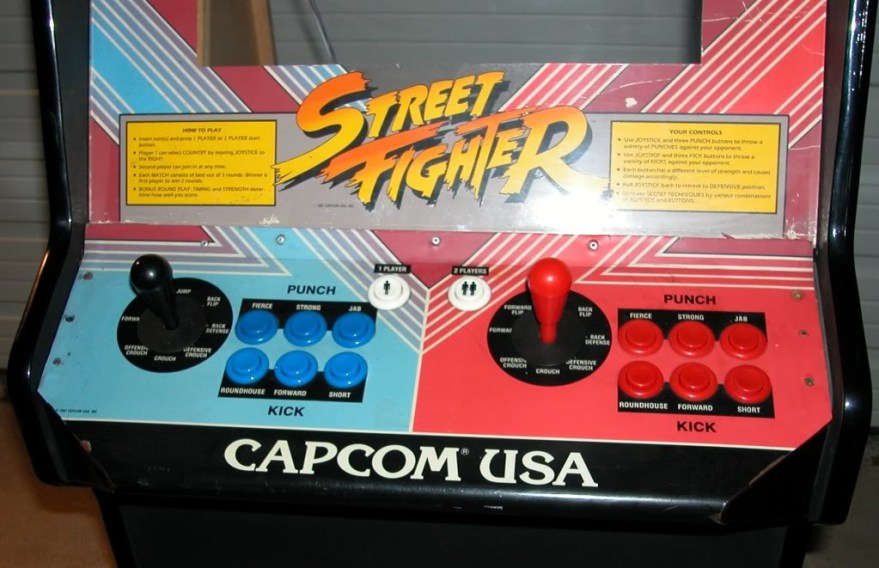
I don’t think anyone could look at that without thinking that this game is pretty complicated.
Try to make your game look welcoming. One of the greatest barriers for any designer is simply getting people to try what you’ve built. You’ll find your audience much faster if you don’t have to get them over the hurdle of a system that appears hostile.
 The Law of Game Design