Theory: Revisiting the Rules for Tile Art

When one follows a rule and gets a shaky result, one of two things has happened. The first possibility is that there was a misstep; the rule wasn’t actually followed. The other is that something is wrong with the rule. Looking back at the rules for tile art, I think the latter led to the failings of Lines of Questioning’s new tiles, which proved confusing in play. Rule #1–that a tile’s gameplay has to be clear–provided a goal without any indication as to how one might achieve it or how one could tell it had been achieved. As a result, I was unable to judge accurately whether its dictates had been met. Crafting a more detailed rule should help avoid similar mistakes in the future.

“A tile’s gameplay implications must be clear” sounded like a great rule–and so far as it goes, I think it is. Game pieces are, by definition, part of a game. They need to function within that environment.

However, the rule is ultimately question-begging. How does one make gameplay clear? What steps should be taken to make gameplay stand out as art is incorporated into the design?

Thinking about this reminded me of some upheaval in Legend of the Five Rings’ graphic design, and I think there are valuable lessons there. When the game first game out, Legend of the Five Rings’ cards looked like this:

11-14-14 - Old L5R CardI’ve always liked this design a great deal. Its border has the monochromatic aspect I like, even if the major color is red rather than black. The lantern, diamond, and circle . . . well, it’s not really clear what they mean, but they’re individually pretty. Using a bronze gradient for the text gives the impression of a plaque, lending a sense of place and permanence that (for me, at least) creates a feeling that this is somewhere important.

Legend of the Five Rings was later bought by Wizards of the Coast (of Magic: the Gathering fame). Under Wizards the card design changed significantly:

11-14-14 - New L5R CardThe background is still textured, but the new stone look is simpler, and the card text is now on plain slate. Perhaps the biggest difference, though, is the numbers: the geometric shapes are gone in favor of a gold coin and a flag that give some sense of what the numbers might mean.

I no longer have the link, but my memory is that a Wizards employee explained that these changes were based on internal focus testing. Players, especially new players, expressed that the old cards were too busy and did too little to indicate what the various numbers meant. The new design was meant to be attractive, but also clear in play.

While I don’t enjoy this look as much from an aesthetic perspective, I can’t deny that it has advantages as a design for game pieces. The text is much easier to read, the numbers are contained in pictures that serve as a shorthand reminder of their meanings, and the game-relevant aspects of the card stick out from the background.

All of this happened years ago (and L5R’s cards have changed again in the years since), but I think this is an interesting case to look at because of how clearly the intent behind the update shows through. There’s still art involved in the cards–a great deal of it–but the focus of attention has shifted. Where the old cards were all about the bold, atmospheric border, the new ones draw the eye toward clear black-on-white text and numbers identified by icons.

The importance of those changes is reinforced, I feel, by the cards used by the still very new Hearthstone:
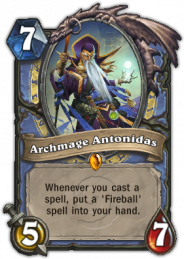
11-14-14 - Hearthstone CardArchmage Antonidas here is pretty elaborate–but it’s not hard to figure him out. The background is textured (interesting how we keep running into “broken stone”) and colorful, but it doesn’t demand attention. Having one number in a sword, and another in a drop of blood, suggests their functions even to those who have never played the game. Another number in a gem is harder to parse, but the gem correctly indicates that it has something to do with the card’s value. Text is large, on a very simple background.

Each of these elements–artistic but “quiet” background, attention-grabbing and useful iconography for key gameplay elements like numbers, high contrast between text and the surface it’s on–follows the same course as the updated Legend of the Five Rings cards. One hardly imagines that that’s an accident.

I see those same elements in Suburbia’s tiles:
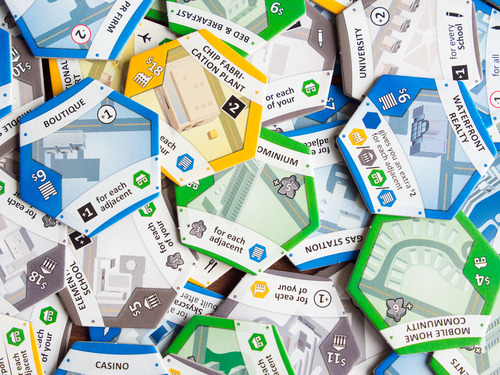
Image from Boardgamegeek

All of these tiles have a background–a picture of the building the tile represents–but it’s done in muted colors that don’t pull focus away from the text. That text is black on plain white banners stretched across the art, and is presented in conjunction with meeples and building shapes that tie into the game’s rules.

Simple background, easy-to-read text, icons that are useful and draw the eye; these seem to be consistent themes. They should be the basis for new, more detailed rules regarding the interaction between tile art and gameplay:

1. A tile’s background must not distract from gameplay elements.

2. Text on tiles must be easy to read.

3. Key gameplay elements should be highlighted with art that reminds the player of their functions.

Where the new tiles seemed to pass the old rule’s muster, these new rules make it clear that they’re not going to work–and why. The background is bright and busy, competing with the lines for attention. Even worse is relying solely on the text to indicate which side of the tiles is which; periods are not nearly as attention-grabbing as Legend of the Five Rings’ gold coins, Hearthstone’s swords and gems, or Suburbia’s meeples. If I’d had these rules when working on the new tiles, I could have predicted that they would have problems in play.

Another update to the tiles is still in the works. In the interim, here’s hoping that these rules help you dial in the art for your projects without wandering in the woods like I have. 🙂

Theory: Rules for Tile Art

While trying to decide what Lines of Questioning’s tiles should look like, I realized that I was breaking my own cardinal rule: approach questions as though they were legal problems, and solve them using the tools provided by legal analysis. I’m not accustomed to doing that with graphic design issues, but there’s no reason why it shouldn’t work. So, let’s do the background research by looking at some cases–successful tile-laying games–and finding the rules that emerge from them.

Tsuro

Tsuro is a personal favorite of mine, and its path-building gameplay was an inspiration for Lines of Questioning. It’s an elegant design: players put a tile down in front of their pieces, and then move forward along the path they’ve created. Whoever can stay on the board longest, extending her path without running off its edge, wins.

Image from Boardgamegeek

I don’t have an artist’s trained eye, but Tsuro’s tiles strike me as both attractive and functional. The paths are easy to see, but there’s still some color, and the mottled backgrounds lend visual interest. Although the brown color scheme might seem drab in other games, here it feels–at least to me–relaxing. Tsuro bills itself as “beautiful and beautifully simple,” and I think these tiles capture that.

Image from Boardgamegeek

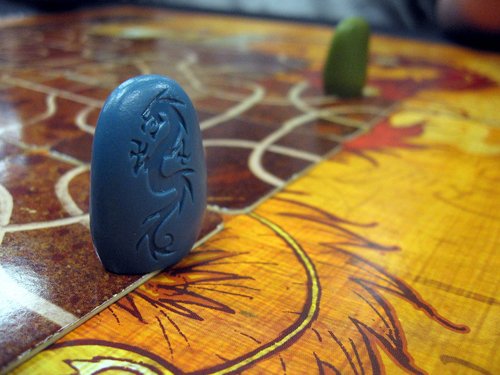
In addition, the tiles mesh well with the board. Their color scheme is consistent with what the board’s doing, but it’s still easy to tell where a tile has been placed.

Carcassonne

A tile-laying classic, Carcassonne is an area-control game in which players create the areas to be controlled on the fly. There’s no board, and the other game pieces (at least when playing without expansions) are simple meeples, so the tiles have to do a lot of heavy lifting. Both the aesthetics and the gameplay ride on them.

Image from Boardgamegeek

Carcassonne’s tiles are more cheerful than Tsuro’s, but they have the same clarity. One is never confused about a road’s path or which sides of the tile are part of a castle. They also have something going on in the background; farmland and castle both have some texture, rather than simply being “green space” and “brown space.”

Everything is also consistent with what one might expect of a medieval city. There are monasteries, walled fortresses, roads, farms. Expansions add things like rivers. At the end of the game, the tableau looks appropriate for the period.

Suburbia

Like Carcassonne, Suburbia has players lay tiles to build a city. Absolutely everything else about the games is completely different. 😉 Nevertheless, some similar principles underlie the design of their tiles.

Image from Boardgamegeek

Both games have thematically appropriate artwork, although in Suburbia’s case this means modern buildings rather than medieval ones. They also share an emphasis on ease of reading during play; Suburbia’s tiles are more complex than Carcassonne’s, but the use of bright colors and easily-recognized icons still allows them to be taken in at a glance. Finally, Suburbia follows Carcassonne’s lead in avoiding dead space on the tiles, filling the center area with art and minimizing the swathes of plain color.

There are many more excellent tile-laying games, but I think the rules are becoming clear. Part of being a good legal researcher is knowing when to stop.

1. A tile’s gameplay implications must be clear. Tsuro, Carcassonne, and Suburbia all put gameplay first in their tiles. There is never any ambiguity about whether this connects to that, or which tiles do what. When tiles are central to the game, as they are in these cases, the tile needs to support the game’s play and foremost.

2. Tile art should connect to the theme of the game. Carcassonne and Suburbia both reinforce their city-building themes with tiles that look like parts of a city. Tsuro’s art is simpler, but appropriate for an abstract.

3. Tiles must be visually interesting. None of the tiles here have plain backgrounds. Whether it’s Carcassonne’s grassy fields, Suburbia’s colorful expanses, or Tsuro’s muted earth, variation and texture are used to keep the entire tile engaging.

4. If the tiles will be played on top of something, their art must mesh attractively with that surface. Tsuro looks as good as it does, not just because it has great tiles (though it does), but because the tiles and the board work together to give the game an appealing overall look.

Applying those rules to Lines of Questioning, it instantly becomes clear that the very simple tiles are out. They’re clear, yes, but they’re athematic and boring to look at. More attractive tiles will benefit the game a great deal. I’ll have some ready for next time.

Theory: Implement Hit Points Thematically

I have a confession to make: I like hit points as a mechanic. They’re quick to explain, easy to understand, tracking them is effortless, and–since there’s generally no negative consequence to losing hit points until they run out–there’s no death spiral as the player gets hit. Hit points even provide an easy way to pace combat; with knowledge of how quickly the player can remove them, designers can give the opponent just enough hit points to make the fight a satisfying length without turning it into a grind. Designers looking for simple, readily tunable combat systems can find hit points to be just what they need.

There is, however, a right way and a wrong way to implement them. Ironically, the Star Wars: Knights of the Old Republic series has done both.

Hit points done right: hit points working in tandem with the fiction

Two important things happen in this clip. Keep one eye on the lightsabers, and the other on Juhani’s health bar.

One of the fundamental rules of Star Wars combat, as it’s demonstrated in the films, is that getting cut by a lightsaber is incredibly bad. Just by nicking Darth Vader’s arm, Luke made the Dark Lord of the Sith cry out; whenever someone really got chopped, the fight ended right then and there. Being struck by a lightsaber is devastating.

That creates a problem for game designers trying to fit Star Wars combat into the hit point mold. If any hit from a lightsaber instantly reduces the opponent to zero hit points, fights will be brief and potentially anticlimactic. On the other hand, making lightsaber blows less serious detracts from the game’s immersiveness.

(At this point one might conclude that the solution is “use a combat system not based on hit points.” That would be a reasonable road to go down. Let’s assume, however, that the game’s design is such that the benefits of a hit point system outweigh its flaws.)

KOTOR’s designers escaped their dilemma by making the game’s hit points more about endurance than about health, and then matching the animations to that understanding. Juhani loses hit points in the video as she parries the player’s attacks, but she doesn’t get hit; the player never lands the big chop that every Star Wars fan knows would be instantly fatal. The hit point system is deployed in a way that makes sense within the game’s fiction.

In fact, KOTOR’s designers went beyond merely solving problems with hit points; they used the hit point system enhance the story. Juhani concedes the duel with some hit points left. Since KOTOR players learn early on that zero hit points equals death, stopping the fight before that point clearly signals that this battle has reached an unexpected non-lethal conclusion. The player blinks and has to reorient just like the player’s character has to check his or her lightsaber swing.

This, then, is how hit points are done right. Implemented in accordance with the game’s theme, and used imaginatively to get emotional responses from the player, hit points become a seamless part of KOTOR’s overall Star Wars experience.

Hit points done wrong: a mechanism in a vacuum

Compare the previous clip to this one:

This fight is nothing but big chops, with the occasional tremendous lunge thrown in. Each and every move should instantly fell the opponent . . . but instead the battle goes on and on, the players shrugging off lightsaber blows as though they were hitting each other with foam swords.

Hit points, implemented in this way, are nothing but a technical measure of progress. They add nothing to the immersion; to the contrary, they undermine it by allowing the players to keep fighting long after the rules of the fictional universe would permit. In a role-playing game that’s all about losing oneself in a story, that is a cardinal sin.

Don’t catch yourself on your double-bladed lightsaber

In the end, hit points are like a hammer: useful when employed thoughtfully, damaging when applied incorrectly. When incorporating them into a game, give due consideration to how they can be implemented so that they are both mechanically effective and thematically appropriate. KOTOR proves that it can be done . . . and that it’s important to get it right.

Theory: Using Dice as a Design Tool

As players, we sometimes feel like we’re at the mercy of the dice–but as designers, dice work for us. They make what’s going on under a game’s hood explicit, and in doing so enable us to see and work with the often-obscure probabilities underlying the game experience. When used correctly, dice can let us tune a player’s experience to the Goldilocks standard: not too little of anything, not too much, just right.

The great merit of dice is that they give the designer direct access to the player’s chance of succeeding in doing something. A bullet has pretty good odds of harming a soldier, but only a very small chance of disabling a tank. Bullets fired by a modern rifle are more effective at both of those things than a weapon from the Napoleonic era. Using dice, a designer can reach into a game and set those percentages: if history demonstrates that the odds of a bullet stopping a tank are a little less than 3%, requiring players to roll a 12 on two dice will model historical events accurately. If playtesting then demonstrates that bullets need to stop a tank about 15% of the time or else tanks are too strong, requiring a roll of 7 solves the problem.

Managing the odds of success in this fashion does more than just let designers model armor penetration; it provides a way to establish the feel of a game. When something is more likely to happen, players will naturally trend toward strategies that favor doing it. Conversely, actions that are unlikely to work will be a minor part of the overall experience.

Take Warmachine as an example. In Warmachine attacks are made by rolling two dice, adding an attack stat, and trying to equal or exceed the target’s defense. An average Warmachine soldier has a ranged attack skill of 5, and a defense of 12. Thus, on average dice the soldier will hit her target (ranged attack skill 5 + roll of 7 = defense of 12).

Since the average roll is a hit, Warmachine skews toward offensive play. Players are aggressive because they know attacking is likely to be rewarded. The game as a whole ends up feeling very active; attacks are frequent, models are steadly removed from the table, and the game constantly progresses.

Yet, making aggression good on average wasn’t enough for Warmachine’s designers. They added a mechanism by which players could roll three dice to hit instead of two. With three dice even bad rolls are enough to make contact, which lends the game even more energy; attacking isn’t just favored, it’s much better than hanging back.

Of course, too much offense would be a problem–Goldilocks’ lesson is just as applicable here as it was to heat in soup–and the precision with which dice odds can be manipulated enables Warmachine’s designers to add just the right amount of defense back in. The (arguably) best defensive spell in the game adds 2 to a soldier’s defense. That’s enough to warrant going to the trouble of getting that third die, but not so much as to make hitting impossible.

Imagine what Warmachine would be like if the average defense was 13. Now players generally need an 8 to hit–or, looking at it conversely, the average roll misses. With the best defensive spell defenses push up to 15, which can only be hit with any reliability when using the third die. It’s hard to envision that game being a high-energy affair. More likely it would mimic trench warfare, with players waiting to attack until they had a dominant position.

Going beyond the overall feel of the game, dice can also be used for subtler applications. The average defense is 12, but Warmachine’s important leader figures often have defenses in the 15-16 range. As a result, they’re hard to hit. Players are thus incentivized to push their leaders forward and get them involved in the action, which focuses attention on these thematically important pieces. The designers have used dice math to support the narrative of the game.

Subtler still. Not every soldier can add that third die. The ones that can have a much better chance of hitting a defense of 15 or 16. Hence, the soldiers who can “boost” their to-hit rolls are well-suited to knocking out enemy leaders, while those who can’t are usually sent against line troops or relatively immobile heavy targets. By setting where soldiers’ attacks fall on the probability curve, Warmachine’s designers establish their tactical functions.

Subtler still. Rolling a handful of dice is fun. People tend to like picking up and throwing more of them; it’s exciting to see if a big pile of dice will spike to a huge total, or collapse stupendously. By giving the ability to “boost” to thematically important soldiers, the designers link those soldiers with the excitement of the big pile of dice. That encourages people to play them, further reinforcing the game’s narrative and intended theme.

With all of that said, Warmachine’s approach to dice isn’t appropriate to all games. A game about World War I trench warfare probably should favor defense over offense! The take-away point is that dice, correctly implemented with an understanding of the probabilities involved, enable designers to build and modify games with substantial precision.

It’s often hard to judge exactly what effect an element of a game’s design will have. The beauty of dice is that the effect is right there to see: the probability of success is now X. Rather than fearing the randomness of dice, use the macro-level predictability they offer to shape the game they’re in.

Theory & Strategy: Average Dice

The number one way to improve your results in dice-based games is to understand how dice work. In particular, it’s important to understand the concept of average dice. Used correctly, it will bend results in your favor. Understood incorrectly, it will trick you into sub-optimal play and frustrating, seemingly incomprehensible defeats.

When people say they will succeed “on average dice” they mean that the most common result, and any result that’s better, will be enough. Without getting into all the math (there’s a good primer here), 7 is the most common result when rolling two dice. Thus, if all you need is a 7, you will usually succeed. The most common result, and all the numbers above the most common result, will work for you.

Once you know what the average result is, you can evaluate your options in dice-driven games much more effectively. If you need an above-average result to succeed, you will probably fail. You can’t rely on something working if you need an 8, and if you need an 11 it’s a true long shot. By contrast, if a less-than-average total is enough the odds are strongly in your favor. They become all the more so as the required total gets lower; it’s easy to roll 5 or more, and you’ll get a 3 or more almost every time.

I play a lot of dice-based wargames, and the difference an understanding of average dice makes in people’s win record is astonishing. They can objectively determine what is likely to work, rather than being seduced by the promise of what might work. Nothing leads to winning like consistently getting positive results from each move, and applying the concept of average dice generates those results.

With all of that said, it’s important to remember that average dice are not guaranteed dice. An average roll is called “average” because half of the remaining possible results are lower. It is likely that you will succeed when all you need is the average, but there is still a substantial chance of failure.

This is especially important to remember when your plan involves multiple rolls. I often hear people say things like “I only need six average rolls.” The odds of rolling the most common result or better six times straight are not very good! It is much more likely that some of those rolls will fall short. Your strategy needs to be able to hang together when that happens.

Misunderstanding the likelihood of an average roll is especially devastating when high results can’t make up for low ones. For example, take to-hit rolls. In most games, whether the player hits the target is binary: either the roll was enough or it wasn’t. An excellent first roll can’t make up for a bad second roll; the first is a hit and the second is a miss, no matter how high the first one was. The excess from the first roll can’t be applied to make up the amount the second is lacking.

When high rolls can make up for low ones, things might even out such that needing “six average rolls” is less of a problem. (Even then you’ve got a good chance of ending up below average; it’s still a problem, just less of one.) When they can’t, however, relying on six average rolls in a row is a critical mistake. Hitting six times in a row, when you need average rolls each time, isn’t an average result. It’s a very unusual one, and you would need to be very lucky to pull it off.

Dice don’t hate you, but math doesn’t pity you, either. Strategies that demand better-than-usual rolls, or even multiple average rolls in sequence, generally don’t work out. Minimizing the number of rolls you have to make, and the results you have to get, will maximize your chance of winning.

Theory: Concession-Proofing Your Game

Although concessions are inevitable, we don’t have to throw up our hands and accept that some percentage of matches will be ruined. Games can be designed so that both the number of concessions and their impact are minimized. Below are some thoughts on how those objectives might be accomplished.

It’s important to recognize that not every technique I suggest here will fit every game. Sometimes page limits mean a legal brief can’t address every opposing argument; sometimes a game can’t include an elegant solution to the problem of concessions. My goal is not to say that all games must implement mechanisms that make them sturdy against players conceding, but simply to encourage designers to think about the issue and to offer some ideas on the topic to prove that it can–at least sometimes–be addressed.

First, we need to put aside some strategies that definitely won’t work:

Making the game shorter (or longer): Game length has no bearing on whether players concede. People surrender in six-minute games of Hearthstone and in weeks-long games of online Diplomacy. There is no “right” length that will prevent concessions.

Indeed, in my experience there’s no game length that even discourages them. If a player wants to concede, the game’s length can always be used as a justification–no matter what that length is. Players looking to get out of short games can take the view that the opponent(s) didn’t have time to get invested; those trying to escape a long game may feel that the investment they’re being asked to make is unreasonable.

Increasing (or decreasing) the number of players: I’ve seen people quit two-player games, seven-player games, and everything in between. Adding players does not necessarily create moral pressure to stay in the game. If anything, it can decrease the perceived need to keep playing–“there’s a lot going on, the game will still be interesting even if I leave.”

While those strategies don’t work, there are some that can. They can be broadly split into two groups: ways to make concessions less frequent, and ways to make them less impactful when they happen.

Making concessions less frequent:

Include one or more comeback mechanisms: Done right, comeback mechanisms discourage concessions by making players feel like the game is still meaningful. They know that if they make good decisions, they can position themselves for an upset victory. Hence, the game stays interesting and the players stay engaged.

Done wrong, of course, comeback mechanisms make the game feel meaningless from the outset. Be careful not to go too far by making the mechanism too strong. Concessions may be harmful to a game, but the game being just plain terrible is a lot worse.

Obscure the score: If it’s hard to tell who’s winning, players are less likely to feel themselves irrevocably behind and concede. The extreme form of this is games where scores are completely hidden during play, like Small World and Puerto Rico. (To be fair, the scores in these games can usually be determined by keeping running totals–but I’ve never seen anyone bother.) Lack of precise information allows players who think they’re losing to hope that they can close the gap.

It’s also possible to obscure just part of the score. Most often, in my experience, this is done with secret objectives that players reveal at the end of the game. The point swing that results when one player achieves her goal and another doesn’t can allow for come-from-behind wins, the promise of which helps keep everyone involved.

The most extreme form of this is something like Killer Bunnies, where the game’s result is always decided by a final roll of the dice. I’m not sure I would recommend that approach, but it certainly makes it harder to predict the winner!

Give players more capability over time: Even if a player is losing now, he or she might hang around if new powers/better stats/more items/etc. will help turn the tide. League of Legends matches against an all-attack damage team can be brutal . . . until your entire team buys Thornmail, and starts reflecting all that damage back at the opponents. Knowing that team-wide Thornmail is coming makes the heavily-slanted early game more bearable.

This approach is tricky to implement, because if the losers are getting new stuff the leader probably does as well. New capabilities only offer hope to those who have fallen behind if they’re numerically superior to what the leader gets (in which case they’re a comeback mechanism, with all the challenges those entail) or they allow one to progress along a totally different axis from what the leader is doing. Giving both leader and loser a sword doesn’t help, but if the leader gets a sword and the loser gets extra points for holding key scenario locations the loser is apt to be tempted by the possibilities.

End the game at the climactic move: If a game is going to be unwinnable for one player after X condition obtains, stop the game at that point. Forcing players to go through a denouement will be frustrating and will likely produce concessions. Warmachine and Hordes are good examples to follow here: those games are essentially over from a tactical perspective once one player loses his or her leader, so defeating the enemy leader is a victory condition that ends the game on the spot.

Note that this doesn’t mean ending the game unpredictably, or prematurely. “Climactic” includes elements of buildup and drama; there should be time enough for both. The goal with this approach is simply to avoid dragging out the endgame to the point where there’s no game left.

Establish objectives other than winning: This goes back to the idea that “building” games can be satisfying even if one loses. I’ve never seen anyone concede a game of Agricola, even though the game can be long and it would be possible to do so with a minimum of disruption; creating one’s farm is reason enough to keep going. MMOs do a lot of this, too, with professions to improve in, things to collect, and stories to experience even if one can’t beat the raid bosses.

Make each match part of a larger whole: Drawing on the car-racing example from last time, players are more likely to keep going if finishing the game is worth points in an overall competition. There’s a limit to this, of course–players might simply concede the entire event! Nevertheless, the possibility of making up a poor performance today with a better one tomorrow is a strong incentive to keep going and minimize the amount of scrabbling back to be done.

Reducing the impact of concessions:

Make the players independent: It’s not hard to keep Race for the Galaxy going after a concession , because the players don’t (generally) interact directly. The loss of a player takes some cards out of the game, and might occasionally result in a phase not being chosen when it otherwise would have, but that’s about it. Everyone remaining can still play a perfectly good RtFG match.

Unfortunately, it’s easy to take this idea too far. Games that can edit a player out cleanly often fall into the trap of “multiplayer solitaire,” with opponents who are so irrelevant that one may as well not have had them in the first place. Use with caution!

Replace departed players: Substitutions are common in professional sports, and their example suggests that this is a fertile area for tabletop and video games as well. We have seen a little of this in video games, with AIs taking over for disconnected players in online games, and tabletop games may also be able to sub in an AI–or another person–for a player who has to leave. Rather than just leaving the conceded position in Race for the Galaxy alone, why not have the solo-play “bot” from the first expansion take over?

Keep the conceded position in play: There are many games which handle player concessions by removing all of his or her stuff from the game. That can be rough in multiplayer games where preying on a weaker player is a valid way to maintain a lead–or to catch up. If the game involves taking things from other players, try to keep the conceded player’s territories/artifacts/etc. available for the remaining players to grab. If this can be combined with a replacement AI that makes realistic efforts to defend those things, so much the better!

Change the objective: This is the flip-side of creating alternative goals for those who are losing: give the winner who’s now without an opponent something else to aim for. John Doe leaving might deny Jane Doe the full satisfaction of beating him, but the frustration will be lessened if she can still compete for the high score or unlock an achievement.

Offer goals along the way: If all of the game’s satisfaction comes in one big lump with the win, anything that seems to cheapen the win will be a major problem. If, however, there are points of satisfaction before that a concession won’t be so bad. This ties back to the question of how to make losing fun; although the positions are reversed–we’re now talking about the winner–the fundamental issue of “keeping a player engaged without the satisfaction of a big win” is related.

Again, I don’t propose that some or all of these need to be in every game. Nor do I mean to say that this is a comprehensive list of ways to deal with concessions. Rather, I hope that these ideas inspire others to take up conceding as a design issue in their own games, and that the approaches here are useful starting points in that process.

Theory: Why Players Concede–and Why Their Opponents Hate It

Why people do people concede–or why, on the flip side, they object to others doing it? Answering those questions will provide us with guideposts for addressing concessions as a design problem. If we know what leads players to concede, we can try to avoid those situations; if we know what makes concessions objectionable, we can design the game to make them less so.

The definition from last time will guide the discussion here. We aren’t going to talk about concessions that are explicitly a form of cheating, because those raise different issues and need to be addressed separately. We will, however, call on forms of concession that feel bad or are unsporting. Minimizing bad feeling among players, after all, is an important design objective.

So, what leads people quit?

The rest of the game doesn’t matter: A player decides that the result is inevitable and that there’s no point in continuing to play. I’m pretty sure that this is the most common reason for conceding, and the least likely to be found objectionable (but some people still hate it; see below). It’s seen in games ranging from chess to Magic to Little League baseball games decided under a mercy rule.

It’s important to recognize that there can be reason to continue even if a player is sure to lose. In card games played over multiple hands, for example, it can be useful to stay in just to get as many points (or as much money) out of a losing hand as possible, so as to stay in the overall running. One also sees this frequently in car racing; even if a driver is sure to finish behind the leader, it’s worth finishing the race to accumulate points toward the overall championship. When a player concedes because the game is no longer meaningful, it’s a statement that there’s no substantial incentive even to play the game out.

The game has stopped being fun: Fun is always tricky to quantify, but there’s no denying when it’s not there–and its lack makes players walk away from games. Often a lack of fun is tied to the rest of the game not mattering; if it doesn’t matter what one does then the game’s decisions probably aren’t very interesting anymore. However, a game can stop being fun for other reasons as well. Perhaps the decisions were interesting once, but the game has gone on too long and the player wants to be done. Maybe there’s a situation the rules don’t handle well, and it’s led to an argument that sucked the joy out of the experience. The opponent might simply be a jerk who’s not worth tolerating any more.

Conceding leads to long-term advantage: Some tournaments are designed in such a way that losing a match has the ironic effect of increasing one’s odds of winning the whole event. The 2012 Olympic badminton debacle grew out of this; the gold medal favorites, among others, threw their first-round games so that they would face weaker teams later in the tournament. While those players were caught (it was hardly difficult) and ejected, sometimes players can manipulate the tournament.

A variation on this theme is the concession that protects what someone already has. One sees this in Magic all the time, as players at the bottom edge of the cutoff for prizes agree to draw their match rather than risk a loss that would push them lower in the standings. Television game shows feature this brand of concession as well, with players deciding to stop with what they have rather than risk it all on one more question.

Stated by themselves, all of those sound like fair reasons to walk away from a game. A bit underhanded, in some cases, but logical. Why, then, do people dislike concessions?

Taking away the climactic move: Some players don’t just want to figure out how to win, they want to actually do it. Concessions deny these players the final moment in which they knock over the opponent’s king or otherwise demonstrate their victory. This is especially galling when the victory was very hard-won and involved a brilliant final sequence of plays; cutting such a game short can feel anti-climactic.

Reducing the time spent playing: I see this reason cited frequently by players who don’t get to play their preferred game often, or who have traveled a long way to play in an event. These players want to savor every moment of their games. Conceding necessarily denies them some of those moments. It doesn’t matter that a concession means they win; these players value time spent playing more than the victory.

Others are affected: Conceding can impact others in the tournament, as it did in the Warmachine event that inspired these articles. When Adam concedes to Beth, it can affect Charlie’s strength of schedule (he played Adam earlier, and will place higher the better Adam does), or Dani’s odds of winning (she has a good matchup against Adam, but a poor one against Beth). It can even, in unusual cases, have more direct effects. The Warmachine tournament’s result was controversial in part because the player who conceded was ineligible for the grand prize; had he played his game out and ended up in the finals, his opponent would automatically have gotten the big-ticket stuff instead of, as actually happened, going home with second place.

The list of people who can be impacted extends beyond the players. Consider professional sports: paying fans would be livid if a hockey team decided that the game wasn’t worth bothering with and left the ice at the end of the first period. Among the complaints leveled against the ejected Olympic badminton players was that they had wasted ticket-holders’ money. Shoeless Joe Jackson had to wonder what the kid who asked him to “say it ain’t so, Joe” learned about sportsmanship from his decision to tank World Series games.

It’s unsportsmanlike: For some players, trying one’s hardest is integral to honest gameplay. Choosing not to pursue victory with all one’s strength is just inherently wrong under this view, regardless of why one might do it. By joining a game, they feel, one commits to try to win it until the very end. The circumstances have no bearing on this moral obligation.

(As a side note: listing these, I feel, helps make clear why discussions about concessions so often involve people talking past each other. The reasons to concede are all about the game’s obligation to the player: when the game stops making play worthwhile, they posit, the player does not need to continue. By contrast, the arguments against conceding are about the player’s obligations to others: they want the player to keep going, even given that the activity is voluntary and no longer rewarding, because doing so benefits those others. Since the two sides value entirely different things, it’s hard for them even to engage with the opponent’s arguments.)

Looking these over, I think that they represent a fairly comprehensive statement of why concessions happen, and why some players would prefer that they didn’t. Next time we’ll try to put this knowledge into practice, discussing how games can be designed to minimize the impact of a player conceding.

Theory: Defining Concessions (and Rules for a New Print-and-Play)

(First things first: I’ve been working on Trust Me’s follow-up. The print-and-play file isn’t ready yet; the pieces are still very much in flux. However, you can find the rules here–Lines of Questioning – Rules – 10-3-14–as a preview.)

The recent blowup about conceding Warmachine tournament games highlighted the issue concessions pose to game designers: some people approve of them, other people think they’re monstrous, and it’s hard to please both groups at once. Nevertheless, concessions are a fact of gaming life and games need to deal with them as effectively as possible. It’s a designer’s responsibility to catch bugs, and a player dropping out is a situation that needs to be handled just like an incorrect key press or a rules corner-case.

Managing concessions is an area where I feel that a lot of games fall down, so I’d like to spend a few posts hashing out the issues involved. We’ll start with the fundamentals: what counts as conceding? From there we’ll move on to why opinions of the practice are so divided. Then, with groundwork laid, we’ll get into how to handle concessions as a design matter.

I hope you’ll join in and leave your thoughts in the comments. All of these are big topics, and there’s room for differing views. If you think I’ve missed something, or that my analysis is off, let me know.

To talk about concessions, we first have to agree on what we’re discussing–and what we’re not. “Conceding,” as I’m using it here, is a decision to take game actions that the player expects and intends will result in a loss. The archetypal form is the player who pushes the “concede” button in Hearthstone, or who says to a real-world opponent “I’m going to lose, so let’s call this early and do something else.”

However, my definition also includes intentionally playing badly so as to lose the game. In other words, it includes throwing games. I feel that to be useful from a design perspective, a definition of conceding has to encompass that kind of intentional loss. While formal concessions and informal tanking may feel different, they raise the same design issues: winners who feel cheated out of competition and threats to tournament integrity.

Concessions can occur negatively through inaction as well, and this definition allows for that. The player who stops submitting orders in a game of Diplomacy, knowing that this will result in an automatic surrender, creates all of the problems that someone who explicitly announces an intent to leave the game does. (Indeed, this player might have even more of an impact, since other players may continue for a time under the mistaken impression that the conceding player is still involved.) Again, this might feel different from other forms of concession, but its effects are the same.

This definition excludes losses where there was no decision–and thus, no intent–to lose. Playing badly does not raise the same issues as conceding, so long as the player’s goal is to win. Concessions can raise questions about whether a tournament was fair and honest; having a lousy day does not call the event as a whole into question.

Also excluded are situations where a player forces an inconclusive result. The legitimate version of this is playing for a draw in a tournament, expecting that the draw will enable the player to advance where a loss would not. Illegitimate versions include things like DDOSing the League of Legends servers or pulling one’s internet connection while playing Street Fighter, both of which tactics have been used to shut a match down before a loss has been recorded. When done legitimately, an effort to draw gives rise to a proper game that doesn’t undermine the tournament or take anything away from a winner who overcomes the strategy. Done illegitimately, forcing a draw is simply cheating. Either way, the issues posed are entirely different.

My feeling is that this definition captures the situations that are logically related and separates out those that aren’t. Next time we’ll get into why conceding (as defined) is so controversial . . . and why the controversy probably won’t end.

Theory: How to Tell If a Concept Is “Valid”

When I first became seriously interested in game design a little less than a decade ago, I often struggled with the question of whether a concept was a “valid game.” I wasn’t trying to figure out whether the concept was good–I knew that most ideas wouldn’t pan out–but whether it had the potential for fun play. Now, all these years later, trying to figure out why the prototype in the previous post wasn’t as much fun as I had expected gave me the way to analyze that question. To decide whether your concept can produce a valid game, you need to determine what kind of decision the player will make and why that decision will be interesting.

By what kind of decision I mean more than just “the player will try to shoot the bad guys.” Will the player test her dexterity by aiming with a mouse? Maneuver his limited resources on a map? Select a number of chips to bet against a roll of the dice? Strip the game’s theme away, and ask what the player will physically do during the game.

When deciding why that decision will be interesting, think through how that decision (again, the physical thing the player does, not the conceptual activity represented thereby) will work in practice. Is the player going to have multiple possibilities to choose from? What will prevent the player from detecting and picking the right answer every time? After the decision’s consequences have played out, will the player feel like the choice mattered? How long will it take for those consequences to emerge? Is that fast enough for the player to recognize the consequences as feedback, or will they just seem random?

My last prototype failed because I didn’t finish the second question. It looked like there were going to be lots of options, but in practice there was only ever one or two–and only one of them was ever reasonable. Had I really thought the problem through, I would have recognized that I was going down a dead end.

What kind of decision will the player make? Why will that decision be interesting? If you can answer both of those satisfactorily, you have something at least worth considering.